Faster response times plus consistent qualification produce more booked meetings and lower cost per lead. That is the core payoff of an AI sales assistant, and it shows up fastest in the two areas revenue teams struggle with most: lead qualification and appointment setting.
The evidence backs this up. Firms that respond to inbound leads within five minutes convert them at dramatically higher rates than slower competitors, according to BizAI’s summary of inbound response research. Teams running AI SDR tools report 40 to 60 percent productivity gains, and MediaBloom’s own deployments with clients like Miracle Ear and 1-800 Accountant have generated over 10,000 monthly leads.
Two things to do right now: measure your current average time-to-contact for inbound leads, then book a demo to see how an AI voice agent handles that same lead in under a minute.
Table of Contents
- What Are the Core Business Benefits of an AI Sales Assistant?
- How Does an AI Sales Assistant Qualify Leads and Book Meetings?
- What KPIs Show an AI Sales Assistant Is Working?
- How Do You Roll Out an AI Sales Assistant Without Disrupting Your Pipeline?
- What Are the Limitations and Compliance Risks of AI Sales Assistants?
- Does an AI Sales Assistant Improve the Customer Experience?
- Where Are AI Sales Assistants Already Working Across Industries?
- AI Sales Assistant vs. Human Sales Rep: Where Does Each Win?
- How Much Does an AI Sales Assistant Save on Sales Costs?
- What’s Next for AI Sales Assistant Technology?
- See MediaBloom’s Results Before You Build Your Own Pilot
- When Should a Sales Leader Trust an AI Assistant to Scale?
- Sources
- FAQ
What Are the Core Business Benefits of an AI Sales Assistant?
The AI sales assistant benefits that matter most to revenue leaders are operational, not theoretical. They come down to five measurable improvements:
- Faster time-to-contact. AI agents engage inbound leads within seconds, not hours, directly addressing the five-minute conversion window Harvard Business Review research highlights.
- Higher qualified-meeting rates. Intent-driven qualification lifts lead conversion by roughly 10 percent, meaning fewer wasted calendar slots for your reps.
- More rep selling time. Automating research and logging saves reps 40 to 60 minutes daily, time that goes straight back into selling.
- Shorter SDR ramp time. Ramp time can fall from roughly 4.2 months to 2.7 months when AI handles the repetitive qualification work.
Pro Tip: Don’t measure success by raw meeting volume alone. A spike in booked meetings that don’t show or don’t convert is a sign your AI is scheduling too loosely. Track qualified-meeting rate, not just meeting count.
How Does an AI Sales Assistant Qualify Leads and Book Meetings?
The mechanics matter because they determine whether the benefits above actually materialize. An AI sales assistant works by combining behavioral signals with structured qualification logic, then handing off cleanly to a human when the lead is ready.
On the front end, the system reads behavioral triggers: which page a visitor is on, how long they’ve stayed, whether they’ve engaged with pricing or demo content. These signals feed a conversation flow that opens naturally rather than with a generic script, since B2B buyers now complete over 70 percent of their buying journey before ever speaking to a rep, and that engagement window can’t be left unattended.
Qualification criteria then run in the background: firmographics like company size and industry, job title and seniority, and expressed intent from the conversation itself. When a lead clears the threshold, the assistant books directly into the rep’s calendar and writes the interaction back to the CRM in real time.

This is where integrations stop being optional. Two-way CRM write-back, calendar sync, and call transcription all need to work together, or the handoff breaks and reps lose trust in the system fast. MediaBloom’s platform connects with 600+ CRM platforms for exactly this reason.
Process flow: Visitor engages → AI detects intent and asks qualifying questions → lead scores against your criteria → qualified lead books directly on a rep’s calendar → CRM updates automatically with full conversation context.
Pro Tip: Ask any vendor to show you the exact fields written back to your CRM during a live demo. If the answer is vague, the integration is probably shallow.
AI sales assistants using this model can now handle up to 80 percent of standard SDR tasks when properly configured and fully integrated across the revenue stack.
What KPIs Show an AI Sales Assistant Is Working?
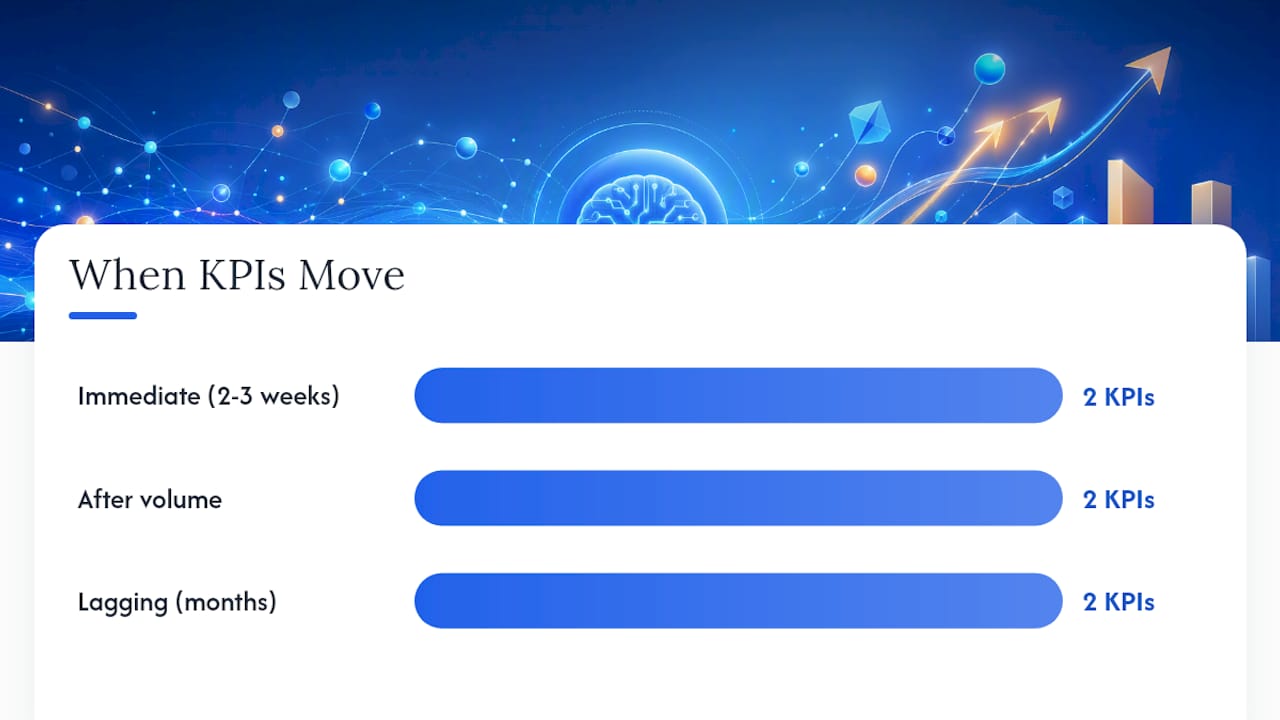
Track six numbers, and track them from day one. Time-to-contact and qualified-meeting rate move first, usually within the first two to three weeks. Cost per qualified lead and meetings set per SDR follow once the system has enough conversation volume to optimize scoring. SDR ramp time and forecast accuracy are lagging indicators that take some time to show clearly.
Typical first-year ROI lands in the 300 to 500 percent range, with payback in 9 to 12 months, but only when utilization stays above 75 percent and CRM write-back is functioning correctly.
| KPI | What to Watch |
|---|---|
| Time-to-contact | Should drop to under 5 minutes within the first two weeks. |
| Qualified-meeting rate | Track meetings that convert to opportunity, not just booked calls. |
| Cost per qualified lead | Expect roughly a 33% reduction once pre-qualification stabilizes. |
| Meetings per SDR | Rises as reps spend saved time on higher value calls. |
| SDR ramp time | Shortens from around 4.2 to 2.7 months as onboarding load drops. |
Build a simple measurement checklist before launch: capture a 30-day baseline, review weekly for the first month, then move to monthly cadence. Pull data from your CRM, engagement logs, and calendar system together, since siloed reporting hides where the gains are actually coming from.
How Do You Roll Out an AI Sales Assistant Without Disrupting Your Pipeline?
Deployment succeeds or fails on sequencing, not ambition. Follow this order:
- Audit your current lead flow and flag every manual handoff point.
- Define three to five success metrics before you touch any software.
- Validate CRM, calendar, and telephony integrations in a sandbox environment first.
- Configure a pilot with a limited lead segment or single territory.
- Set human-in-the-loop rules for edge cases and high-value accounts.
- Roll out broadly, then optimize scoring weekly based on real conversation data.
| Phase | Timeline | Primary Owner |
|---|---|---|
| Pilot | Days 0–30 | RevOps + sales leadership |
| Optimize | Days 30–60 | RevOps with SDR feedback |
| Scale | Days 60+ | Sales leadership + IT/security |
Rollout requires more than one department at the table:
- Sales leadership sets the success metrics and approves qualification thresholds.
- RevOps owns integration health and scoring adjustments.
- IT/security validates data handling and access controls.
- Legal/compliance reviews outreach cadence and consent requirements.
- Frontline SDRs flag handoff friction the dashboards won’t show you.
This is also the stage where the 88 percent of organizations that use AI but never achieve real integration at scale tend to fall behind. The technology isn’t the bottleneck. Execution is.
What Are the Limitations and Compliance Risks of AI Sales Assistants?
No AI deployment is risk-free, and pretending otherwise sets teams up for a rough second quarter. The most common failure modes are mechanical: broken CRM write-back that silently drops lead data, over-sending that damages email deliverability, and poor context handoff that makes a prospect repeat themselves to a human rep.
- Broken write-back: test integrations under real load, not just a demo account.
- Deliverability damage: cap outreach frequency and monitor sender reputation weekly.
- Context loss at handoff: require full conversation transcripts attached to every CRM record.
Compliance deserves the same rigor. Outreach and appointment setting touch TCPA rules around consent and call timing, and healthcare-adjacent sales work should confirm HIPAA-ready handling of patient data. SOC 2 compliance signals that a vendor takes data security seriously at the infrastructure level. None of this replaces your own legal review, but a vendor that can’t speak to these standards clearly is a red flag.
AI also has real limits. Complex negotiation and executive relationship building still favor a skilled human rep. Hybrid setups that pair AI qualification with human closing generate roughly 2.3 times more revenue per meeting than fully autonomous agents in controlled comparisons.
Pro Tip: Treat your AI assistant as the SDR that never sleeps, not the closer. That framing keeps expectations realistic and keeps your best reps focused where they add the most value.
Does an AI Sales Assistant Improve the Customer Experience?
Prospects notice speed before they notice anything else. A visitor who gets an intelligent, relevant response within seconds of filling out a form forms a different impression of your company than one left waiting for a callback the next business day.
Consistency matters just as much as speed. Human reps have off days, get pulled into other calls, or forget to follow up. An AI assistant asks the same qualifying questions the same way every time, which means every prospect gets a baseline experience that doesn’t depend on which rep happened to pick up.
Availability closes the gap further. A lead who converts at 9 p.m. on a Sunday because a chatbot answered their question doesn’t have to wait until Monday morning to feel like your business is paying attention. That immediacy shapes first impressions long before a human ever joins the conversation, and it compounds: prospects who get fast, accurate answers early tend to arrive at the sales call already warmer and further along in their decision.
The risk sits on the other side. A poorly configured assistant that misunderstands intent or loops a prospect through irrelevant questions does real damage to trust. The difference between those two outcomes comes down entirely to how well the qualification logic and conversational design are built, not whether AI is involved at all.
Where Are AI Sales Assistants Already Working Across Industries?
The pattern repeats across sectors: wherever lead volume outpaces available reps, an AI assistant fills the gap.
In home services, voice agents answer inbound calls around the clock, qualify urgency, and book appointments directly, which matters enormously for businesses where a missed call often means a lost customer to a competitor. In legal services, firms use AI to triage intake calls and screen for case fit before an attorney’s time gets involved, a model MediaBloom has deployed in its Vision Law engagement. Insurance agencies use chatbots on quote pages to capture and qualify leads the moment someone starts comparing coverage, rather than losing them to a competitor’s faster response.
Healthcare and franchise businesses, including multi-location retailers like Miracle Ear, use AI to handle appointment scheduling at scale across dozens of locations without hiring a scheduler for each one. Financial services firms like 1-800 Accountant use similar automation to qualify tax and accounting leads during seasonal volume spikes when hiring temporary staff isn’t practical.
Real estate and SaaS companies apply the same logic to website chat: qualifying a buyer’s budget and timeline, or a software prospect’s team size and use case, before a sales rep spends thirty minutes on a call that was never going to close. The industries differ, but the underlying job is identical: catch the lead while intent is high, qualify it accurately, and hand off only what’s worth a human’s time.
AI Sales Assistant vs. Human Sales Rep: Where Does Each Win?
This isn’t a replacement question. It’s an allocation question.
AI wins decisively on speed, availability, and consistency. It engages leads instantly, works 24 hours a day, and never has an off day that affects qualification quality. It also wins on cost at scale: once configured, an AI assistant handles volume that would require multiple additional SDR hires, without the ramp time or turnover risk.
Human reps win where judgment and relationship-building matter most. Complex negotiations, executive-level trust-building, and nuanced objection handling still respond better to a skilled person who can read tone and adapt in real time. The 2.3x revenue advantage of hybrid setups over fully autonomous ones isn’t a knock against AI. It’s evidence that the two do different jobs well.
The practical model most revenue teams land on: AI handles first contact, qualification, and scheduling. Humans handle the meeting itself and everything after. This division plays to each side’s strength instead of forcing either into work it isn’t suited for, and it’s the model behind most successful deployments today, including the ones referenced throughout this article.
How Much Does an AI Sales Assistant Save on Sales Costs?
The savings show up in three places: headcount efficiency, cost per lead, and reduced ramp time on new hires.
Headcount efficiency is the biggest lever. An AI assistant handling qualification and initial outreach means each SDR can focus purely on qualified conversations, effectively multiplying what your existing team can handle without adding salaries. Given that AI can automate up to 80 percent of standard SDR tasks when properly integrated, a team that once needed four SDRs to cover a lead volume might need two, with the AI handling the qualification work the other two used to do manually.

Cost per qualified lead drops by roughly 33 percent because unqualified leads get filtered out before they ever consume a rep’s time. That’s not a marginal efficiency gain. It changes the unit economics of your entire top-of-funnel spend, since every dollar of marketing spend now produces more usable pipeline.
Ramp time reduction adds a third layer of savings. New SDRs historically take around 4.2 months to reach full productivity; with AI handling the repetitive qualification groundwork, that shrinks to roughly 2.7 months. Faster ramp means faster payback on every new hire’s salary.
Together, these three factors are why first-year ROI for AI sales agents commonly lands between 300 and 500 percent. The number depends heavily on utilization and whether integrations are built correctly from day one, which is why the implementation steps above aren’t optional extras.
What’s Next for AI Sales Assistant Technology?
The next wave of development centers on three things: deeper personalization, tighter integration, and better judgment about when to escalate to a human.
Personalization is moving beyond name and company fields. AI-personalized outreach sequences already produce measurably higher open and reply rates than static templates, and that gap is likely to widen as models get better at referencing specific context from a prospect’s behavior and industry.
Integration depth is the second frontier. The gap between the 88 percent of companies using AI in some form and the roughly 5 percent achieving real integration at scale is closing as platforms consolidate voice, chat, SMS, and email into single systems rather than disconnected point tools. That consolidation, not raw model improvement, is what will drive the next round of measurable gains for most sales teams.
Escalation logic is the quieter but more important shift. Systems are getting better at recognizing when a conversation needs a human, whether due to complexity, deal size, or emotional tone, and routing accordingly rather than trying to handle everything autonomously. That’s consistent with the hybrid advantage already showing up in revenue-per-meeting data, and it suggests the winning platforms of the next few years will be the ones that know their own limits.
See MediaBloom’s Results Before You Build Your Own Pilot
MediaBloom brings AI voice agents, chatbots, and multi-channel automation into one platform instead of stitching together separate tools for calls, chat, and text. That matters because the failure modes covered above (broken CRM write-back, fragmented context, deliverability damage) mostly come from running disconnected point solutions rather than one integrated system.
The platform connects with 600+ CRM systems and is built with TCPA, SOC 2, and HIPAA-ready compliance in mind, so security and legal teams aren’t an afterthought during rollout. Clients like Miracle Ear and 1-800 Accountant have used MediaBloom to generate over 10,000 monthly leads across multiple locations and seasonal demand spikes, and the Vision Law case study shows how the same approach applies to intake-heavy service businesses.
If you’re evaluating vendors, the fastest way to judge fit is to see the qualification and booking flow firsthand. Watch a live demo of MediaBloom’s AI voice agent handling a real inbound call, or review the full case study library to see lead volume and conversion results across industries similar to yours.
When Should a Sales Leader Trust an AI Assistant to Scale?
Pilot with a single lead segment, not your whole pipeline, and set a 30 day threshold before judging results. Red flags include declining qualified-meeting rates or CRM data that doesn’t match reality. Green lights are consistent time-to-contact under five minutes and a qualified-meeting rate that holds steady as volume grows.
When choosing a partner, prioritize integration depth and CRM write-back over flashy demos. Ask how deliverability is protected and what support looks like after launch. The best outcomes still pair AI qualification with a human closer.
The strongest predictor of ROI is faster lead response combined with consistent CRM integration, not the sophistication of the AI model itself.
| Point | Details |
|---|---|
| Speed drives conversion | Responding within five minutes significantly outperforms slower follow-up on inbound leads. |
| Track qualification, not volume | Measure qualified-meeting rate and cost per qualified lead, not raw meetings booked. |
| Integration determines ROI | CRM write-back and calendar sync are required for the 300 to 500 percent first-year ROI range. |
| Hybrid models outperform pure automation | Human-plus-AI setups generate roughly 2.3 times more revenue per meeting than fully autonomous agents. |
| MediaBloom offers an integrated path | Its voice agents, chatbots, and CRM integrations across 600+ platforms have driven over 10,000 monthly leads for clients like Miracle Ear and 1-800 Accountant. |
Sources
Before you commit budget, check the primary data yourself.
FAQ
What Is the Main Benefit of an AI Sales Assistant?
The main benefit is faster, more consistent lead qualification that increases qualified-meeting rates while lowering cost per lead, with typical first-year ROI between 300 and 500 percent when CRM integration works properly.
Can an AI Sales Assistant Replace My SDR Team?
Not entirely. AI can automate up to 80 percent of standard SDR tasks, but hybrid setups pairing AI qualification with human closing generate roughly 2.3 times more revenue per meeting than fully autonomous agents.
How Long Does It Take to See Results From an AI Sales Assistant?
Time-to-contact and qualified-meeting rate typically improve within the first two to three weeks, while cost per lead and SDR ramp time gains show up over the following one to two quarters.
Is MediaBloom’s Platform Compliant With Sales Outreach Regulations?
MediaBloom is built with TCPA, SOC 2, and HIPAA-ready compliance in mind, though businesses should still confirm specific outreach practices meet their own legal requirements.
What Integrations Does an AI Sales Assistant Need to Work Well?
At minimum, it needs two-way CRM write-back, calendar sync for booking, and call transcription; MediaBloom connects with over 600 CRM platforms to support this.