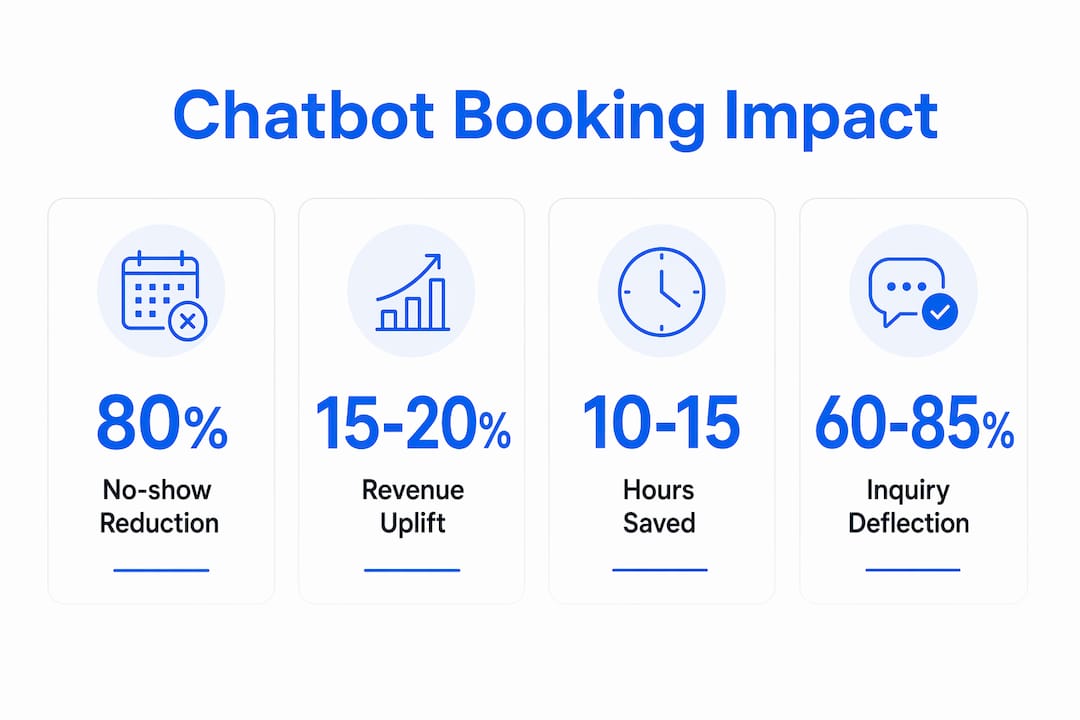
Chatbot booking automation is defined as the use of AI-driven conversational interfaces to handle reservation inquiries, scheduling, and transactional processes without human intervention. Understanding how chatbots replace booking staff is now a core operational question for managers in hospitality, travel, and professional services. Hospitality AI chatbots deflect 60–85% of standard guest inquiries without any human involvement. That single figure reframes the conversation: the question is no longer whether to automate booking operations, but how fast and how far. The industry term for this capability is conversational AI automation, and it covers everything from natural language processing (NLP) to API-based transactional booking.
How chatbots replace booking staff: the core mechanics
Chatbots take over booking operations by handling the tasks that consume the most staff time but require the least human judgment. These are high-volume, low-complexity interactions: answering questions about availability, confirming reservation details, processing cancellations, and sending reminders. NLP engines parse customer intent from typed or spoken input, then trigger the correct workflow through API connections to property management systems, scheduling platforms, or CRM databases.
The specific tasks chatbots automate well include:
- Availability checks and rate inquiries: A bot queries live inventory and returns accurate pricing in seconds, at any hour.
- Booking modifications: Guests change dates, room types, or party sizes through a guided conversation without calling a front desk.
- Cancellation processing: The bot confirms cancellation policies, processes the request, and triggers a refund workflow automatically.
- Appointment scheduling: For clinics, salons, and professional services, bots match open slots to customer preferences and send calendar confirmations.
- Pre-arrival and pre-appointment messaging: Automated reminders reduce no-shows before a human ever needs to pick up the phone.
- FAQ deflection: Questions about check-in times, parking, pet policies, and amenities are answered instantly from a structured knowledge base.
The technology enabling all of this is a combination of NLP for intent recognition, slot-filling dialogs for collecting required data fields, and read/write API access to backend reservation systems. When a customer types “I need to move my reservation to Friday,” the bot identifies the intent (modification), extracts the entity (Friday), verifies availability, and confirms the change. The entire exchange takes under 30 seconds.
Pro Tip: Deploy your chatbot on the channel where your booking volume is highest first. If 70% of your inquiries arrive via website chat, start there before expanding to SMS or WhatsApp. Focused deployment builds accuracy faster.

Businesses that automate scheduling report saving 10–15 hours per team member weekly by eliminating manual confirmations alone. That is not a marginal efficiency gain. It is the equivalent of reclaiming nearly two full workdays per employee every week.
How do chatbots improve booking efficiency and customer experience?
The operational gap between a staff-only booking model and an AI-assisted one is measurable across four dimensions: speed, availability, revenue, and cost.
Speed and availability
Human agents answer booking inquiries during business hours, with response times ranging from minutes to hours depending on call volume. A chatbot responds in seconds, at 3 a.m. on a Sunday. For customers ready to book, that immediacy is the difference between a confirmed reservation and an abandoned session. Multilingual support extends this advantage globally, with modern NLP models handling dozens of languages without additional staffing.
Revenue and cost impact
Hotels deploying AI-assisted booking systems see a 15–20% uplift in direct booking revenue, while simultaneously avoiding OTA commissions that typically run 15–25% per transaction. That combination produces a compounding financial benefit. A property generating $2 million in annual bookings that shifts even 10% of OTA volume to direct channels saves $30,000 to $50,000 in commission fees annually, before accounting for the revenue uplift itself.
No-show reduction
Fully automated scheduling reduces no-shows by up to 80% through consistent, timely reminders. No-shows are a silent revenue drain in hospitality, healthcare, and professional services. Eliminating them through automation produces immediate, measurable returns without any change to pricing or capacity.
Operational efficiency comparison
| Metric | Staff-only model | Chatbot-assisted model |
|---|---|---|
| Average response time | Minutes to hours | Under 30 seconds |
| Availability | Business hours | 24/7, every day |
| Inquiry deflection rate | 0% automated | 60–85% automated |
| No-show rate impact | Dependent on staff capacity | Up to 80% reduction |
| Direct booking uplift | Baseline | 15–20% increase |
| OTA commission exposure | Full 15–25% | Reduced by direct shift |
The data above reflects outcomes reported across hospitality and travel deployments. Each metric compounds the others. Faster response times increase conversion. Higher direct booking rates reduce commission costs. Lower no-show rates improve revenue per available slot. Together, they produce a fundamentally different cost structure.
What are the best practices for integrating chatbots into booking operations?
Successful chatbot deployment follows a disciplined, phased approach. Managers who attempt a broad, all-at-once rollout consistently report lower accuracy, higher staff resistance, and slower ROI. The evidence points clearly toward narrow, focused launches.
-
Define three core intents before building anything. Effective implementations start with three core intents and one channel to build precision and trust. For a hotel, those three intents might be availability checks, cancellation requests, and check-in time inquiries. For a medical practice, they might be appointment scheduling, rescheduling, and directions. Scope discipline at launch determines accuracy at scale.
-
Start with read-only API access, then expand. Phased integration starting with read-only API access before enabling transactional capabilities prevents operational disruption. In the first phase, the bot retrieves information but routes all changes to staff. In the second phase, it processes modifications directly. This staged approach builds reliability before adding transactional risk.
-
Implement human-in-the-loop training from day one. Staff reviewing chatbot transcripts improves bot performance and increases staff acceptance. Assign a team member to review flagged conversations weekly. Identify where the bot misread intent or gave an incomplete answer. Feed corrections back into the training data. This process is not optional. It is the mechanism by which the bot gets better.
-
Communicate the bot’s role to your team before launch. Staff resistance to chatbot adoption is almost always rooted in fear of replacement. Address that directly. Explain which tasks the bot will handle and which tasks remain human responsibilities. Frame the bot as a tool that removes the repetitive work, not the interesting work.
-
Set a realistic timeline. Airlines and travel firms can deploy their first automated booking use case in under three months using a phased approach. Three months is achievable for most organizations when scope is narrow and integration is staged. Expecting full automation in week two sets the project up for failure.
Pro Tip: Before selecting a platform, map your top 10 most frequent booking inquiries from the last 90 days. Those 10 questions are your chatbot’s first knowledge base. Build from real volume, not assumptions.
The Sky Consulting case study illustrates how phased AI integration in booking operations produces measurable results without disrupting existing workflows. Starting narrow and expanding deliberately is the consistent pattern in successful deployments.
Do chatbots fully replace booking staff or augment them?
Chatbots augment booking staff. They do not fully replace them. This distinction matters operationally and strategically.
Chatbots are designed to automate repetitive, low-value tasks so human agents can focus on complex service interactions. The tasks that remain firmly in human territory include:
- Complex multi-part requests: A guest who needs a room modification, a restaurant reservation, and a late checkout arranged simultaneously requires judgment and coordination that current bots handle poorly.
- VIP and high-value guest management: Relationship-driven service for repeat guests, corporate accounts, or loyalty program members depends on memory, context, and emotional intelligence.
- Complaint resolution and service recovery: When something goes wrong, customers want empathy and accountability. A bot that responds to a billing dispute with a scripted answer escalates frustration.
- Upselling and cross-selling: Experienced agents read cues and make personalized recommendations. Bots can present offers, but closing a premium upgrade requires human conversation.
- Escalation handling: Any inquiry the bot cannot resolve with high confidence should route immediately to a live agent, with full conversation context transferred.
Hospitality labor shortages remain roughly 15% below pre-pandemic levels. That gap is not closing quickly. Chatbots give managers a way to maintain service levels without waiting for the labor market to recover. The bot handles the volume. The human handles the value.
The Booking Holdings CEO has emphasized that operational leverage, not full replacement, is the correct frame for AI in booking operations. Focused AI use improves effectiveness where it matters most. That perspective from one of the world’s largest travel platforms carries significant weight.
Staff retention also improves when automation removes the most tedious parts of a booking role. Agents who spend their day answering the same five questions repeatedly experience higher burnout. Agents who handle escalations, VIP requests, and complex problem-solving report higher job satisfaction. Automation changes the composition of the work, not just the volume.
Key Takeaways
Chatbot booking automation produces the greatest ROI when deployed narrowly, integrated in phases, and paired with ongoing human oversight rather than treated as a full replacement for booking staff.
| Point | Details |
|---|---|
| Deflection rates are high | AI chatbots deflect 60–85% of standard booking inquiries without human involvement. |
| Revenue impact is direct | Hotels report a 15–20% uplift in direct booking revenue after deploying AI-assisted systems. |
| Phased integration reduces risk | Start with read-only API access and three core intents before enabling transactional capabilities. |
| Humans handle what bots cannot | Complex requests, VIP management, and complaint resolution require human judgment and empathy. |
| Staff augmentation beats replacement | Automation removes repetitive tasks, reduces burnout, and improves retention in booking roles. |
Mediabloom’s perspective on chatbot deployment in booking operations
The most common mistake we see managers make is treating chatbot deployment as a technology project rather than an operations project. They focus on the platform selection, the integration specs, and the launch date. They underinvest in the three things that actually determine success: scope discipline, staff training, and transcript review.
Narrow scope is not a limitation. It is the strategy. A bot that handles three intents with 90% accuracy delivers more value than a bot that attempts twenty intents at 60% accuracy. The first builds trust. The second erodes it. Every failed bot interaction that routes to a human agent without context creates more work than it saves.
The staff dimension is equally underestimated. We have seen well-built bots fail because the front desk team routed around them. When staff understand that the bot removes the work they find most draining, adoption follows. When they feel threatened, they find ways to bypass the system. The internal communication strategy is not a soft consideration. It is a deployment requirement.
The long-term case for chatbot automation in booking operations is not just efficiency. It is resilience. A business that depends entirely on human availability for booking confirmation is exposed to every labor shortage, sick day, and peak-season surge. A business with a well-trained AI layer handles volume spikes without degrading response times or customer experience. That structural advantage compounds over time in ways that are difficult to reverse-engineer once a competitor has built it.
The managers who move deliberately, start narrow, and treat the bot as a teammate rather than a replacement are the ones reporting the strongest outcomes eighteen months after launch.
— Mediabloom
Mediabloom’s AI chatbot solutions for booking automation
Booking operations that still rely entirely on human staff for routine inquiries are leaving measurable revenue and efficiency on the table. Mediabloom builds AI chatbot systems that automate the high-volume, repetitive side of booking and appointment management, so your team can focus on the interactions that actually require a human.
Mediabloom’s chatbot automation platform integrates with existing reservation systems, handles omnichannel communication across SMS, email, and web chat, and deploys in a phased structure that minimizes operational risk. Clients like Miracle Ear and 1-800 Accountant have used Mediabloom’s AI systems to generate over 10,000 monthly leads. The case studies show exactly how those results were built. If you are evaluating chatbot technology for your booking operations, the evidence is already there.
FAQ
What tasks can a chatbot handle in booking operations?
Chatbots handle availability checks, booking confirmations, cancellations, rescheduling, and FAQ responses. These high-volume, low-complexity tasks account for 60–85% of standard guest inquiries in hospitality settings.
Will a chatbot fully replace my booking staff?
No. Chatbots automate repetitive tasks but cannot replace human judgment for complex requests, VIP management, or complaint resolution. The correct model is augmentation, where bots handle volume and humans handle value.
How long does it take to deploy a booking chatbot?
Airlines and travel firms report deploying their first automated booking use case in under three months using a phased integration approach. Narrowing scope to three core intents and one channel accelerates that timeline.
How do chatbots reduce no-show rates?
Automated scheduling systems send consistent, timely reminders that reduce no-shows by up to 80%. This improvement requires no change to pricing or staffing, making it one of the fastest-returning benefits of chatbot booking automation.
How should I introduce a chatbot to my booking team?
Communicate the bot’s role before launch and frame it as a tool that removes repetitive work. Staff who understand which tasks transfer to the bot and which remain human responsibilities adopt the system faster and route fewer interactions around it.