
Intent-based lead generation is defined as the practice of identifying and targeting prospects whose online behaviors signal active research and a high likelihood of purchase. Unlike cold outreach or broad awareness campaigns, this approach focuses on buyers who are already evaluating solutions. Platforms like Clay, Leadfeeder, and HubSpot have built entire product lines around capturing these signals. The payoff is significant: intent-based leads convert at roughly 14.6% compared to 1.7% for cold leads, and they close in 7–14 days versus 60–90 days for traditional outreach. For marketing professionals and business owners, understanding what is intent-based lead generation is no longer optional. It is the foundation of efficient customer acquisition in 2026.
What is intent-based lead generation and why does it matter?
Intent-based lead generation targets prospects whose online behaviors indicate active research, such as searching specific product features, visiting pricing pages, or requesting demos. The industry also refers to this practice as “signal-based selling” or “demand signal marketing,” though intent-based lead generation remains the most widely used term. What separates it from traditional lead generation is the qualifier: buying readiness. You are not reaching out to everyone who fits your ideal customer profile. You are reaching out to the fraction of that profile actively evaluating right now.
That fraction is smaller than most marketers expect. Only 3–5% of your ICP is actively in-market at any given time. That number sounds discouraging until you realize that targeting this group yields dramatically better efficiency than broadcasting to the other 95%. Intent-driven marketing concentrates your budget and your sales team’s time on the prospects most likely to convert this week, not this quarter.

The business case is straightforward. Cost per lead drops by 3–6 times compared to cold outreach. Sales cycles compress. And because your message arrives when the buyer is already researching, it feels relevant rather than intrusive. Companies like Miracle Ear and 1-800 Accountant have used AI-powered intent systems to generate over 10,000 monthly leads by acting on these signals at scale.
What are the key intent signals and how are they collected?
Intent signals are specific online actions that indicate where a prospect sits in their buying process. Not all signals carry equal weight. A Google search for “what is CRM software” signals awareness. A visit to your pricing page signals evaluation. Knowing the difference determines how you respond.
Three categories of intent signals
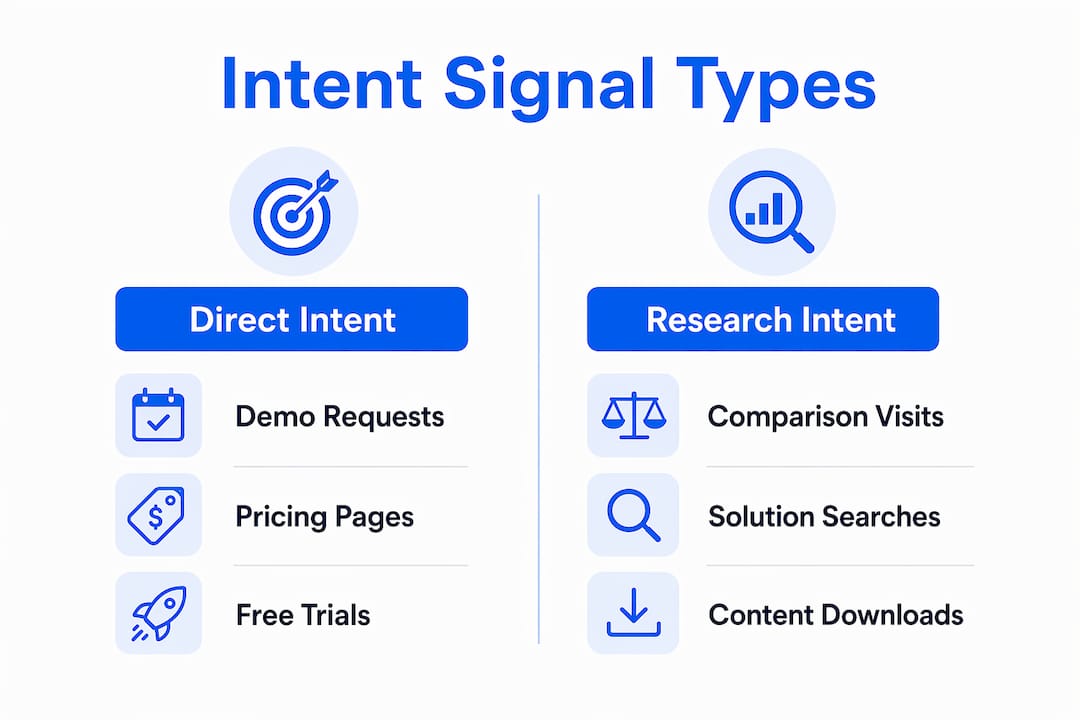
Direct intent signals show a buyer has made a decision and is selecting a vendor. These include demo requests, pricing page visits, and free trial sign-ups. Direct intent signals convert better because clear buying decisions are already underway.
Research intent signals show a buyer is comparing options. These include visits to product comparison pages, searches for feature-specific terms, and time spent on case study pages. A prospect reading three case studies in one session is telling you something important.
Problem awareness signals show a buyer has recognized a pain point but has not yet committed to a solution category. These include searches for symptoms (“why is my sales team missing quota”) rather than solutions (“best sales automation software”). These leads need nurturing before direct outreach.
First-party vs. third-party data sources
Intent data comes from two source types: first-party signals from your own website, app, and CRM, and third-party signals aggregated from external publishers, review sites, and content networks.
First-party signals carry more weight. First-party website interactions provide direct context about prospect engagement and are more predictive than external data alone. When a prospect visits your pricing page twice in three days, that is a high-confidence signal. Third-party data, such as a prospect reading competitor reviews on G2 or Capterra, is useful for prioritization but requires more caution in interpretation.
- First-party sources: Website analytics (Google Analytics 4), CRM activity logs, email engagement data, chatbot conversations, product usage data
- Third-party sources: Intent data platforms like Bombora, G2 Buyer Intent, TechTarget Priority Engine, and Leadfeeder’s company identification layer
- Behavioral triggers to track: Pricing page visits, demo request form abandonment, repeated blog visits on solution-specific topics, social posts asking for vendor recommendations
Pro Tip: Set up event tracking in your CRM for high-value page visits before investing in third-party intent platforms. Your own data is free, immediate, and often more accurate than aggregated external signals.
How does intent-based lead generation differ from other strategies?
Marketers often conflate intent-based lead generation with account-based marketing (ABM) or interest-based targeting. These are related but distinct approaches, and mixing them up leads to misallocated budgets.
Intent-based marketing differs from ABM in a fundamental way: ABM starts with a predefined list of high-value target accounts and then personalizes outreach to them regardless of their current buying activity. Intent-based marketing starts with behavioral signals and identifies which accounts are actively searching right now, whether or not they were on your original list. IBM, for example, uses intent signals to find accounts actively searching for enterprise solutions, expanding their addressable market beyond a fixed ABM list.
The table below clarifies the key distinctions across four common lead generation approaches:
| Strategy | Targeting Basis | Timing | Conversion Efficiency |
|---|---|---|---|
| Intent-based lead generation | Active buying behavior and signals | Real-time, during evaluation | Highest: 14.6% conversion rate |
| Account-based marketing (ABM) | Predefined high-value account list | Ongoing, regardless of readiness | High for named accounts |
| Interest-based targeting | Demographic and psychographic data | Broad, awareness stage | Moderate |
| Cold outreach | Firmographic fit only | Arbitrary, no signal basis | Lowest: 1.7% conversion rate |
Focusing on buying readiness avoids wasting resources on prospects who fit your ICP but are not evaluating solutions today. This is the core efficiency argument for intent-driven marketing. A CFO who matches your ideal customer profile perfectly is still a bad outreach target if they signed a three-year contract with a competitor last month. Intent signals tell you who is actually in the market.
Interest-based leads occupy a middle ground. They show affinity for a topic or category but have not yet demonstrated evaluation behavior. They require more nurturing cycles before they are ready for direct sales engagement. Intent-based leads, by contrast, are ready for a conversation now.
How do marketers implement intent-based lead generation effectively?
Collecting intent signals is step one. Acting on them correctly is where most teams fail. The implementation framework that works consistently separates three variables: fit, intent strength, and timing.
Build a three-dimensional lead scoring model
Effective lead scoring separates fit, intent, and timing to prevent two common mistakes. The first mistake is pursuing high-fit accounts that show no current buying signals. The second is chasing high-intent signals from companies that will never be good customers. You need both dimensions aligned before routing a lead to sales.
- Score for fit first. Assign points based on firmographic and technographic criteria: company size, industry, tech stack, and budget range. A score of 70 or above qualifies an account for intent monitoring.
- Layer in intent strength. Weight signals by specificity. A pricing page visit scores higher than a blog read. A demo request scores highest. Use tools like HubSpot’s AI automations or Leadfeeder to automate this scoring in real time.
- Apply a timing multiplier. Intent signals decay rapidly, so recency matters. A pricing page visit from yesterday is worth more than the same visit from three weeks ago. Build decay logic into your scoring model so stale signals do not inflate lead scores.
- Set routing thresholds. Accounts that hit a combined threshold on all three dimensions go directly to sales for same-day outreach. Accounts with high fit but low intent enter a nurture sequence. Accounts with high intent but low fit get a lighter-touch qualification call.
- Review and recalibrate monthly. Signal patterns shift as your market evolves. A signal that predicted purchase six months ago may not carry the same weight today.
Automate monitoring without losing context
Continuous monitoring is not optional. Treating intent as a continuously updating state rather than a one-time trigger is what separates high-performing intent programs from average ones. HubSpot’s workflow automation, combined with Leadfeeder’s company identification, can alert your sales team the moment a target account crosses a scoring threshold. That alert needs to include context: which pages they visited, how many times, and over what time period.
Pro Tip: Assign a “signal summary” field in your CRM that auto-populates with the last three intent actions a prospect took. Sales reps who open a lead record and immediately see context convert at higher rates than reps who receive a bare name and phone number.
What tactics and tools help you attract and convert intent-based leads?
Knowing how to attract leads through intent signals requires matching your outreach method to the signal type. High-intent signals demand speed and personalization. Research-stage signals demand content and nurturing.
Tactics that work at each intent stage
- Pricing page visitors: Trigger an immediate chatbot conversation or speed-to-lead response within 60 seconds. Offer a direct booking link for a 15-minute call. Do not send a generic email sequence.
- Comparison page visitors: Serve retargeted ads that highlight your differentiators versus the specific alternatives they viewed. Use LinkedIn’s matched audiences or Google’s customer match to reach them across channels.
- Demo request abandonment: Send a personalized follow-up within five minutes referencing the specific product area they were exploring. Automation tools like HubSpot or Marketo Engage can trigger this without manual intervention.
- Third-party research signals: Use Bombora or G2 Buyer Intent to identify accounts researching your category on external sites. Add them to a targeted ad campaign and a light outreach sequence simultaneously.
- Social recommendation posts: Monitor LinkedIn and Reddit for posts asking for vendor recommendations in your category. A direct, helpful response to these posts converts at high rates because the buyer has self-identified their need publicly.
The speed imperative
Response time is the single most controllable variable in intent-based conversion. A prospect who visits your pricing page and receives a personalized response within five minutes is far more likely to engage than one who hears from you 48 hours later. Searching a specific term signals active research, but that window closes fast as buyers move through their evaluation process.
AI voice agents and chatbots have made sub-minute response times achievable at scale. Mediabloom’s platform, for example, deploys AI voice agents that engage inbound leads in under 60 seconds, qualify them against predefined criteria, and book appointments automatically. For high-volume intent programs, this kind of automation is not a luxury. It is the mechanism that makes the strategy work.
Content alignment matters equally. A prospect in the research phase needs a comparison guide or ROI calculator, not a sales pitch. A prospect who just submitted a demo request needs a confirmation, a calendar link, and a brief agenda. Matching content to signal type is what turns intent data into pipeline.
Key takeaways
Intent-based lead generation outperforms cold outreach because it targets the 3–5% of your ICP actively evaluating solutions right now, not the full universe of potential buyers.
| Point | Details |
|---|---|
| Define intent clearly | Intent-based leads show active buying behavior, not just demographic fit or general interest. |
| Prioritize first-party signals | Your own pricing page and demo data outperform third-party aggregated signals in predictive accuracy. |
| Score on three dimensions | Fit, intent strength, and timing must all align before routing a lead to direct sales outreach. |
| Act on signals immediately | Intent signals decay fast; same-day or sub-minute follow-up dramatically improves conversion rates. |
| Match content to signal stage | Research-stage signals need nurture content; direct-intent signals need a booking link and a call. |
The uncomfortable truth about intent data most guides skip
Most articles on intent-based lead generation treat intent signals as a targeting upgrade. They are not. They are a fundamental shift in how sales and marketing teams should organize their time and resources.
At Mediabloom, we have seen the same pattern repeatedly across clients in healthcare, financial services, and SaaS. Teams collect intent data, build a scoring model, and then route leads to a sales team that still operates on a weekly cadence. The intent data becomes useless because the window has already closed by the time a rep picks up the phone.
The real transformation is not in the data. It is in the response infrastructure. When Miracle Ear and 1-800 Accountant scaled to over 10,000 monthly leads, the differentiator was not better intent signals. It was the ability to act on those signals in under 60 seconds, at any hour, without adding headcount. AI voice agents and automated appointment setting made that possible.
The other pitfall we see consistently: teams treat intent scoring as a one-time setup. They build a model in Q1 and never revisit it. Signal patterns shift. A competitor launches a new product and suddenly your comparison page traffic means something different. Intent models need monthly review, not annual audits.
The future of intent-based lead generation is not more data. It is faster, smarter action on the data you already have. Teams that build response infrastructure first and refine their signal models second will outperform teams that do the opposite. That is the lesson we keep relearning with every client deployment.
— Mediabloom
How Mediabloom turns intent signals into booked revenue
Intent data is only as valuable as your ability to act on it. Mediabloom’s AI-driven platform connects intent signal detection directly to automated engagement, qualifying leads and booking appointments before your competitors even send their first email.
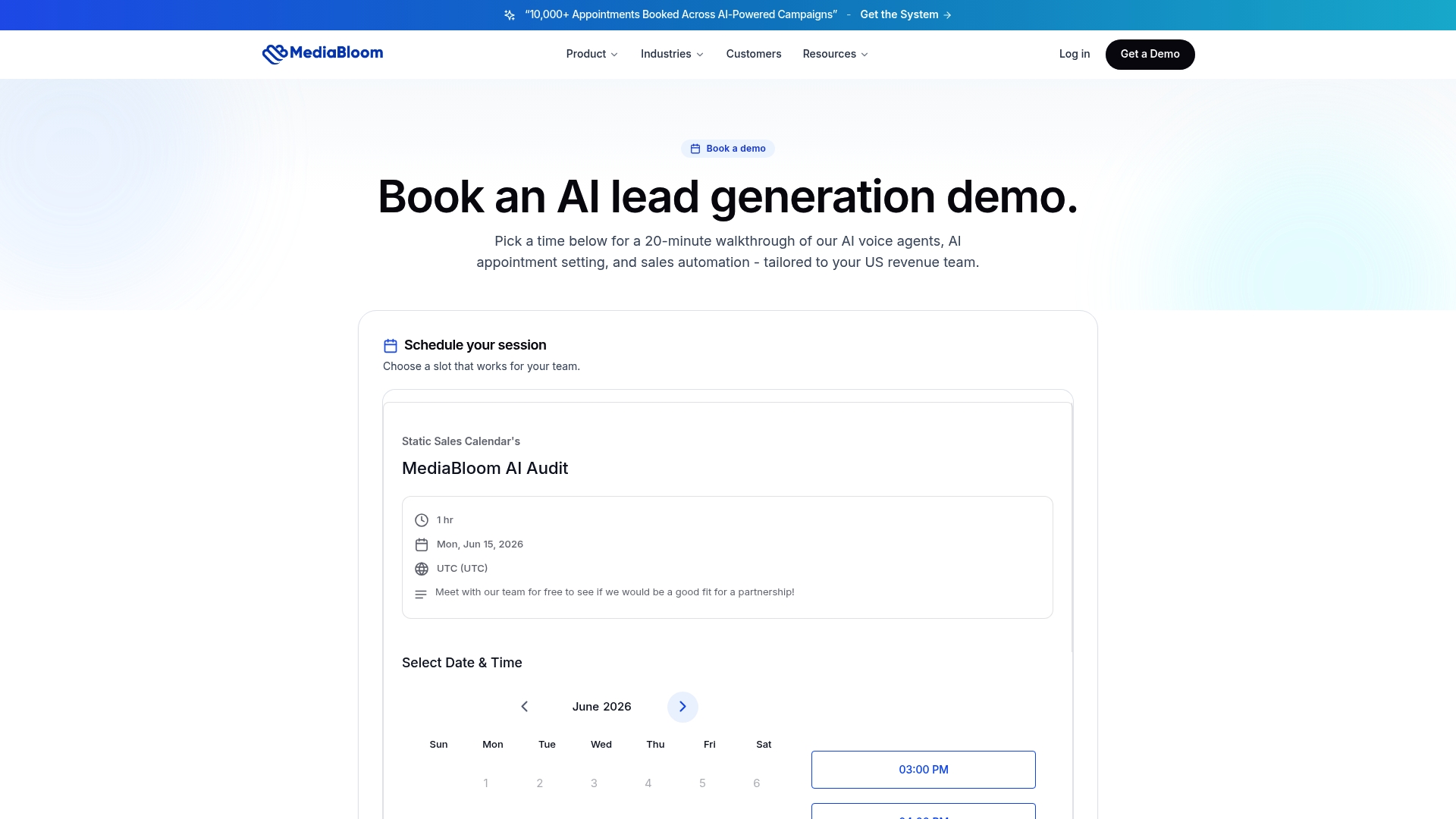
Mediabloom deploys AI voice agents, chatbots, and sales automation across SMS, email, and chat to engage high-intent prospects in under 60 seconds. Clients like those featured in the Fifth Avenue Leads case study have seen measurable pipeline growth by combining intent-based targeting with automated follow-up. Whether you are scaling inbound qualification or building an outbound intent program, Mediabloom’s AI lead generation platform gives your team the response speed and qualification depth that intent-based strategies demand. Book a demo and see the difference real-time engagement makes.
FAQ
What is intent-based lead generation in simple terms?
Intent-based lead generation identifies prospects who are actively researching a solution and targets them with relevant outreach. It focuses on behavioral signals like pricing page visits and demo requests rather than static demographic data.
How do intent signals differ from general website traffic?
Intent signals are specific, high-value actions such as visiting a pricing page, requesting a demo, or comparing products. General traffic includes passive browsing that does not indicate evaluation behavior or purchase readiness.
What percentage of my ICP is actively in-market at any time?
Only 3–5% of your ideal customer profile is actively evaluating solutions at any given moment. Intent data helps you identify and prioritize this segment rather than spreading outreach across the full ICP.
How quickly should i follow up on a high-intent signal?
Follow up within five minutes for the highest conversion rates. Intent signals decay rapidly, and waiting 24 hours or more significantly reduces the likelihood of engagement.
What is the difference between intent-based marketing and ABM?
ABM targets a predefined list of high-value accounts regardless of their current buying activity. Intent-based marketing targets accounts showing active buying signals right now, which may or may not overlap with a fixed ABM list.


