
AI-assisted live chat support is a customer service model where artificial intelligence augments or automates real-time chat interactions between customers and service teams. The industry term for the broader category is “AI-powered support,” which covers both agent-assist tools and fully autonomous chatbots. Understanding what is ai-assisted live chat support matters because it determines how you staff, train, and measure your support operation. AI augmentation with humans in the loop is fundamentally different from full automation, and each model requires different metrics, governance, and quality controls. Businesses that conflate the two often deploy the wrong solution and measure the wrong outcomes.
What is AI-assisted live chat support and how does it work?
AI-assisted live chat support involves AI helping in real-time chat by automating parts of the interaction or assisting human agents with responses and insights. Two distinct operational models exist, and choosing between them shapes every downstream decision your team makes.
The first model is agent-assist. The AI runs alongside a human agent, reading the conversation in real time and surfacing suggested replies, relevant knowledge base articles, or next-best actions. The human agent reviews the suggestion and decides whether to send it. This model keeps a person accountable for every customer-facing message.

The second model is full automation. The AI handles the entire conversation without a live agent. It resolves the request, confirms completion, and closes the ticket. A human only enters when the AI cannot resolve the issue and triggers an escalation. This model works best for high-volume, low-complexity queries.
The technologies behind AI chat
Three core technologies power both models. Natural language processing (NLP) lets the AI read and interpret customer messages. Machine learning trains the AI on historical conversations so it improves over time. Knowledge base integration gives the AI access to product documentation, policies, and FAQs so it can retrieve accurate answers quickly.
Common tasks that AI handles well include:
- Answering frequently asked questions about pricing, hours, or policies
- Checking order status and tracking numbers
- Resetting passwords and verifying account details
- Routing tickets to the correct department based on intent
- Collecting customer information before a human agent joins
Pro Tip: Map your top 20 inbound query types before selecting an AI model. If more than half are simple, high-frequency questions, full automation delivers faster ROI. If your queries are complex or emotionally sensitive, agent-assist is the safer starting point.
Context preservation is the technical requirement that separates good implementations from poor ones. When a conversation moves from AI to human, the full conversation history, the AI’s reasoning, and any data the customer already provided must transfer instantly. Without that transfer, customers repeat themselves, agents start from scratch, and resolution times climb.
What are the main benefits and challenges of AI chat support?
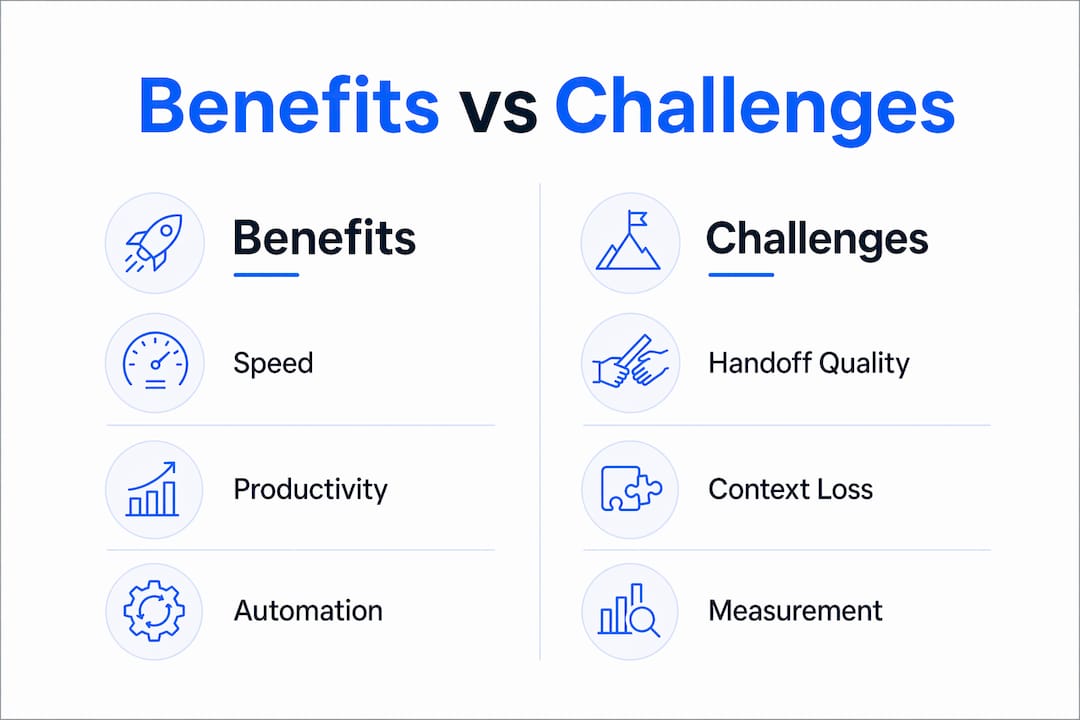
The primary benefit of AI-driven customer support is speed. AI responds in milliseconds, not minutes. That speed reduces wait times across every channel where you deploy it.
The productivity gain for human agents is equally significant. AI agents can automate up to 80% of interactions, freeing your team to focus on complex, high-value conversations. That ratio means a team of ten agents can effectively handle the workload that previously required fifty, without sacrificing quality on the cases that need human judgment.
AI chatbots provide 24/7 self-service on common questions, reducing wait times and customer dependence on human agents. That availability matters most for businesses with customers across multiple time zones or those who cannot staff overnight shifts cost-effectively.
Key benefits at a glance
- Faster first response times across chat, SMS, and web
- Reduced agent workload on repetitive, low-complexity queries
- Around-the-clock availability without overnight staffing costs
- Consistent answers that do not vary by agent knowledge or mood
- Real-time agent coaching through suggested replies and alerts
The challenges you cannot ignore
The handoff moment is where most AI chat implementations fail. Ignoring handoff quality causes longer resolution times and poorer customer experience. Customers who must repeat their problem to a human agent after already explaining it to a bot report significantly lower satisfaction scores.
Governance is the second major challenge. Customer-facing AI chatbots carry higher risk than internal AI tools and require explicit disclosure policies, escalation controls, and claims verification processes. Customers have a right to know when they are speaking with AI, and regulators in multiple jurisdictions are beginning to require it.
“Customer satisfaction often hinges on the quality of the AI-to-human handoff, making it a vital operational focus rather than a technical afterthought.” — Intercom Learning Center
A subtler challenge is measurement. Teams that track deflection rates, meaning the percentage of chats the AI handles without escalation, often overestimate their AI’s value. Deflection is not resolution. A customer who abandons a chat after the AI fails to help counts as a deflection but not a success.
How to optimize AI and human collaboration in live chat support?
Effective AI and human collaboration requires deliberate workflow design, not just good technology. The following steps build a foundation that holds up at scale.
-
Design explicit handoff workflows. Define exactly what triggers an escalation: query complexity, customer sentiment, specific keywords, or failed resolution attempts. Document the data fields the AI must pass to the human agent at the moment of handoff.
-
Transfer full context automatically. The human agent should see the complete conversation transcript, the AI’s confidence score, the customer’s account data, and any actions the AI already took. The escalation moment with context loss is the top failure point in AI-assisted live chat, and it requires explicit workflow design to carry AI reasoning forward.
-
Run a unified QA system. Shared evaluation criteria across AI and human conversations help identify strengths and weaknesses across channels and reduce the risk of low-quality AI responses slipping through undetected. Score AI responses on the same rubric you use for human agents.
-
Train agents to use AI suggestions effectively. An agent who ignores every AI suggestion wastes the tool. An agent who accepts every suggestion without reading it creates liability. Train your team to treat AI suggestions as a first draft that requires a two-second review before sending.
-
Monitor AI suggestion acceptance rates. A low acceptance rate signals that the AI’s suggestions are off-target. A very high rate may signal that agents are rubber-stamping responses without review. Both extremes require investigation.
-
Iterate based on resolution data, not deflection data. Measuring success by resolution means confirming the customer’s intended task was completed, not just that a response was sent. Resolution data tells you where the AI genuinely helps and where it creates more work.
Pro Tip: Run a monthly sample review of 50 escalated conversations. Look specifically at what the AI said before the handoff and whether the human agent had to re-collect information the AI already gathered. That single audit reveals more about handoff quality than any dashboard metric.
The customer service AI solutions that perform best treat the AI and the human agent as a single unit with shared accountability, not as two separate systems that happen to share a chat window.
What should businesses consider when implementing AI live chat?
Implementation decisions made early determine whether your AI chat program scales or stalls. The following framework covers the six areas that matter most.
Assess your use cases first
Deploy AI chatbots strategically where they handle simple, high-frequency queries, with humans tackling complex and emotional interactions. Audit your inbound query volume by type before selecting any technology. Queries that require judgment, empathy, or access to sensitive account data are poor candidates for full automation.
Select technology with appropriate risk controls
Not all AI chat platforms carry the same risk profile. A chatbot answering general product questions carries lower risk than one processing refunds or handling medical inquiries. Governance controls should be use-case specific, with tighter controls for customer-facing AI compared to internal AI assistants. Build your vendor evaluation around the risk level of your specific use cases.
Integrate with existing systems
AI chat tools that cannot read your CRM, order management system, or knowledge base deliver limited value. The AI needs access to real customer data to give accurate, personalized answers. Integration depth is often the difference between an AI that resolves issues and one that only collects information before handing off to a human.
Establish governance policies before launch
Your governance policy must address three things: customer disclosure (telling customers they are speaking with AI), escalation controls (defining when and how the AI hands off), and claims verification (ensuring the AI does not make promises your business cannot keep). These are not optional. They protect your customers and your brand.
Evaluate implementation approaches
| Consideration | Entry-level AI chat tools | Enterprise AI chat platforms |
|---|---|---|
| Setup complexity | Low; template-based | High; requires technical resources |
| Integration depth | Limited CRM connectivity | Full API access to core systems |
| Governance controls | Basic escalation rules | Custom disclosure and compliance workflows |
| Customization | Pre-built conversation flows | Purpose-built agents for unique workflows |
| Best fit | Small teams, simple queries | High-volume, complex support operations |
Measure resolution, not just response
Deflection metrics alone underestimate AI chat impact. Evaluating resolution, meaning task completion confirmed by the customer, gives you an accurate picture of whether the AI is actually helping. Set resolution rate as your primary KPI from day one, and track it separately for AI-only conversations and AI-assisted human conversations.
For teams building more complex workflows, purpose-built AI development allows you to design agents that match your exact escalation logic, data architecture, and compliance requirements rather than forcing your operation into a generic platform’s constraints.
Key Takeaways
AI-assisted live chat support delivers measurable efficiency gains only when handoff quality, governance, and resolution measurement are treated as core operational priorities, not afterthoughts.
| Point | Details |
|---|---|
| Two distinct models exist | Agent-assist keeps humans accountable; full automation handles queries end-to-end without live agents. |
| Handoff quality determines satisfaction | Full conversation context must transfer instantly when AI escalates to a human agent. |
| Automate up to 80% of interactions | AI can handle the majority of routine queries, freeing human agents for complex cases. |
| Measure resolution, not deflection | Task completion confirmed by the customer is the only metric that reflects true AI value. |
| Governance is non-negotiable | Customer-facing AI requires disclosure policies, escalation controls, and use-case-specific risk management. |
The handoff is where AI chat wins or loses
After working with businesses across industries on AI-driven customer support, the pattern is consistent: teams spend 90% of their implementation budget on the AI itself and almost nothing on the handoff. That is the wrong allocation.
The AI conversation is the easy part. Natural language processing has matured to the point where most platforms handle routine queries reliably. The hard part is what happens in the three seconds when the AI decides it cannot resolve the issue and passes the conversation to a human. If the human agent opens a blank screen and asks the customer to start over, the AI has not helped. It has added a step.
We have seen businesses with technically excellent AI implementations score lower on customer satisfaction than teams using basic live chat, purely because their escalation workflows were broken. The fix is almost never a technology change. It is a workflow and training change.
The businesses that get this right treat AI-to-human handoff as a quality dimension with its own metrics, its own review process, and its own improvement cycle. They score handoffs the same way they score agent conversations. They audit escalations monthly. They track how often agents have to re-collect information the AI already gathered.
The future of AI in customer service is not AI replacing human agents. It is AI making human agents faster, better informed, and more focused on the conversations that actually require human judgment. That future is already here for teams willing to build the operational discipline to support it.
— Mediabloom
How Mediabloom’s AI solutions support your customer service team
Mediabloom builds AI systems that handle the full customer interaction lifecycle, from first contact through resolution, across chat, voice, and SMS.
Mediabloom’s chatbot solutions deploy on-brand chat automation across your website and app surfaces, handling high-frequency queries around the clock without adding headcount. For teams with complex workflows, Mediabloom’s custom AI development delivers purpose-built agents designed around your escalation logic, CRM data, and compliance requirements. Clients including Miracle Ear and 1-800 Accountant have used Mediabloom’s platform to generate over 10,000 monthly leads while maintaining high customer satisfaction. See the results from businesses that have deployed Mediabloom’s AI across their support and sales operations.
FAQ
What is AI-assisted live chat support?
AI-assisted live chat support is a customer service model where artificial intelligence either helps human agents respond faster or autonomously resolves customer queries in real-time chat. The AI uses natural language processing and machine learning to read, interpret, and respond to customer messages.
How does AI chat differ from a standard chatbot?
A standard chatbot follows fixed decision trees. AI-assisted chat uses machine learning and NLP to understand intent, adapt to varied phrasing, and improve over time based on conversation data.
What percentage of interactions can AI automate?
AI agents can automate up to 80% of interactions, allowing human agents to concentrate on complex, high-value conversations that require judgment or empathy.
Why does the AI-to-human handoff matter so much?
Context loss at the escalation moment is the top failure point in AI-assisted live chat. When customers must repeat information they already provided to the AI, satisfaction scores drop and resolution times increase.
Do businesses need to disclose when AI is handling a chat?
Customer-facing AI chatbots require appropriate disclosure and escalation controls as part of responsible governance. Regulatory requirements vary by jurisdiction, but transparency about AI use is both an ethical standard and an emerging legal expectation.


