AI customer service is defined as the integration of artificial intelligence systems within existing communication workflows to automate, triage, and personalize customer interactions at scale. This is distinct from simply adding a chatbot to a website. The industry term is “AI-embedded customer support,” and it covers everything from AI agents inside your CRM to voice automation that qualifies leads before a human ever picks up the phone. Embedded AI tools can handle about 20% of real SME inquiries that traditional automation misses entirely. That number signals a meaningful shift: AI in customer support is no longer a novelty layer. It is a core operational component that business leaders and CX managers must understand and deploy with precision.
What is AI customer service, and how does it work?
AI customer service is the practice of using machine learning, natural language processing, and workflow automation to handle customer inquiries without constant human involvement. The key word is “embedded.” These systems do not sit in a separate portal. Embedded AI works inside tools like WhatsApp, Gmail, and CRM platforms to draft replies, triage issues, and follow up automatically. That integration is what separates modern AI customer support from the clunky FAQ bots of five years ago.
The mechanics are straightforward. A customer sends a message. The AI reads it, classifies the intent, pulls relevant data from your CRM or help desk, and either resolves the issue or routes it to the right team with full context attached. Response times drop from hours to seconds. Agent workloads shrink because the AI absorbs the administrative layer of communication. The human team focuses on decisions that require judgment, empathy, or authority.

This architecture also enables 24/7 support without 24/7 staffing. A customer submitting a billing question at 11:00 PM gets an accurate, personalized response immediately. That capability alone changes the competitive math for businesses that previously could not afford round-the-clock support teams.
What are the core types of AI customer service technologies?
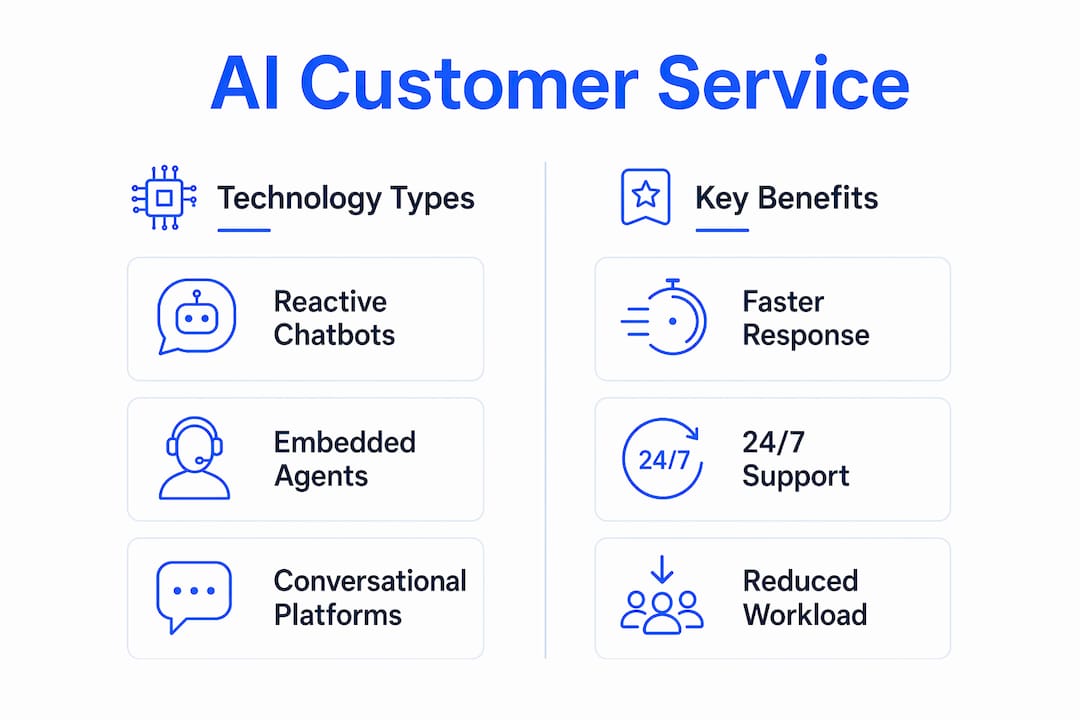
Three main categories define AI customer engagement: reactive chatbots, embedded AI agents, and conversational engagement platforms. Each serves a different purpose, and confusing them leads to expensive mismatches between what you buy and what your business actually needs.
Reactive chatbots
Reactive chatbots respond to direct customer inputs using scripted decision trees or basic intent classification. They excel at FAQ deflection, store hours, and simple order status checks. Their ceiling is low. When a question falls outside the script, the bot fails and the customer gets frustrated. These tools are inexpensive and fast to deploy, but they are not a substitute for deeper automation.
Embedded AI agents
Embedded AI agents live inside your existing business tools. They read incoming emails, draft responses, flag urgent tickets, and update CRM records without switching platforms. AI automation absorbs administrative communications, freeing agents to focus on complex cases. This category delivers the highest ROI for SME teams because it multiplies the output of existing staff rather than replacing them.
Conversational engagement platforms
Conversational engagement platforms treat structured conversations as the primary value, not just ticket deflection. They guide customers through multi-step processes, such as onboarding, qualification, or troubleshooting, using dynamic dialog flows. These platforms are purpose-built for businesses where the conversation itself generates revenue or qualifies a lead.
| Category | Primary function | Best fit |
|---|---|---|
| Reactive chatbot | FAQ deflection and scripted responses | High-volume, low-complexity inquiries |
| Embedded AI agent | Drafts, triages, and updates within existing tools | SME teams needing workflow automation |
| Conversational platform | Structured multi-step customer dialog | Lead qualification and onboarding flows |
Pro Tip: Before purchasing any AI customer service tool, map your top 20 inquiry types by volume and complexity. That map will tell you which category you actually need, not which one has the best demo.
How does AI customer service improve efficiency and experience?
The operational case for AI in customer support rests on three measurable outcomes: faster response times, lower agent workload, and higher customer satisfaction scores. Each outcome compounds the others.
Speed is the most visible benefit. AI resolves tier-1 issues in seconds rather than hours. Customers do not wait in queues for password resets, appointment confirmations, or account balance checks. That speed directly reduces inbound volume for human agents, who can then spend more time on complex cases that actually require their expertise.
Personalization is the less obvious but more powerful benefit. Embedded AI pulls customer history, purchase data, and prior interactions before composing a response. The result is a reply that feels tailored, not templated. Customers notice the difference, and satisfaction scores reflect it.
The efficiency gains for teams are equally concrete:
- Reduced repetitive work: AI handles routine follow-ups, status updates, and data entry that previously consumed agent hours.
- Faster onboarding for new agents: AI-drafted responses give new team members a starting point, reducing training time.
- Consistent tone and accuracy: AI applies your brand voice and pulls from verified data sources, reducing errors from manual responses.
- Scalable capacity: Volume spikes during product launches or seasonal peaks no longer require emergency hiring.
AI customer service automation helps teams focus on decisions requiring human judgment by absorbing the administrative layer of communication. That shift is not about cutting headcount. It is about deploying your team where they create the most value.
Pro Tip: Measure AI performance by tracking “first-contact resolution rate” before and after deployment. A meaningful increase in that metric confirms the AI is resolving issues, not just deflecting them.
What is AI escalation in customer service and why does it matter?
AI escalation in customer service is the process of detecting when an AI-handled interaction has reached its limit and routing it to a human agent with full context preserved. AI escalation is a trust-preserving process that defines safe automation boundaries and manages the handoff so customers feel supported, not abandoned.
Most businesses treat escalation as a fallback. That framing is wrong. Escalation is an architecture decision, not an exception handler. The best systems define escalation triggers before deployment, not after complaints arrive.
How escalation triggers work
AI escalation uses sentiment analysis and repeat contact detection to route customers to the right human agent before frustration peaks. The system monitors tone shifts, detects when a customer has contacted support more than twice about the same issue, and identifies contextual signals like billing disputes or legal language. When those triggers fire, the AI routes the interaction proactively.
The critical distinction is timing. Waiting for explicit customer requests to escalate leads to poor outcomes. By the time a customer asks for a human, trust is already damaged. Proactive escalation, triggered by behavioral signals, preserves the relationship.
Designing an effective escalation workflow
- Define trigger categories. Separate sentiment triggers (anger, distress) from complexity triggers (multi-department issues, legal questions) and volume triggers (third contact about the same issue).
- Build context summaries. The AI should generate a structured summary of the interaction before transfer, so the human agent does not ask the customer to repeat themselves.
- Write clear handoff messages. Escalation handoff messages should acknowledge the issue, explain the transfer, set timing expectations, and confirm that full context carries forward.
- Route to the right agent. Match the escalation to an agent with the relevant skill set, not just the next available person.
- Measure and adjust. Track escalation rates by trigger type monthly. A high rate on a specific trigger means the AI needs better training on that topic.
“AI escalation is not a sign that automation failed. It is proof that the system is working as designed. A business that never escalates has either set its triggers too high or is losing customers silently.”
Effective AI escalation routes customers to the right human agent with full context, eliminating the frustrating experience of repeating a problem to three different people. That single improvement has an outsized effect on customer retention.
Pro Tip: Set a “maximum AI turns” rule for any single conversation. If the AI has exchanged more than five messages without resolving the issue, escalate automatically. Most customers lose patience well before that point.
How can businesses implement AI customer service effectively?
Effective implementation starts with an honest assessment of your current support operation. Before selecting a tool, document your inquiry volume by category, your average resolution time, and your current escalation rate. Those three numbers define your baseline and tell you where AI will deliver the fastest return.
Businesses often err by treating different AI tools as equivalent, resulting in misaligned purchases and failed deployments. A company that buys a reactive chatbot when it needs an embedded AI agent will see minimal improvement and conclude that “AI doesn’t work for us.” The architecture mismatch is the problem, not the technology.
The implementation steps that consistently produce results are:
- Audit your communication stack. Identify which platforms your team uses daily, such as your CRM, help desk, or email client, and confirm that your chosen AI tool integrates natively with those systems.
- Start with one inquiry category. Deploy AI on your highest-volume, lowest-complexity inquiry type first. Prove the model before expanding scope.
- Train on your actual data. Generic AI models perform adequately. Models trained on your specific customer language, product terminology, and resolution patterns perform significantly better.
- Set escalation parameters on day one. Do not wait for a customer complaint to define your escalation rules. Build them into the deployment plan.
- Review performance weekly for the first 90 days. AI systems improve with feedback. Weekly reviews catch misclassifications and tone errors before they become patterns.
Agentic AI pursues goals and executes tasks end-to-end in customer experience workflows. That capability is the next frontier for businesses that have already deployed conversational AI. Agentic systems do not just respond. They take actions: booking appointments, processing refunds, updating account records, and following up without human prompting. Planning for that evolution now means your architecture choices today do not become obstacles tomorrow.
The most important mindset shift for business leaders is this: AI customer service is not a replacement for your support team. It is a force multiplier. Your agents handle customer service AI tools as a 24/7 resolution layer, and they step in when judgment, empathy, or authority is required. That division of labor produces better outcomes than either humans or AI working alone.
Key Takeaways
AI customer service delivers measurable results only when businesses match the right architecture to their specific inquiry types, deploy proactive escalation rules from day one, and treat AI as a force multiplier for their human support teams.
| Point | Details |
|---|---|
| Architecture match is critical | Buying a chatbot when you need an embedded AI agent produces poor results and wasted budget. |
| Embedded AI multiplies team output | AI handles administrative communications so agents focus on complex, high-value interactions. |
| Escalation is a design decision | Define sentiment, complexity, and volume triggers before deployment, not after complaints arrive. |
| Proactive escalation preserves trust | AI should route customers to humans before frustration peaks, not after they ask for help. |
| Agentic AI is the next step | Plan your architecture today to support end-to-end task execution as AI capabilities advance. |
What Mediabloom has learned about AI customer service in practice
The most common mistake we see is businesses deploying AI as a cost-cutting measure rather than a capability expansion. That framing produces the wrong success metrics, the wrong tool selection, and ultimately, the wrong outcomes. When you measure AI customer service by “how many agents did we eliminate,” you miss the real value: how many customers did we retain, qualify, and convert because response times dropped from four hours to four seconds.
The second thing we have learned is that escalation design separates good deployments from great ones. Every business we work with has a different escalation threshold. A legal services firm needs to escalate faster than a retail brand. A healthcare provider needs different trigger language than a SaaS company. There is no universal rule. The businesses that invest time in mapping their escalation architecture before launch consistently outperform those that treat it as an afterthought.
The future belongs to agentic AI. Conversational AI manages the dialog. Agentic AI completes the task. The businesses building toward that capability now, by choosing architectures that support end-to-end workflow execution, will have a structural advantage over those still debating whether to add a chatbot to their website. The gap between those two positions is widening every quarter.
One more observation: customers do not care whether they are talking to AI or a human, provided the interaction resolves their issue quickly and accurately. Trust is built through resolution, not through disclosure. Build your AI customer service operation around that principle, and the technology becomes invisible in the best possible way.
— Mediabloom
Mediabloom’s AI customer service platform in action
Mediabloom deploys AI customer service systems that integrate voice agents, chatbots, and workflow automation across SMS, email, and chat from a single platform. Clients like Miracle Ear and 1-800 Accountant use this infrastructure to generate over 10,000 monthly leads while maintaining fast, accurate responses at every touchpoint.
The Sky Consulting case study shows how embedded AI reduced manual follow-up work and accelerated qualification cycles for a professional services firm. For businesses ready to move from reactive support to proactive, automated customer engagement, Mediabloom’s customer service AI solution resolves tier-1 issues end-to-end, 24/7, with escalation rules built in from day one. Review the full case study library to see deployment results across industries.
FAQ
What is AI customer service in simple terms?
AI customer service is the use of artificial intelligence embedded within communication tools to automatically handle, triage, and respond to customer inquiries without requiring constant human involvement.
What are the main types of AI customer interactions?
The three main types are reactive chatbots for scripted FAQ responses, embedded AI agents that work inside CRM and help desk tools, and conversational engagement platforms that guide customers through structured multi-step dialogs.
What is AI escalation in customer service?
AI escalation is the process of detecting when an AI-handled conversation has exceeded its capability and routing it to a human agent with full context, triggered by sentiment analysis, repeat contact detection, or complexity signals.
How do businesses handle customer inquiries with AI effectively?
Effective AI deployment starts with auditing inquiry volume by category, selecting the right architecture for that inquiry type, and defining escalation triggers before launch rather than after problems arise.
What is an AI customer interaction log?
An AI customer interaction log is a structured record of every exchange between AI and a customer, including intent classifications, resolution outcomes, escalation events, and agent handoff summaries, used to audit performance and improve AI training over time.