Yes, AI email personalization works, and the evidence is no longer anecdotal. Personalized B2B sends outperform generic ones by 26% on opens, 41% on clicks, and 143% on replies, with email-to-meeting conversion climbing 161%. The technology scales the research and writing that used to cap outreach volume, helping marketing teams plan, write, and launch faster. The rest of this guide covers how it works, how to roll it out, and how to evaluate a vendor without getting sold a demo.
TL;DR:
- AI-driven email personalization relies on verified signals such as funding news or hiring surges, which significantly outperform surface-level tactics like merge tags.
- The most effective features to test first are subject line generation, dynamic content blocks, send-time optimization, and reply-likelihood scoring.
- Successful implementation requires a five-stage process: data hygiene, insight engineering, human-reviewed copy generation, deliverability management, and iterative testing.
- Personalization benefits are maximized when built on clean, consented data and reviewed by humans, rather than treating AI as just a copywriting shortcut.
- Using AI across multiple channels with unified signals and workflows can generate over 10,000 monthly qualified leads but demands careful integration and initial pilot testing.
Table of Contents
- Why AI Email Personalization Matters Now
- How AI Email Personalization Works Under the Hood
- Implementation Workflow: From Raw Data to Booked Meetings
- How Do You Choose the Right AI Personalization Approach?
- Templates and A/B Tests That Actually Move Reply Rates
- What We’ve Learned Deploying AI Personalization at Scale
- Our Honest Take on Where AI Email Personalization Delivers
- A Managed Path if You’d Rather Not Build the Pipeline Yourself
- Sources
- FAQ
Why AI Email Personalization Matters Now
The business case isn’t theoretical anymore. It’s a set of numbers you can hold your own campaigns against.
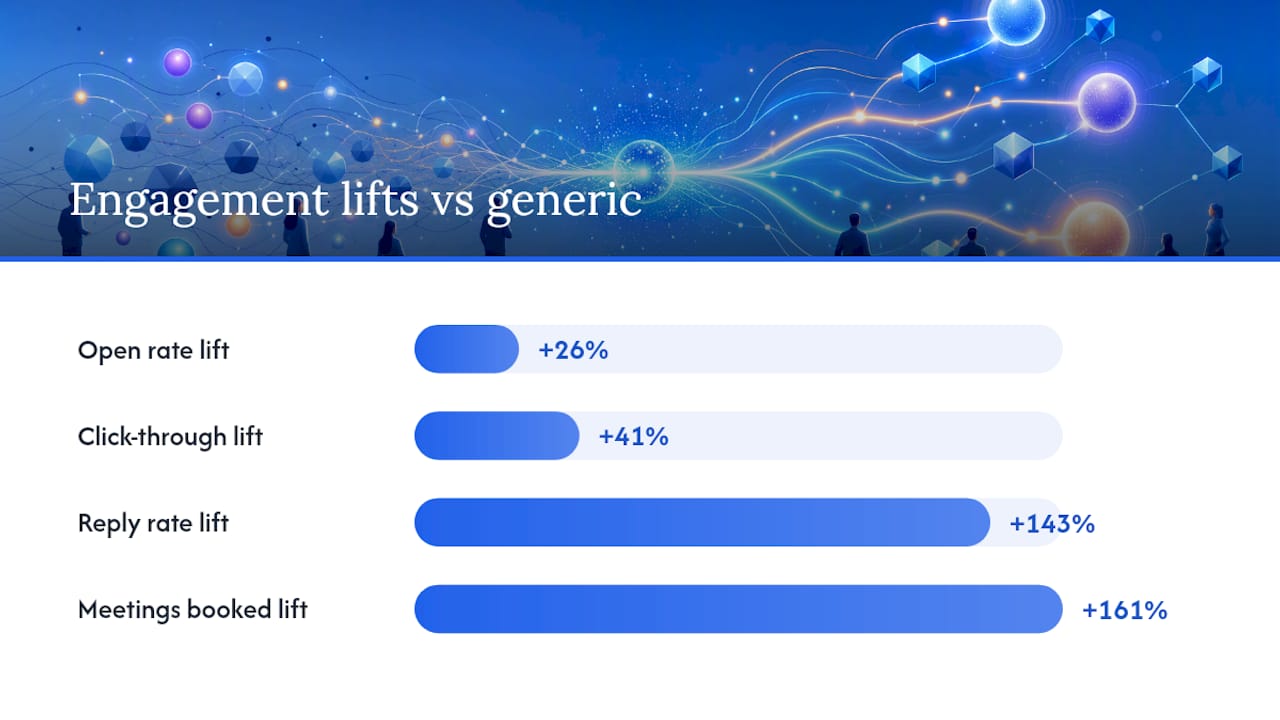
Personalized B2B emails beat generic sends across every metric that matters to a revenue team: open rates rise 26%, click-through jumps 41%, reply rates climb 143%, and meetings booked increase 161%. Those aren’t rounding errors.
Adoption has caught up with the promise. Roughly half of marketers now use AI to generate email content, and AI-driven personalization is tied to click-through gains near 41% in production campaigns, not lab tests. That number matters because it tells you this isn’t an emerging tactic reserved for enterprise teams with data science departments. It’s already the median approach among competitors sending into the same inboxes as you.
Why content-level personalization beats a first-name merge field
Merge tags feel like personalization but read like automation the moment a prospect notices the pattern. “Hi {{FirstName}}” tells the recipient nothing except that a system exists. Real personalization works because it demonstrates the sender did homework: it references a funding round, a recent hire, a product launch, or a specific pain point tied to the recipient’s role. Personalization built on active intent signals like funding events, hiring surges, or leadership changes consistently outperforms surface-level tactics, because it proves relevance instead of asserting it.
That distinction explains why so many “personalized” campaigns still flop. Swapping in a name or company doesn’t change the substance of the pitch. AI-driven personalization changes the substance, not just the greeting.
Benchmark snapshot: Personalized B2B email campaigns see open rates up 26%, click-through up 41%, replies up 143%, and meetings booked up 161% compared to generic sends, according to 2026 engagement benchmarks.
A handful of AI-driven features tend to produce most of the measurable lift. If you’re prioritizing where to start, these are the ones worth testing first:
- Subject line generation and testing — AI can produce a dozen variants tuned to different signals (urgency, curiosity, social proof) in the time it takes a human to write two, and subject-line optimization consistently produces double-digit engagement lifts when tested against control groups.
- Dynamic content blocks — swapping case studies, pricing tiers, or CTAs based on industry or company size without building separate email versions.
- Send-time optimization — modeling when an individual recipient is statistically most likely to open, rather than blasting a list at 9:00 AM in one time zone.
- Reply-likelihood scoring — flagging which leads in a sequence are worth a human follow-up call versus another automated touch.
None of these require replacing your sales team with software. They require giving your team better raw material to work with, faster than a human researcher could produce it alone.
How AI Email Personalization Works Under the Hood
Every credible AI email personalization system runs on the same basic pipeline, whether it’s a homegrown script or a packaged platform. Understanding the pipeline is what lets you vet a vendor’s claims instead of taking their word for it.
The data inputs that actually drive quality
The output is only as good as what goes in. Four categories of signal tend to matter most:
- CRM history — past interactions, deal stage, and prior email engagement tell the system what’s already been said and what landed.
- Intent signals — job changes, funding announcements, new hires, and technology adoption events give the copy something concrete to reference.
- Firmographics — company size, industry, and revenue band shape which pain points and case studies are relevant.
- Public signals — press mentions, product launches, and executive statements add texture that generic data feeds miss entirely.
Predictive AI vs. generative AI: two different jobs
These terms get used interchangeably, and that’s a mistake. Predictive AI scores and ranks: it decides which lead is likely to reply, which send time maximizes opens, and which signal is most relevant to surface first. Generative AI writes: it takes the predictive layer’s output and turns it into a subject line, an opening sentence, or a full email draft.
The division of labor matters because it tells you where human review belongs. Predictive scoring can run largely unsupervised once it’s calibrated. Generative output almost always benefits from a human pass before it hits a prospect’s inbox, especially in the first weeks of a new campaign.
The four components you’ll find in any serious system
- Ingestion — pulling CRM, intent, and firmographic data into a unified record per contact.
- Insight extraction — the predictive layer ranking which signals are worth writing about.
- Copy generation — the generative layer drafting subject lines and body copy around the top-ranked signal.
- Dynamic rendering — assembling the final email with the right content blocks, links, and CTA for that specific recipient at send time.
Pro Tip: Ask any vendor to walk you through which signals fed a specific sample email before you evaluate the writing quality. If they can’t trace the copy back to a data point, the personalization is cosmetic.
On privacy: US-based teams generally operate under a legitimate-interest or consent framework depending on the data source and how the contact was acquired, and CAN-SPAM sets baseline requirements for commercial email regardless of how personalized the content is. Treat public firmographic and intent data differently from anything scraped from private sources, and document where each data point in your pipeline originated. Prioritizing consented, verifiable signals isn’t just a compliance question. Personalization built on active intent signals is both more effective and less likely to feel invasive to the recipient, which protects deliverability as much as it protects you legally.
Implementation Workflow: From Raw Data to Booked Meetings
Rolling out AI email personalization works best as a five-stage sequence. Skipping a stage, especially the first one, is the most common reason pilots underperform.
-
Signal and list hygiene. Before any AI touches your list, verify consent status, remove bounced or invalid addresses, and prioritize enrichment on the accounts most likely to convert. Garbage data produces confident, well-written, completely wrong emails. This stage takes longer than teams expect and it’s the one most often rushed.
-
Insight engineering. Decide which signals get surfaced and in what order. A funding announcement from last week should outrank a firmographic fact that’s been true for three years. Build simple ranking rules: recency beats staleness, and specific beats generic.
-
Copy generation with human review. Generate drafts using the ranked signals, then route them through a human check before the first send in any new segment. Keep templates tight: a cold outreach email should run 50 to 125 words, with one clear signal referenced and one CTA. Set a guardrail that flags any draft referencing a signal older than 30 days or a claim the system can’t source back to CRM or intent data.
-
Deliverability and send-time optimization. Personalized copy means nothing if it lands in spam. Confirm SPF, DKIM, and DMARC are properly configured, warm up new sending IPs gradually, and use AI-driven send-time modeling to spread volume instead of blasting entire lists at once. Poor deliverability hygiene undermines even the best copy, since a message that never reaches the inbox can’t be opened, let alone replied to.
-
Testing and iteration. Run structured A/B tests comparing signal-based personalization against generic sends, track results over at least two to three weeks per test to account for weekly reply-rate variance, and feed the winning patterns back into your insight-ranking rules.
Pro Tip: Run your first pilot on a segment small enough to hand-review every single send, usually under 200 contacts. You’re not testing volume yet. You’re testing whether the signal-to-copy pipeline produces emails you’d be comfortable sending under your own name.
The teams that see compounding gains apply AI across content, targeting, and timing together rather than adopting one feature in isolation. Integrating AI across the full email lifecycle produces larger engagement gains than bolting a single AI feature onto an otherwise unchanged process. A smarter subject line on top of a poorly targeted list still underperforms a mediocre subject line sent to the right 200 people.
For teams building this alongside broader outbound motions, the workflow overlaps heavily with AI-powered outreach automation patterns used across SMS and voice channels, since the same signal pipeline can feed more than one channel.
How Do You Choose the Right AI Personalization Approach?
Deciding whether to build in-house, bolt AI onto your existing email tool, or adopt a managed platform comes down to seven criteria. Weigh them honestly before you sign anything.
- Signal coverage. Does the system pull from CRM, intent data, and firmographics, or does it rely on a single thin data source dressed up as personalization?
- Integrations. Can it connect to your existing CRM and marketing stack without a six-month engineering project? A platform advertising 600+ CRM integrations signals a mature connector library; a handful of integrations signals you’ll be writing custom code.
- Editability. Can a human easily override or edit generated copy before send, or does the system force a black-box approval flow?
- Scale and latency. Does personalization quality degrade as list size grows, and how fast does the system generate copy at volume?
- Compliance posture. Does the vendor address CAN-SPAM, data handling, and consent tracking explicitly, or is it an afterthought in the sales deck?
- Analytics depth. Can you see open, click, reply, and meeting-conversion data broken out by personalization variant, not just aggregate campaign performance?
- Pricing shape. Is pricing tied to volume, seats, or outcomes, and does it scale predictably as your list grows?
Questions worth asking any vendor or internal team before committing:
Ask them to show a real personalized email traced back to the specific data point that generated it. Ask how the system handles a contact with thin or missing data, since that’s most of your list, not the exception. Ask what happens to unsubscribe and consent status across integrated channels, especially if voice or SMS touches the same contact. Ask for a reference customer in a comparable industry and company size, not just a logo wall.
Red flags that should pause a pilot:
Watch for vendors who can’t explain their signal sources in plain language, platforms that show only aggregate lift numbers without a breakdown by segment or variant, and any tool that generates copy faster than it can explain where the copy came from. If a sales rep describes the system as “fully automated, no review needed,” treat that as a warning rather than a selling point. Every credible implementation still routes early sends through a human check.
Templates and A/B Tests That Actually Move Reply Rates
Good AI email personalization shows up in specific, testable patterns, not vague “relevance.” Here’s what the working versions actually look like.
Subject line patterns and when to use them:
- Signal-specific: “Congrats on the Series B, {{Company}}” — use when a funding or growth event happened in the last two weeks.
- Role-specific pain point: “Cutting no-show rates for {{Industry}} teams” — use for cold outreach where no recent event exists but the role is well understood.
- Curiosity plus specificity: “Saw your team just posted 3 SDR roles” — use when a hiring signal is fresh and directly relevant to your offer.
Opening sentences that lead with a verified signal:
Skip “Hope you’re doing well” entirely. Open with the signal itself: “Noticed {{Company}} just closed a Series B, congratulations, that usually means the sales team is about to grow fast.” That sentence does two things a generic opener can’t: it proves the email isn’t a template, and it sets up the pitch naturally in the next line.
Follow-up cadence and low-commitment CTAs:
- Touch 1: signal-based opener, one specific value point, a low-commitment CTA (“worth a quick reply if this is relevant?”).
- Touch 2 (3 to 4 days later): a different angle on the same signal, plus a one-line case reference.
- Touch 3 (5 to 6 days later): a short, direct ask, “Should I check back in a quarter, or is this worth 15 minutes now?”
Keep every touch under 125 words. Long emails signal effort the recipient didn’t ask for, and length rarely correlates with reply rate in cold outreach.
A simple A/B test matrix to run your first pilot:
| Test Variable | Variant A | Variant B | What You’re Measuring |
|---|---|---|---|
| Personalization depth | Generic industry pitch | Signal-based opener | Reply rate lift |
| Subject line style | Direct/descriptive | Curiosity-based | Open rate |
| Send time | Fixed 9:00 AM send | AI-modeled optimal time | Open rate |
| CTA commitment | “Book a 30-minute call” | “Worth a quick reply?” | Reply rate |
Run each test on a segment large enough to produce a meaningful sample, generally a few hundred contacts per variant, and let it run a full send cycle before calling a winner.
What We’ve Learned Deploying AI Personalization at Scale
Across deployments with companies like Miracle Ear and 1-800 Accountant, the biggest operational lift hasn’t come from prettier subject lines. It’s come from AI compressing the lead qualification step that used to eat hours of a rep’s day, then handing off cleanly to appointment setting once a lead crosses a qualification threshold.
The lesson that surprised us most: teams don’t struggle with generating personalized copy. They struggle with routing the right signal to the right message at the right moment across channels. Email, SMS, and voice all pulling from the same disconnected data create more inconsistency than a slower, unified process ever would.
The most common deployment pitfall isn’t the AI itself. It’s teams launching personalization across every channel simultaneously before confirming the underlying data is clean. A funding signal that’s three months stale, cited in a “recent news” opener, damages trust faster than a generic email ever could. The mitigation is boring but effective: pilot on one channel, one segment, with human review on every send for the first two weeks, before scaling.
The second recurring pitfall is treating integration as optional. Personalization that lives in email but doesn’t sync with CRM status or voice follow-up creates duplicate, contradictory outreach. Every implementation that worked cleanly treated the CRM sync as step one, not a later optimization.
Our Honest Take on Where AI Email Personalization Delivers
The research supports a specific, narrower claim than most vendors make: AI personalization works when it’s built on verified signals and reviewed by a human, and it underperforms when treated as a copy-writing shortcut. That distinction gets lost in most pitch decks.
The conventional advice, “use AI to write more emails, faster,” misses the actual lever. Volume was never the constraint. Relevance was. A team sending 200 signal-based emails a week will beat a team sending 2,000 generic ones almost every time, based on the engagement gaps the benchmarks show.
If you take one thing from this guide, prioritize signal quality and data hygiene before you evaluate any writing tool. The best teams treat AI as an augmentation layer, not a replacement for judgment, and that framing changes what you should build or buy first.
— MediaBloom
A Managed Path if You’d Rather Not Build the Pipeline Yourself
Everything above assumes your team has the time to engineer the signal pipeline, train a review process, and monitor deliverability yourself. If that’s more lift than your team has bandwidth for, managed platforms may run that pipeline as an omnichannel system instead of a single-channel email tool.

Mediabloom connects the same signal, scoring, and copy-generation workflow described in this guide across email, SMS, chat, and voice, so a lead qualified through one channel doesn’t get a contradictory message through another. Engagements typically include onboarding, integration with your existing CRM among 600+ supported platforms, and ongoing optimization rather than a one-time setup and handoff. Businesses like Miracle Ear and 1-800 Accountant have used the platform to generate over 10,000 monthly leads through this kind of coordinated, done-for-you deployment, as detailed in the Fifth Avenue Leads case study. If your outreach needs qualification and appointment booking on top of email personalization, the cold outbound campaigns solution is the natural next step to review and see how the pieces fit your pipeline.
Sources
The figures cited throughout this guide come from a small set of primary reports worth bookmarking if you’re building a business case internally.
- B2B Email Engagement Benchmarks 2026
- AI in Email Marketing — Statistics & Benchmarks 2026 | Stripo Research
FAQ
Can ChatGPT write my outreach emails?
ChatGPT and similar generative tools can draft email copy, but they need CRM and intent data fed in to produce anything more relevant than a generic template. The stronger approach pairs a generative model with a predictive layer that ranks which signal to write about first, which is how dedicated AI email personalization platforms differ from a standalone chatbot.
Is there a free AI email assistant for Outlook?
Microsoft offers built-in Copilot features in Outlook for drafting and summarizing, though the depth of personalization depends on the data connected to it. For B2B outreach at scale, most teams find a dedicated personalization or automation layer outperforms a general-purpose email assistant once volume grows past a handful of contacts a day.
Can I have AI organize and manage my emails?
Yes, AI can sort, prioritize, and route emails based on rules like sender intent, reply likelihood, or deal stage, which is standard in most modern email and CRM tools. For outbound teams, this same scoring layer typically also drives which leads get personalized outreach first.
How can I personalize my emails effectively?
Effective personalization means referencing a specific, verified signal, like a funding round, a new hire, or a product launch, rather than just inserting a name into a template. Personalized emails built this way see reply rates rise 143% and meetings booked rise 161% compared to generic sends, and platforms like Mediabloom automate the signal-gathering step so reps aren’t researching each contact by hand.