
Automated sales follow-up is defined as software-driven messaging that sends personalized outreach to prospects based on predefined triggers or schedules, without requiring manual effort from a sales rep. This approach replaces the error-prone habit of tracking leads by memory or spreadsheet. 80% of sales require 5 or more contacts to close, yet most reps never get there. Structured follow-up processes increase sales revenue by 29% in the first year. Automation makes that consistency achievable at scale, which is why sales teams across industries are deploying it as a core part of their automated sales process.
What is an automated sales follow-up and how does it work?
Automated sales follow-up operates through a combination of triggers, sequences, and behavioral signals. A trigger is any event that starts or advances a follow-up: a form submission, a link click, a missed call, or simply the passage of time. The system detects the trigger and sends the next message in the sequence without any rep involvement.
There are four main trigger types every sales team should understand:
- Sequence steps: A fixed schedule sends messages at set intervals, such as day 1, day 4, and day 8 after initial contact.
- Behavior-based triggers: A prospect opens an email or visits a pricing page, and the system responds with a relevant message automatically.
- No-response triggers: If a lead has not replied after a set period, the system sends a follow-up nudge.
- Post-meeting triggers: After a demo or discovery call, the system fires a recap email or next-step request within minutes.
Timing is one of the most underestimated variables in follow-up automation. Leads contacted within one hour are 700% more likely to convert, which makes instant response a non-negotiable standard. Mediabloom’s Speed to Lead AI, for example, is built to engage every inbound lead in under 60 seconds. For subsequent touches, spacing messages roughly 3 days apart produces the highest reply rates without overwhelming prospects.
Exit conditions are equally critical. The moment a lead replies, books a meeting, or converts, the automation must pause immediately. Failing to build this logic into your sequences turns helpful follow-up into robotic harassment.

Multi-channel delivery multiplies the effectiveness of any sequence. Email remains the primary channel, but SMS, voicemail drops, and chat messages each reach prospects in different contexts. Combining them creates more touchpoints without requiring more rep time.
Pro Tip: Design your workflow logic before you write a single word of copy. Map every branch, including what happens when a lead replies, ignores, or clicks, before drafting messages. This prevents logic gaps that cause prospects to receive irrelevant messages at the wrong moment.
What are the benefits of automated follow-ups for sales teams?
Automation delivers measurable gains across three areas: conversion rates, rep productivity, and customer experience. Automation reduces manual administrative time by 35% and boosts sales team speed by 15–20%. That time goes back to high-value activities: discovery calls, negotiations, and relationship building.
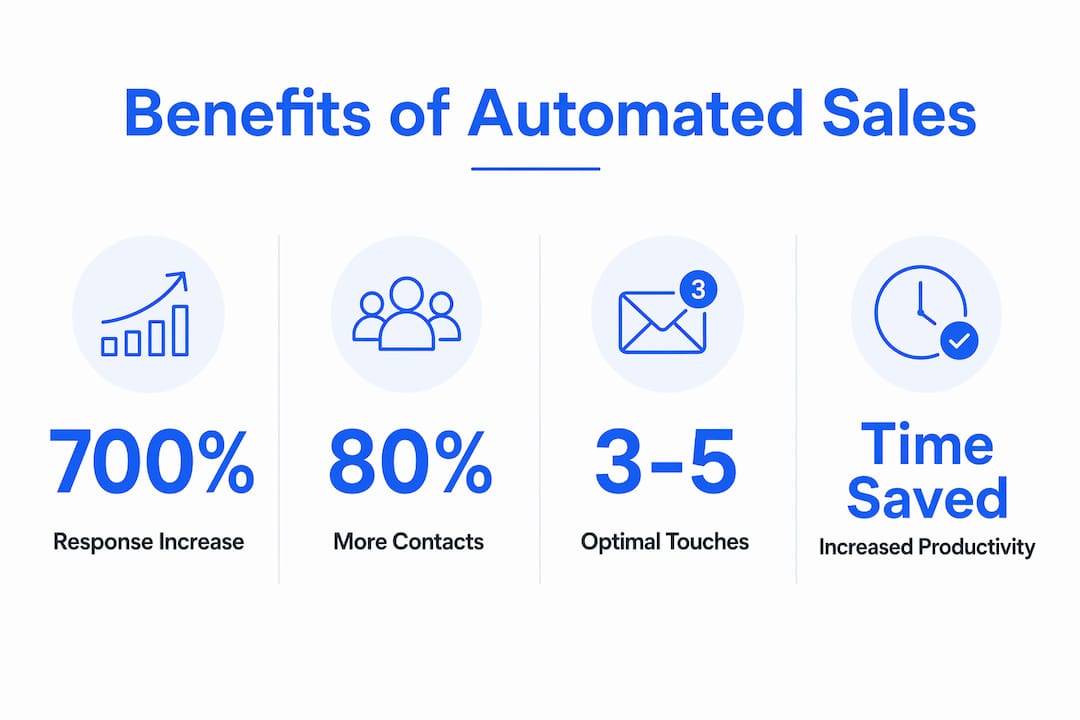
The conversion impact is direct. Automated systems produce a 20–30% increase in average conversion rates by ensuring no lead falls through the cracks. 44% of salespeople only attempt one follow-up, which means the majority of pipelines are leaking deals that automation would have closed.
The benefits extend beyond numbers:
- Consistency: Every lead receives the same quality of follow-up regardless of rep workload or mood.
- Speed: Automated responses fire in seconds, not hours.
- Relevance: Behavior-based triggers send messages tied to what the prospect actually did, not a generic check-in.
- Pipeline visibility: Automated systems log every touch, giving managers accurate data on sequence performance.
Customer experience improves when follow-ups arrive at the right time with the right message. A prospect who downloads a pricing guide and receives a relevant case study within minutes feels attended to, not chased. That distinction separates high-performing sales teams from average ones.
Automation excels at handling routine tasks, freeing reps to focus on the empathetic, high-stakes conversations that close deals. The technology does not replace the human. It removes the friction that prevents humans from doing their best work.
Sales follow-up best practices for designing effective sequences
The most common mistake in building follow-up sequences is starting with the email copy. The right starting point is the workflow diagram. Mapping every possible path a prospect can take, including non-linear behaviors, prevents logic errors that send the wrong message at the wrong time.
A proven cadence structure follows this pattern:
- Touch 1 (Day 0): Immediate response within 5 minutes of the trigger event. This is the highest-leverage message in any sequence.
- Touch 2 (Day 3): A value-add message. Share a relevant case study, a short video, or a specific insight tied to the prospect’s industry.
- Touch 3 (Day 7): A direct ask. Request a call, a demo, or a specific next step. Keep it short.
- Touch 4 (Day 12): A “last attempt” message that creates mild urgency without being aggressive.
- Touch 5 (Day 18): A breakup message. This often generates replies from leads who had gone silent.
A 3-to-5 touch cadence yields the highest reply rates, and effective follow-ups focus on moving leads forward with clear next steps, not generic check-ins. Every message should answer the question: “What do I want this person to do next?”
Personalization is not optional. Generic messages produce generic results. Use merge fields for name and company at minimum. Where possible, reference the specific action that triggered the sequence, such as the webinar they attended or the page they visited.
The table below compares two common sequence approaches by key design criteria:
| Design criteria | Generic broadcast sequence | Behavior-triggered sequence |
|---|---|---|
| Trigger type | Time-based only | Action or inaction based |
| Message relevance | Low (same for all leads) | High (tied to prospect behavior) |
| Exit condition | Manual or end of sequence | Fires on any positive engagement |
| Reply rate | Below average | Above average |
| Compliance risk | Moderate | Lower with proper opt-in logic |
Legal compliance is non-negotiable for SMS channels. SMS automation in the US requires explicit TCPA-compliant opt-in. Ignoring opt-out requests leads to carrier blacklisting and delivery failure. Every SMS sequence must include a clear STOP pathway, and your system must honor it immediately.
Pro Tip: Test every variable in your sequence with at least 100 sends before drawing conclusions. Subject lines, send times, and message length all affect reply rates, but small sample sizes produce misleading data.
Reviewing sequences on a quarterly basis prevents stale content from damaging your brand. A message referencing a promotion that ended six months ago signals to prospects that no one is paying attention. Regularly updating automated sequences is one of the highest-return maintenance tasks in any sales operation.
When choosing enterprise automation tools, prioritize platforms that support multi-channel delivery, granular exit conditions, and A/B testing at the sequence level. Entry-level tools often lack the branching logic needed for behavior-based triggers.
Common pitfalls that break automated sales follow-up
The “set-and-forget” mindset is the single biggest threat to automation performance. Sequences built in january and never reviewed become liabilities by april. Markets shift, offers change, and messaging that felt relevant six months ago can now feel tone-deaf.
The most damaging failures in follow-up automation share a common root: poor logic design. Specifically:
- Missing exit conditions: Sending follow-up messages to a lead who already booked a meeting destroys trust instantly. Failing to implement exit conditions causes robotic, intrusive messaging that harms the brand.
- Inconsistent tone: If your first email is warm and conversational but your third sounds like a legal notice, the prospect notices. Maintain a consistent voice across every touch.
- Ignoring opt-outs: For SMS, failing to honor STOP requests is not just a reputation problem. It is a legal violation under TCPA that can result in carrier blacklisting.
- Fractured handoffs: When a lead converts and moves from automation to a human rep, the rep must know the full history. A rep who asks “So, what brings you to us today?” to a lead who received five emails looks uninformed.
- Over-messaging: Sending daily emails signals desperation. Spacing matters as much as content.
Maintaining human connection inside an automated system requires deliberate design. Sequences should sound like they come from a person, not a system. Use first-person language, reference real context, and make every message feel like it was written for that specific lead.
Automation pauses immediately on engagement, transitioning the lead to a human conversation. That transition is where deals are won or lost. The automation’s job is to get the lead to that moment. The rep’s job is to close it.
Key Takeaways
Automated sales follow-up drives consistent, multi-touch engagement that manual processes cannot sustain, making it the most reliable method for converting leads at scale.
| Point | Details |
|---|---|
| Define triggers first | Build sequences around specific events like form fills, link clicks, or no-response periods. |
| Speed determines conversion | Leads contacted within one hour are 700% more likely to convert; automate instant responses. |
| Use a 3-to-5 touch cadence | Space messages 3 days apart and include a clear next step in every touch. |
| Exit conditions protect trust | Pause all automation the moment a lead replies, books, or converts. |
| Compliance is mandatory | SMS sequences must follow TCPA opt-in rules and honor STOP requests immediately. |
The balance automation cannot replace
After working with sales teams across industries, one pattern stands out clearly. The teams that get the most from automation are not the ones with the most sophisticated sequences. They are the ones who treat automation as infrastructure, not strategy.
Automation handles the volume. It fires the right message at the right time, logs every interaction, and keeps the pipeline moving. But the strategy, the offer, the positioning, and the empathy still come from people. When those elements are weak, no amount of automation compensates.
The most common mistake I see is teams deploying automation to avoid the hard work of understanding their buyers. They build five-touch sequences with generic copy and wonder why reply rates are low. The automation is working perfectly. The message is the problem.
AI is changing what automation can do. Natural language generation, intent detection, and real-time behavioral scoring are making sequences smarter and more adaptive. But the fundamental principle does not change: automation amplifies what you put into it. A well-researched, empathetic message sent automatically at the right moment outperforms a generic message sent by a human every time.
The future of sales follow-up is not fully automated or fully human. It is a system where automation handles the first four touches, surfaces the highest-intent leads, and hands them to a rep at exactly the right moment. Teams that build that system now will have a structural advantage that compounds over time.
— Mediabloom
How Mediabloom powers your follow-up pipeline
Mediabloom’s AI platform is built for sales teams that need to move fast and follow up consistently. The chatbot and automation suite engages inbound leads across SMS, email, and chat within seconds of first contact, qualifying prospects and booking appointments without rep involvement. Clients like Miracle Ear and 1-800 Accountant have used Mediabloom to generate over 10,000 monthly leads through automated, omnichannel engagement.
The AI Lead Generation platform integrates voice agents, chatbots, and outbound sequences into a single system, so your follow-up logic runs across every channel without gaps. Review the case studies to see how businesses have deployed automated follow-up to increase conversion rates and reduce manual workload. Contact Mediabloom to build a follow-up system designed around your pipeline.
FAQ
What is an automated sales follow-up?
An automated sales follow-up is a software-driven message sent to a prospect based on a trigger or schedule, without manual rep involvement. It replaces manual tracking and ensures consistent, timely outreach across the entire sales pipeline.
How many follow-up touches does it take to close a sale?
80% of sales require 5 or more contacts to close, but most reps stop after one. Automation ensures all five touches happen consistently, which is why structured follow-up processes increase first-year sales revenue by 29%.
What triggers can start an automated follow-up sequence?
Common triggers include form submissions, email opens, link clicks, missed calls, and elapsed time since last contact. Behavior-based triggers produce higher reply rates because the message is tied to something the prospect actually did.
Is SMS automation legal for sales follow-up in the US?
Yes, but only with explicit TCPA-compliant opt-in from the prospect. Every SMS sequence must include a clear STOP pathway, and the system must honor opt-out requests immediately to avoid carrier blacklisting.
When should automation pause and hand off to a human rep?
Automation should pause the moment a lead replies, books a meeting, or takes any positive action. The rep then takes over with full visibility into the lead’s history, so the conversation picks up without repetition or friction.


