A B2B sales cadence is a multi-channel, time-bound sequence of outreach touches built to move a prospect from cold to booked meeting. The recommended baseline is 8 to 15 touches across at least three channels, timed to deal size, with early touches front-loaded and later ones spaced wider. Reply rate and meeting-booked rate are key metrics that help evaluate cadence performance.
TL;DR:
- Effective B2B sales cadences layer at least three channels and vary touch timing, with early touches concentrated within the first three days.
- Larger deals require more touches over a longer period, with enterprise cadences often spanning over 30 days and involving multiple stakeholders.
- Proper operational setup, including data hygiene, automation, and a pre-written breakup email, is critical to maintaining cadence performance.
- Personalization should scale with deal size, focusing on quick, high-impact details for SMBs and in-depth research for enterprise accounts.
- Regularly reviewing step-level metrics and treating cadences as hypotheses helps optimize and sustain outreach effectiveness.
Table of Contents
- What Are the Core Components of a B2B Sales Cadence?
- What Do Copy-Ready B2B Cadence Templates Look Like?
- How Do You Design and Roll Out a New Cadence?
- How Deep Should You Personalize Each Touch?
- How Do You Measure and Improve Cadence Performance?
- What Operational Mistakes Break Cadences, and How Do You Fix Them?
- How Are Teams Using AI to Scale Cadences Without Losing Personalization?
- Publisher Perspective: Treat Every Cadence as a Hypothesis
- How Mediabloom Helps You Scale Cadences Without Scaling Headcount
- Where to Go for Cadence Benchmarks and Templates
- Sources
- FAQ
What Are the Core Components of a B2B Sales Cadence?
Every cadence is built from four moving parts: channel mix, touch count, timing rhythm, and an exit condition. Get any one wrong and the other three won’t save it.
Email carries the bulk of your message and documentation. Phone calls create the highest-value moment of contact when they connect. LinkedIn builds familiarity and social proof between other touches. Video adds a personal signal that’s hard to fake, and direct mail works as a pattern-breaker for high-value accounts that have gone quiet on digital channels. None of these carry a cadence alone. Salesforce’s cadence framework found that high-performing sequences layer at least three channels and orchestrate them together rather than firing each one independently.
Timing rhythm matters as much as channel selection. Front-load your first three or four touches into days one through three, then widen the gaps as the sequence progresses into days four through ten and beyond. That early density builds pattern recognition. A prospect who sees your name three times in three days registers you as persistent; a prospect who sees your name once a week for a month barely registers you at all.
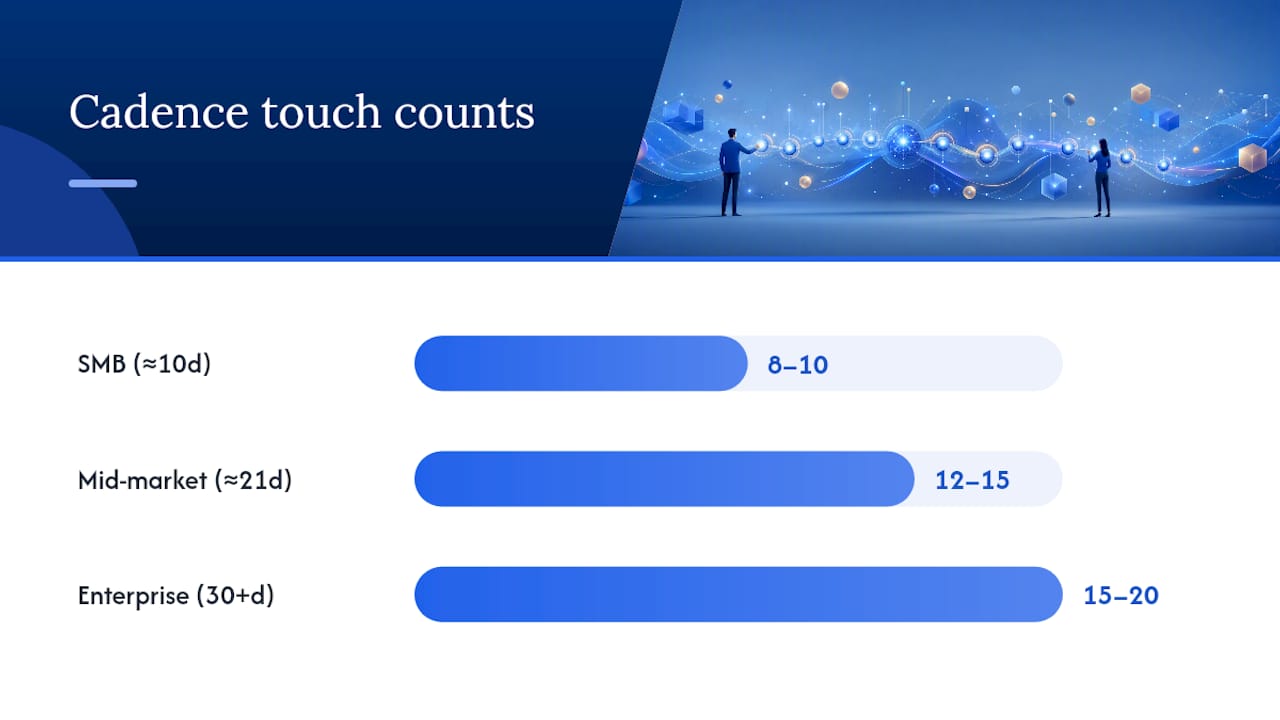
Touch count scales with deal size, and this is where a lot of teams get lazy and use one sequence for every deal:
- SMB deals: 8 to 10 touches over roughly 10 business days
- Mid-market deals: 12 to 15 touches over roughly 21 business days
- Enterprise deals: 15 to 20 touches spread across 30 or more days
That guidance comes from cadence benchmarks aggregated by Quota, and it reflects a simple truth: bigger deals have more stakeholders, longer evaluation windows, and more reasons to go quiet between touches.
Every cadence also needs an end condition with a breakup step to exit or suppress unresponsive prospects, preventing wasted effort. Cadences without an exit plan don’t fail loudly. They just quietly consume rep hours for months.
What Do Copy-Ready B2B Cadence Templates Look Like?
Templates only work when they’re matched to the right scenario. Here are five that cover most B2B outreach situations, each mapped to when you’d actually use it.
-
Cold outbound SMB (10 days, 9 touches). Day 1: personalized email plus LinkedIn connection request. Day 2: phone call. Day 4: value-add email with a case study link. Day 6: LinkedIn comment or message. Day 8: second call attempt. Day 10: breakup email. Use this when targeting high-volume, lower-complexity accounts where one decision-maker typically owns the buying call.
-
Standard multi-channel mid-market (21 days, 13 touches). This is the workhorse sequence: email and same-day call on day 1, LinkedIn touch on day 2, a mid-sequence value email around day 8 (case study or short video), a second call block around day 12, a direct mail piece around day 15 for accounts showing engagement, and a breakup email on day 21. A practical version of this exact structure, including per-touch purpose, is laid out in Quota.training’s 12-touch framework, which pairs early personalized email and same-day calling with mid-sequence value adds and a final breakup message.
-
Enterprise ABM (35 to 45 days, 18 touches). Multiple stakeholders get parallel tracks: the economic buyer gets executive-level LinkedIn and email touches, while champions and influencers get more frequent, lighter check-ins. Direct mail and video messages appear around day 20 to break through noise. Use this only when the deal size justifies the research time; running this template on a low-value account wastes hours you won’t get back.
-
Inbound fast-follow (5 days, 6 touches). Someone filled out a form or downloaded a resource. Speed matters more than volume here: call within minutes if possible, follow with email same day, then two lighter touches over the next four days. Leadfeeder’s research found that trigger-based cadences convert meaningfully better when launched within 48 hours of the signal, and inbound leads are the clearest trigger you’ll get.
-
Event or webinar follow-up (14 days, 10 touches). Reference the specific session or conversation in touch one, since generic follow-up after an event reads as lazy. Space touches slightly wider than cold outbound since you’re working warmer intent.
-
Re-engagement for stalled deals (21 days, 8 touches). Lighter cadence, wider spacing, and a different angle each touch (new use case, new stakeholder, pricing change, product update) rather than repeating the original pitch.
Adapting any of these to a specific industry or buyer role usually means swapping the value-add content, not restructuring the timing. A CFO gets ROI-focused case studies; an IT director gets security and integration proof points. The skeleton stays the same.
How Do You Design and Roll Out a New Cadence?
Building a cadence that survives contact with real prospects takes more than picking a template off a list. Follow this sequence when you’re standing one up from scratch.
- Define the scenario and segment first. Are you targeting cold SMB accounts, warm inbound leads, or an enterprise ABM list? The segment dictates touch count and channel mix before you write a single line of copy.
- Choose your channels and touch count based on the deal-size guidance above, then sketch the day-by-day skeleton before writing messaging.
- Map a messaging angle to each step. Touch one earns attention, touch three or four delivers proof, mid-sequence touches add value, and the final touch is the breakup. Write templates for each angle rather than freelancing copy every time.
- Operationalize it inside your sales engagement platform and CRM. Set automation triggers for each step, wire in opt-out handling, and confirm every touch logs back to the contact record automatically. If a rep has to manually update the CRM after every call, the cadence will decay within a month.
- Pilot with a small group before a full rollout. Run it with two or three reps for two weeks, watch step-level metrics, and fix the obvious breaks before you hand it to the whole team.
- Train reps on intent, not just steps. A rep who understands why touch six exists will adapt on the fly better than one just following a script.
- Assign ownership. Someone needs to own cadence iteration going forward, or it will sit untouched for a year while reply rates quietly drop.
Pro Tip: Build your breakup email template before you launch the cadence, not after week three when you’re staring at a list of unresponsive contacts. Writing it in the moment almost always produces something either too apologetic or too aggressive.
How Deep Should You Personalize Each Touch?
Personalization is a budget decision, not a philosophy. The goal is spending research minutes where they’ll actually move the needle and skipping them where they won’t.
A tiered model keeps this sane across a full pipeline:
- Tier 1 (SMB, high volume): Roughly 30 seconds per lead. Use segment-level tokens: company name, industry, and role pulled from data fields, not manual research.
- Tier 2 (mid-market): A few minutes per lead for account-level personalization. Pull one specific detail from the company’s recent activity, like a job posting, funding news, or a product launch.
- Tier 3 (enterprise ABM): More substantial time investment per lead for individual-level research. Read the executive’s LinkedIn posts, recent interviews, or company earnings commentary before writing the first touch.
Experts generally agree that personalization should scale with account tier: SMB outreach can lean on persona-level messaging, while enterprise ABM requires real account-specific research on every lead. Trying to apply Tier 3 effort to a Tier 1 volume list is how good reps burn out chasing deals too small to justify the time.
Not every touch needs deep personalization even within a single sequence. Touch one and any touch referencing a specific trigger event deserve real research time. Touches three, five, and seven, the value-add and check-in steps, can run on templated content with light token substitution. Save your personalization budget for the moments that actually determine whether someone replies.
How Do You Measure and Improve Cadence Performance?
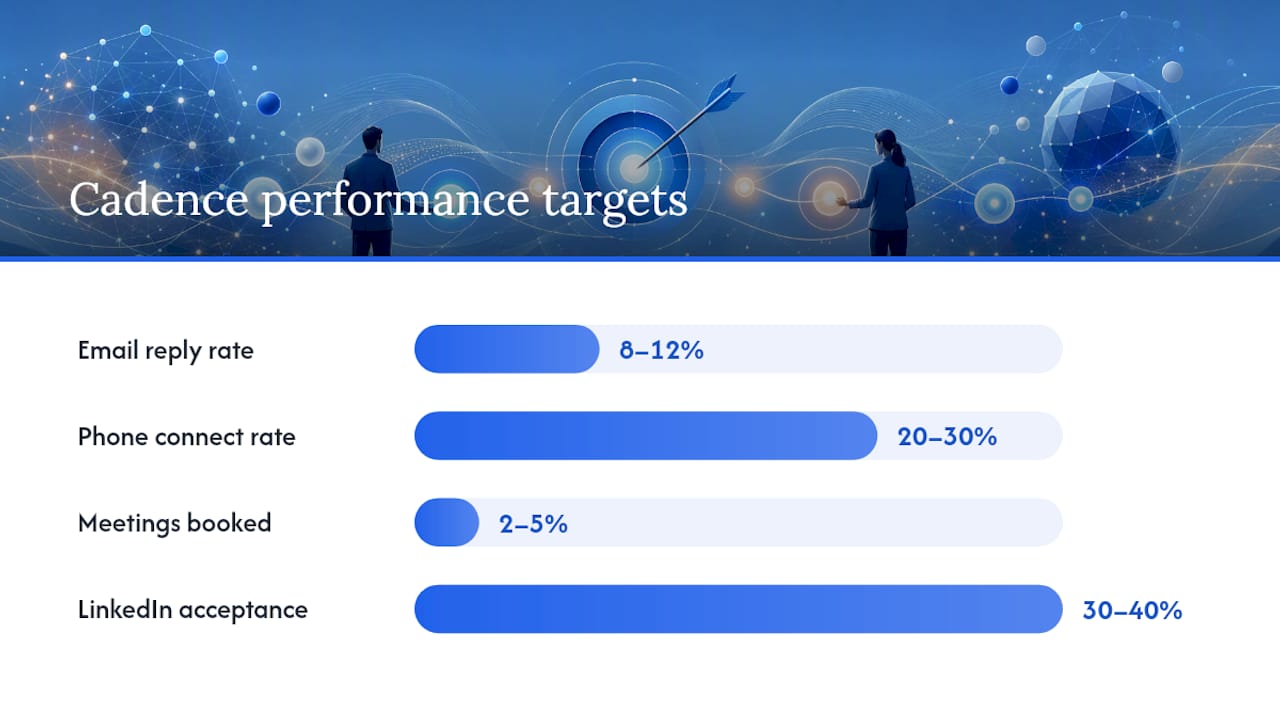
Three numbers tell you almost everything about whether a cadence is working:
- Reply rate: target 8 to 12% on email
- Connect rate: target 20 to 30% on phone touches
- Meeting-booked rate: target 2 to 5% of all prospects entering the cadence
Statistic Callout: Salesforce’s benchmarking data also flags LinkedIn acceptance rate as a fourth metric worth tracking, with a target range of 30 to 40 percent, since a stalled acceptance rate often signals your connection request messaging needs work before the rest of the sequence gets a fair test.
Step-level metrics matter more than sequence-level averages. If your overall reply rate is 6%, that number alone doesn’t tell you what to fix. Break it down by touch: if replies cluster on touches one and two but disappear by touch five, your problem is spacing or fatigue, not messaging. If connect rates on calls are strong but nobody’s booking, the problem is your ask, not your outreach volume.
Run A/B tests one variable at a time. Test subject line against subject line, not subject line and send time and CTA all at once, or you won’t know what actually moved the number. Review performance every two weeks. That rhythm is frequent enough to catch decay before it compounds, and infrequent enough that you’re not chasing statistical noise from a handful of sends.
What Operational Mistakes Break Cadences, and How Do You Fix Them?
Most underperforming cadences fail on operations, not strategy. Run this checklist before launch:
- Data hygiene: verify email deliverability and suppress bounced or unsubscribed contacts before the sequence starts.
- Sender setup: rotate sending domains and mailboxes across reps to protect deliverability at scale.
- Logging: confirm every touch writes back to the CRM automatically, not manually.
- Over-templating: a sequence with zero personalization tokens reads as spam; add at least one variable field per email.
- Wrong spacing: touches crammed too close together read as desperate; touches too far apart lose momentum. Follow the front-loaded rhythm from the components section.
- Missing breakup logic: every sequence needs a defined final step, or reps keep manually pinging dead leads for months.
Fix these before your first pilot, not after you’re three months into declining reply rates.
How Are Teams Using AI to Scale Cadences Without Losing Personalization?
Scaling a cadence across dozens of reps used to mean choosing between volume and personalization. AI-driven orchestration is closing that gap. Voice agents can handle first-touch outbound calls and qualification questions at volume, chatbots can capture and qualify inbound leads the moment they land on a site, and automation layers can route qualified conversations straight into a rep’s calendar without a human touching the CRM in between.
Case studies from vendors running AI-enabled omnichannel orchestration show measurably higher qualified-meeting volume when voice agents, chat, and CRM data work from the same pipeline rather than three disconnected tools.
Mediabloom’s clients, including Miracle Ear and 1-800 Accountant, have used this kind of orchestration to generate over 10,000 monthly leads, with automated qualification handling the first filter before a human rep ever joins the conversation. The practical lesson: keep pacing conservative on automated touches early in a sequence, and make sure the automation platform writes back to your CRM in real time so reps aren’t working from stale data.
Publisher Perspective: Treat Every Cadence as a Hypothesis
Most teams write a cadence once and run it for a year without touching it. That’s the single biggest reason performance decays. Treat every sequence as a hypothesis: review step-level reply and meeting rates every two weeks, and be willing to kill a touch that isn’t earning its place in the sequence.
Sender infrastructure decays too. Rotate domains and mailboxes, and refresh copy on a schedule rather than waiting for reply rates to visibly drop. If your team needs help operationalizing this inside a real tech stack, that’s worth a direct conversation rather than another template download.
— MediaBloom
How Mediabloom Helps You Scale Cadences Without Scaling Headcount
Running a 15-touch, multi-channel cadence well takes real operational lift: qualifying replies, booking meetings, keeping sender infrastructure healthy, and logging every interaction back to the CRM. Mediabloom builds that infrastructure into one platform instead of five disconnected tools.

Mediabloom combines AI voice agents, chatbots, and omnichannel automation across SMS, email, and chat, with lead qualification and appointment booking handled automatically and CRM integrations across more than 600 platforms. Clients like Miracle Ear and 1-800 Accountant have used the platform to generate over 10,000 monthly leads while keeping response times fast enough to catch prospects before they go cold. If you’re trying to run enterprise-grade cadence volume without hiring an enterprise-sized SDR team, the Fifth Avenue Leads case study shows what that looks like in practice. Start with a look at how Mediabloom’s cold outbound solution fits into your existing cadence structure.
Where to Go for Cadence Benchmarks and Templates
For deeper reading beyond this playbook: Salesforce’s cadence guide covers channel orchestration and KPI benchmarks. Quota.training offers a detailed 12-touch template with email copy guidance. Leadfeeder breaks down trigger-based sequencing. Leadhaste’s guide covers sender rotation and iteration cadence. For analytics tooling, ExpressSheet’s guide to automating sales data analysis is a useful next step, and Sdr shows what a fully automated SDR function looks like in practice.
Sources
- The Ultimate Guide to Sales Cadences — Salesforce
- Quota
- Sales Cadence in 2026: A Complete Guide — Leadfeeder
FAQ
What Are the Best Tactics for B2B Sales?
Layering channels (email, phone, LinkedIn, and video) instead of running them separately, launching trigger-based outreach within 48 hours of a buying signal, and scaling personalization effort to deal size all outperform single-channel, one-size-fits-all outreach.
What Is the Rule of 7 in B2B Marketing?
B2B cadences are built on multiple touches across multiple channels rather than a single email or call to effectively move prospects to action.
What Is the 10-3-1 Rule in Sales?
The 10-3-1 rule is a prospecting benchmark suggesting it takes roughly 10 touches to generate 3 meaningful conversations that produce 1 qualified opportunity, a ratio that reinforces why cadences need enough touches and channels to survive normal attrition at each stage.
How Fast Should You Follow Up on Inbound Leads?
Start within minutes when possible, and never later than the same business day; inbound leads followed up within 48 hours of the trigger convert at meaningfully higher rates than those left to sit.