


AI lead qualification is defined as the use of machine learning models to automatically score, prioritize, and route inbound leads based on behavioral, firmographic, and intent data. To qualify leads faster with AI, your system must replace manual review with real-time scoring that fires the moment a lead enters your pipeline. The stakes are concrete: 78% of buyers purchase from the first vendor to respond, and AI-powered systems can cut response times to under 30 seconds. That speed advantage is not incremental. It is the difference between winning and losing the deal. This guide walks you through the data inputs, model setup, common failure points, and performance benchmarks you need to deploy AI lead qualification that actually converts.
What data does AI need to qualify leads accurately?
AI lead qualification does not work on empty pipelines. The model is only as accurate as the data you feed it, so getting your inputs right is the first real decision you make.
The three data categories that matter most are historical CRM data, behavioral signals, and firmographic enrichment. Historical CRM data means closed-won and closed-lost records with deal size, sales cycle length, and rep notes attached. Behavioral signals include page visits, email opens, demo requests, and product usage events. Firmographic enrichment adds company size, industry, revenue range, and technology stack to each lead record.
Your Ideal Customer Profile (ICP) must be translated into machine-readable attributes before any model runs. That means defining ICP criteria as specific field values: “company headcount between 50 and 500,” “industry = SaaS,” “technology stack includes Salesforce.” Vague ICP descriptions produce vague scores. Tools like Lead Scorer and platforms that connect to Salesforce, HubSpot, or Dynamics 365 support this kind of structured data ingestion natively.
Lead enrichment fills the gaps your forms leave behind. Providers like Clearbit, ZoomInfo, and Apollo.io append firmographic and technographic data automatically when a new lead record is created. AI scoring tools that enrich leads with multi-dimensional company data and align scoring to your product description produce the highest relevance scores.
-
CRM integration: Connect your CRM to the AI model so historical deal data flows in automatically.
-
Behavioral tracking: Install event tracking on your website and product to capture intent signals in real time.
-
Enrichment layer: Use a data enrichment provider to append firmographics to every new lead record.
-
ICP mapping: Translate your ICP into specific, field-level attributes the model can read.
-
Feedback loop: Tag every closed deal as won or lost so the model learns from outcomes.
Pro Tip: Start with 12 months of closed-won and closed-lost data before training any model. Fewer than 500 historical deals typically produce unreliable scores.
How do you build an AI lead scoring model step by step?
Building an AI lead scoring system follows a repeatable sequence. Skipping steps creates models that score confidently but predict poorly.

Step 1: Prepare your data. Clean your CRM records, remove duplicates, and standardize field formats. Null values in key fields like company size or job title will bias the model. Export a training dataset that includes both won and lost deals with all relevant attributes attached.
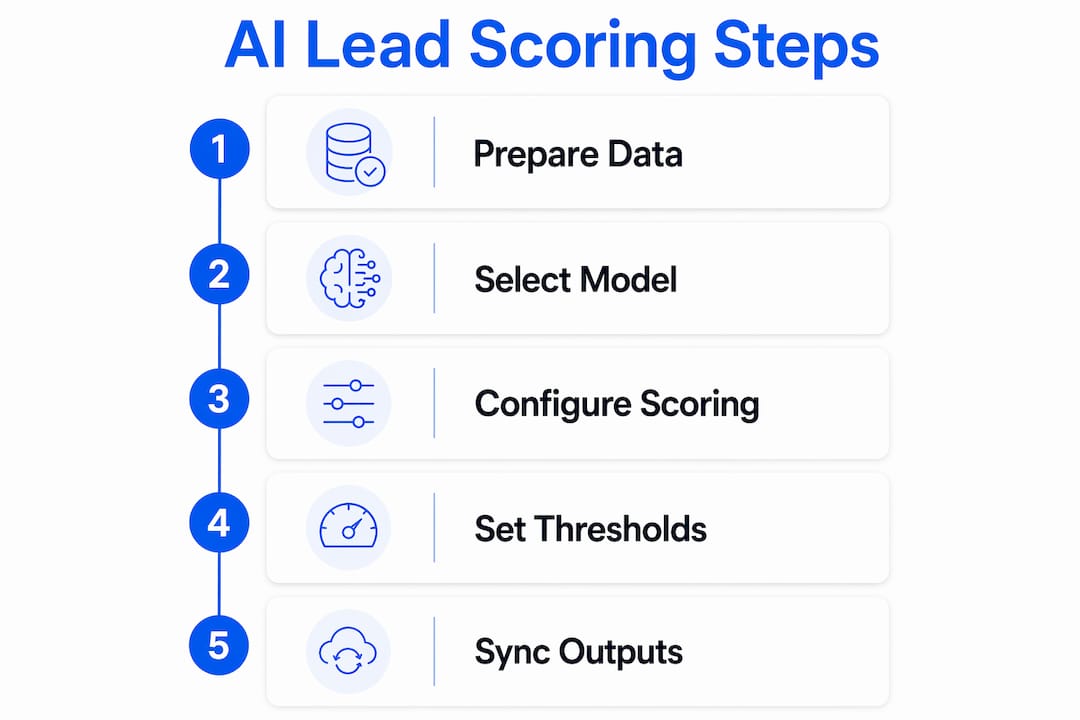
Step 2: Select your model type. Static rule-based scoring assigns fixed point values to attributes. Machine learning models, including gradient boosting frameworks like XGBoost and large language models (LLMs) used in tools like Lead Scorer, learn patterns from your historical data instead of relying on manual rules. Relational machine learning models that read connected multi-table CRM and product data outperform flat-table approaches because they capture relationships between contacts, accounts, and activities simultaneously.
Step 3: Configure real-time scoring. Once trained, the model must score leads as they arrive, not in nightly batch runs. Real-time AI scoring with confidence triggers automated lead assignment, nurture sequences, or deprioritization by thresholds. A lead scoring 85 out of 100 routes directly to a senior account executive. A lead scoring 40 enters a nurture sequence automatically.
Step 4: Set confidence thresholds. Every score should carry a confidence level. High confidence plus high score means immediate routing. Low confidence means the lead falls to a fallback rule rather than a bad assignment.
Step 5: Sync outputs to your CRM and sales workflow. Score values, confidence levels, and routing decisions must write back to your CRM in real time. Sales reps should see the score and a one-line rationale inside the lead record without opening a separate tool.
| Score Range | Confidence Level | Automated Action |
|---|---|---|
| 80–100 | High | Route to senior AE, immediate follow-up task |
| 60–79 | Medium | Route to SDR, add to high-priority sequence |
| 40–59 | Low | Enter automated nurture sequence |
| Below 40 | Any | Deprioritize, flag for review |
Pro Tip: Build your scoring model in a staging environment first and run it in parallel with your existing process for 30 days before going live. Compare predicted scores against actual outcomes before cutting over.
What pitfalls should you avoid in AI lead qualification?
The most expensive mistake in AI lead qualification is assuming the model stays accurate after deployment. Models drift as your market, product, and buyer behavior change. Feedback loops with closed-won and closed-lost data are the only reliable mechanism to prevent drift. Schedule model retraining quarterly at minimum, and trigger an unscheduled retrain any time your win rate shifts by more than 10 percentage points.
Sales rep adoption is the second failure point. Reps who do not trust scores will ignore them and revert to gut instinct. Transparent scoring rationale, such as a one-line explanation showing “scored high due to VP-level job title, recent funding round, and three product page visits,” builds the trust that drives adoption. Explainability is not a nice-to-have feature. It is a prerequisite for rep buy-in.
Sparse or incomplete lead data breaks scoring models silently. A lead with only an email address and a company name produces a score with very low confidence. Fallback static rules are needed when AI confidence is low or data is sparse, so no lead falls through the cracks. Configure your system to route low-confidence leads to a default SDR queue rather than leaving them unassigned.
“Sales leaders emphasize correctness over speed. AI should route complex leads to specialists, not generic queues.” — TractionComplete
The metrics that tell you whether your model is working are conversion lift, sales acceptance rate, and time to close. Conversion lift measures whether AI-scored leads convert at a higher rate than unscored leads. Sales acceptance rate tracks whether reps accept and work the leads the model routes to them. Time to close shows whether better-qualified leads move through the pipeline faster. Review all three monthly.
AI lead scoring vs. manual and rule-based methods
Manual lead qualification and AI-driven scoring are not variations of the same process. They produce fundamentally different outcomes at scale.
Manual qualification requires a rep to review each lead individually, check LinkedIn, cross-reference the CRM, and make a judgment call. This works for 20 leads per week. It fails at 200. Rule-based scoring assigns fixed points to attributes, such as 10 points for a company with over 100 employees and 5 points for a demo request. It is faster than manual review but cannot detect patterns across multiple data dimensions simultaneously.
AI-driven scoring reads dozens of signals at once and weights them dynamically based on what has actually predicted closed deals in your specific pipeline. Predictive AI models improve lead handoff efficiency by 25–40% and conversion probability by 50–70% compared to traditional scoring. That gap widens as your lead volume grows because the model gets more training data while manual processes get slower.
| Method | Speed | Accuracy | Scalability | Explainability |
|---|---|---|---|---|
| Manual review | Slow | Variable | Poor | High |
| Rule-based scoring | Fast | Moderate | Good | High |
| AI predictive scoring | Real-time | High | Excellent | Medium (requires config) |
AI lead prioritization reduces time wasted on low-fit leads by 30–50%. That time goes back to reps working accounts that are actually likely to close. Companies that deploy AI scoring report 2–3x SDR reply rates and triple pipeline lifts compared to manual methods. Those numbers reflect what happens when reps spend their time on the right leads instead of the entire list.
Advanced AI routing uses contextual signals like legal filings, hiring spikes, and technology changes to route high-value leads to the right specialist. That level of context is impossible to replicate manually at any meaningful volume.
Pro Tip: Run a 90-day A/B test: let AI score half your inbound leads and use your current process for the other half. Measure conversion rate, time to first contact, and deals closed. The data will make the case for full deployment better than any vendor pitch.
Key takeaways
AI lead qualification delivers measurable conversion gains only when built on clean data, real-time scoring, explainable outputs, and continuous model retraining.
| Point | Details |
|---|---|
| Speed determines win rate | AI reduces response times to under 30 seconds, critical since 78% of buyers pick the first vendor to respond. |
| Data quality drives model accuracy | Clean CRM history, behavioral signals, and enriched firmographics are required before any model trains reliably. |
| Explainability drives rep adoption | One-line score rationale inside the CRM record prevents reps from ignoring AI outputs. |
| Feedback loops prevent model drift | Retrain your model quarterly using closed-won and closed-lost data to maintain scoring accuracy over time. |
| AI outperforms manual at scale | Predictive models improve conversion probability by 50–70% and cut time wasted on low-fit leads by 30–50%. |
What we’ve learned deploying AI lead qualification at scale
The teams that get the most from AI lead qualification are not the ones with the most sophisticated models. They are the ones that aligned their AI setup to their actual sales cycle before writing a single line of configuration.
We have seen revenue teams deploy technically sound models that failed in practice because the scoring criteria reflected an outdated ICP. The model was trained on deals from two years ago, before the company shifted upmarket. Every score it produced was optimized for the wrong buyer. The fix was not a better algorithm. It was a two-hour session with sales leadership to redefine ICP attributes, followed by a model retrain on the most recent 18 months of data.
The other pattern we see consistently is teams that skip explainability because it feels like extra work. Reps who receive a score without context treat it as a black box. They route around it. The AI becomes shelfware. Adding a one-line rationale to every score, pulled directly from the top three contributing signals, is the single highest-return configuration change you can make after initial deployment.
Start simple. Score on five to seven attributes. Get reps using the output. Then add complexity: relational signals, buying committee detection, intent data feeds. Complexity added before adoption is just noise. Complexity added after adoption is acceleration.
The future of AI lead qualification is not faster scoring. It is more contextual scoring. Models that read hiring patterns, funding announcements, and product usage signals simultaneously will separate high-performing revenue teams from the rest within the next 18 months. The teams building that foundation now will have a compounding advantage that is very difficult to replicate later.
— Mediabloom
See AI lead qualification in action with Mediabloom
Mediabloom’s AI platform is built to help sales and marketing teams qualify and route inbound leads before a human rep has even opened their inbox.
The Speed to Lead AI solution engages every inbound lead in under 60 seconds using AI voice agents and chatbots that qualify, score, and book appointments automatically. Clients like Miracle Ear and 1-800 Accountant generate over 10,000 monthly leads through the platform. Mediabloom’s AI appointment setting results show consistent pipeline lifts across industries from SaaS to professional services. If you are ready to deploy AI lead qualification that connects directly to your CRM and sales workflow, explore Mediabloom’s platform and request a demo today.
FAQ
What is AI lead qualification?
AI lead qualification is the automated process of scoring, prioritizing, and routing leads using machine learning models trained on historical CRM and behavioral data. It replaces manual review with real-time decisions that fire the moment a lead enters your pipeline.
How does AI score sales leads automatically?
AI scores leads by analyzing dozens of signals simultaneously, including job title, company size, behavioral activity, and intent data, then assigning a weighted score based on patterns from your closed-won deals. Tools like Lead Scorer and platforms integrated with Salesforce or HubSpot run this process in real time.
How do you prioritize high-intent leads with AI?
Set score thresholds so leads above a defined confidence level route directly to senior reps or trigger immediate outreach sequences. Advanced routing uses contextual signals like hiring spikes and recent funding rounds to identify high-intent accounts before they fill out a form.
How long does it take to build an AI lead scoring model?
A basic AI lead scoring model can be configured and tested within four to six weeks if your CRM data is clean and your ICP is defined. More complex relational models that read multi-table data typically require eight to twelve weeks for initial deployment.
What metrics prove AI lead qualification is working?
Track conversion lift, sales acceptance rate, and time to close. Conversion lift measures whether AI-scored leads close at a higher rate. Sales acceptance rate confirms reps are working the leads the model routes. Time to close shows whether better-qualified leads move faster through the pipeline.


