
Integrated AI outbound platforms are the most direct path to higher outreach ROI, with 4.2x ROI within six months documented for teams that deploy them correctly. That figure is not a ceiling. It is the average. The industry term for this discipline is AI-driven sales development, and it covers everything from signal-triggered personalization to automated reply handling. Platforms like Outreach and HubSpot Breeze AI have moved this from experiment to standard practice. Teams that still rely on manual sequencing are leaving measurable pipeline on the table. This guide gives you the frameworks, metrics, and governance rules to capture it.
What AI platforms are best for boosting outreach ROI?
The platform decision is the highest-leverage choice you will make. Integrated AI outbound platforms deliver 4.2x ROI versus 2.1x from standalone point solutions. That gap exists because integrated platforms connect signal detection, sequencing, CRM sync, and analytics in one data loop. Point tools force your team to manually transfer context between systems, which kills speed and accuracy.
Integrated platforms vs. point AI tools
Outreach, Salesloft, and HubSpot Breeze AI represent the integrated category. They pull buying signals, score contacts, generate personalized copy, and log activity directly into your CRM without manual steps. Point tools, such as a standalone AI subject-line generator or a separate send-time optimizer, require your team to stitch outputs together. The stitching creates lag and data loss.

| Platform Type | Key Capability | Expected ROI Lift | Best For |
|---|---|---|---|
| Integrated AI Platform (e.g., Outreach) | Signal detection, sequencing, CRM sync | 4.2x within 6 months | Mid-market and enterprise teams |
| CRM-Native AI (e.g., HubSpot Breeze AI) | Workflow automation, lead scoring, email generation | 52% higher outreach ROI | SMB to mid-market |
| Standalone AI Tools | Single-function optimization | 2.1x average | Teams with existing stack gaps |
| Custom AI Development | Purpose-built agents for specific workflows | Variable, highest ceiling | Enterprise with complex GTM motions |
For enterprise clients with non-standard sales motions, custom AI development produces the highest ceiling. Off-the-shelf platforms optimize for common use cases. A purpose-built agent can encode your specific ICP signals, territory rules, and qualification logic directly into the workflow.
- Signal-triggered outreach: AI monitors intent data sources like G2, Bombora, and LinkedIn activity to fire sequences when a prospect shows buying behavior.
- Agentic personalization: The platform generates opening lines based on recent company news, job postings, or funding events rather than static templates.
- CRM-native logging: Every touchpoint writes back to Salesforce or HubSpot automatically, keeping attribution clean.
Pro Tip: Before selecting a platform, audit your current CRM data quality. An AI platform running on dirty contact data will produce confident-sounding outreach to the wrong people. Fix the data layer first.
How does AI improve open rates and response rates?
Predictive send-time optimization is the fastest win available to most outreach teams. Using individual behavior models, send-time optimization delivers an 11.4–23% lift in open rates. That lift compounds when you layer in AI-generated subject-line testing, pushing total performance gains to 35–45%. These are not marginal improvements. A 35% lift in open rates on a 10,000-contact campaign means thousands of additional conversations initiated without adding headcount.
Why generic AI copy underperforms
The most common mistake teams make is treating AI as a content factory. Generic AI copy underperforms human-written controls by 10–18%. That penalty exists because AI trained on broad datasets produces statistically average sentences. Average sentences do not stand out in a crowded inbox. The fix is specificity: AI should generate personalized opening lines based on real signals, not produce entire emails from a generic prompt.
Here is what actually moves reply rates:
- Behavior-driven personalization: Reference a prospect’s recent LinkedIn post, a funding announcement, or a new product launch in the opening line. AI can pull and format this at scale.
- Subject-line multivariate testing: Platforms like HubSpot Breeze AI run A/B and multivariate tests on subject lines automatically, surfacing winners without manual analysis.
- Send-time optimization per contact: Rather than blasting at 9 a.m. Tuesday for everyone, AI schedules each email for the window when that specific contact historically opens messages.
- Reply-intent classification: AI reads incoming replies and routes positive, negative, and neutral responses to the right workflow automatically, cutting response lag.
Pro Tip: Write three strong subject-line templates yourself, then let AI generate 10 variations of each. Test the AI variations against your human originals. You will learn which signals your audience responds to faster than any manual process allows.
What is the step-by-step AI outreach execution framework?
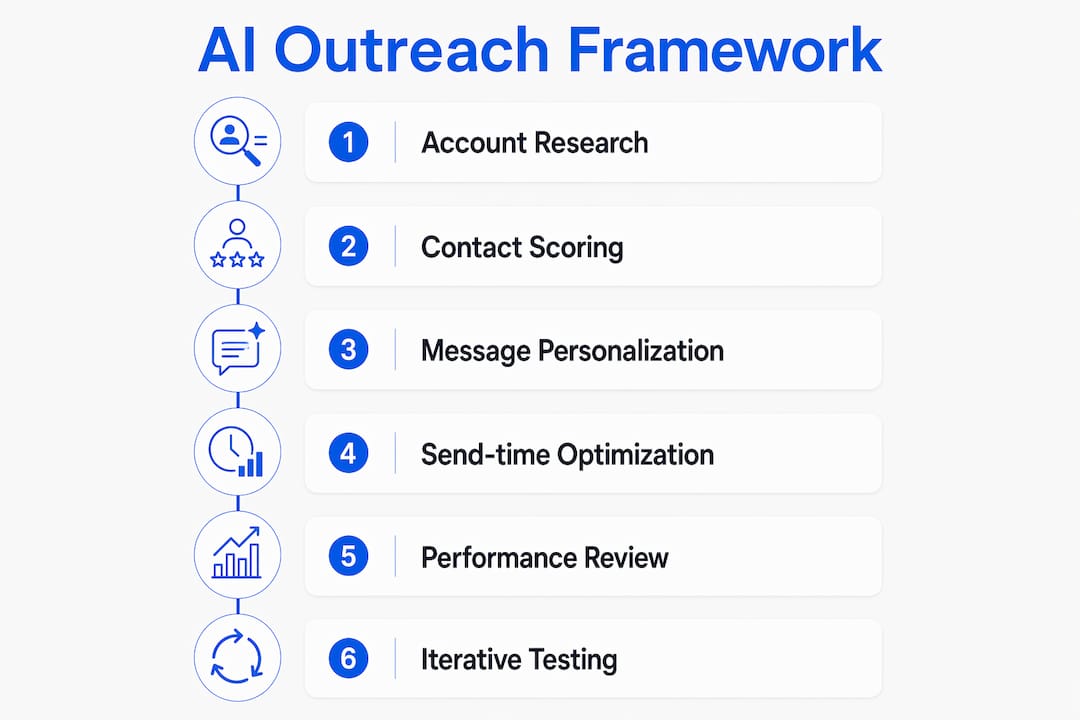
AI-driven sales development follows a defined loop. AI SDR outreach produces a 2.4x lift in qualified meeting rates compared to manual list-based prospecting. That lift comes from executing each stage of the loop correctly, not from automating volume alone.
Here is the full AI SDR outreach loop:
- Account research: AI scans intent data, technographic signals, and firmographic filters to identify accounts showing active buying behavior. Tools like Bombora and G2 feed this layer.
- Contact selection and scoring: AI ranks contacts within target accounts by role fit, engagement history, and signal strength. This replaces manual list building.
- Sequence design: AI drafts multi-step sequences across email, LinkedIn, and phone. Each step is timed based on engagement data from prior campaigns.
- Execution: The platform sends emails at individually optimized times, triggers LinkedIn connection requests, and queues call tasks for SDRs.
- Reply handling: AI classifies incoming replies by intent. Positive replies route to calendar booking. Objections trigger a specific follow-up sequence. Unsubscribes are suppressed immediately.
- Qualification: AI scores reply quality against ICP criteria and flags high-priority leads for immediate SDR review.
- CRM handoff: Qualified leads transfer to your CRM, such as HubSpot or Salesforce, with full engagement history attached. No manual data entry required.
Integrating AI with your CRM
HubSpot Breeze AI reduced manual outreach time by 48% and increased qualified lead engagement by 37% in a documented six-month deployment. The key was CRM-native integration. Every AI action wrote directly to contact records, keeping pipeline data accurate without SDR intervention. Teams using disconnected tools do not see these numbers because data transfer errors accumulate across the loop.
| Workflow Stage | AI Function | Human Role |
|---|---|---|
| Account Research | Signal scanning and scoring | ICP validation |
| Sequence Design | Draft generation | Tone and strategy review |
| Execution | Automated sending and scheduling | Exception handling |
| Reply Handling | Intent classification and routing | High-value reply response |
| CRM Handoff | Data logging and lead scoring | Final qualification call |
Pro Tip: Set a weekly 30-minute review cadence for your AI outreach sequences. Check reply rates, meeting conversion, and bounce rates. AI optimizes within the parameters you set. You need to update those parameters as market conditions shift.
How do you avoid AI outreach failures and governance gaps?
The two most common failure points in AI outreach programs are underinvestment in deliverability infrastructure and the absence of governance layers. Deliverability and governance are the constraints most teams overlook when scaling AI outreach. Volume without infrastructure destroys sender reputation, which collapses open rates regardless of how good your AI personalization is.
“Overproduction of generic emails, what practitioners call AI bloat, is the single fastest way to tank deliverability and pipeline quality simultaneously.” — AI Outbound Sales 2026, Knowlee
The 80/20 rule for AI email content
The 80/20 personalization rule is the most practical governance framework available. Template 80% of your email content: the value proposition, the CTA, and the closing. Use AI to generate the personalized 20%, specifically the opening line, based on a real signal about that prospect. This approach maintains brand voice and deliverability while still producing individualized outreach at scale.
Key governance and deliverability practices:
- Domain warming: Use warmed secondary domains rather than your primary domain for cold outreach. Protecting your primary domain preserves email reputation for transactional and marketing sends.
- Volume caps: Limit sending to 30–50 emails per inbox per day. Multi-inbox setups with multiple warmed domains allow you to scale volume without triggering spam filters.
- AI transparency in governance: Document which AI tools are generating content, what signals they use, and how outputs are reviewed. This matters for compliance and for diagnosing performance drops.
- Content review cadence: Review a sample of AI-generated emails weekly. AI models drift. An opening-line generator trained on Q1 signals may produce irrelevant copy by Q3 without recalibration.
The AI transparency in your governance stack is also a competitive differentiator. Teams that document their AI workflows can diagnose failures faster and build trust with prospects who increasingly recognize AI-generated outreach.
How do you measure and attribute ROI from AI outreach?
ROI measurement for AI-driven outreach requires tracking three primary metrics: reply rate, meeting conversion rate, and pipeline velocity. Target benchmarks are a reply rate of 6.8% or higher, a meeting conversion rate of 3.7% of contacted prospects, and pipeline velocity improvement of 34% or faster compared to your pre-AI baseline. These numbers give you a clear performance floor. If you are below them after 90 days, the issue is almost always ICP accuracy or deliverability, not the AI platform itself.
Attribution challenges and how to solve them
Attribution is the hardest part of measuring AI outreach ROI. A prospect may receive an AI-generated email, engage with a LinkedIn ad, and then book a meeting through a chatbot. Each touchpoint contributed. CRM-native platforms like HubSpot and Salesforce solve this by logging every AI-triggered interaction against the contact record. You can then run multi-touch attribution reports that show which sequence steps and channels drove pipeline.
Key metrics to track from day one:
- Reply rate by sequence step: Identifies which touchpoints generate engagement and which create drop-off.
- Meeting conversion rate: Measures how many replies convert to booked calls. A low rate here signals qualification problems, not volume problems.
- Pipeline velocity: Tracks how much faster deals move from first contact to closed-won compared to your manual baseline. Teams using integrated AI platforms report 34% faster pipeline velocity on average.
- Revenue attribution: Links closed revenue back to specific AI outreach sequences. This requires clean CRM data and consistent UTM or campaign tagging.
Pro Tip: Set your ROI measurement window at 3–6 months post-deployment. AI outreach compounds over time as the system learns which signals and sequences perform. Evaluating ROI at 30 days will always understate the actual return.
Key takeaways
AI-driven outreach ROI is determined by platform integration, personalization quality, deliverability governance, and disciplined metric tracking, not by volume alone.
| Point | Details |
|---|---|
| Integrated platforms outperform point tools | Integrated AI platforms deliver 4.2x ROI versus 2.1x from standalone solutions. |
| The 80/20 rule governs email quality | Template 80% of content and use AI only for the personalized 20% to protect deliverability. |
| Deliverability infrastructure is non-negotiable | Cap sends at 30–50 emails per inbox daily and use warmed secondary domains to protect sender reputation. |
| Measure three core metrics | Track reply rate (6.8%+ target), meeting conversion (3.7%), and pipeline velocity (34%+ improvement). |
| ROI visibility requires 3–6 months | AI outreach compounds over time; evaluate performance over a full quarter, not the first 30 days. |
Mediabloom’s take: what we have learned building AI outreach at scale
Most teams that come to us have the same problem. They invested in an AI outreach tool, ran it for 60 days, saw mediocre results, and concluded that AI does not work for their market. The real diagnosis is almost always the same: they skipped the foundation.
The ICP and persona modeling layer is not optional. It is the variable that determines whether your AI generates relevant, signal-driven outreach or confident-sounding noise. We have seen teams with strong AI platforms underperform teams with simpler tools simply because the simpler team had sharper ICP definitions and cleaner contact data. AI amplifies what you give it. Garbage in, garbage out applies here more than anywhere else in the sales stack.
The second thing we have learned is that governance is not a compliance checkbox. It is a performance lever. Teams that review AI-generated content weekly, monitor deliverability scores, and recalibrate signal sources quarterly outperform teams that set their AI sequences and walk away. The AI revolution in business is real, but it rewards operators, not spectators.
Our honest advice: start with your ICP. Define it tighter than feels comfortable. Then build your signal sourcing layer. Then select your platform. Teams that follow this sequence see results within 90 days. Teams that start with the platform and work backward spend six months troubleshooting problems that were never about the platform.
— Mediabloom
How Mediabloom helps you scale AI outreach results
Mediabloom builds the AI outreach infrastructure that marketing and sales teams need to generate pipeline at scale. The Fifth Avenue Leads case study shows what happens when AI lead generation is deployed with the right ICP modeling, signal sourcing, and governance layers in place: conversion rates climb and cost per qualified meeting drops.
Mediabloom’s platform integrates AI voice agents, chatbots, and cold outbound campaigns into a single omnichannel system. Clients like Miracle Ear and 1-800 Accountant generate over 10,000 monthly leads through this infrastructure. If you are ready to move from manual sequencing to a fully automated AI outreach engine, explore Mediabloom’s AI solutions and see what the right stack can do for your pipeline.
FAQ
What ROI can AI outreach platforms realistically deliver?
Integrated AI outbound platforms deliver an average of 4.2x ROI within six months, compared to 2.1x from standalone point tools. Teams also report 34% faster pipeline velocity and 28% larger average deal sizes.
How does AI improve open rates in email campaigns?
Predictive send-time optimization produces an 11.4–23% lift in open rates by scheduling emails based on each contact’s individual behavior patterns. Combined with AI-generated subject-line testing, total performance gains reach 35–45%.
What is the biggest mistake teams make with AI outreach?
The most common failure is scaling volume without fixing deliverability infrastructure and ICP accuracy first. Generic AI-generated copy underperforms human controls by 10–18%, and sending at high volume from unwarmed domains collapses sender reputation.
How long does it take to see ROI from AI outreach?
Attribution data and compounding performance improvements require a 3–6 month measurement window post-deployment. Evaluating results at 30 days consistently understates actual return because AI sequences improve as engagement data accumulates.
What metrics should i track to measure AI outreach ROI?
Track reply rate (target 6.8% or higher), meeting conversion rate (3.7% of contacted prospects), and pipeline velocity improvement (34% faster is the benchmark). Log all touchpoints in your CRM to enable accurate multi-touch revenue attribution.


