
A lead generation funnel is the structured marketing process that moves strangers through stages of awareness, consideration, and conversion until they become qualified leads ready for sales engagement. The term “lead funnel” is widely used in practice, but the recognized industry term is the marketing funnel or demand generation funnel, and understanding that distinction matters when you’re building strategy. Salesforce 2025 data shows that 83% of sales teams using AI agents report measurable improvements in lead generation and conversion outcomes. That number signals a structural shift: funnels built without automation are now operating at a competitive disadvantage. This guide breaks down every stage, clarifies how funnels differ from sales funnels and workflows, and gives you a practical framework for building one that actually converts.
What is a lead generation funnel and how does it work?
A lead generation funnel is defined as a repeatable system that attracts prospects, captures their contact information, qualifies their intent, and delivers them to a sales team at the right moment. The funnel metaphor holds because volume shrinks at every stage. You attract thousands, capture hundreds, qualify dozens, and close a fraction. That compression is not a failure. It is the system working correctly by filtering out poor-fit prospects before they consume sales resources.

The lead generation process differs from general marketing activity in one critical way: every stage has a measurable output. Awareness produces traffic. Consideration produces opt-ins. Conversion produces sales-ready leads. When you treat each stage as a metric rather than a concept, you gain the ability to diagnose exactly where your funnel is losing people and fix it with precision.
Lead generation funnels focus explicitly on attracting and qualifying leads at the top of the funnel, distinct from the broader sales funnel that manages closing and retention. That boundary matters for resource allocation. Your marketing team owns the lead funnel. Your sales team owns what happens after handoff.
What are the key stages of a lead generation funnel?
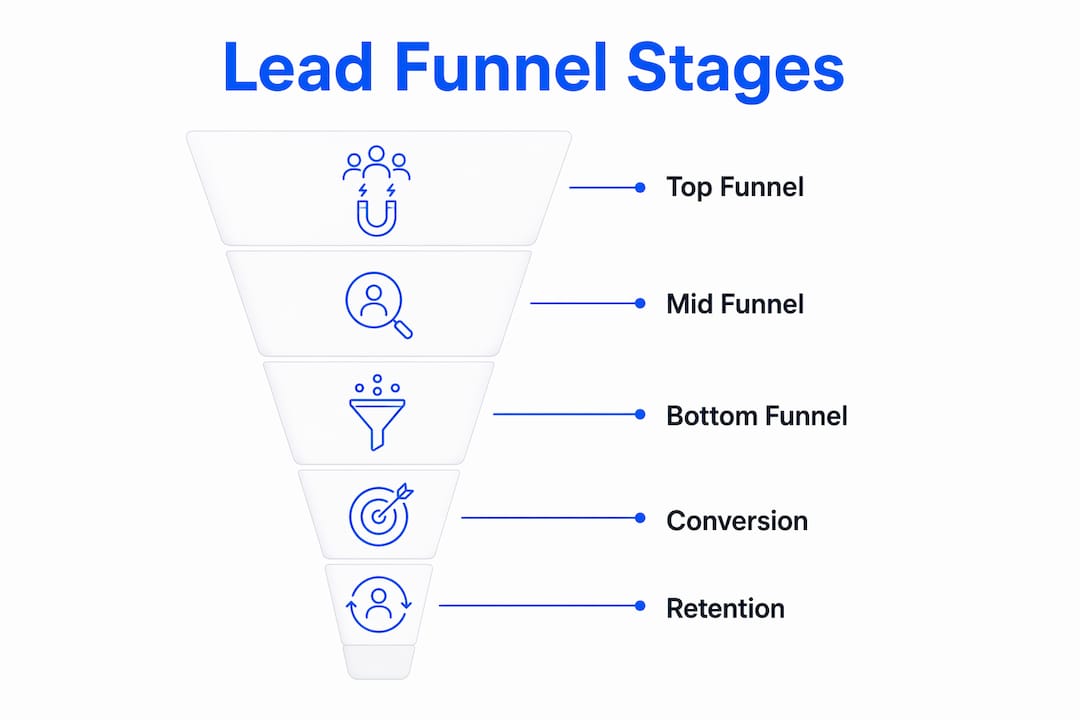
The three core stages of a lead generation funnel are top-of-funnel (TOFU), mid-funnel (MOFU), and bottom-of-funnel (BOFU). Each stage demands a different message, a different offer, and a different success metric.
Top-of-funnel: attract and educate
TOFU is where strangers become aware your business exists. The goal is reach, not conversion. Content at this stage includes blog posts, social media, paid search ads, YouTube videos, and podcast appearances. You are solving a problem the prospect already has, not pitching your product. Platforms like Google Ads and Meta Ads are the primary traffic drivers for most B2B and B2C funnels at this stage.
Mid-funnel: capture and qualify
MOFU is where interest converts into a lead. The prospect exchanges their contact information for something valuable: a guide, a webinar, a free tool, or a consultation. This is the lead capture moment. Qualification happens here too, through forms, surveys, or behavioral signals like which pages they visited and how long they stayed.
Bottom-of-funnel: convert and hand off
BOFU is where qualified leads receive direct conversion offers: product demos, free trials, case studies, or pricing pages. The messaging shifts from educational to evaluative. The prospect is comparing options, and your job is to give them a clear reason to choose you. Strong calls to action, social proof from clients like Miracle Ear and 1-800 Accountant, and fast response times all drive conversion at this stage.
| Funnel Stage | Primary Goal | Typical Activities | Key Metric |
|---|---|---|---|
| TOFU (Awareness) | Attract visitors | Blog content, paid ads, SEO, social media | Traffic, impressions |
| MOFU (Consideration) | Capture and qualify leads | Lead magnets, webinars, email opt-ins | Opt-in rate, lead volume |
| BOFU (Conversion) | Convert to sales-ready leads | Demos, trials, case studies, pricing pages | Conversion rate, cost per lead |
Pro Tip: Write separate email sequences for each funnel stage. A prospect who just downloaded a guide needs education. A prospect who visited your pricing page three times needs a direct offer. Sending the same message to both destroys conversion rates.
How does a lead funnel differ from a sales funnel and a workflow?
These three terms are often used interchangeably, and that confusion costs teams real money. Each concept describes a different scope of activity, and conflating them leads to misaligned ownership and broken handoffs.
Lead generation funnel vs. sales funnel
The lead generation funnel ends when a qualified lead is handed to sales. The sales funnel begins at that handoff and extends through discovery calls, proposals, negotiations, and closed deals. Marketing professionals view lead generation funnels as the critical top-of-funnel phase, focused on capturing and qualifying leads before sales funnel engagement begins. In practice, the two funnels share data but operate under different teams with different KPIs.
What is a lead generation workflow?
A lead generation workflow is the operational system that executes the funnel. Where the funnel is a strategic framework, the workflow is the sequence of automated and manual actions that move a prospect from one stage to the next. Workflows integrate audience research, outreach, qualification, nurturing, and sales handover as a coordinated operational backbone. Think of the funnel as the map and the workflow as the engine driving movement across it.
Key differences at a glance
- Lead generation funnel: Strategic framework with defined stages and conversion goals
- Sales funnel: Extends the process from qualified lead through closed deal and retention
- Lead generation workflow: The automated and manual sequence executing the funnel strategy
- Lead generation workflow types: Include inbound nurture sequences, outbound cold outreach cadences, re-engagement campaigns, and event-triggered follow-ups
- CRM integration: Tools like Salesforce and CRM platforms connect all three systems, ensuring data flows from first touch to closed revenue without manual entry gaps
Understanding these distinctions lets you assign the right team, tool, and metric to each layer of your revenue process.
How do AI and automation improve lead generation workflow performance?
Automation transforms a lead generation workflow from a manual, error-prone process into a system that operates at scale without proportional headcount increases. Successful lead generation automation functions like a digital assembly line, automatically responding to prospect behaviors with trigger-action-condition logic and no manual data entry required. A prospect downloads a whitepaper, and within seconds they receive a personalized follow-up email. They visit the pricing page, and a sales alert fires. That speed and precision cannot be replicated manually at volume.
Inbound vs. outbound: the conversion gap
The performance difference between inbound and outbound channels is significant and should directly shape your workflow investment priorities.
| Channel Type | Typical Conversion Rate | Best Use Case |
|---|---|---|
| Inbound lead qualification | 25–40% conversion | Warm prospects who engaged with content |
| Cold outbound prospecting | 3–8% reply rate | Net-new prospect outreach at scale |
Inbound lead qualification workflows convert at 25–40%, compared to cold outbound prospecting at only 3–8% reply rates. That gap does not mean outbound is worthless. It means outbound requires volume and persistence to generate equivalent pipeline. Notably, 69% of B2B buyers accepted cold calls from new providers in the previous 12 months, confirming that outbound remains a viable channel when executed with the right cadence.
The role of AI in funnel execution
AI agents deployed within lead generation workflows perform qualification conversations, schedule appointments, send follow-up sequences, and score leads based on behavioral signals. Mediabloom’s platform, used by companies like Miracle Ear and 1-800 Accountant, generates over 10,000 monthly leads by combining AI voice agents, chatbots, and multi-channel outreach across SMS, email, and chat. The speed to lead metric is critical here: engaging an inbound lead within 60 seconds dramatically increases conversion probability compared to a response hours later.
Persistence is the other variable most teams underestimate. Up to 50% of all successful sales happen after the fifth contact, yet many sales reps abandon outreach after one or two attempts. Automated follow-up sequences solve this problem by maintaining contact cadence without relying on human memory or discipline.
Pro Tip: Do not start by selecting your automation software. Start by mapping your workflow logic on paper: what triggers an action, what condition qualifies a lead, and what the next step is. The best tool running a poorly designed workflow will underperform a basic tool running a well-designed one.
What are best practices for building and optimizing a lead funnel?
Building a high-performing lead generation funnel does not require a perfect system on day one. Industry practitioners recommend launching within 2–4 weeks and iterating based on real engagement metrics rather than aiming for a perfect build upfront. The cost of delay is always higher than the cost of imperfection.
The core build sequence
Follow these steps in order before going live with any lead funnel:
- Define your ideal customer profile. Specify industry, company size, job title, and the specific problem your product solves. Vague targeting produces vague leads.
- Create a lead magnet. Offer something with clear, immediate value: a checklist, a calculator, a short video course, or a free audit. The offer must solve a specific problem your ideal customer has right now.
- Build a dedicated landing page. Remove navigation links and distractions. The only action available should be submitting the opt-in form.
- Set up your email nurture sequence. Write at least three to five emails that educate, build trust, and move the prospect toward a conversion offer. Space them over 7–14 days.
- Drive targeted traffic. Use Google Ads, LinkedIn Ads, or organic SEO content to send qualified visitors to your landing page. Start with one channel and add others once you have baseline data.
- Qualify leads automatically. Use form fields, lead scoring in your CRM, or a chatbot to separate high-intent prospects from casual browsers before they reach your sales team.
- Define the sales handoff criteria. Agree with your sales team on exactly what a sales-ready lead looks like before you launch. A lead handed off too early wastes sales time. A lead held too long goes cold.
Measuring and optimizing funnel performance
The three metrics that matter most in a lead funnel are conversion rate by stage, cost per lead, and lead-to-opportunity rate. Conversion rate by stage tells you where prospects are dropping off. Cost per lead tells you which traffic channels are efficient. Lead-to-opportunity rate tells you whether your qualification criteria are accurate.
Run A/B tests on landing page headlines, lead magnet offers, and email subject lines before making structural changes to the funnel. Small copy changes routinely produce 20–30% lifts in opt-in rates. Structural changes like adding a new funnel stage or switching traffic channels require more data and longer testing windows.
Balancing automation with human touchpoints is the final optimization lever. Automated sequences handle volume and consistency. Human calls and personalized video messages handle high-value prospects who need a relationship before they commit. Automated systems attract, capture, qualify, nurture, and notify sales teams of ready leads with minimal manual input, freeing your team to focus on closing rather than chasing.
For industry-specific funnel strategies, the build sequence remains the same but the lead magnet, traffic channel, and qualification criteria shift significantly. A SaaS company’s funnel looks very different from a healthcare provider’s, even though both follow the same structural logic.
What we’ve learned building funnels at scale
The most common mistake we see marketing teams make is treating the funnel as a one-time build rather than a living system. They spend weeks perfecting the landing page, launch it, and then move on. Six months later, conversion rates have drifted down and no one knows why because no one was watching the data.
The second mistake is underestimating follow-up. Most teams send one or two emails and call a lead dead. The data says otherwise. 50% of successful sales happen after the fifth contact, which means the majority of your pipeline is sitting in leads your team already gave up on. Automated sequences are not optional. They are the mechanism that captures the revenue your competitors are leaving behind.
We have also watched teams spend months evaluating automation platforms before building a single workflow. The true differentiator is workflow design, not software selection. A well-designed workflow running on a basic platform will outperform a poorly designed workflow running on the most sophisticated AI stack available.
The trend we are watching closely is the convergence of AI voice agents and lead qualification. Prospects now expect immediate, intelligent responses at any hour. Businesses that deploy AI agents to handle first-contact qualification are compressing their speed-to-lead times from hours to seconds. That compression directly increases conversion rates. The teams that treat AI as a core workflow component rather than an add-on are the ones building durable revenue engines in 2026.
Experiment with one new channel or workflow variation per quarter. Measure it against your baseline. Keep what works, discard what does not, and build on the results. That discipline, applied consistently, compounds into a funnel that outperforms the market.
— Mediabloom
How Mediabloom helps you execute your lead funnel
Knowing how to build a lead generation funnel is one thing. Having the infrastructure to run it at scale is another.
Mediabloom’s AI lead generation platform combines AI voice agents, chatbots, and multi-channel sales automation to execute every stage of your funnel without proportional headcount growth. Clients like Miracle Ear and 1-800 Accountant generate over 10,000 monthly leads using Mediabloom’s omnichannel system across SMS, email, and chat. The platform engages inbound leads in under 60 seconds, qualifies prospects automatically, and books appointments directly into your sales team’s calendar. If you want to see the system in action, watch an AI voice agent demo or explore real client results to see what a fully automated funnel looks like in practice.
Key takeaways
A high-performing lead generation funnel requires defined stages, automated workflows, persistent follow-up, and continuous measurement to convert prospects into sales-ready leads at scale.
| Point | Details |
|---|---|
| Funnel stages drive clarity | TOFU, MOFU, and BOFU each require distinct content, offers, and success metrics. |
| Workflow executes the strategy | A lead generation workflow is the automated sequence that moves prospects through the funnel. |
| Inbound outperforms outbound | Inbound qualification converts at 25–40%, versus 3–8% for cold outbound prospecting. |
| Persistence closes deals | Up to 50% of sales happen after the fifth contact; automated sequences capture this revenue. |
| Launch fast, optimize continuously | Deploy an imperfect funnel within 2–4 weeks and refine based on real engagement data. |
FAQ
What is a lead generation funnel in simple terms?
A lead generation funnel is a structured process that moves strangers through awareness, consideration, and conversion stages until they become qualified leads ready for sales engagement. Every stage has a measurable output that tells you where prospects are dropping off.
How does a lead funnel differ from a sales funnel?
A lead generation funnel ends when a qualified lead is handed to the sales team. The sales funnel begins at that handoff and covers discovery, proposals, negotiation, and closing. Marketing owns the lead funnel; sales owns what follows.
What is a lead generation workflow?
A lead generation workflow is the automated and manual sequence of actions that executes the funnel strategy, including outreach triggers, qualification steps, nurture emails, and sales handoff notifications. It is the operational engine behind the strategic funnel framework.
How long does it take to build a lead generation funnel?
Industry practitioners recommend launching a functional lead funnel within 2–4 weeks and iterating based on real data rather than waiting for a perfect build. A basic funnel with a landing page, lead magnet, and three-email nurture sequence can be live in days.
What lead generation strategies work best in 2026?
Inbound content combined with AI-powered qualification and automated multi-channel follow-up produces the strongest results. Inbound workflows convert at 25–40%, and AI agents deployed for first-contact qualification compress response times to under 60 seconds, which directly increases conversion rates across all funnel types.


