What “AI Sales Forecasting” Really Means for Revenue Teams
In this article, “AI sales forecasting” refers to AI-driven lead generation, qualification, and automated appointment booking, not predictive models that crunch historical pipeline data. It’s the operational engine that finds prospects, verifies them, and books meetings on autopilot. It works best for B2B teams with a defined ideal customer profile, deal sizes that justify automation spend, and enough lead volume to feed the machine.
TL;DR:
- AI lead generation is most effective for high-value deals and businesses with sufficient lead volume, as it depends on clear targeting and consistent signals.
- Proper CRM hygiene and a precise ideal customer profile are critical upfront, as poor data quality significantly hampers AI accuracy and results.
- A phased 90-day rollout, starting with one ICP and one signal type, helps optimize messaging and scoring before scaling to additional segments.
- Monitoring both leading KPIs, such as reply rate and verified contacts, and lagging KPIs, like pipeline influenced and revenue, is essential to measure success clearly.
- Failures often stem from data issues or deliverability mistakes rather than AI quality, emphasizing the importance of legal compliance, data normalization, and careful system tuning.
Table of Contents
- What Is AI Sales Forecasting in Practice? The Components That Power It
- When Does AI Lead Generation Actually Pay Off?
- How Do You Roll Out AI Lead Generation in 90 Days?
- What KPIs Actually Prove This Is Working?
- Why Do AI Lead Gen Implementations Fail?
- What Types of AI Models Power This Kind of Forecasting?
- What Data Do You Need Before You Start?
- Is AI Actually More Accurate Than Manual Prospecting?
- How Does This Fit Into Your Existing CRM and Sales Stack?
- How Do You Get Your Sales Team on Board?
- What Ethical Risks Should You Watch For?
- Mediabloom’s Perspective: What We See Across Real Deployments
- Ready to Put This Stack to Work?
- Sources
- FAQ
What Is AI Sales Forecasting in Practice? The Components That Power It
Forget spreadsheets and quarterly guesswork. What most revenue teams call “AI sales forecasting” today is a lead generation and appointment-setting pipeline built from six connected components, each doing one job well before handing off to the next.
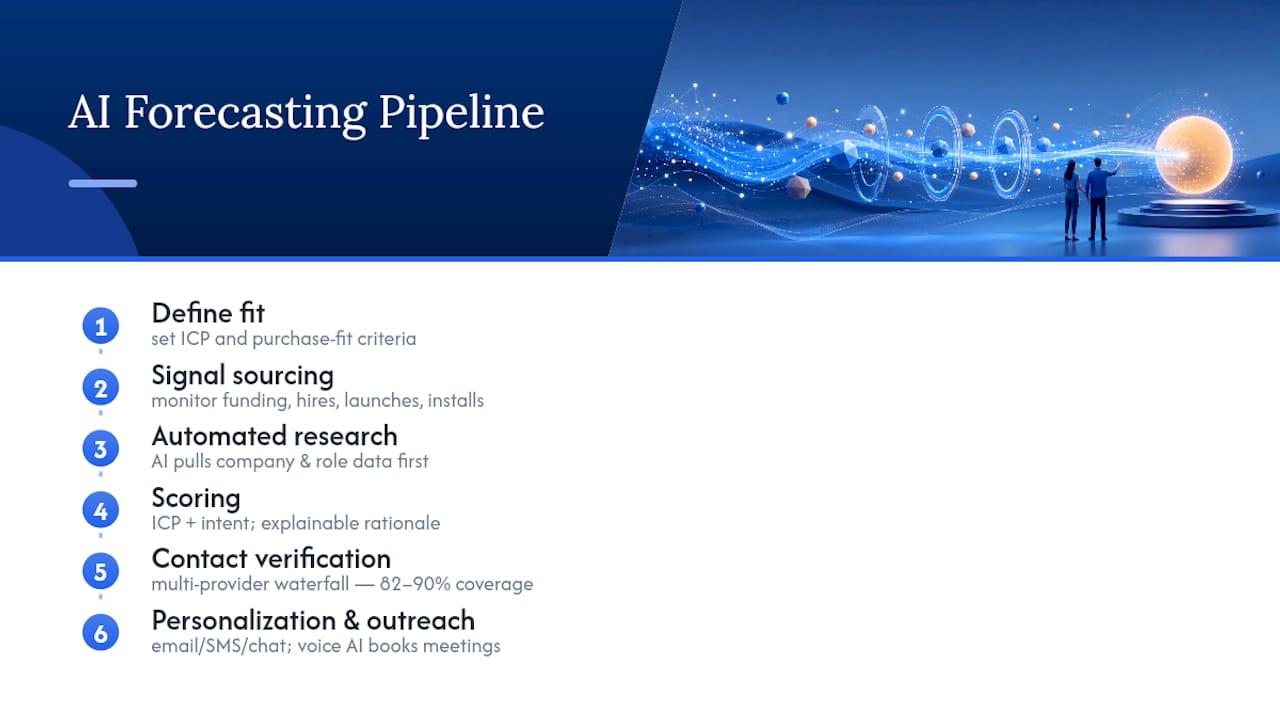
Sourcing starts with signal monitoring: tracking funding rounds, executive hires, tech installs, and product launches that indicate a company is ready to buy. Signal-based outbound consistently beats untargeted blasts on reply rates, because timing a message to a real trigger event feels relevant instead of random, as SyncGTM’s research on layered lead generation shows.
Automated research and enrichment comes next. AI agents pull company data, recent news, and role-specific detail the way a human SDR would, minus the eight hours of manual digging. The sequence matters here: research first, then write. Clay’s guide to AI lead generation found that generating personalized outreach before verifying the facts is what causes hallucinated, embarrassing openers.
Scoring separates two different questions: does this account fit our ICP, and is this account showing intent right now? Good scoring models explain their rationale instead of spitting out an opaque number.
Contact verification runs through a waterfall of data providers, querying one source, then the next, until a valid email or phone number surfaces. This alone can push contact coverage from a single-source rate up toward the 82 to 90 percent range multi-provider waterfalls typically achieve.
Personalization and outreach happen across email, SMS, and chat. Then voice AI takes over: answering inbound calls, following up on warm leads, and booking directly into a calendar.

The canonical sequence: define fit, source, research, score, verify, personalize, send, book.
When Does AI Lead Generation Actually Pay Off?
Not every business is ready for this stack, and pretending otherwise wastes budget. The math depends heavily on deal size and lead volume, not on how excited your team is about automation.
- Deal size matters more than most people assume. Higher average contract values justify more automation spend per lead, because a single closed deal covers months of platform cost. Lower-ACV, high-volume businesses need the automation to work at scale instead.
- Lead volume has a floor. A pipeline running a handful of leads a month won’t generate enough signal to tune scoring models or test messaging variants. You need consistent volume to see patterns.
- CRM hygiene comes before automation, not after. Dirty fields, duplicate records, and inconsistent lifecycle stages will poison scoring models before they get a fair test.
- ICP precision is non-negotiable. A vague ICP (“mid-size companies that might need our product”) produces noisy signals and wasted enrichment calls. A precise one (“50 to 200 employee logistics companies that just raised Series B funding”) tells the system exactly what to look for.
- Timing-based signals outperform static firmographic filters informed by payment data. Buying signals tied to recent events (a new VP of Sales, a funding announcement, a tech stack change) tend to produce meaningfully higher reply and meeting rates than filtering on industry and headcount alone, according to SyncGTM and Searchlab’s analysis of outbound performance.
How Do You Roll Out AI Lead Generation in 90 Days?
A phased rollout beats a big-bang launch every time. Here’s a realistic 90-day path from zero to steady pipeline.
- Weeks 0 to 2: Define and prepare. Nail down your ICP with specificity, pull 20 to 30 closed-won deals to reverse-engineer what “good fit” looks like, and set up dedicated sending domains and clean CRM fields.
- Weeks 2 to 4: Wire the pipes. Connect sourcing and enrichment tools, configure waterfall contact verification across multiple providers, and start warming your new sending domains slowly so spam filters don’t flag them.
- Weeks 4 to 8: Run a soft pilot. Launch with one ICP segment and one signal type. Have a human review AI-generated outputs before they go out, and use that review to tune scoring thresholds and outreach cadence.
- Weeks 8 to 12: Scale what works. Expand sequences to additional segments, automate calendar routing for booked meetings, and stand up a KPI dashboard with clear metric ownership.
Most teams following a structured pilot see first replies within 2 to 3 weeks and steadier pipeline gains by month two or three, once messaging and scoring get tuned against real response data.
Pro Tip: Start with exactly one ICP and one signal type during the pilot phase. Resist the urge to test five segments at once. You can’t tune what you can’t isolate.
Operationally, keep a running checklist: which CRM fields sync automatically, where human review gates sit in the workflow, how domain warm-up is progressing, and who receives the weekly reporting snapshot.
What KPIs Actually Prove This Is Working?
Two categories of metrics matter, and conflating them is the most common measurement mistake. Leading indicators tell you if the machine is running correctly; lagging indicators tell you if it’s making money.
Leading KPIs: percentage of verified contacts, reply rate, qualified meetings booked per 100 touches, and time-to-first-response.
Lagging KPIs: pipeline influenced, meeting-to-close rate, cost per booked meeting, and revenue influenced.
The 5-minute rule: Response time under five minutes drives materially higher lead conversion than slower response windows. Treat this as a testable hypothesis in your own pipeline, not a guarantee, and measure your own conversion delta against it directly.
Assign one metric owner per KPI and snapshot the dashboard weekly. Without a named owner, dashboards get built and then quietly ignored by week three.
Why Do AI Lead Gen Implementations Fail?
Most failures trace back to a small handful of preventable mistakes, and almost none of them are about the AI itself being “bad.”
- Dirty CRM data and a vague ICP. Fix this first, always. No amount of AI sophistication compensates for a target list that doesn’t reflect who actually buys.
- Hallucinated personalization. Models will invent a reason to reach out if you let them. Constrain outputs so the AI only references verified facts, and instruct it to return “none found” rather than fabricate a detail, per Clay’s guidance on research-first outreach.
- Deliverability mistakes. Skipping domain warm-up or misconfiguring SPF, DKIM, and DMARC records tanks your sender reputation fast, and recovering it takes weeks.
- Single-source contact data. One enrichment provider misses too many valid contacts. A waterfall approach across multiple providers catches what a single source drops.
- Compliance blind spots. TCPA and Do Not Call rules apply to outbound calling and texting, and the specifics vary by channel and consent status. Check current legal requirements with counsel before scaling outbound voice or SMS campaigns.
What Types of AI Models Power This Kind of Forecasting?
The term covers several distinct model types working together, not one monolithic algorithm. Classification models handle lead scoring, sorting prospects into fit and intent tiers based on firmographic and behavioral features. Natural language models, the large language models behind most enrichment and personalization tools today, read unstructured data like news articles, job postings, and company websites, then extract structured facts a scoring model can use.
Named entity recognition models identify people, companies, and roles inside scraped text, which is how automated research agents know that a paragraph about “the new VP of Sales at Acme Corp” refers to a specific person worth contacting. Conversational AI models, the technology behind voice agents and chatbots, handle real-time dialogue, understanding intent mid-conversation and routing a caller toward a booked appointment or a human handoff.
Time-series and predictive models exist in adjacent sales-forecasting tools that estimate future revenue from historical data, but that’s a different use case than the lead generation and appointment-setting stack this article covers. Deep learning shows up mainly in voice transcription and speech recognition, where accuracy at natural conversational speed matters more than in simpler rule-based systems.
What ties these together in practice isn’t a single unified model. It’s an orchestration layer that routes data between a scoring classifier, a research agent, and a conversational system, each specialized for its one job.
What Data Do You Need Before You Start?
Garbage in, garbage out applies here more literally than almost anywhere else in sales technology. Before any scoring model or personalization engine can do useful work, it needs three data layers in reasonably clean shape.
Firmographic data (company size, industry, location, revenue band) defines the outer boundary of your ICP. Behavioral and intent data (website visits, content downloads, hiring signals, technology adoption) tells you who inside that boundary is actually in motion. Historical closed-won and closed-lost records give any scoring model something to learn from. Without at least a few dozen examples of real deals on both sides, scoring is just an educated guess wearing a data science costume.
Preprocessing matters as much as collection. Deduplicating CRM records, standardizing company name formats (is it “Acme Corp,” “Acme Corporation,” or “Acme Inc”?), and normalizing job titles across data sources prevents the same account from getting scored three different ways under three different labels. Enrichment providers return data in inconsistent formats, so a normalization layer that maps everything to one schema before it hits your scoring model saves painful debugging later.
One underrated step: strip stale data on a schedule. A signal that a company “just raised Series B funding” stops being a useful trigger after a few months. Set expiration windows on time-sensitive signals so your sourcing engine doesn’t keep chasing news that’s gone cold.
Is AI Actually More Accurate Than Manual Prospecting?
Manual prospecting relies on a rep’s gut feel, a handful of static filters, and whatever time is left after admin work. AI-driven systems replace that gut feel with consistent, testable logic applied at a scale no human team can match.
The accuracy gain shows up in three places. First, signal freshness: a human rep checking LinkedIn once a week misses the funding announcement that happened three days ago; a monitoring system catches it in near real time. Second, consistency of scoring: two reps will rate the same lead differently depending on mood, caseload, and experience, while a scoring model applies the same criteria every time, which makes it easier to audit and improve.
Third, research depth at scale: waterfall enrichment across multiple providers surfaces verified contact details a single rep doing manual searches would never have time to chase for every lead on a list of thousands.
None of this means AI eliminates error. It means errors become visible and fixable instead of buried in individual rep habits. A scoring model that’s miscalibrated will misfire consistently, which is actually easier to diagnose than a team of ten reps each qualifying leads slightly differently. Traditional methods don’t fail because humans are bad at their jobs. They fail because manual research and static filtering can’t keep pace with how fast buying signals change.
How Does This Fit Into Your Existing CRM and Sales Stack?
The lead generation and appointment-setting engine described here isn’t a replacement for your CRM. It’s a layer that feeds it and, in the best implementations, closes the loop back into it automatically.
Integration depth varies by platform, but the pattern holds across most CRM systems: enriched contact records sync in automatically, scoring updates lead status fields without manual re-entry, and booked meetings create calendar events with context notes attached, including call transcripts where voice AI was involved. Voice AI systems that integrate directly with calendars and CRM data show meaningfully better booking completion and lower no-show rates than standalone scheduling tools bolted on after the fact.
Beyond lead generation, the same integration layer supports pipeline reactivation, reaching back out to stalled deals with fresh signals, and campaign automation that adjusts messaging based on where a lead sits in the funnel. A well-integrated stack means your sales team never has to toggle between five tools to piece together why a lead scored the way it did or what a voice agent discussed on a call. Platforms with broad native integration coverage, connecting to hundreds of CRM and marketing tools rather than a handful, reduce the custom engineering work needed to make this loop actually close.
How Do You Get Your Sales Team on Board?
The technology is rarely the hard part. Getting a sales team to trust and actually use an AI-driven pipeline is where most rollouts stall.
Start with transparency about what changes and what doesn’t. Reps keep ownership of relationship-building and closing; the AI stack handles the volume work of sourcing, research, and initial outreach that reps historically resented doing anyway. Framing it as removing grunt work rather than replacing judgment lowers resistance significantly.
Training should focus on two things: how to read and trust the scoring rationale (not just the score itself), and how to intervene when something looks off, like flagging a hallucinated personalization detail or overriding a bad fit score. Reps who understand why a lead scored a certain way engage with the system instead of ignoring its output.
Expect a adjustment period. The first few weeks of any pilot involve reps second-guessing AI-qualified leads against their own instincts, which is healthy skepticism, not resistance to be stamped out. Build in a structured feedback loop where reps flag bad leads and that feedback retrains scoring thresholds. Teams that treat rep feedback as tuning data, not noise to ignore, get to a trusted system faster than teams that force adoption top-down.
What Ethical Risks Should You Watch For?
Automated lead scoring and outreach at scale introduce bias risks that manual prospecting, for all its inconsistency, sometimes avoided simply by being slower and more human-judgment-heavy.
The biggest risk is proxy discrimination: a scoring model that uses company size or location as a proxy for something else entirely, inadvertently deprioritizing legitimate prospects because of patterns in historical closed-won data that reflect past sales team bias rather than true buying likelihood. If your historical deal data skews toward certain company types because that’s who your reps happened to prioritize, your scoring model will learn to replicate that skew rather than correct it.
Mitigation starts with auditing what data goes into scoring models and testing outputs across different segments to check for unexplained disparities. Regularly reviewing which accounts get deprioritized and why catches drift before it becomes an entrenched pattern.
The second risk sits with personalization: outreach that references scraped personal details can cross from “relevant” into “unsettling” fast. Constraining AI outputs to verified, professionally relevant facts, and instructing models to skip personalization entirely rather than guess, protects both accuracy and the prospect’s comfort level. Compliance considerations around TCPA and Do Not Call registries add a legal layer on top of the ethical one, particularly for voice and SMS outreach, and both deserve a documented review before any campaign scales beyond a pilot.
Mediabloom’s Perspective: What We See Across Real Deployments
We built Mediabloom’s platform around the exact sequence this article describes: AI voice agents, chatbots, and omnichannel automation working from one CRM-connected system rather than five disconnected tools. Clients like Miracle Ear and 1-800 Accountant have used this approach to generate over 10,000 monthly leads combined. What separates functional deployments from stalled ones is rarely the AI itself. It’s response speed and governance discipline applied consistently from week one.
— MediaBloom
Ready to Put This Stack to Work?
Reading about sourcing, scoring, and voice AI is one thing. Running it as a working pipeline that books qualified meetings on your calendar without a rep lifting a phone is another. Mediabloom is the done-for-you alternative to piecing together five separate point tools yourself: one platform handles sourcing, enrichment, scoring, outreach, and voice AI appointment booking, connected to your CRM through integrations with 600-plus platforms.

A pilot with Mediabloom starts the same way the 90-day roadmap above recommends: one defined ICP, one signal type, human review gates in place, and a clear KPI dashboard from day one. You get done-for-you setup, not a self-serve tool you have to configure alone, plus compliance groundwork already built in, including TCPA-aware calling practices and SOC 2 controls. Businesses like the ones featured in Mediabloom’s case studies started exactly where you are now: a defined ICP, a target deal size, and a team ready to stop manually chasing leads that go cold before anyone calls them back. Get a demo to see how the pilot maps to your own pipeline.
Sources
FAQ
What Does “AI Sales Forecasting” Mean in This Context?
It refers to AI-driven lead generation, qualification, and automated appointment setting, using voice agents, chatbots, and multichannel outreach, rather than predictive revenue modeling based on historical pipeline data.
How Long Does It Take to See Results?
Most structured pilots produce first replies within 2 to 3 weeks, with steadier pipeline gains showing up by month two or three as messaging and scoring get tuned.
What Deal Size Justifies This Kind of Automation?
Higher-ACV businesses see faster payback because one closed deal covers more platform cost, but high-volume, lower-ACV businesses can also benefit once volume and CRM hygiene support consistent testing.
Does This Raise Compliance Concerns?
Yes. TCPA and Do Not Call rules apply to outbound calling and texting, and requirements vary by channel and consent status, so confirm current legal requirements with counsel before scaling outbound voice or SMS campaigns.
Can a Small Sales Team Realistically Run This Without a Big Tech Investment?
Small-business setups can run on modest monthly budgets, but managed platforms like Mediabloom typically get mid-market teams to working pipeline faster than building and integrating five separate point tools from scratch.