AI sales analytics delivers predictive forecasts, prioritized pipeline actions, and measurable time savings, but only when the underlying CRM data is clean and the rollout is scoped tightly. The single prerequisite that determines success is boring: fix your data hygiene and pick one visible metric before you touch a model. Start with a five-rep pilot, name a champion, and demand a leading indicator visible within 72 hours.
TL;DR:
- Accurate, complete CRM data is essential; below 70% field completion significantly diminishes AI model reliability.
- Focus on one use case, such as lead scoring or forecasting, during initial deployment to avoid organizational overload.
- Weekly metrics like adoption rate, CRM completion, and routing disputes provide early signs of pilot health, while outcome metrics need monthly review.
- Proper scoping, including a five-rep pilot and clear success metrics within 72 hours, dramatically increases the likelihood of pilot success.
- Main failure modes include rep rebellion, lead-score gaming, model overfitting, bias, and inadequate data hygiene, which can be mitigated through disciplined governance.
Table of Contents
- What Is AI Sales Analytics and Where It Delivers Value First
- Which KPIs Actually Prove the Model Is Working
- How Predictive Forecasting and Scoring Models Actually Work
- Your 90-Day Pilot Playbook, Phase by Phase
- The Seven Ways AI Sales Analytics Backfires
- Your 90-Day Health-Check Dashboard
- Data Privacy and Ethical Considerations in AI Sales Analytics
- Integration Challenges With Existing CRM and Sales Tools
- Case Studies: What Impact Actually Looks Like Across Industries
- What’s Next for AI Sales Analytics
- What I’ve Learned Watching These Rollouts Succeed and Fail
- See How MediaBloom Handles This in Practice
- Primary Sources and Further Reading
- Sources
- FAQ
What Is AI Sales Analytics and Where It Delivers Value First
AI sales analytics refers to machine learning applied to pipeline, engagement, and conversation data to predict outcomes and prescribe next actions. It is not a dashboard with a new label. The distinction matters because most sales teams already have dashboards, and they still miss forecasts. What changes with machine learning sales analytics is the shift from descriptive reporting (what happened) to predictive sales analytics (what’s likely to happen) and prescriptive guidance (what to do about it).
Five use cases account for nearly all the practical value revenue teams see in year one.
Prospecting and lead prioritization. Lead scoring models rank inbound and outbound leads by conversion likelihood, then route the highest-probability leads to the reps most likely to close them. This is where automated sales reporting first pays for itself, because routing decisions that used to take a sales ops analyst a full day now happen in seconds.
Predictive forecasting and deal risk scoring. Instead of a rep’s gut-feel percentage on a deal, the model scores each opportunity against thousands of historical patterns, flagging deals that look healthy on the surface but carry risk signals like stalled engagement or missing stakeholders.
Conversation intelligence. Call recording and transcription tools generate auto-notes, surface competitor mentions, and prompt coaching moments in near real time. Managers no longer have to sit in on calls to know which reps are struggling with objection handling.
Next-best-action automation. The system tells a rep what to do next, whether that’s a follow-up email, a specific case study to send, or a signal to escalate to a manager. This is where AI-driven sales insights turn from analysis into workflow.
Segmentation, churn prediction, and cross-sell signals. For teams managing renewals or expansion revenue, models flag accounts showing early churn indicators (usage drop, support ticket spikes, contract non-engagement) and identify accounts ready for upsell conversations.
Here’s what typically shows up in the first 90 days when these use cases are scoped correctly:
- Lead response time drops because scoring and routing happen automatically instead of manually.
- Reps report saving several hours a week on call notes and CRM updates, time that teams see averaging close to 4.8 hours weekly when the time savings get reinvested into coaching and prospecting rather than absorbed into slower workdays.
- Forecast variance narrows, though not dramatically, in the first quarter, since the model needs at least one full sales cycle of data before its predictions stabilize.
- Managers get earlier warning on at-risk deals, often two to three weeks before a deal would have otherwise slipped in a traditional pipeline review.
The mistake most teams make is trying to deploy all five use cases simultaneously. Pick one, usually lead scoring or forecasting, prove it, then expand. A sales enablement AI platform that already integrates with your CRM makes that sequencing far easier than stitching together point solutions one at a time.
Which KPIs Actually Prove the Model Is Working
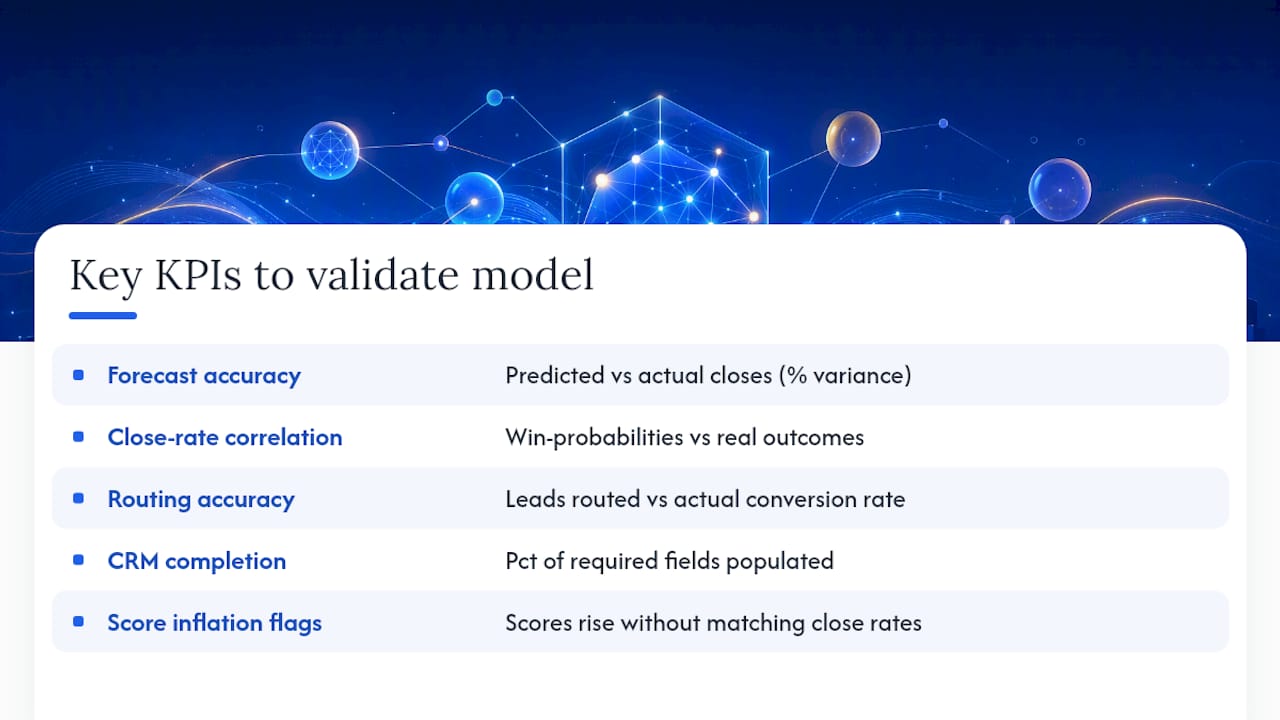
Forecast accuracy is the metric everyone watches, but it’s the last one you should trust. Before that number means anything, you need data-quality metrics that confirm the model is being fed accurate, complete information.
Forecast accuracy compares predicted close dates and deal values against actuals, usually measured as a percentage variance per quarter. It’s the headline metric, and it’s also the most easily gamed if reps learn to sandbag or inflate stages to satisfy a model they don’t trust.
Close-rate correlation checks whether the model’s win-probability scores actually track with real outcomes.
Routing accuracy measures whether leads sent to a given rep or team actually convert at the rate the routing logic predicted. Poor routing accuracy is often the first visible sign that lead-scoring inputs have drifted.
CRM completion rate tracks the percentage of required fields (next steps, close date, stage, stakeholder contact) that are populated and current. This is the single leading indicator that predicts every other metric on this list.
Score inflation flags catch when deal or lead scores creep upward over time without a corresponding increase in actual close rates, usually a sign reps have learned to game the inputs.
Data quality callout: A strong majority of data and analytics leaders say AI outputs are only as good as the data feeding them. That’s not a caveat, that’s the whole ballgame. If CRM hygiene sits below roughly 70% field completion, treat every model output as directional at best, not a number to build a board forecast around.
Which signals do models actually use, and how do you test whether they hold up? Most sales forecasting models weight four categories: deal attributes (size, stage, product mix), engagement signals (email opens, meeting frequency, response latency), buyer profile data (firmographics, technographics), and velocity metrics (time in stage, days since last touch). Test fidelity by holding out a sample of closed deals the model has never seen, running its predictions against them, and comparing to what actually happened. If the model’s confident predictions and its accurate predictions don’t overlap well, the feature weighting needs review before you scale it.
You’ll see leading indicators of pilot health well before quarter-end numbers arrive. Watch adoption rate (are reps actually opening the tool daily), CRM field completion trending upward, and next-best-action acceptance rate. All three typically move within the first one to two weeks. If they don’t, the pilot has an adoption problem, not a data problem, and no amount of model tuning fixes that.
How Predictive Forecasting and Scoring Models Actually Work
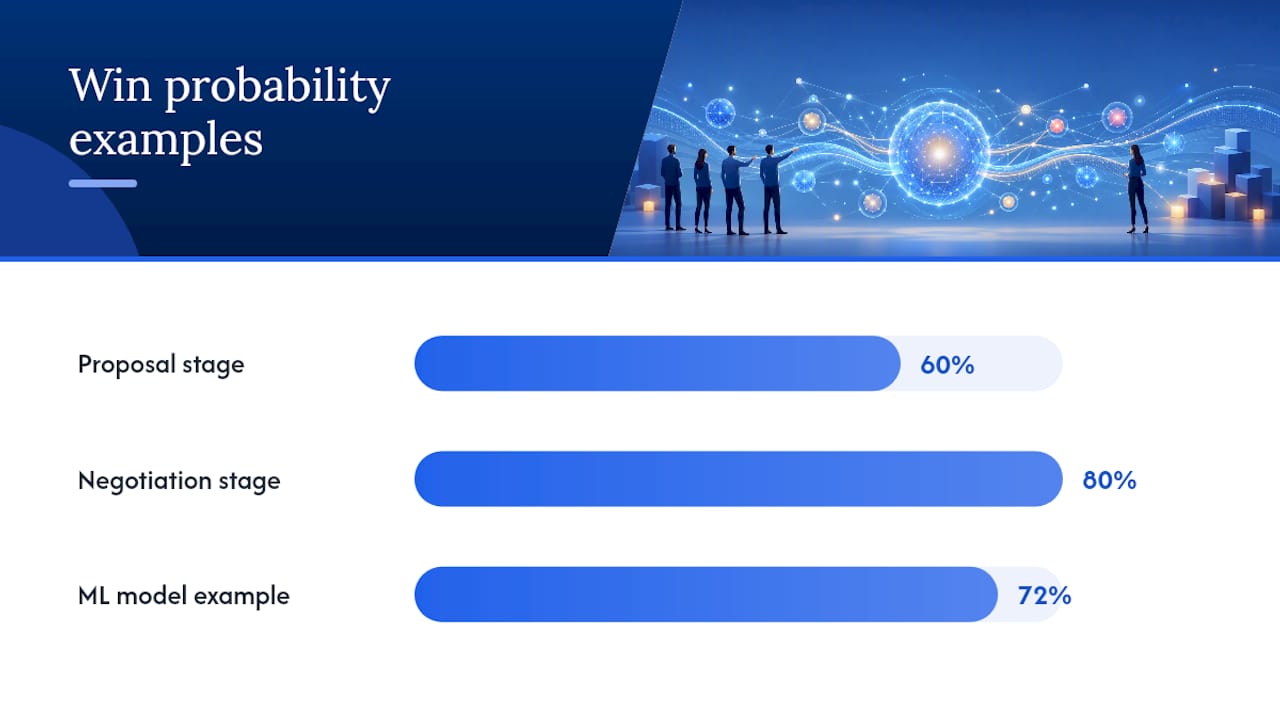
Traditional forecasting weights deals by sales stage: a deal in “proposal” counts for 60% of its value, a deal in “negotiation” counts for 80%. It’s simple, and it’s also wrong more often than most VPs admit, because it treats every deal in a stage identically regardless of the actual signals behind it.
Deal-level machine learning scoring replaces that flat weighting with a probability generated from dozens of variables specific to that opportunity. Two deals sitting in the same “proposal” stage can carry very different win probabilities depending on stakeholder engagement, deal velocity, and how the account compares to historically won deals.
Most models draw on five feature categories:
- Deal attributes: contract value, product mix, discount level, competitive situation.
- Engagement signals: email response times, meeting attendance, document views.
- Buyer profile: company size, industry, technographic fit with past customers.
- Velocity metrics: days in current stage compared to historical median for won deals.
- Recency: how long since the last meaningful touch from either side.
Explainability is where most vendor pitches fall apart and most rollouts earn or lose trust. A forecast that just outputs “72% probability” with no reasoning is a black box, and sales managers will not act on a black box for long. Look for scenario views that show which factors are pushing a deal’s score up or down, and insist on the ability for a manager to override a score with a documented reason. That override data isn’t just a safety valve, it’s training data. Good platforms feed those overrides back into future model tuning.
Pro Tip: Run a shadow period where the model’s predictions run alongside human forecasts without replacing them for at least one full sales cycle before letting it anchor real decisions. This is standard advice in most credible forecasting guidance, and it exists because trust in a model has to be earned with evidence, not assumed on day one.
Two failure modes show up repeatedly in forecasting models specifically. Overfitting to recent quarters happens when the model over-weights the last two or three quarters of deals, producing forecasts that chase recent trends instead of reflecting durable patterns; this shows up as wildly swinging predictions quarter over quarter. Model drift happens gradually as your market, product, or buyer behavior shifts and the model keeps scoring against outdated patterns; the telltale sign is a slow, steady decline in close-rate correlation over several months. Both are detectable if someone is actually watching the correlation metrics, which is exactly why the KPI section above isn’t optional reading.
If your pipeline runs disciplined and mid-volume, CRM-native forecasting tools generally handle the job well; longer, more complex enterprise cycles tend to need more specialized modeling.
Your 90-Day Pilot Playbook, Phase by Phase
The single biggest predictor of pilot success isn’t the sophistication of the model, it’s whether you scope the rollout narrowly enough to protect it from organizational chaos. Roughly 93% of AI sales pilots that fail do so because of scope, not technology.
Phase 0: Before you touch a model (roughly two weeks)
- Name a champion, ideally a middle sales manager, not an executive sponsor and not an individual contributor. This person owns daily troubleshooting and rep questions.
- Baseline your current metrics: forecast accuracy over the last two quarters, average CRM field completion, current lead response time. You cannot prove improvement without a starting point.
- Set a data cleanup target. If CRM completion sits below 70%, that’s your first project, not an afterthought squeezed in during rollout.
- Pick exactly one metric that will be visible to leadership within 72 hours of pilot launch. This could be lead response time, routing accuracy, or CRM completion rate, but it has to move fast enough to build early confidence.
Pilot scope and structure
Limit the pilot to five reps. Pilots that stay this narrow surface edge cases quickly without creating enough organizational noise to attract political resistance before the results speak for themselves. Choose top performers for the initial group rather than struggling reps, since strong performers tend to surface data and workflow issues faster and create peer-driven adoption once colleagues see the results firsthand.
Days 1 to 30: Data cleanup and shadow launch
- Enforce mandatory field completion for the pilot group specifically, not the whole team yet.
- Run the model in shadow mode: it generates predictions, but nobody acts on them yet.
- Compare shadow predictions weekly against actual outcomes to build a track record.
- Surface the 72-hour metric to the champion and one executive sponsor, and nobody else yet.
Days 31 to 60: Shadow continues, trust builds
- Extend shadow mode through at least one full sales cycle if your average cycle is under 45 days.
- Start sharing model reasoning (the “why” behind scores) with the pilot reps, even though they’re not acting on it yet.
- Log every instance where a manager’s gut call would have diverged from the model’s prediction, and check who was right after the deal closes.
Days 61 to 90: The model earns a vote
- Let the model’s forecast anchor the number, with managers empowered to adjust and document why.
- Track override frequency. A high override rate isn’t automatically bad, it might mean the model needs retuning, or it might mean managers are resistant to a tool that’s actually more accurate than they are.
- Compile the 90-day results against your Phase 0 baseline and decide: expand, adjust, or pause.
Governance that has to exist from day one: define a retrain cadence (quarterly is common for most sales cycles), require every manager override to be logged with a reason, and set up a dispute process for reps who believe a score or routing decision is wrong. Decide now who owns retraining decisions (usually sales ops) versus who owns day-to-day coaching decisions (frontline managers) so those two groups aren’t fighting over the same data six months from now.
The Seven Ways AI Sales Analytics Backfires
Roughly 80.3% of AI projects fail to deliver the business value they promised, and a third get abandoned before they even reach production. Sales analytics deployments aren’t immune. Seven failure modes account for most of that pattern, and each one is well documented enough to have a known fix.
- Rep rebellion. Reps quietly stop using the tool because it feels like surveillance rather than support. Watch for declining usage logs in week two or three, well before anyone complains out loud. Fix it by involving reps in defining what “good” looks like before launch, not after.
- Lead-score gaming. Reps learn which fields inflate a lead’s score and fill them in regardless of accuracy. The tell is a lead score that keeps climbing without a matching climb in actual conversion. Audit score distributions monthly against real outcomes.
- Auto-draft quality collapse. AI-generated emails or call summaries start sounding generic or repetitive once reps stop reviewing them closely. Spot-check a sample of outputs weekly, and pair any auto-drafting tool with mandatory human review, a point echoed in research on multi-channel AI content quality.
- Coaching anxiety. Reps disengage from conversation intelligence tools because they feel constantly graded rather than developed. Frame every coaching prompt around growth, not punishment, and have managers use the tool in one-on-ones, not performance reviews.
- Model overfit and drift. Covered above in forecasting, but it applies to lead scoring and churn prediction too. Retrain on a fixed cadence rather than waiting for obvious failure.
- Routing bias. The model starts favoring certain rep profiles or territories in ways that weren’t intentional, often because historical data baked in past inequities. Run a quarterly fairness check comparing routing outcomes across reps and territories.
- Audit overhead. Compliance and legal teams get buried trying to explain model decisions after the fact. Build override logging and explainability into the tool from day one instead of retrofitting it under pressure.
Pro Tip: If you see two or more of these signals stacking in the same month, pause the rollout rather than pushing forward. A short pause to retrain or recalibrate costs far less than losing rep trust, and trust is much harder to rebuild than a model.
Your 90-Day Health-Check Dashboard
Once the pilot moves past day 90, monitoring becomes a recurring discipline, not a one-time checkpoint. Split it into weekly leading indicators and monthly outcome metrics, because they answer different questions: weekly numbers tell you if people are using the tool, monthly numbers tell you if it’s actually working.
| Cadence | Metric | Healthy range | Action threshold |
|---|---|---|---|
| Weekly | Adoption rate | Above 80% of pilot reps active | Below 60% triggers a champion check-in |
| Weekly | Routing disputes | Under 10% of routed leads | Above 10% triggers a routing logic review |
| Weekly | CRM field completion | Above 70% | Below 70% pauses forecast reliance |
| Weekly | Next-best-action acceptance | roughly 70% | Below 30% signals recommendation quality issues |
| Monthly | Forecast error | Narrowing quarter over quarter | Widening for two straight months triggers retraining |
| Monthly | Close-rate correlation | Scores track with actual outcomes | A significant divergence triggers model review |
| Monthly | Score inflation | Stable or declining | Rising without matching close rates |
Sales ops typically owns the monthly outcome metrics, while the pilot champion or frontline manager owns the weekly adoption numbers. Retraining decisions should sit with whoever owns the monthly review, and that person needs authority to pause the rollout, not just flag concerns to someone else who might act on them eventually.
Data Privacy and Ethical Considerations in AI Sales Analytics
AI sales analytics touches sensitive information: call recordings, email content, buyer behavior patterns, and sometimes personal data about prospects who never consented to being scored by a model. That creates real exposure if handled carelessly.
Start with consent and disclosure. If you’re recording sales calls for conversation intelligence, most US states require some form of notice to participants, and multi-state teams need to track which states require two-party consent versus one-party. Legal counsel, not a sales ops assumption, should confirm your specific obligations.
Data minimization matters more than most rollouts acknowledge. Feed the model what it needs to score deals and leads accurately, not every scrap of data your CRM happens to store. The more personal data flowing into a model, the more exposure you carry if that data is ever breached or subpoenaed.
Bias is an ethical issue as much as a technical one. A routing or scoring model trained on historical data can quietly encode who your sales team has historically favored, whether by territory, account type, or even demographic proxies buried in the data. Quarterly fairness audits, mentioned earlier as a routing-bias fix, double as an ethical safeguard, not just a technical one. Vendors that support enterprise compliance standards like SOC 2 give you a baseline, but compliance certifications don’t replace your own governance discipline.
Integration Challenges With Existing CRM and Sales Tools
The model is rarely the hard part. Getting clean data flowing between your CRM, your calling or email platform, your marketing automation, and the analytics layer is where most timelines slip.
Field mapping mismatches are the most common snag. A “stage” field in your CRM might not correspond cleanly to the stage taxonomy a new analytics tool expects, and reconciling that takes real hours from someone who understands both systems. Budget for this explicitly rather than assuming it’s a weekend task.
API rate limits and sync delays create quieter problems. If your CRM only syncs with the analytics layer every few hours instead of in real time, next-best-action recommendations can lag behind what a rep actually needs in the moment, and reps notice that lag fast.
Legacy CRM instances with years of inconsistent data entry are the deepest integration challenge. A model fed a decade of inconsistent stage definitions and abandoned custom fields will produce inconsistent scores no matter how good the algorithm is. This is precisely why the Phase 0 cleanup step in the playbook above isn’t optional, it’s the actual integration work, disguised as a data hygiene task.
Platforms built with broad, pre-built CRM integrations reduce this burden considerably compared to custom-built connections that a smaller internal team has to maintain and patch indefinitely.
Case Studies: What Impact Actually Looks Like Across Industries
Home services companies using AI-driven lead qualification and appointment automation have seen faster response times translate directly into more booked jobs, since a lead that waits hours for a callback often books with a competitor first. Insurance agencies applying conversation intelligence to sales calls have used auto-generated call summaries to cut administrative time between calls, freeing agents to take more calls per day rather than spending that time on manual note-taking.
Legal services firms adopting AI-driven lead qualification for intake calls have used scoring models to prioritize which inquiries warrant an attorney’s immediate attention versus a standard intake process, shortening the time between initial contact and case evaluation. SaaS companies running churn-prediction models on usage and support data have caught at-risk accounts early enough for customer success teams to intervene before a renewal conversation turns into a save attempt.
The common pattern across all four: the technology mattered less than the organizational discipline to act on what it surfaced. A churn signal that nobody follows up on is just a notification nobody reads. An appointment-booking case study worth reviewing, like the chatbot-driven booking outcomes documented in recent implementation guides, tends to show the same thing: the win comes from pairing the signal with a fast, consistent human or automated follow-up process.
What’s Next for AI Sales Analytics
Conversation intelligence is moving from post-call analysis toward real-time coaching, surfacing objection-handling prompts to reps mid-call rather than in a summary the next morning. That shifts the value from a coaching retrospective to an in-the-moment assist, though it also raises the stakes on getting the recommendations right the first time.
Multimodal analysis, combining voice tone, email sentiment, and behavioral engagement data into a single deal-health score, is emerging as the next layer past today’s largely text-and-CRM-field-driven models. Expect scoring models to increasingly weigh how something was said, not just what was said.
Agentic workflows, where the system doesn’t just recommend a next-best-action but executes low-risk parts of it (drafting the follow-up, scheduling the meeting, updating the CRM field), are extending automated sales reporting into automated sales execution. That raises the governance bar covered earlier, since an agent that acts autonomously needs even tighter override logging than one that only recommends.
Enterprise buyers evaluating this next wave should still apply the same criteria market analysts use to judge CRM and engagement platforms: governance maturity, explainability, and integration depth, not just how impressive the demo looks.
What I’ve Learned Watching These Rollouts Succeed and Fail
The pattern that stands out across successful AI sales analytics rollouts is how little the winning teams talk about the model itself. They talk about the champion who fielded rep questions in week one. They talk about the one metric that moved fast enough to keep skeptical executives patient. They talk about the CRM cleanup nobody wanted to do but that made every downstream number trustworthy.
Typical quick wins fall in a fairly consistent range: reduced prep time per rep, often measured in minutes saved per call, and a modest but real lift in qualified appointments booked per week once routing and scoring stabilize. These ranges could be sharpened further with specific user success metrics or case studies, but the pattern holds directionally across similar deployments we’ve observed.
The organizational blockers we see most often during onboarding aren’t technical. They’re response time gaps between a lead coming in and a human (or AI voice agent) reaching out, fragmented qualification happening across disconnected channels, and CRM integrations that were never built to handle real-time data flow. Omnichannel automation solves the first two; deep CRM integration solves the third. Prioritization of which to fix first depends on each client, but the sequencing above holds true across many deployments we’ve observed.
— MediaBloom
See How MediaBloom Handles This in Practice
Everything in this playbook, the pilot scoping, the routing accuracy, the qualification signals, is exactly what MediaBloom’s platform is built to run day one instead of building from scratch over 90 days. MediaBloom combines AI voice agents, chatbots, and lead scoring into one system that qualifies leads the moment they arrive, routes them to the right rep, and books the appointment without a human touching the handoff.

A typical demo walks through how the platform ingests a lead across SMS, email, or chat, scores it in real time, and either books an appointment directly or hands off a qualified conversation to a rep, all inside your existing CRM rather than a separate tool reps have to remember to check. Companies like Miracle Ear and 1-800 Accountant have used this exact workflow to generate over 10,000 monthly leads without adding headcount to their intake teams. Case studies like the Fifth Avenue Leads results and the My Legal Coach deployment show what the 60 to 90 day range actually looks like once qualification and routing run on autopilot instead of a spreadsheet.
If you’re ready to see the qualification and routing logic in action before you build a pilot plan around it, watch a live demo of the AI voice agent platform and bring your current CRM setup to the call.
Primary Sources and Further Reading
The claims and frameworks in this playbook draw on a small set of sources worth reading directly if you want to go deeper on any single piece.
- Failure Modes: When AI Sales Ops Backfires documents the seven failure modes covered above along with a pre-deployment checklist and 90-day health-check framework.
- AI Sales Forecasting: The Complete 2026 Guide breaks down the 30/30/30 rollout structure and the data-quality research behind it.
- Why 93% of AI Sales Pilots Fail — and What Ships is the source for the five-rep, 72-hour pilot architecture used throughout this playbook.
- AI Sales Forecast: A No-Fluff Guide offers useful criteria for choosing between CRM-native forecasting and specialist platforms.
- Magic Quadrant for the CRM Customer Engagement Center defines the enterprise trust signals worth applying when evaluating any vendor.
Sources
FAQ
What Is the 30 Percent Rule in AI?
There’s no single agreed-upon “30 percent rule” specific to AI sales analytics; definitions vary depending on the source.
Which AI Tool Is Best for Sales?
There’s no single best tool, because the right choice depends on whether you need lead qualification and appointment automation, deal-level forecasting, or conversation intelligence. Platforms like MediaBloom focus specifically on AI-driven lead qualification and omnichannel appointment setting, which fits teams whose bottleneck is response time and routing rather than deal scoring.
How Can AI Be Used in Sales?
AI in sales analytics covers five main use cases: lead scoring and routing, predictive forecasting, conversation intelligence, next-best-action recommendations, and churn or upsell prediction. Most teams see the fastest returns by starting with lead scoring or routing before expanding into forecasting.
Which AI Is Best for Sales Forecasting?
CRM-native forecasting tools tend to work well for disciplined, mid-volume pipelines, while specialist forecasting platforms handle longer, more complex sales cycles better. The deciding factor is less about the specific tool and more about whether your CRM data is clean enough to trust either option.
How Long Before AI Sales Analytics Shows Results?
Leading indicators like adoption and CRM completion typically move within one to two weeks of a well-scoped pilot launch, while forecast accuracy improvements usually take a full sales cycle, often 60 to 90 days, to become reliable.