A sales enablement AI platform is software that automates lead generation, qualification, and appointment booking across voice, SMS, email, and chat, then syncs every interaction back to your CRM in real time. The platform acts as a behavioral layer that delivers next-best-action guidance at the exact moment a rep needs it, not hours later in a debrief.
TL;DR — the three capabilities that matter most for omnichannel revenue teams:
- Automated omnichannel outreach and qualification: AI voice agents, chatbots, and sequenced email/SMS engage and score leads without rep involvement.
- Appointment setting and calendar orchestration: Qualified leads book directly into rep calendars; no back-and-forth, no dropped handoffs.
- CRM-integrated next-best-action: Every touchpoint updates the CRM and surfaces the recommended next step, so reps act on data, not instinct.
Mediabloom’s deployments with clients like Miracle Ear and 1-800 Accountant have generated substantial monthly leads using exactly this model.
Table of Contents
- What does a sales enablement AI platform actually do?
- Why do businesses adopt these platforms, and which KPIs matter?
- What features and technologies should you expect?
- What do teams need to plan for before adopting one?
- What do real-world deployments look like?
- How do you evaluate vendors and run a focused pilot?
- Key Takeaways
- The real gap most teams miss
- Mediabloom’s platform for omnichannel lead generation
- Useful sources
- FAQ
What does a sales enablement AI platform actually do?
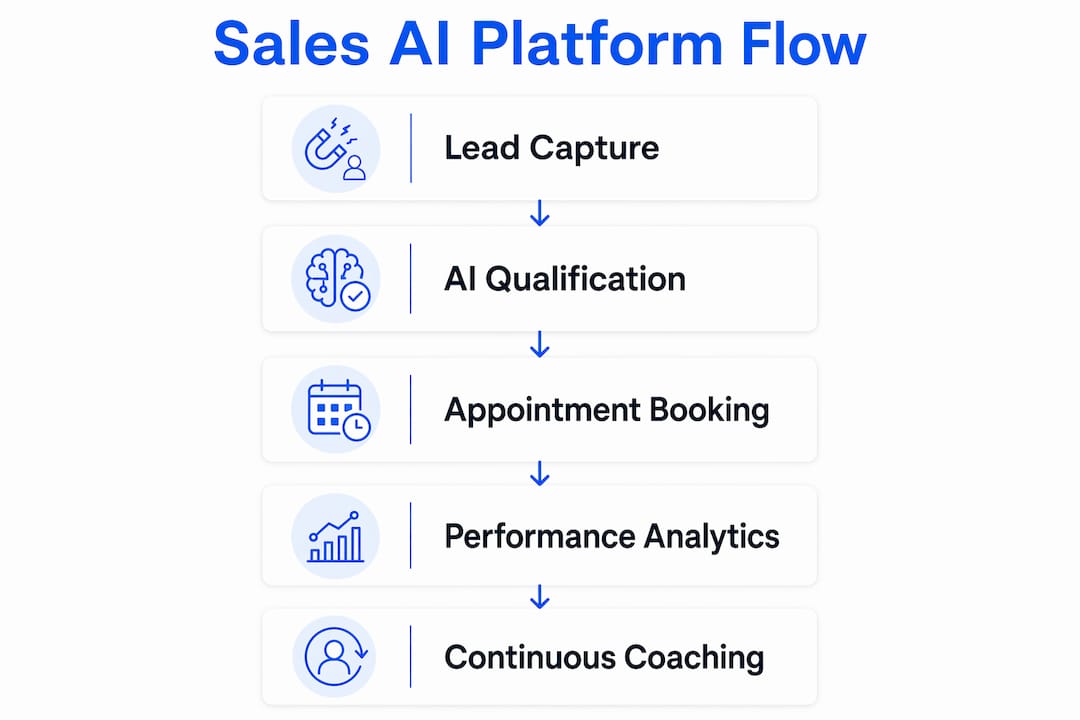
These platforms cover five concrete capability buckets, each mapped to a specific point in the lead-to-appointment flow.
- Omnichannel outreach: AI initiates contact via voice, SMS, email, and chat simultaneously, reaching leads on whichever channel they respond to first.
- Lead qualification and scoring: Predictive lead scoring ranks prospects by conversion likelihood using behavioral signals and historical data.
- Appointment booking: Once a lead qualifies, the AI books directly into the assigned rep’s calendar, confirms via SMS, and sends reminders to reduce no-shows.
- Meeting summarization and follow-up: After each call or meeting, the platform generates a summary, logs it to the CRM, and queues the next follow-up task automatically.
- CRM sync: Two-way data flow means the platform augments your CRM rather than replacing it. It adds the behavior and automation layer your CRM alone cannot provide.
A typical flow looks like this: an inbound call hits an AI voice agent, which qualifies the caller against your criteria in under two minutes, then books the appointment into the rep’s calendar before the call ends. The rep sees a pre-populated CRM record and a suggested next step waiting for them.
Sales enablement AI is broader than content management. It ties content, coaching, conversation intelligence, and analytics together to change seller behavior and improve every buyer interaction.

Pro Tip: When evaluating platforms, ask vendors to run a live demo using your actual lead flow, not a canned script. The gap between a polished demo and real-world performance is where most buyers get surprised.
Why do businesses adopt these platforms, and which KPIs matter?
The primary driver is efficiency. Automating repetitive tasks like data entry, lead scoring, and meeting summarization frees reps to spend more time on conversations that close deals. That shift compounds quickly at scale.
The KPIs to track from day one:
- Response time: How fast does the platform engage a new lead? Speed is directly correlated with conversion.
- Qualified lead volume: Total leads contacted versus leads that meet your scoring threshold.
- Contact-to-booked-appointment rate: The conversion rate from first touch to confirmed appointment.
- Show rate: What percentage of booked appointments actually happen. AI-driven reminders via SMS and email move this number.
- Time to follow-up: How quickly does the system queue the next action after a meeting or no-show.
- Forecast accuracy: Predictive analytics improve pipeline revenue forecasting as the model learns your historical close patterns.
Leading teams measure enablement by business outcomes tied to revenue, not platform adoption alone. Tracking logins or content views tells you nothing about whether the platform is moving pipeline.
Statistic callout: Only 8% of sellers report not using AI at all in their role, which means your competitors are already deploying these tools. The question is whether your stack is coordinated or fragmented.
What features and technologies should you expect?
A mature platform combines several AI disciplines working in parallel. Sales enablement AI includes generative AI, conversational and coaching AI, predictive AI, and chatbots, often deployed together as a unified digital sales assistant.
Core technical components:
- Generative AI: Drafts outreach messages, follow-up emails, and meeting summaries tailored to each prospect’s profile.
- Conversational/NLP engines: Power voice agents and chatbots that handle qualification dialogs in natural language across phone, web chat, and SMS.
- Predictive lead scoring: Ranks inbound and outbound leads by conversion probability before a rep ever touches them.
- Conversation intelligence: Records and analyzes calls after the fact to surface coaching opportunities. This is retrospective by design.
- Behavior layer guidance: Delivers in-the-moment next-best-action prompts inside the CRM. Conversation intelligence and the behavior layer are complementary, not interchangeable.
- Calendar orchestration: Manages availability, books slots, sends confirmations, and reschedules automatically.
- Audit logs and compliance controls: Essential for U.S. businesses subject to TCPA, CAN-SPAM, or industry-specific regulations governing outbound messaging.
For omnichannel appointment setting specifically, the chatbot-in-pipeline strategy matters as much as the voice layer. Web chat and SMS qualification often convert leads that never pick up a phone.
Pro Tip: Ask vendors for data retention policies and CRM sync logs during the demo. If they cannot show you a timestamped audit trail of lead interactions, that is a compliance risk for outbound campaigns.
What do teams need to plan for before adopting one?
Integration and change management are where most implementations stall. Address both before signing a contract.
Integration checklist:
- CRM (Salesforce, HubSpot, or equivalent) with two-way field mapping confirmed
- Calendar system (Google Workspace, Microsoft 365, or similar)
- Email provider and sending domain authentication (SPF, DKIM, DMARC)
- Phone/SIP gateway for voice agent routing
- Chat channels (web widget, SMS aggregator, WhatsApp if applicable)
For practical guidance on sequencing these connections, sales AI integration best practices cover the common failure points teams miss.
Time-to-value milestones:
| Milestone | Timeframe | What to expect |
|---|---|---|
| Reduced admin time | 30 days | Data entry, scheduling, and follow-up tasks automated; reps report time savings |
| Meaningful ROI in conversion rates | ~90 days | Models trained on historical data; forecast accuracy and booked-appointment rates improve |
Most teams see reduced administrative time within 30 days, and significant ROI in conversion rates and forecast accuracy typically takes about 90 days as the model trains on historical data.
Operational requirements to plan for:
- Playbook updates so AI messaging matches current positioning
- Governance policy for outbound volume and opt-out handling (TCPA compliance in the U.S.)
- Vendor SLA for uptime, response latency, and escalation to human reps
- Training sessions for reps on reviewing AI-generated summaries and acting on next-step prompts
A useful overview of automation software examples can help teams benchmark what realistic quick wins look like before committing to a full deployment.
What do real-world deployments look like?
The fastest results come from high-volume, repeatable qualification scenarios where the AI can apply consistent rules at scale.
- Miracle Ear: Mediabloom deployed omnichannel AI outreach and appointment booking for this hearing care brand, generating qualified appointment volume at a scale that manual outreach could not sustain.
- 1-800 Accountant: Mediabloom’s platform handled inbound lead qualification and appointment scheduling, contributing to the over 10,000 monthly leads figure the brand reports across its client base.
The Vision Law case study shows how a similar omnichannel approach works in a regulated professional-services context, where compliance and handoff precision matter as much as volume.
How do you evaluate vendors and run a focused pilot?
Score vendors against these criteria before committing to a pilot:
- Omnichannel channel coverage (voice, SMS, email, web chat minimum)
- Calendar orchestration with real-time availability sync
- CRM integration maturity and two-way field mapping
- AI training methods and model retraining cadence
- Security, data residency, and U.S. compliance controls (TCPA, CAN-SPAM)
- Reporting on adoption metrics and pipeline outcomes, not just activity counts
- Defined escalation path from AI to human rep
Questions to ask on a demo:
- Show me a live qualification flow using our lead type, not a generic script.
- What is your data retention policy, and where is data stored?
- How often is the model retrained, and who controls the training inputs?
- What is your SLA for response latency on voice and SMS?
- Can you provide a sample ROI projection based on our lead volume and current conversion rate?
Immediate next steps for a pilot:
- Map one high-volume, repeatable lead flow (e.g., inbound demo requests or appointment bookings).
- Define success metrics upfront: response time, contact-to-booked rate, show rate.
- Run a 30–90 day pilot with a defined lead segment.
- Review adoption metrics at 30 days; review conversion and forecast impact at 90 days.
- Iterate the playbook based on what the conversation intelligence data surfaces.
Key Takeaways
A sales enablement AI platform delivers the fastest ROI when deployed against high-volume, repeatable lead flows with clear qualification rules and CRM integration confirmed before launch.
| Point | Details |
|---|---|
| Core definition | Automates lead gen, qualification, and appointment booking across voice, SMS, email, and chat with CRM sync. |
| Primary KPIs | Track response time, contact-to-booked rate, show rate, and forecast accuracy from day one. |
| Time-to-value | Most teams see reduced admin time within 30 days and significant ROI in conversion rates and forecast accuracy within about 90 days. |
| Pilot approach | Map one high-volume flow, define KPIs upfront, and run a 30–90 day pilot before scaling. |
| Mediabloom | Deploys omnichannel AI for lead generation and appointment setting; Miracle Ear and 1-800 Accountant report over 10,000 monthly leads. |
The real gap most teams miss
Most revenue teams evaluate sales enablement AI platforms on feature checklists. That is the wrong frame. The platforms that generate measurable pipeline impact are the ones that govern the moment of sale, not the ones with the longest feature list.
What that means in practice: the AI has to be present at the exact second a lead engages, qualify them in real time, and book the appointment before they lose interest. A platform that does this well at 2 AM on a Saturday is worth more than one with superior analytics that still requires a rep to manually follow up. Speed and consistency at scale are the actual differentiators.
The limitation worth acknowledging: AI-led qualification works best when the decision criteria are clear and repeatable. Complex enterprise negotiations, custom legal workflows, or deals that require relationship-based judgment still need human reps in the lead role. The AI handles the volume; the human handles the nuance. Teams that try to automate everything, including the parts that require genuine judgment, tend to see lower show rates and more frustrated prospects.
The smarter approach is to deploy AI where the rules are clear and the volume is high, then use the time savings to give your best reps more capacity for the deals that actually need them.
Mediabloom’s platform for omnichannel lead generation
Businesses that need to generate qualified appointments at scale, without adding headcount, have a concrete option in Mediabloom. The platform combines AI voice agents, chatbots, and automated SMS and email outreach into a single system that qualifies leads and books appointments around the clock. Miracle Ear and 1-800 Accountant are among the clients generating over 10,000 monthly leads through this model.
The next step is straightforward: watch a live AI voice agent demo to see how qualification and booking work in a real lead flow, or review the client case studies to see outcome data from comparable deployments. If you are ready to map your own pilot, the Mediabloom team can scope a 30–90 day program against your specific lead volume and qualification criteria.
Useful sources
- Microsoft Dynamics 365: What Is Sales Enablement? — Covers how AI combines machine learning, NLP, and predictive analytics to improve efficiency across sales, marketing, and customer success teams.
- monday.com: AI in Sales Enablement — Primary source for the 30-day admin reduction and 90-day ROI timeline cited in the implementation section.
- Supered: What Is Sales Enablement Software? — Source for the behavior-layer definition and the distinction between conversation intelligence and in-the-moment guidance.
- Seismic: Sales Enablement Content Management — Supports the argument that enablement is broader than content storage and that measurement should tie to revenue outcomes.
- IBM: AI in Sales Enablement — Describes end-to-end platform expectations and integrated workflow positioning.
- Bigtincan: What Is Sales Enablement AI? — Defines the four AI tool categories (generative, conversational, predictive, chatbots) used in the features section.
- HubSpot: AI in B2B Sales — Source for the adoption statistic on seller AI usage.
- Gartner Peer Insights: Revenue Enablement Platforms — Authoritative market definition for revenue enablement platforms and their core capability categories.
- Mediabloom: Conversational AI Platform Guide — E-E-A-T resource defining conversational AI capabilities in the context of omnichannel lead generation.
FAQ
What is a sales enablement AI platform in simple terms?
It is software that automates lead outreach, qualification, and appointment booking across multiple channels (voice, SMS, email, chat) and syncs every interaction to your CRM, so reps spend time on conversations rather than admin.
How does sales enablement AI work for appointment setting?
An AI voice agent or chatbot engages the lead, applies your qualification criteria in real time, and books a confirmed appointment directly into the assigned rep’s calendar, often before the initial conversation ends.
What KPIs should you track with a sales AI platform?
Track response time, contact-to-booked-appointment rate, show rate, qualified lead volume, and forecast accuracy. Leading teams tie these metrics to revenue outcomes, not platform activity counts.
How long does it take to see ROI from a sales enablement AI platform?
Most teams see reduced administrative time within 30 days, and significant improvements in conversion rates and forecast accuracy typically require about 90 days as the AI model trains on historical data.
Which businesses benefit most from Mediabloom’s platform?
Businesses with high-volume, repeatable lead flows, such as those in healthcare, professional services, and financial services, see the fastest results. Mediabloom clients including Miracle Ear and 1-800 Accountant report over 10,000 monthly leads generated through the platform.