AI lead enrichment turns incomplete leads into sales-ready profiles by adding firmographics, behavioral signals, and AI-researched judgment fields no database can supply on its own. The winning stack order is providers first, a waterfall to patch gaps, then AI agents reserved for judgment calls like ICP fit or trigger detection. Run in that sequence, teams see faster qualification, sharper personalization, and higher meeting-booking rates without paying research-grade prices for lookups a $0.02 API call could have handled.
TL;DR:
- Enrichment should start with low-cost provider data for firmographics and verified contacts before deploying AI for judgment fields to avoid overspending.
- AI research agents are best reserved for interpreting dynamic, scattered evidence such as trigger events and persona fit, not basic firmographic data.
- A structured workflow involves filtering leads, using provider APIs first, then waterfall enrichment, followed by AI judgment calls, with human verification before CRM entry.
- Accuracy of AI-enriched fields tends to be highest for firmographics (above 85%) and lower for role or seniority (60-75%), making human sampling critical for reliability.
- Implementing a repeatable weekly cycle with strict source citation, sample QA, and gating of expensive AI calls ensures cost-effective, trustworthy lead enrichment at scale.
Table of Contents
- What Is AI Lead Enrichment?
- How Does AI Lead Enrichment Work in Practice?
- Where AI Enrichment Adds the Most Value
- How Do You Choose the Right Enrichment Tools?
- Step-by-Step: Build a Weekly AI Lead Enrichment Workflow
- Accuracy Guardrails and Human-in-the-Loop Rules
- Integration and CRM Considerations for AI Lead Enrichment
- How MediaBloom Approaches AI Lead Enrichment
- Practical Checklist and Trade-Offs
- How MediaBloom Can Help You Scale Enrichment and Outreach
- Sources
- FAQ
What Is AI Lead Enrichment?
AI lead enrichment is the practice of using AI agents to research, reason about, and fill in data fields that a static database cannot answer reliably. That distinction matters because most teams already run some form of enrichment. What changes with AI is the type of field you can fill.
Classic enrichment pulls from structured databases: company size, industry code, employee count, verified email, phone number. These providers built their catalogs by scraping public filings, crawling company sites, and buying data exchanges. They’re fast, cheap, and accurate for anything that sits still long enough to be indexed.
AI research agents work differently. Instead of matching a row in a table, they read a company’s website, recent press, LinkedIn activity, and job postings, then reason about what they found. The Clay guide to AI lead enrichment describes this as “research, not lookup.” An agent can answer questions like “does this company sell to enterprise or SMB?” or “did they just raise a Series B?” because it synthesizes scattered evidence rather than querying a fixed schema.
That reasoning step fills judgment fields providers structurally can’t touch:
- ICP fit — whether a lead matches your ideal customer profile based on stated criteria, not just firmographic overlap.
- Trigger summaries — a one-line explanation of why now (funding, leadership change, product launch).
- Persona fit — whether the contact’s role and seniority suggest buying authority.
- What a company actually sells — useful when a firm’s stated industry code doesn’t match its real business model.
Use database providers when the field is structural and stable, like headcount or headquarters location. Reserve AI enrichment for anything requiring interpretation, inference, or synthesis across multiple sources. Skipping this distinction is the single most common reason teams overspend: they run every lead through an AI agent when a $0.01 provider call would have answered the question just as well.
How Does AI Lead Enrichment Work in Practice?
The workflow follows a predictable sequence, and skipping steps is where most enrichment budgets go to waste. Here’s the order that operator guides consistently recommend, and why each step exists.
- Filter the seed list against ICP criteria. Before spending a cent on enrichment, gate leads by industry, size, and geography. A noisy seed list poisons every downstream step.
- Run cheap provider enrichment first. Pull firmographics, verified contact data, and technographics from database providers. This is the lowest-cost, highest-confidence layer, and it should resolve a substantial share of your required fields.
- Waterfall across providers for gaps. No single provider has full coverage. A waterfall queries additional providers only for fields missed, which keeps costs down while closing coverage holes.
- Deploy AI agents only for judgment fields. Point the agent at named, specific sources (the company homepage, a specific press release URL, a specific LinkedIn page) rather than an open web search. This constrains hallucination risk and keeps the output auditable.
- Detect and summarize triggers. Have the agent scan for funding announcements, executive hires, or product launches, and return a one-line summary tied to the source it found.
- Produce structured judgments with evidence. Every output field should return alongside the URL that justified it. If the agent can’t find justification, the field should return “unclear,” not a guess.
- Verify before writeback. Route a sample of AI-generated fields through a manual check before they touch your CRM. This step catches drift before it reaches your sales team’s inbox.
Operator workflows described in the Causo Hub guide to AI lead research frame this explicitly: run providers first for cheap coverage, and reserve AI research agents for the last mile, where judgment beats lookup. That ordering isn’t just about cost. It’s about trust. Sales reps stop believing enrichment data the moment they catch two or three confidently wrong AI outputs, and rebuilding that trust takes far longer than building it the first time.
Pro Tip: Lock your AI agent’s output schema before you run a single lead through it. Define exact allowed values (e.g., icp_fit: high/medium/low, trigger: one named event or none) so the agent can’t drift into vague prose that’s hard to act on or audit later.
The evidence_url requirement deserves its own emphasis. When an agent claims a company “recently raised funding,” that claim is worthless without a link a rep can click before they mention it on a call. Requiring evidence isn’t a compliance nicety. It’s what makes AI-driven lead scoring defensible when a prospect asks, “Where did you hear that?”
Where AI Enrichment Adds the Most Value
AI enrichment earns its cost on judgment calls and timing, not on filling in fields a provider could hand you for pennies. The clearest returns show up in three places.
Trigger detection. Funding rounds, executive hires, hiring ramps, and product launches are high-signal events. The Causo Hub workflow guide recommends lagging outreach 30 to 60 days after a funding announcement, giving the company time to actually start spending before your rep reaches out. Reach out too early and you’re pitching a company that hasn’t finished its planning cycle.
Judgment fields that shape outreach. ICP fit, persona fit, and buying-signal strength let reps write a first line that references something specific instead of a generic value proposition. That’s the difference between a cold email that gets deleted and one that gets a reply.
Hybrid workflows with human QA. Case examples collected by Acumen Intelligence show the highest returns come from combining firmographics, trigger detection, and AI summaries with human review on high-value accounts, not from letting AI run unsupervised end to end.
Where it’s a poor fit: noisy seed lists, weak ICP definitions, or campaigns targeting industries with thin public data (some regulated or private sectors) all blunt AI enrichment’s advantage. If your seed list is garbage, no amount of AI reasoning fixes the underlying targeting problem.
Track these outcomes to know if the investment is paying off:
- Speed-to-lead: time from lead capture to first qualified outreach.
- MQL to SQL conversion lift: whether enriched leads convert to sales-qualified status at a higher rate.
- Meeting booking rate: whether personalized, trigger-aware outreach books more meetings per outreach attempt.
- Pipeline moved: dollar value of opportunities created from enriched versus unenriched leads.
Teams evaluating AI prospecting tools should watch accuracy by field type before scaling spend. Firmographic accuracy from provider databases regularly exceeds 85 percent, while role and seniority fields sourced by AI research land closer to 60 to 75 percent, according to Causo Hub’s field-level accuracy data. That gap is exactly why human review matters most on the fields AI is weakest at.
How Do You Choose the Right Enrichment Tools?
Most explainers on this topic default to a vendor-versus-vendor comparison. That’s the wrong frame. The right question isn’t “which brand,” it’s “which capability category am I missing,” because most teams end up stitching two or three categories together anyway.
Provider APIs handle the structural firmographic and contact layer: company size, industry, verified emails, phone numbers. This is your cheapest, highest-volume tier.
Validation services confirm that contact data is still live: email deliverability checks, phone number verification, bounce-rate reduction. Skipping this step quietly poisons your speed-to-lead metrics with dead-end contacts.
AI research or agent layers handle judgment fields: ICP fit, trigger detection, persona reasoning. This is the most expensive tier per lead, and it should be gated behind triggers, not run on every row by default.
Workflow and orchestration platforms stitch the other layers together, routing leads through providers, waterfalls, and AI steps in sequence, then writing results back to your CRM.
Intent providers track behavioral signals like page visits, content downloads, or search activity that indicate active buying research, feeding real-time enrichment for high-intent moments like demo requests, per the Leadfeeder lead enrichment guide.
When evaluating tools in any of these categories, ask concrete operational questions rather than accepting a feature list at face value:
- Does the tool expose an evidence URL for every AI-generated claim, or does it return unsourced text?
- Can the output schema return “unclear” when a field can’t be verified, or does it force a guess?
- What’s the field-level pricing model, and does it charge the same for a $0.02 firmographic lookup as a $0.20 AI research call?
- What are the rate limits and throughput ceilings during a large batch run?
- How deep is the integration list, and does it support writeback to your specific CRM?
Pro Tip: Ask any vendor to show you a single enriched row end to end, including the raw evidence link behind each field. If they can’t produce one in the demo, assume the production output won’t have it either.
Step-by-Step: Build a Weekly AI Lead Enrichment Workflow
A workflow you run once and never touch again decays fast. Contact data goes stale, triggers expire, and the AI model you built prompts around eventually updates its behavior. Build this as a repeatable weekly cycle instead of a one-off project.
- Define your seed list. Pull leads from your CRM, a purchased list, or inbound form fills, and apply hard ICP filters (industry, size band, geography) before anything else touches them.
- Run a cheap firmographic pass. Send the filtered list through a provider API for company size, industry, technographic stack, and verified contact details. This resolves the bulk of your required fields at minimal cost.
- Waterfall for missing fields. Route unresolved fields to a second and third provider automatically, rather than manually rerunning the whole list.
- Detect triggers before spending on person-level research. Scan for funding, hiring, or launch signals first. This step decides which leads are worth the more expensive next step.
- Enrich person-level data only where triggered. Person-level enrichment (verified titles, direct dials, LinkedIn activity) typically costs three to ten times more than firmographic-level calls, based on operator cost breakdowns. Gating it behind a real trigger keeps this cost proportional to lead quality.
- Generate AI summaries and fit scores. Run the AI agent step against named sources only, producing structured output: ICP fit, persona fit, trigger summary, evidence URL.
- Verify and write back. Sample-check outputs, then push verified fields into your CRM with clean field mapping.
Three cost-control tactics keep this workflow sustainable at scale:
Gate expensive calls behind cheap filters. Never run AI research on a lead that hasn’t already cleared ICP and trigger checks. This alone eliminates most wasted spend.
Batch and cache aggressively. Process leads in scheduled batches rather than one-off API calls, and cache results for accounts you’ve already researched recently. Recomputing the same firmographic data every week for a slow-moving account burns budget for zero new information.
Sample-check before scaling any change. Before rolling a new prompt or provider out to your full pipeline, run it against a small batch and manually review the results.
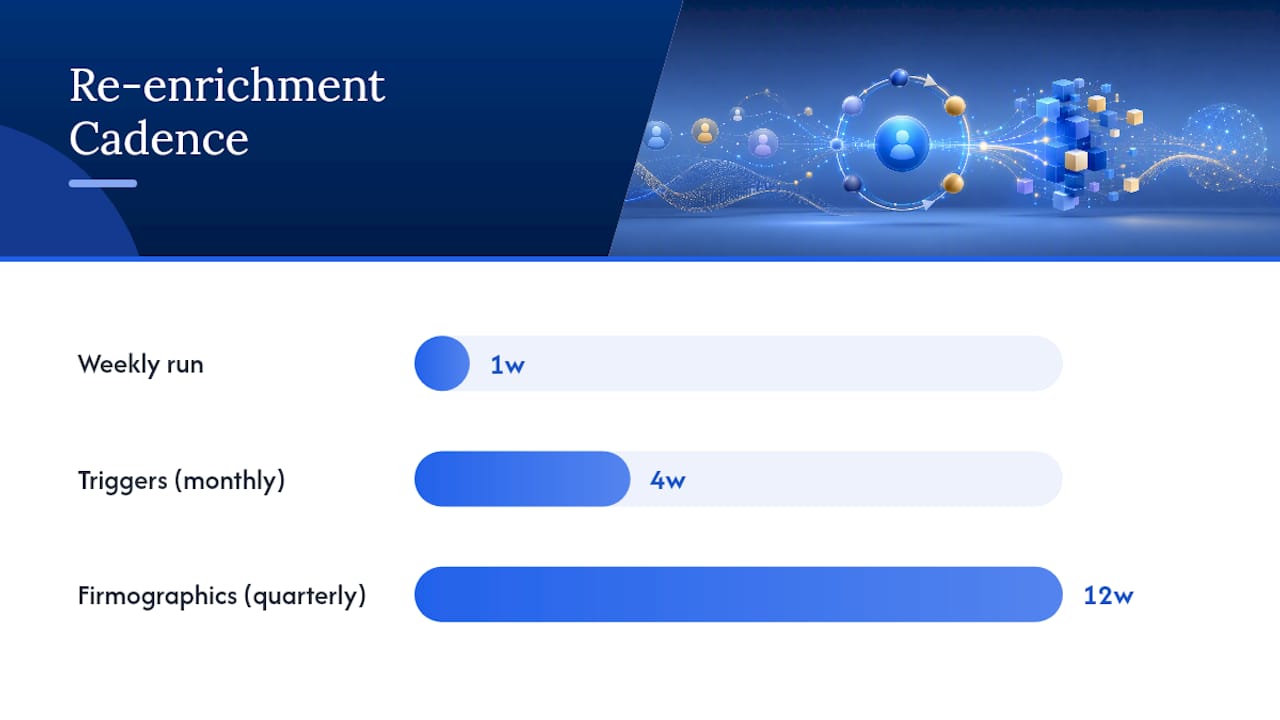
On cadence, treat different field types differently. Firmographics change slowly, so quarterly re-enrichment is usually sufficient. Triggers are time-sensitive and decay within weeks, so run that layer monthly at minimum. Your highest-value accounts deserve a manual verification pass every single run, regardless of how well the automated pipeline is performing. Automation should compound effort, not replace judgment on the accounts that matter most.
Accuracy Guardrails and Human-in-the-Loop Rules
Three controls separate a reliable AI enrichment pipeline from one that quietly damages your outreach credibility.
Point the agent at named sources. Don’t let it search the open web freely. Feed it a specific URL (the company’s homepage, a specific press release, a specific job posting) and require it to cite that source for any claim it returns. Open-ended web search dramatically raises hallucination risk.
Lock the output schema with an explicit “unclear” option. According to the Clay AI lead enrichment guide, designing prompts that return structured fields like icp_fit: high/medium/low and requiring an evidence_url for every positive claim is what keeps an agent honest. When the agent can’t find justification, force it to say so instead of guessing.
Require a verification pass before CRM writeback. No AI-enriched field should reach a sales rep’s screen without at least a sampled human check.
The sampling regime itself is straightforward: sample 10 percent of enriched rows, or one in ten, and check them against source material. If the sampled hit rate lands below 90 percent, stop scaling that field until you fix the prompt or source targeting. This threshold is a practical industry rule of thumb, not a formal standard, but it’s a workable bar for most teams running AI insights for leads at volume.
The human-in-the-loop rule that matters most: always hand-edit the top decile of accounts by deal size or strategic priority. Include the evidence URLs directly in outreach copy for these leads. A rep who can say “I saw your Series B announcement from last month” with a link behind it closes more meetings than one reciting an unsupported AI summary.
Integration and CRM Considerations for AI Lead Enrichment
Enrichment data that doesn’t map cleanly into your CRM creates more cleanup work than it saves. Map fields explicitly and canonicalize values (standardize industry naming, seniority tiers, and company size bands) before writing anything back. Avoid appending new custom fields nobody on the sales team actually uses.
Deduplication matters as much as the enrichment itself. Match incoming leads against existing records using multiple keys (domain, email, phone) rather than a single fragile identifier, and design writes to be idempotent so rerunning the same batch never creates duplicate records or overwrites a manually corrected field. Keep a change log for anything AI-generated so a rep can trace where a claim came from.
For throughput, batch large enrichment runs instead of firing calls one lead at a time, and cache results for accounts you’ve already processed recently to cut duplicate API costs. Review this alongside broader sales AI integration best practices before connecting any new enrichment layer to your CRM. One rule overrides convenience every time: verify the source behind any trigger-based field before it gets written to a live record.
How MediaBloom Approaches AI Lead Enrichment
Enrichment only pays off if the lead gets acted on fast, and that’s the gap MediaBloom is built to close. The platform pairs enrichment logic with omnichannel response across voice, chat, SMS, and email, so a lead that clears ICP and trigger checks moves straight into qualification and appointment booking without sitting in a queue.
Some clients have run this combined approach at scale, generating over 10,000 monthly leads across their programs. That volume only works because speed-to-lead and qualification logic run in the same system instead of being stitched across separate tools.
If you’re evaluating a demo, ask for MediaBloom’s integrations list, how evidence-linking works in practice, what verification rules gate a lead before it reaches a rep, and what onboarding support looks like in the first 30 days.
Practical Checklist and Trade-Offs
Run this sequence: clean the seed list, gate AI calls behind triggers, sample-check every batch, hand-edit the top decile, and measure speed-to-lead weekly. Expect process improvements (cleaner data, faster qualification) within a few weeks. Revenue lift from AI-driven lead scoring and better targeting typically takes a few months to show up clearly in pipeline numbers, since it depends on your sales cycle length as much as your enrichment quality.
— MediaBloom
How MediaBloom Can Help You Scale Enrichment and Outreach
Most teams trying to build this stack end up managing three or four separate vendors: a provider API, a waterfall tool, an AI research layer, and a workflow platform to stitch them together. One platform pairs enrichment logic with omnichannel response, appointment booking, and CRM integrations, so a qualified lead moves from enrichment to a booked meeting without a handoff gap.

The platform’s cold outbound campaign tools apply trigger detection and verification flows directly to pipeline generation, and managed onboarding means your team isn’t left configuring API keys and field mappings alone. Case results from programs like Fifth Avenue Leads and My Legal Coach show what an integrated setup looks like in practice.
When you book a demo, ask for a Speed-to-Lead walkthrough, one example enrichment row with evidence links, the integrations list, and sample SLAs for response time. Visit MediaBloom’s platform overview to schedule that conversation and see the workflow running against a real lead list.
Sources
These sources go deeper into the specific mechanics and cost trade-offs covered above.
- The Complete Guide to AI Lead Enrichment (2026) | Clay
- AI for lead research and enrichment in 2026: the workflow | Causo Hub
- What Is Lead Enrichment? A Practical Guide for B2B Sales | Leadfeeder
FAQ
What Is AI Lead Enrichment?
AI lead enrichment uses AI agents to research and reason about judgment fields, like ICP fit or trigger events, that static provider databases can’t reliably supply.
Should AI Run Before or After Provider Enrichment?
Run provider enrichment and a waterfall first for cheap, broad coverage, then reserve AI agents for the last-mile judgment fields providers can’t answer.
How Accurate Is AI-Enriched Data?
Accuracy varies by field type: firmographics from providers often exceed 85 percent accuracy, while AI-sourced role and seniority data typically lands between 60 and 75 percent, so human sampling matters most on the weaker fields.
What Sample Rate Should Teams Use for QA?
A common practical benchmark is sampling 10 percent of enriched rows and targeting at least a 90 percent hit rate before scaling that field further.
Can an Integrated Platform Replace a Multi-Vendor Enrichment Stack?
An integrated platform like MediaBloom pairs enrichment logic with omnichannel outreach and appointment booking, which suits teams that prefer one managed system over stitching together separate provider, waterfall, and AI tools.