A conversational AI platform is software that enables natural language interactions between humans and machines across text, voice, and multimodal channels. These systems go far beyond scripted chatbots. They understand context, remember prior exchanges, and generate responses that match the intent behind a question. For businesses evaluating enterprise conversational AI platforms, the decision is no longer whether to deploy AI-driven communication but which architecture best fits their operational needs. Mediabloom builds on this foundation, combining AI voice agents, chatbots, and sales automation into one system that generates over 10,000 monthly leads for clients like Miracle Ear and 1-800 Accountant.
How does a conversational AI platform work?
A conversational AI platform processes human input through three core layers: natural language processing (NLP), dialogue management, and response generation. NLP is the engine that converts raw text or speech into structured meaning. Dialogue management tracks the conversation state and decides what the system should do next. Response generation then produces a reply that fits the context.
The role of NLP in customer service AI is particularly significant. NLP models parse grammar, detect intent, and extract named entities from a sentence. Without NLP, a system cannot distinguish “I want to cancel” from “I want to cancel my appointment” versus “I want to cancel my subscription.” That distinction determines which workflow fires next.

Modern platforms handle multimodal inputs, meaning they process text, voice, and images within the same conversation thread. State-aware AI models dynamically adapt responses based on dialogue context, achieving greater user engagement and accuracy. That adaptability is what separates a true conversational AI assistant from a basic FAQ bot.
The architecture also includes integration layers that connect the AI to existing business systems. Conversational AI platforms integrate with hundreds of enterprise apps, including Gmail, Slack, and Salesforce, to automate workflows and customer interactions. That connectivity means the AI does not operate in isolation. It reads CRM data, updates records, and triggers downstream actions in real time.
Key components of a production-ready conversational AI system include:
- Intent recognition: Classifies what the user wants from each message
- Entity extraction: Pulls specific data points such as dates, names, and product codes
- Context management: Retains conversation history across multiple turns
- Dialogue policies: Determines the next best action based on current state
- API integration layer: Connects to CRM, scheduling, and messaging platforms
Pro Tip: Test any platform’s context retention by running a multi-turn conversation that references information from three exchanges back. If the system loses the thread, it will frustrate customers at scale.
What are the key use cases and benefits of conversational AI platforms in business?
Customer service automation is the most immediate application. A voice AI platform or chat agent can resolve tier-1 support issues around the clock without human intervention. Conversational AI automates workload by handling pre- and post-appointment tasks while offering multilingual, 24/7 support. That capability directly reduces staffing costs and wait times simultaneously.
Lead generation and appointment setting represent the second major use case. Conversational AI agents for customer service qualify prospects by asking structured questions, scoring responses, and routing high-intent leads to sales teams. Mediabloom’s platform executes this workflow across SMS, email, and chat, booking appointments without human involvement in the qualification stage.
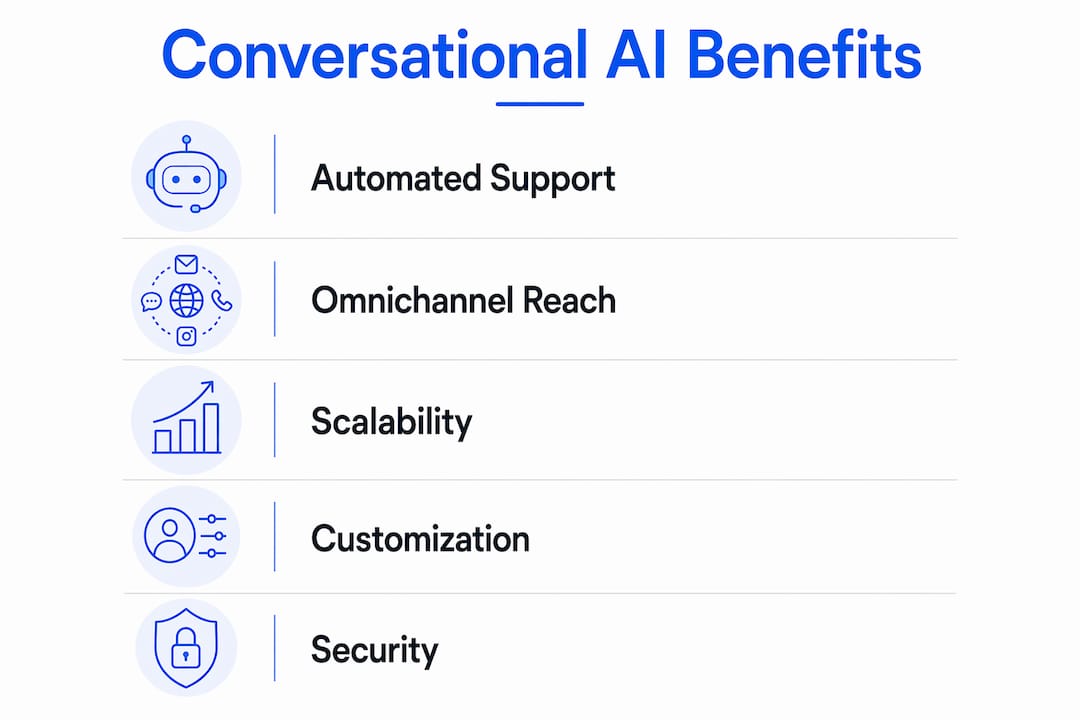
The business benefits extend across five concrete areas:
- 24/7 availability: AI agents handle inquiries at 3 a.m. with the same accuracy as during business hours, eliminating coverage gaps.
- Multilingual reach: Production platforms support dozens of languages, allowing businesses to serve global customers without hiring multilingual staff.
- Personalized engagement: AI systems pull CRM data to address customers by name, reference past purchases, and tailor recommendations.
- Workflow automation: Agents complete tasks such as order lookups, appointment confirmations, and payment reminders without human handoff.
- Operational cost reduction: Automating repetitive interactions frees human agents to handle complex, high-value cases that require judgment.
Conversational AI in retail shows how these benefits compound. A retail brand can deploy an AI agent that handles product questions, processes returns, sends shipping updates, and upsells related items, all within a single chat session. The customer gets a faster resolution. The business captures more revenue per interaction.
Stat to know: Intention-oriented multi-agent dialogue systems achieve over 95% response accuracy and deliver better personalized reasoning compared to general large language models. That accuracy gap matters when the AI is representing your brand in every customer conversation.
The omnichannel dimension is equally important. Businesses that deploy AI across a single channel miss the majority of customer touchpoints. A platform that unifies SMS, web chat, email, and voice into one conversation thread gives customers a consistent experience regardless of where they start.
What factors should businesses consider when choosing a conversational AI platform?
Platform selection is a structural decision, not a software purchase. The wrong choice creates technical debt that compounds over time. Evaluate each candidate across these dimensions before committing.
Scalability and enterprise readiness
Enterprise conversational AI platforms must handle volume spikes without degrading response quality. Ask vendors for documented performance benchmarks under peak load. Entry-level systems often perform well in demos but fail when concurrent sessions multiply.
Multimodal and state-aware reasoning
A platform that handles only text misses voice and image-based interactions. State-aware conversational AI demonstrates non-inferior management reasoning compared to physician-led care in multi-visit scenarios. That same context-tracking capability applies to business conversations where a customer contacts support across three different sessions.
Integration depth
The platform must connect to your existing CRM, ticketing system, and communication channels. Shallow integrations that require manual data exports defeat the purpose of automation. Prioritize platforms with native connectors to the tools your teams already use.
Customization and training
Generic AI models produce generic responses. A platform that allows domain-specific training produces answers that reflect your products, policies, and tone. Mediabloom’s system, for example, trains on client-specific data to qualify leads according to each business’s exact criteria.
Security and compliance
Businesses in regulated industries face strict data handling requirements. Healthcare organizations need HIPAA-compliant AI that protects patient data at every layer of the conversation. Financial services firms face similar obligations. Verify that the platform’s data storage, encryption, and audit logging meet your industry’s standards.
User experience and interpretability
Healthcare experts emphasize that conversational AI systems must provide interpretable reasoning grounded in clinical evidence to build user trust. The same principle applies in business. If your team cannot understand why the AI gave a particular response, they cannot correct it or trust it in high-stakes situations.
Pro Tip: Request a sandbox environment before signing any contract. Run your actual customer scenarios through it, not the vendor’s curated demos. Real-world edge cases reveal integration gaps that polished presentations hide.
The table below compares evaluation criteria across platform tiers:
| Evaluation criterion | Entry-level platforms | Enterprise platforms |
|---|---|---|
| Multimodal input support | Text only | Text, voice, and image |
| Context retention | Single session | Multi-session, state-aware |
| CRM integration | Manual export | Native, real-time sync |
| Compliance certifications | Basic | HIPAA, SOC 2, GDPR |
| Custom model training | Template-based | Domain-specific fine-tuning |
| Concurrent session capacity | Limited | High-volume, load-balanced |
How is conversational AI transforming healthcare operations?
Conversational AI in healthcare has moved from pilot projects to clinical validation. Multimodal AI platforms outperformed primary care physicians in diagnostic accuracy on 29 of 32 evaluation axes during telehealth consultations involving 105 simulated clinical cases. That result does not mean AI replaces physicians. It means AI-assisted triage and diagnosis can catch what a rushed 15-minute appointment might miss.
The applications span the full patient journey:
- Triage and symptom assessment: AI agents collect symptom data, assess urgency, and route patients to the appropriate level of care before a clinician is involved.
- Chronic disease management: State-aware AI models track patient-reported outcomes across multiple visits and flag deterioration patterns that warrant clinical review.
- Administrative automation: Scheduling, insurance verification, and post-visit follow-up consume significant staff time. AI handles all three without human input.
- Multilingual patient communication: AI agents communicate in a patient’s preferred language, reducing miscommunication in diverse communities.
- Personalized care guidance: Systems pull patient history to deliver tailored medication reminders, dietary guidance, and appointment preparation instructions.
The trust gap remains the central challenge. Clinicians accept AI recommendations more readily when the system explains its reasoning. Multi-agent dialogue systems that show their clinical logic, citing specific guidelines such as NICE or BMJ standards, earn higher adoption rates than black-box models that produce answers without explanation.
“Conversational AI platforms are rapidly transforming customer engagement by automating complex interactions beyond scripted chatbots, enabling 24/7 support and multilingual conversations.” Salesforce
Large language models with structured clinical reasoning align AI outputs with current practice guidelines and formularies. Retrieval-enhanced reasoning allows the system to pull the latest clinical evidence before generating a response, rather than relying on static training data. That architecture keeps the AI current without requiring full model retraining every time guidelines change.
Healthcare organizations evaluating AI for patient engagement should also consider the trust design principles that govern how patients perceive AI-generated communication. Transparency about AI involvement, clear escalation paths to human clinicians, and consistent branding all affect whether patients engage with or ignore AI-driven outreach.
Key takeaways
A conversational AI platform delivers measurable business value only when it combines state-aware NLP, deep system integration, and domain-specific training across every customer channel.
| Point | Details |
|---|---|
| NLP powers intent accuracy | Natural language processing converts raw input into structured intent, enabling precise automated responses. |
| State-aware reasoning drives engagement | Platforms that track conversation context across sessions produce more accurate and relevant replies. |
| Healthcare validation is real | Multimodal AI outperformed physicians on 29 of 32 diagnostic axes in a 105-case clinical study. |
| Integration depth determines ROI | Native CRM and workflow connections generate automation value; shallow integrations create manual workarounds. |
| Interpretability builds trust | AI systems that explain their reasoning earn higher adoption from both business teams and clinical staff. |
Mediabloom’s perspective on conversational AI adoption
The most common mistake businesses make when deploying conversational AI is treating it as a cost-cutting tool rather than a revenue-generating one. We have seen organizations automate their lowest-value interactions and declare success, while leaving the highest-impact use cases, lead qualification, appointment booking, and proactive outreach, entirely untouched.
The second mistake is underestimating the importance of conversation design. The AI model is only as good as the dialogue flows built around it. A technically advanced platform with poorly designed conversation paths will frustrate customers faster than a simpler system with well-crafted scripts. Businesses that invest in conversation design before launch consistently outperform those that treat it as an afterthought.
The healthcare data is worth taking seriously even if you operate outside that sector. The fact that a multimodal AI system outperformed primary care physicians on 29 of 32 diagnostic criteria tells you something important about where this technology is heading. The same reasoning capabilities that support clinical decision-making apply directly to complex sales conversations, multi-step customer service resolutions, and high-stakes qualification workflows.
One pattern we observe consistently: businesses that deploy AI across multiple channels simultaneously, rather than piloting on a single channel, see compounding returns. A customer who gets a consistent AI experience on SMS, web chat, and voice develops trust in the brand faster than one who encounters AI only in one place. Omnichannel deployment is not a luxury. It is the architecture that makes the investment worthwhile.
The future of conversational AI is not about replacing human judgment. It is about giving human teams the data, speed, and coverage they cannot achieve alone. The organizations that understand this distinction deploy AI as a force multiplier, not a headcount reduction strategy.
— Mediabloom
Mediabloom’s AI platform for business growth
Mediabloom deploys AI voice agents, chatbots, and sales automation for businesses that need to qualify leads and book appointments at scale. Clients like Miracle Ear and 1-800 Accountant generate over 10,000 monthly leads through Mediabloom’s omnichannel system, which manages customer interactions across SMS, email, and chat from a single platform.
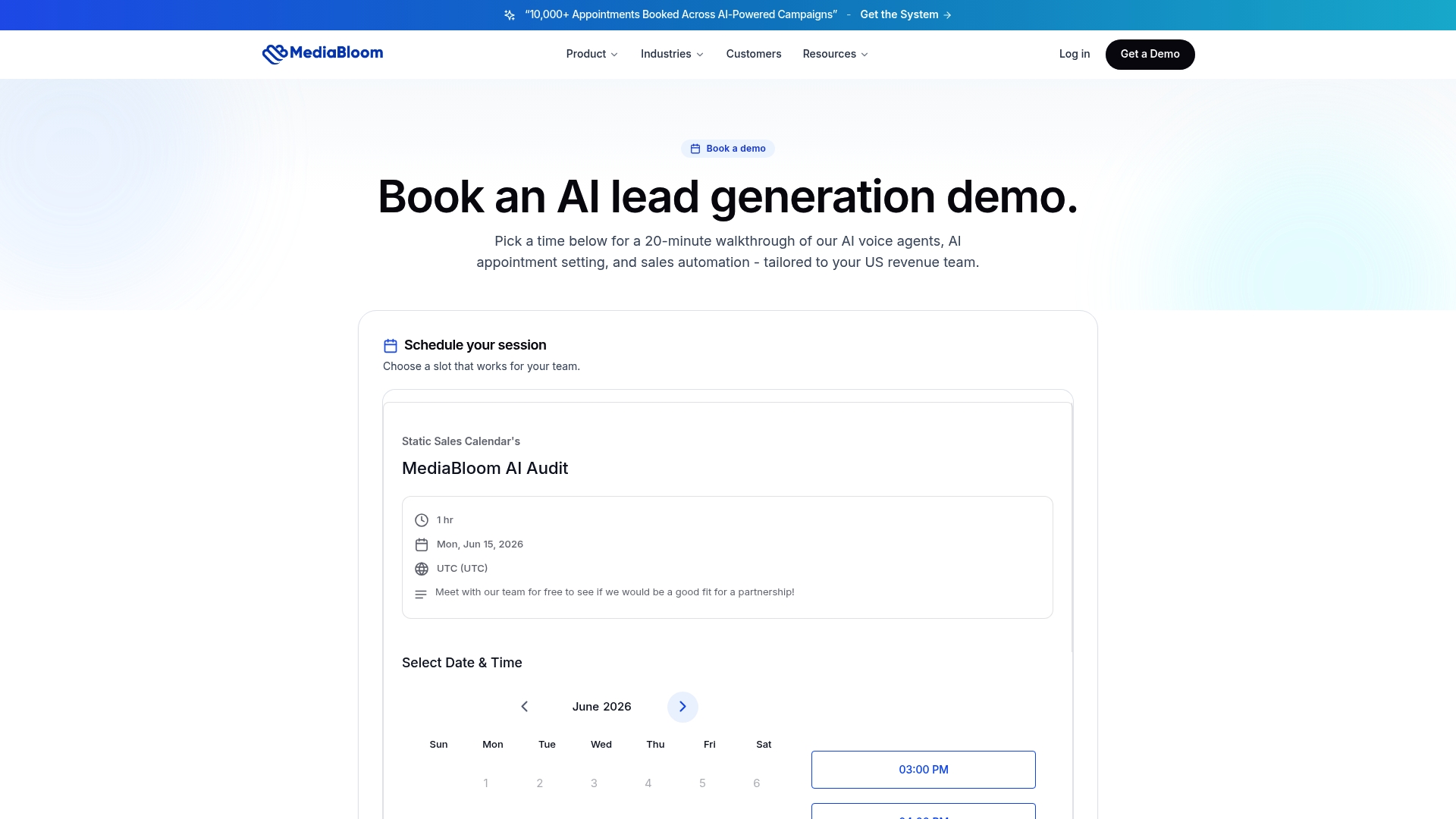
The customer service AI solution resolves tier-1 issues end-to-end, 24 hours a day, without human intervention. For businesses ready to see the results in action, the AI appointment setting case studies document exactly how clients moved from manual follow-up to fully automated lead pipelines. Schedule a demo to see how Mediabloom’s system performs against your actual customer scenarios.
FAQ
What is a conversational AI assistant?
A conversational AI assistant is software that understands natural language input, tracks conversation context, and generates relevant responses across text or voice channels. It differs from a basic chatbot by handling multi-turn conversations and adapting to user intent in real time.
How does NLP improve customer service AI?
NLP allows AI systems to parse intent, extract key data points, and classify customer requests accurately. Without NLP, automated systems cannot distinguish between similar phrases that require different responses or workflows.
What industries benefit most from conversational AI platforms?
Customer service, healthcare, retail, and financial services see the highest returns. Healthcare AI has demonstrated clinical-grade diagnostic accuracy in multimodal telehealth settings, while retail and financial services benefit from 24/7 automated support and lead qualification.
How do enterprise conversational AI platforms differ from entry-level tools?
Enterprise platforms support multimodal inputs, multi-session context retention, native CRM integration, and compliance certifications such as HIPAA and SOC 2. Entry-level tools typically handle text only, lose context between sessions, and require manual data exports.
How does conversational AI qualify sales prospects?
Conversational AI agents ask structured qualification questions, score responses against predefined criteria, and route high-intent prospects to human sales teams or directly to appointment booking. Mediabloom’s system executes this process across SMS, email, and chat without human involvement in the qualification stage.