The single biggest business benefit of AI conversation intelligence is this: it reclaims selling time and turns every customer conversation into searchable, actionable data instead of a lost recording. Companies deploying it report meaningful win-rate improvement and service-quality gains, while automating documentation that used to eat hours out of every rep’s week.
The measurable wins stack up fast:
- Hours reclaimed per rep, per week, from automated note-taking and CRM updates
- Higher win rates when coaching is built on real call patterns instead of guesswork
- CRM fields that populate automatically instead of sitting blank after every call
- Support and CX teams that catch friction points before they become churn
- Product and marketing teams that mine 100% of conversations for feature requests and messaging cues
Key Takeaways
AI conversation intelligence works because it converts unstructured conversations into structured, searchable data that directly improves win rates, CRM accuracy, and cross-team decision-making.
| Point | Details |
|---|---|
| Biggest benefit | Reclaims selling time and turns conversations into searchable business data automatically. |
| Track CRM completeness | Automated field population can push CRM completeness rates above 90% in reported cases. |
| Scope pilots by volume | Start with the highest-volume, worst-CRM-hygiene team for the fastest measurable payoff. |
| Watch accuracy limits | Audit transcripts for accents, jargon, and sarcasm to catch model drift early. |
| Mediabloom as the integration layer | Mediabloom pairs voice agents and chatbots with CRM sync and compliance readiness for a done-for-you pilot path. |
Table of Contents
- What Are the Business Benefits of AI Conversation Intelligence?
- How Does the Technology Turn Conversations Into Insight?
- What Measurable Benefits Should You Expect Across Teams?
- Where Does Conversation Intelligence Deliver Value by Team Size?
- What KPIs Prove the ROI of Conversation Intelligence?
- How Do You Roll Out Conversation Intelligence Without Losing Adoption?
- What Are the Limitations of Conversation Intelligence?
- What Do Real-World Results Look Like?
- When Does Conversation Intelligence Actually Pay Off?
- Start Your Conversation Intelligence Pilot With Mediabloom
- Sources
- FAQ
What Are the Business Benefits of AI Conversation Intelligence?
Conversation intelligence software captures voice, video, and chat interactions, then applies speech recognition and natural language processing to extract structure from what was said. It transcribes, tags speakers, detects sentiment and topics, and surfaces patterns a human reviewer would never catch across thousands of calls. That is the whole category in one sentence, and it’s worth being precise about it, because the term gets confused with two adjacent things it is not.

A meeting recorder saves audio and maybe a transcript. It doesn’t analyze anything. A conversational AI agent, like a voice bot or chatbot, actually talks to the customer and drives the interaction. Conversation intelligence sits behind both of those, analyzing the conversations that already happened (human-to-human or bot-to-human) and turning them into insight. It’s the analytics layer, not the engagement layer.
Core capabilities that separate a real conversation intelligence platform from a glorified transcript file:
- Transcription and speaker identification across every channel
- Sentiment and topic detection at the sentence level, not just call-level scoring
- Automatic extraction of action items and commitments made on the call
- CRM autofill that eliminates manual data entry after every interaction
- Real-time coaching prompts that surface during live calls, not in a report three days later
The distinction matters because buyers often shop for “AI conversation tools” expecting one thing and getting another. Knowing which layer you need determines whether conversation intelligence solves your problem or just adds another dashboard nobody opens.
How Does the Technology Turn Conversations Into Insight?
Every conversation intelligence platform runs the same basic pipeline, even when the marketing language differs from vendor to vendor.
- Capture. The system records or ingests voice calls, video meetings, and chat transcripts from wherever they originate, whether that’s a dialer, a video platform, or a messaging app.
- Speech-to-text. Automatic speech recognition converts audio into a timestamped, speaker-labeled transcript.
- NLP and machine learning analysis. Models score sentiment, flag topics, detect competitor mentions, and identify moments like objections, pricing discussions, or buying signals.
- Insight extraction. The platform aggregates patterns across calls, not just within a single call, to answer questions like “which objection kills more deals this quarter?”
- Integration and automation. Insights flow into the tools teams already use: CRM records auto-populate, ticketing systems get tagged, and follow-up emails get drafted from the call summary.
The integration step is where most of the practical value lives. A platform that analyzes conversations brilliantly but dumps insights into a standalone dashboard nobody checks delivers a fraction of the value of one that pushes updates directly into Salesforce, HubSpot, or a dialer queue. Vendor guidance across the category consistently points to the same conclusion: enterprise ROI comes from action, not from the data sitting there looking impressive.
Pro Tip: Audit a sample of transcripts monthly against the raw audio, especially for industry jargon or accented speech. Speech recognition accuracy drifts on domain-specific terms, and catching it early protects both coaching quality and CRM data integrity.
What Measurable Benefits Should You Expect Across Teams?
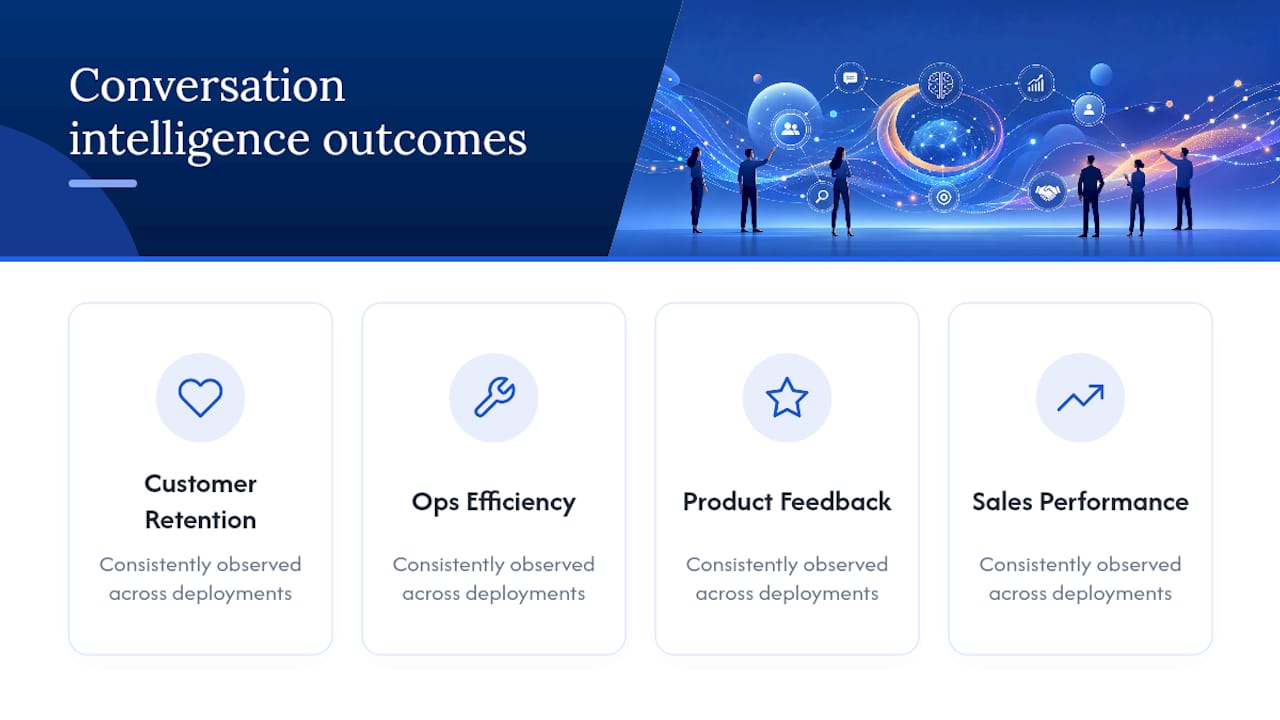
Conversation intelligence pays off differently depending on which team is using it, but four outcome categories show up consistently across deployments.
Revenue and sales performance
Sales leaders get the clearest ROI story. When coaching is built on actual patterns from top performers rather than a generic playbook, reps adopt behaviors faster. This is the same logic behind challenger and insight-based selling frameworks: identify what top performers do differently, then scale it. Conversation intelligence just automates the identification step across every call instead of relying on manager spot-checks.
- Coaching built on real call data → measurable win-rate lift over generic training
- Automated call scoring → managers spend review time on deals that need it, not every deal
- Talk-time and objection-pattern analysis → faster ramp for new hires
Customer experience and retention
Support and CX teams use the same technology to catch friction before it becomes a churn event. Sentiment tracking across every ticket, not a random sample, flags accounts trending negative weeks before a cancellation request lands.

Operational efficiency and documentation
Automating transcription, note-taking, and follow-up tracking cuts manual documentation dramatically in reported cases. Reps who used to spend evenings writing up call notes get that time back for actual selling.

Product feedback and marketing attribution
This is the benefit most executives underestimate. Because conversation intelligence analyzes every interaction rather than a sampled subset, product and ops teams can query 100% of conversations for recurring complaints, feature requests, or billing confusion. That turns anecdote into a searchable, prioritized backlog. Marketing teams mine the same data for messaging that actually resonates versus messaging that sounds good in a deck. Our guide on chatbots in the sales pipeline covers how these signals feed lead qualification upstream of the sales conversation itself.
Where Does Conversation Intelligence Deliver Value by Team Size?
The right starting point depends on team size and function, not just budget.
- Small sales teams (5 to 20 reps). The quick win is CRM accuracy and reclaimed admin time. A pilot scoped to auto-populate deal fields and draft follow-up emails often proves value within a single quarter.
- Customer service and contact centers. Quality assurance and call routing improve fastest here. Instead of reviewing 2% of calls manually, QA teams review flagged calls only, and route based on real-time sentiment detection.
- Product and marketing teams. These teams benefit most from cross-team access to the same conversation data, mining sales and support calls for feature requests and message testing without running a single new survey.
- Enterprise organizations. Compliance monitoring, unified analytics across regions, and standardized coaching across hundreds of reps become the priority, with governance and role permissions mattering as much as the AI itself.
Quick wins versus long-term programs look different in practice:
- Quick win: automated CRM autofill for a 10-person sales team, live within weeks
- Quick win: sentiment-flagged support calls routed to senior agents automatically
- Longer-term: a shared insight layer across sales, support, product, and marketing that becomes—as research on cross-functional knowledge sharing suggests—a genuine source of truth rather than four separate data silos
What KPIs Prove the ROI of Conversation Intelligence?
Building a defensible business case means tracking the right numbers from day one, not retrofitting metrics after the fact.
- Reclaimed seller hours per week, measured before and after automation of notes and follow-ups
- CRM completeness, where vendor reports show fields populated automatically can push completeness rates above 90%
- Win rate lift, tracked over a full sales cycle, not a single month
- Average handle time (AHT) for support teams, alongside first-contact resolution
- CSAT or NPS movement, tied specifically to accounts flagged by sentiment analysis
- Ramp time reduction for new reps onboarded with searchable call libraries instead of shadowing alone
Run a pilot with a defined baseline, a sample size large enough to matter (not three reps for two weeks), a minimum 60 to 90 day window, and a pre-agreed success threshold. Skipping the baseline is the single most common mistake that turns a good pilot into an inconclusive one.
How Do You Roll Out Conversation Intelligence Without Losing Adoption?
A rollout succeeds or fails on the boring parts, not the AI itself.
- Scope the pilot narrowly. Pick one team, one use case, and one integration point rather than trying to instrument the whole revenue organization at once.
- Map your integrations first. Confirm CRM, dialer, and ticketing system connections before training starts. Our sales AI integration guide walks through the common connection points revenue teams miss.
- Clean your data mapping. Decide which fields the AI updates automatically and which stay manual.
- Train users on the “why,” not just the “how.” Reps who understand the coaching value adopt faster than reps told to comply with a new tool.
- Update playbooks based on what the data shows, not what the sales methodology deck said two years ago.
- Set a measurement cadence. Weekly for pilot teams, monthly once at scale.
Governance deserves its own checkpoint: define data retention windows, confirm consent flows for recorded calls, set role-based permissions for who sees coaching data, and schedule quarterly reviews to retune models as language and products change.
Pro Tip: Assign one champion per team to review flagged calls weekly during the pilot. Adoption dies fastest when leadership treats the rollout as a one-time training event instead of an ongoing coaching habit. For broader change-management lessons, our customer service AI integration guide covers the friction points teams hit most often.
What Are the Limitations of Conversation Intelligence?
No platform gets this perfect, and pretending otherwise sets up a failed pilot.
- Speech recognition still struggles with background noise, heavy accents, and crosstalk on multi-party calls
- Domain-specific jargon (medical, legal, technical) needs custom model tuning or accuracy suffers
- Sentiment models are brittle around sarcasm and can misread a frustrated but polite customer as satisfied
- Intent detection produces false positives, flagging a hypothetical question as a real buying signal
Mitigate with periodic human audits of a call sample, conservative automation thresholds for anything customer-facing, and redaction rules for sensitive data before transcripts get stored or shared broadly.
What Do Real-World Results Look Like?
Mediabloom’s work with clients like Fifth Avenue Leads shows the pattern: when conversation data feeds directly into automated follow-up and CRM workflows, lead response time drops and booked appointments climb without adding headcount. One client using automated call analysis to route service calls saw agents spend less time on manual notes and more time resolving the actual issue on the first call.
Industry-wide, the signal is consistent across sources:
- Reported reductions in manual documentation time when transcription and note-taking are automated
- CRM completeness rates climbing sharply when conversation data autofills fields instead of relying on reps to type it in
- Product teams identifying recurring friction points across 100% of support calls instead of a sampled handful
The Mediabloom numbers are proprietary results from client deployments. The documentation and CRM figures come from independent industry research. Keeping that distinction clear matters when you’re building your own business case internally.
When Does Conversation Intelligence Actually Pay Off?
Conversation intelligence delivers the most value when three conditions line up: high conversation volume, cross-team dependence on the same customer signals, and a CRM that’s currently a mess because reps skip manual entry.
It pays off more slowly for low-volume, highly manual niche processes, like a five-person team closing two enterprise deals a quarter through relationship-driven, largely offline conversations. There simply isn’t enough data volume to make pattern detection meaningful yet.
My decision rule: scope your pilot around the team with the highest conversation volume and the worst CRM hygiene, not the team leadership cares most about politically. Set success criteria before you start, and give it a full quarter before judging the result.
Start Your Conversation Intelligence Pilot With Mediabloom
Mediabloom’s platform combines AI voice agents, chatbots, and multi-channel automation with the CRM integrations and compliance groundwork (TCPA, SOC 2, HIPAA-ready) that make conversation intelligence usable on day one, not month six.
Instead of stitching together a transcription tool, a separate analytics dashboard, and manual CRM updates, Mediabloom’s chatbot and voice automation platform connects the conversation directly to the follow-up, the appointment booking, and the CRM record in one workflow. Clients like My Legal Coach have used this integrated approach to convert conversation data into booked appointments without adding staff. If you’re weighing analytics add-ons or point solutions, decision-intelligence partners like The Intent Ledger offer complementary pipeline visibility worth exploring alongside a done-for-you platform.
Starting is straightforward: book a demo, scope a pilot around your highest-volume team, measure against the KPIs outlined above for 60 to 90 days, then scale what works. Explore Mediabloom’s case studies to see deployment patterns across industries before your first call.
Sources
- Conversation intelligence: The complete guide for 2026
- Research: How virtual teams can better share knowledge
- Challenger Sale (Gartner)
FAQ
What are the main benefits of using conversation intelligence?
The core benefits are reclaimed selling time, higher win rates from data-driven coaching, cleaner CRM data through automated field population, and a searchable feedback loop for product and marketing teams.
What is the main purpose of conversational AI in business?
Conversational AI agents like voice bots and chatbots handle live customer engagement, while conversation intelligence analyzes those and other interactions afterward to extract coaching, CX, and operational insights. Mediabloom combines both layers in one platform.
What are the top benefits companies see from AI adoption in customer service?
Reported gains include faster average handle time, improved CSAT through sentiment-flagged escalations, reduced manual documentation, and more consistent quality assurance across every call instead of a small sampled subset.
How accurate is AI conversation intelligence?
Accuracy is strong for clear audio and common language but drops with background noise, heavy accents, or domain-specific jargon, which is why periodic human audits and conservative automation thresholds matter.
Does conversation intelligence work for small sales teams, or only enterprise?
It works for both, though the entry point differs: small teams typically start with CRM autofill and reclaimed admin time, while enterprises prioritize compliance monitoring and unified analytics across large rep populations.