Proactive AI customer outreach is automated communication that anticipates a customer’s need and contacts them before they ever have to reach out. Instead of waiting for a support ticket, the system detects a signal, a shipping delay, a failed payment, a usage drop, and initiates contact on its own. Companies that deploy it well see real financial return: 62% of businesses using proactive outreach cite revenue generation as a primary benefit, with some reporting an 18% average revenue lift and 81% reporting improved customer satisfaction. The biggest shift in 2026 is agentic AI: systems that don’t just flag a problem, they decide what to do about it and act.
- Proactive means the business initiates contact, not the customer
- AI systems watch for triggers across CRM, order, and product data
- Agentic AI can act autonomously within approved guardrails
- Outcomes tracked include revenue, CSAT, and deflection rate
Key Takeaways
Proactive AI customer outreach works when agentic systems act on real CRM and product data under clear human-in-the-loop approval gates, not when they replace judgment entirely.
| Point | Details |
|---|---|
| Definition | Proactive AI outreach means the business contacts the customer first, triggered by a detected signal rather than a complaint. |
| Proven revenue impact | 62% of companies cite revenue as a primary benefit, with an 18% average uplift among reporting firms. |
| Agentic AI is the differentiator | Agentic systems act autonomously across channels and can significantly reduce assisted-channel incidence ratios. |
| Governance is non-negotiable | Confidence thresholds and human approval for consequential actions prevent costly automation mistakes. |
| Mediabloom as a starting point | Mediabloom runs voice, SMS, chat, and email outreach on one platform with CRM integrations across 600+ tools. |
Table of Contents
- What Triggers Proactive AI Outreach, and Which Channels Work?
- Does Proactive Outreach Actually Improve Revenue and CSAT?
- How Does Agentic AI Power Proactive Outreach?
- What Does a Proactive AI Outreach Pilot Checklist Look Like?
- Which KPIs Prove Proactive AI Outreach Is Working?
- What Are the Risks of Proactive AI Outreach?
- How Does Mediabloom Handle Proactive AI Outreach?
- Why Governance Determines Whether Proactive Outreach Works
- Ready to Pilot Proactive AI Outreach?
- Sources
- FAQ
What Triggers Proactive AI Outreach, and Which Channels Work?
Reactive support waits for the customer to complain. Proactive outreach flips that: the business speaks first, based on a signal the customer may not even know about yet.
Common triggers include:
- Usage anomalies — a customer’s login frequency or feature use drops sharply, signaling churn risk.
- Shipping or fulfillment delays — the order system flags a missed carrier scan.
- Fraud signals — a transaction pattern trips a risk score.
- Stalled checkout — a shopper abandons a cart at the payment step.
These triggers only mean something if the AI can see them. That requires connecting the CRM, order management systems, product usage monitoring, and identity resolution tools so the same customer is recognized across every channel. Channel choice matters as much as the trigger itself: SMS suits urgent, time-sensitive alerts like delivery windows; email works for detailed follow-ups or documentation; chat fits in-product nudges; voice is reserved for high-stakes moments like fraud verification or appointment confirmations, where a human tone reduces friction.
Does Proactive Outreach Actually Improve Revenue and CSAT?
The evidence is stronger than most marketing teams assume. It’s not just a satisfaction play, it moves revenue.
62% of companies using proactive outreach name revenue generation as a primary benefit, with an average lift of 18% among reporting firms, and 81% cite improved CSAT as a direct result, according to TechTarget.
The mechanism behind those numbers is straightforward:
- Resolving issues before a complaint prevents the frustration that erodes loyalty
- Timely, relevant contact creates upsell and renewal moments competitors miss
- Fewer inbound tickets free human agents for higher-value, proactive work
McKinsey’s research on AI-enabled customer service adds an operations angle: agentic AI programs integrated with CRM and product data can significantly reduce assisted-channel incidence ratios. That’s a meaningful cost reduction on top of the revenue and satisfaction gains, but it only materializes when the AI has real data to work with, not generic scripts.
How Does Agentic AI Power Proactive Outreach?
The operational flow behind proactive outreach follows a consistent pattern: detect a signal, assess its impact, select the right channel, then either act automatically or escalate to a human. What separates 2026 systems from earlier chatbot deployments is the “act” step.

Non-agentic AI recommends. Agentic AI decides and executes. It can autonomously manage an entire workflow, identifying a qualified lead, sending a personalized message, adjusting tone based on response, and closing the loop, all without a human writing each step. It also learns from outcomes, adapting future outreach based on what worked last time.
Concrete examples where this plays out:
- Outage messaging: the system detects a service disruption and proactively notifies affected accounts with an estimated resolution time, rather than waiting for a flood of support tickets.
- Fraud verification: a suspicious transaction triggers an automated voice or SMS check with the customer before the charge completes.
- Outbound sales sequences: AI analytics identify next-best customers and initiate a qualification conversation, a use case now common enough that A significant portion of organizations run outbound sales through proactive AI contact…
None of this works without CRM integration. An agent that doesn’t know a customer already called about a billing issue yesterday will re-trigger the same outreach today, and that mistake is what makes proactive contact feel intrusive instead of helpful.
Pro Tip: Before evaluating any agentic AI vendor, ask them to demonstrate how the system handles a customer who already contacted support through a different channel. If the answer is vague, the integration isn’t ready.
What Does a Proactive AI Outreach Pilot Checklist Look Like?
Running a pilot without a plan is how proactive outreach turns into spam. Here’s a sequence that keeps the first deployment small, measurable, and reversible.
- Pick one high-value, predictable use case. Shipping delays, fraud alerts, or onboarding nudges work well because outcomes are easy to define and deflection is measurable.
- Verify data readiness. Confirm the required fields exist, identity resolution links a customer across systems, and the triggering event data is fresh enough to act on, not hours stale.
- Assign ownership. A Customer Experience Manager should own the evidence package: source records, affected customer IDs, timestamps, and the confidence score behind each recommended action.
- Set a confidence threshold. Below it, the system routes to a human for approval before any message goes out.
- Design the test. Use a control group that receives no proactive contact, define your success criteria upfront (verified completion rate, revenue lift, CSAT change), and set a rollback rule if early results show subgroup harm.
Keep the initial sample size modest, big enough to detect a real signal, small enough that a mistake doesn’t reach your whole customer base. For teams weighing where AI fits into the broader integration stack, this guide to customer service AI integration challenges covers the technical prerequisites in more depth.
Pro Tip: Run the pilot for at least one full billing or service cycle before judging results. Early wins from urgent triggers (like fraud) don’t predict performance on slower-moving triggers (like renewal nudges).
Which KPIs Prove Proactive AI Outreach Is Working?
Four metrics matter most: verified completion rate (the message resolved the issue without a follow-up contact), revenue uplift, CSAT change, and deflection rate (tickets avoided).
- Track verified completion rate by case type and customer subgroup to catch bias before scaling
- Use a test/control holdout design so lift is measured against customers who received no proactive contact, not just before/after comparisons
- Watch early-signal metrics in the first two to four weeks: response rate and opt-out rate flag channel or tone problems fast
The 18% average revenue increase reported by some firms is a useful benchmark, but treat your own pilot’s control-group comparison as the number that actually justifies scaling.
What Are the Risks of Proactive AI Outreach?
Proactive outreach fails in predictable ways: messages that feel intrusive, contact through the wrong channel, or automated actions taken on low-confidence signals. Each is preventable with the right guardrails.
- Require explicit customer consent and practice data minimization, only pull the fields the trigger actually needs
- Keep a recordkeeping trail for every automated message, in case of disputes or audits
- Set human-in-the-loop checkpoints for consequential actions (refunds, cancellations, anything touching finance or safety), so low-confidence decisions route to a person instead of executing automatically
How Does Mediabloom Handle Proactive AI Outreach?
Mediabloom’s platform runs proactive outreach across voice, SMS, chat, and email from a single system, so a fraud alert or a stalled lead doesn’t fall between disconnected tools. It connects to more than 600 CRM platforms, keeping context consistent across every touchpoint, and is built with TCPA, SOC 2, and HIPAA readiness for regulated industries.
- Businesses like Miracle Ear and 1-800 Accountant run lead generation and appointment setting through the platform
- Combined client deployments generate over 10,000 monthly leads
- A managed pilot includes onboarding, integration setup, and ongoing performance tracking
A pilot with Mediabloom looks like the checklist above in practice: one use case, clear ownership, and measurable results before any decision to scale.
Why Governance Determines Whether Proactive Outreach Works
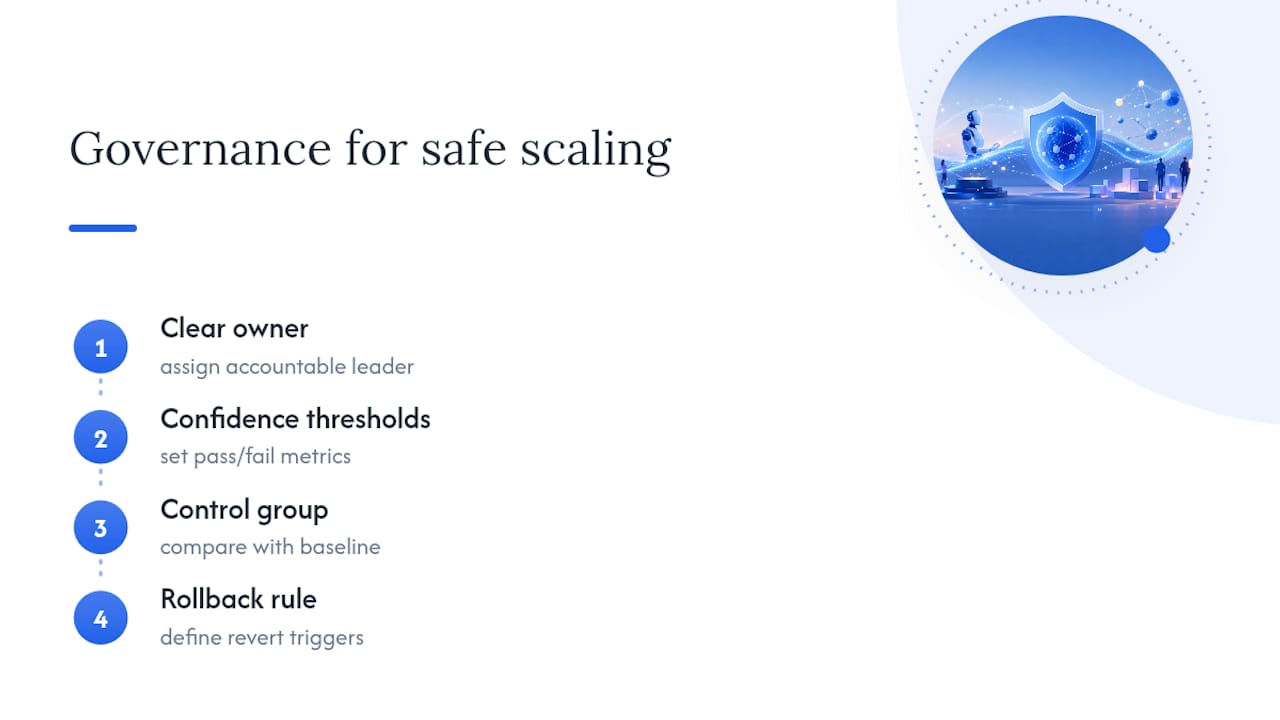
Most proactive AI programs don’t fail on technology, they fail on discipline. Teams chase the agentic capability before they’ve built the confidence thresholds and evidence trail that make automation safe to trust. Mediabloom has seen that the pilots which scale are never the flashiest; they’re the ones with a clear owner, a control group, and a rollback rule from day one.
Ready to Pilot Proactive AI Outreach?
If you’re comparing options for proactive outreach, the standard path is a patchwork: one tool for chat, another for SMS campaigns, a separate voice vendor, and a CRM integration project stitched together by an internal team. Mediabloom replaces that patchwork with a single all-in-one platform that runs voice agents, chatbots, and campaign automation from the same data layer, so the fraud alert your voice agent handles today is visible to the SMS follow-up tomorrow.

A Mediabloom-managed pilot includes onboarding, integration with your existing CRM, and ongoing performance tracking against the KPIs covered above, verified completion rate, revenue uplift, and CSAT. You can review documented outcomes on the case studies page or see how the chatbot layer fits into a broader outreach strategy. If cold outbound and lead qualification is your priority use case, start with Mediabloom’s cold outbound campaigns and request a demo to scope a pilot around your highest-value trigger.
Sources
- Proactive customer service drives satisfaction and revenue
- The next frontier of customer engagement: AI-enabled customer service
- How AI agents deliver proactive customer success
FAQ
What Is Proactive AI Customer Outreach?
It’s automated communication that identifies a customer need or issue from data signals and reaches out before the customer contacts support, often using agentic AI to act on that signal directly.
How Is Proactive Outreach Different From Reactive Support?
Proactive outreach starts with the business detecting a trigger and initiating contact; reactive support starts when the customer files a ticket or call.
What Results Can Businesses Expect From Proactive AI Outreach?
What Is Agentic AI in the Context of Outreach?
Agentic AI can autonomously decide and execute a full outreach workflow, from detecting a trigger to messaging and closing the loop, rather than just recommending an action for a human to send.
Does Mediabloom Support Proactive AI Outreach?
Yes. Mediabloom runs proactive outreach across voice, SMS, chat, and email from one platform, with CRM integrations across 600+ systems and compliance readiness for regulated industries.