In 2026, a clever subject line is no longer enough to save your outreach from the p=reject DMARC graveyard. If you want to improve email open rates, your technical infrastructure must be as sharp as your copy. You've likely felt the sting of declining ROI as sophisticated AI filters block legitimate sales efforts. It's a common struggle to maintain a clean domain reputation when every sent message feels like a gamble against a black-box algorithm. You need a system that ensures your voice is actually heard in a world where 376 billion emails are sent every single day.
This guide provides the exact blueprint to master the technical and psychological frameworks required to bypass modern AI filters. Secure consistent 30% plus open rates. Protect your domain reputation. Integrate your outreach seamlessly with your CRM. We'll examine mandatory authentication protocols like BIMI and DMARC, the transition from vanity metrics to revenue-focused KPIs, and the hyper-personalization strategies that define high-performance sales teams. Stop guessing. Start engineering your inbox placement for maximum scalability.
Key Takeaways
- Adapt to the AI Filter Era by shifting focus from outdated spam triggers toward modern behavioral engagement scoring.
- Deploy a mandatory technical stack including SPF, DKIM, and DMARC to protect your domain reputation and improve email open rates.
- Move beyond basic personalization tokens by leveraging AI to generate high-relevance context at scale for every prospect.
- Implement a Zero-Tolerance list hygiene protocol and a 90-day sunset policy to maintain peak deliverability and sender authority.
- Construct a self-optimizing engine that integrates AI voice agents and automated email sequences into a unified CRM-driven feedback loop.
The 2026 Email Landscape: Why Traditional Tactics Fail
The era of "volume over value" has officially collapsed. In 2026, inbox providers use neural networks to categorize mail before it even hits the server. If you want to improve email open rates, you can't rely on 2020 era hacks. Modern filters prioritize behavioral engagement scoring over simple keyword blacklists. They track how often recipients move your mail to folders, reply, or delete without reading. "Batch and blast" isn't just inefficient; it's a terminal threat to your domain health. A single spike in unauthenticated bulk mail can trigger a permanent p=reject policy across major providers. Your email open rate is now a direct reflection of your technical credibility and historical engagement.
To better understand this concept, watch this helpful video:
The Rise of AI-Powered Inbox Gatekeepers
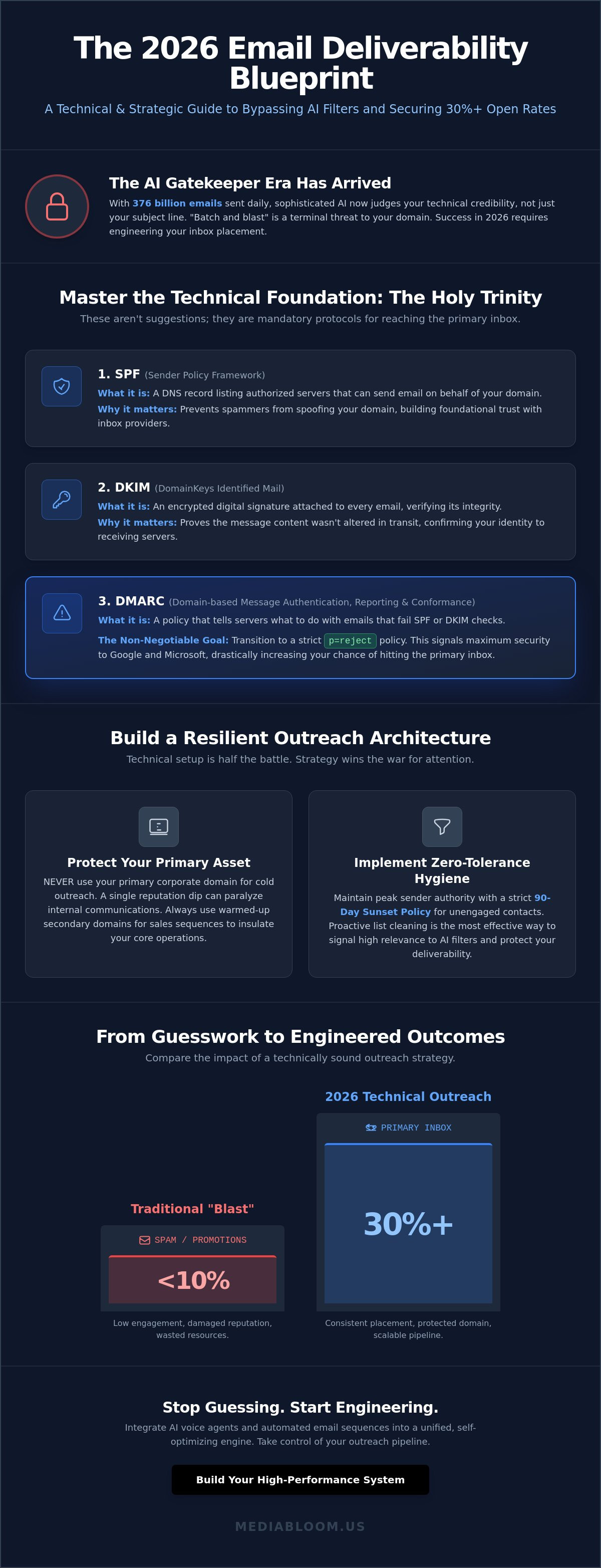
Machine learning models now scan for intent. They analyze the semantic relationship between the sender and the receiver. High sender authority is non-negotiable in this ecosystem. If your domain lacks SPF, DKIM, or DMARC authentication, you're dead on arrival. Providers identify red flags like mismatched metadata, low reply rates, and sudden volume fluctuations. This isn't about avoiding a list of "spam words." It's about demonstrating that your outreach is expected, relevant, and valuable. When you fail these technical checks, your messages are diverted to the "Promotions" tab or blocked entirely, stalling your sales engine before it starts.
The Psychological Shift in Prospect Behavior
Prospects have developed a natural immunity to clickbait. Deceptive subject lines that "tease" information lead to immediate unsubscribes and spam reports. This behavior destroys your sender score. You need "zero-friction" subject lines that respect the recipient's time and provide clear value upfront. Email is no longer an isolated event; it's a foundational component of automated lead nurturing. High-velocity sales teams use these touchpoints to build trust rather than just grabbing attention. When you align your technical delivery with psychological relevance, your pipeline velocity accelerates because your prospects actually see your message. To improve email open rates, you must treat the inbox as a high-stakes environment where every unread message is a wasted resource.
Master the Technical Foundation: Authentication and Deliverability
To improve email open rates, you must prioritize technical deliverability over creative flair. Domain reputation is the bedrock of 2026 outreach. You can spend weeks crafting compelling subject lines, but if your technical foundation is cracked, those messages won't even reach the inbox. In the current landscape, your sender identity is more valuable than your creative content. High-volume sales organizations must treat their email infrastructure like a precision engine. Neglecting these protocols leads to immediate blacklisting and wasted operational resources.
The Holy Trinity: SPF, DKIM, and DMARC
DMARC stands as the ultimate protocol for sender verification in 2026. It provides a set of instructions for receiving servers when an email fails authentication checks. Setting up DKIM (DomainKeys Identified Mail) is equally critical. It attaches a digital signature to every message, proving it hasn't been altered during transit and boosting overall trust. Transitioning to a "Reject" policy (p=reject) in your DMARC record is now a non-negotiable requirement to improve email open rates. This strict setting signals to providers like Google and Microsoft that you maintain rigorous security standards, which significantly increases your chances of hitting the primary inbox instead of the spam folder.
Domain Warming and IP Reputation Management
Never use your primary corporate domain for cold outreach. It's a high-risk strategy that can paralyze your company's internal communications if your reputation dips. Instead, deploy secondary domains specifically for sales sequences. Every new domain requires a 30-day warm-up period. Start with a handful of manual emails and gradually increase volume to signal natural, human-like growth to AI filters. Monitor your "Sender Score" and Google Postmaster Tools daily. These metrics provide the telemetry needed to adjust your sending speed before you hit a spam trap or trigger a rate limit.
Use this checklist to verify your technical health:
- SPF Records: Ensure all authorized sending IPs are included.
- DKIM Keys: Verify that keys are correctly rotated and active.
- DMARC Status: Confirm your policy is set to "quarantine" or "reject".
- BIMI Configuration: Deploy a verified brand logo to increase visual trust.
- Reverse DNS: Check that your IP address points back to your domain.
This infrastructure is a core component of our data-driven email marketing blueprint. Without a stable foundation, your AI-driven strategies will fail to gain traction. If you're unsure whether your current stack is compliant, you should audit your technical setup with a team of automation experts.
Beyond Subject Lines: Leveraging AI for Hyper-Personalization
Stop using basic merge tags. They're a liability. To improve email open rates, you must deploy hyper-personalization at scale. This isn't just about inserting a first name or a company title. Those are legacy tactics that readers now recognize as automated red flags. Hyper-personalization uses machine learning to synthesize disparate data points into a cohesive, high-relevance narrative. You're moving from "sending a campaign" to "delivering a tailored solution." In 2026, the recipients' inbox is a crowded battlefield. Only the most relevant messages survive the initial scan.
Traditional tokens are static and predictable. AI-generated context is dynamic and authoritative. By analyzing recent company filings, social activity, or industry shifts, AI builds a bridge between your solution and the prospect's current reality. This strategy aligns with academic research on email marketing performance, which highlights how authority and relevance drive engagement. You're no longer just another salesperson; you're a strategic architect offering specific value. This level of sophistication achieves "Human-Parity," where the recipient can't distinguish between an AI-drafted message and a manual note from a senior executive.
AI-Generated Contextual Openers
Use AI to scrape LinkedIn profiles, SEC filings, and recent news cycles for hooks that feel genuinely human. Your opener must pass a "Three-Point" check to be effective. It has to relate to the individual's recent professional activity, their company's broader trajectory, and a specific friction point in their current workflow. Relevance is the 2026 alternative to "catchy" subject lines. Catchy is often perceived as annoying or deceptive. Relevant is perceived as indispensable. When the preview text shows a genuine insight into the prospect's world, you'll improve email open rates because you've earned their attention before they even click.
Dynamic Send-Time Optimization (STO)
Stop sending emails based on broad time zones or "best day to send" myths. Use AI to predict individual behavior. Dynamic Send-Time Optimization ensures your message lands at the top of the inbox exactly when a specific prospect is most likely to be active. This drastically reduces "dwell time," the period where your email sits unread and gets buried by newer incoming mail. The less time it spends sitting idle, the higher the probability of an immediate open. AI tracks these interaction patterns across millions of data points to find the perfect window for every lead.
This synchronization is most powerful when integrated with your broader ai voice agent strategy. Multi-channel synchronization ensures your email isn't a cold shout in the dark. It becomes part of a coordinated, "Human-Parity" outreach cycle. You're building a self-optimizing engine that learns from every interaction. When your email arrives at the perfect moment, supported by a voice follow-up or a chatbot interaction, you create a seamless revenue operations workflow that scales without losing the personal touch.
Strategic List Architecture: Segmentation and Hygiene Protocols
Your list is the fuel for your revenue engine. If that fuel is contaminated with inactive leads or spam traps, your entire outreach machine will seize up. A refined list architecture is the most direct way to improve email open rates in 2026. High-performance sales teams must adopt a Zero-Tolerance policy for inactive subscribers. This means purging any contact that hasn't engaged with your content in the last 90 days. This 90-day Sunset Policy ensures your sender score remains high and your messages land in the primary inbox. Managing these complex hygiene protocols is a core responsibility of a b2b email marketing agency that understands the technical stakes of modern deliverability.
Automating List Hygiene with CRM Workflows
Manual list cleaning is an obsolete practice. You need automated workflows that integrate directly with your CRM to maintain a pristine database. Connect tools like ZeroBounce or Never-Bounce to your lead intake forms for real-time validation. This prevents invalid addresses from ever entering your system. You must also build logic that automatically flags and removes "Honey Pot" or "Spam Trap" addresses. These are deceptive records designed by inbox providers to identify and blacklist bulk senders. By validating leads at the point of capture, you eliminate the risk of high bounce rates before they can damage your domain. It's a proactive defense strategy for your digital infrastructure.
Micro-Segmentation for Precision Outreach
Generic industry or title-based segments are no longer sufficient. To achieve 50% plus open rates, you must pivot to intent-based micro-segmentation. This involves using CRM data to identify prospects who have shown specific behaviors, such as visiting a pricing page or downloading a technical whitepaper. When your subject line addresses a specific, real-time action, your relevance skyrockets. This level of precision is how top-tier teams improve email open rates while maintaining a pristine domain reputation. Effective micro-segmentation relies heavily on crm automation to trigger sequences based on behavioral signals. You're not just sending mail; you're responding to a prospect's digital body language.
Precision architecture is the difference between a scaling revenue engine and a stalled campaign. If your current list is bloated with unengaged leads, it's time to re-engineer your approach. You can optimize your list architecture today to ensure your outreach remains competitive and compliant.
Building the Self-Optimizing Engine: The MediaBloom Approach
MediaBloom treats technology as a foundational component of your business architecture. We don't just provide tools; we build an "Automated AI Workforce" designed for operational excellence. High-performance sales teams understand that the effort to improve email open rates is just one gear in a much larger machine. In 2026, success requires a shift from chasing vanity metrics to mastering Revenue Operations (RevOps). This transition ensures that every digital interaction feeds back into a centralized intelligence system, refining your strategy in real-time and driving tangible growth.
The goal isn't just to get an email seen. It's to create a self-correcting feedback loop. When your email sequences are integrated with your broader CRM, every open and reply becomes a data point that optimizes the next touchpoint. This systematic approach eliminates the inefficiencies of manual outreach. You're building a revenue engine that gains momentum with every lead it processes. To truly improve email open rates at scale, you must move beyond isolated campaigns and adopt a holistic, automated infrastructure.
Integrating Email with AI Voice and Chat
Multi-channel synchronization is the ultimate force multiplier for sales teams. A strategic follow-up from an AI voice agent can serve as a psychological prompt, driving a prospect to search their inbox for your specific message. This creates a sense of brand authority and urgency before the recipient even clicks. Simultaneously, ai chatbots handle preliminary lead qualification on your site, ensuring your email sequences are reserved for high-intent prospects. This synergy creates a seamless experience where the prospect feels consistently supported by a competent, "Human-Parity" system.
Scaling with Data-Driven Certainty
MediaBloom utilizes predictive analytics to optimize campaign performance with mathematical precision. This isn't a "set and forget" tool; it's a "Done-For-You" automated sales pipeline that evolves based on recipient behavior. Our systems analyze engagement patterns to identify which segments are most likely to convert, allowing you to allocate resources with total certainty. You get a high-performance sales machine that operates 24/7 without the overhead of a massive human team. To see this infrastructure in action and understand how it can transform your outreach, you can Watch a Demo of our proprietary sales engine.
The ultimate competitive advantage in the 2026 landscape is a custom CRM automation setup. It serves as the brain of your operation, managing the technical protocols, the hyper-personalization, and the multi-channel synchronization discussed throughout this guide. Stop fighting against AI filters with outdated tactics. Build an architecture that bypasses the noise and delivers results. Reach out to our team to architect your automated future today.
Master the Future of Sales Outreach
The 2026 inbox is a high-stakes environment where only the most technically sound and relevant messages survive. You've seen how mandatory authentication and AI-driven hyper-personalization have replaced the "batch and blast" tactics of the past. To truly improve email open rates, your organization must pivot toward a holistic, automated infrastructure that treats deliverability as a prerequisite for growth. Success now depends on the seamless integration of technical protocols, behavioral triggers, and strategic list hygiene. You can't afford to leave your domain reputation to chance in this competitive landscape.
MediaBloom provides the architectural expertise required to dominate this environment. We specialize in custom AI and CRM workflows that turn fragmented outreach into a synchronized revenue engine. By deploying human-parity AI voice agents and automated lead nurturing, we ensure your sales pipeline operates with total efficiency and precision. It's time to stop reacting to algorithm changes and start engineering your own data-driven revenue growth. Your competitors are already adopting these standards. Don't let your outreach fall behind.
Optimize Your Sales Engine with MediaBloom and take command of your digital infrastructure. Your future scale starts today.
Frequently Asked Questions
What is a good email open rate in 2026?
A high-performance open rate in 2026 typically ranges between 30% and 45% for targeted B2B outreach. While broad industry averages often hover around 23.44%, elite sales teams achieve higher benchmarks by leveraging technical authentication and hyper-personalization. You should focus on unique open rates rather than total opens to accurately gauge prospect interest and the health of your sender authority.
How do AI filters affect my email deliverability?
AI filters function as intent-based gatekeepers that analyze the semantic value of your message and your historical engagement patterns. If your content lacks relevance or your domain shows low reply rates, these machine learning models will divert your mail to the "Promotions" tab or "Spam" folder. Maintaining a high sender reputation is the only way to bypass these sophisticated filters consistently.
Should I use emojis in my subject lines to improve open rates?
Use emojis sparingly and only when they align with your brand's professional register. While they can increase visual prominence in a crowded inbox, overusing them often triggers "Promotional" categorization by modern AI filters. To improve email open rates, prioritize clarity and relevance over decorative elements that might signal low-value marketing content to a sophisticated recipient.
How often should I clean my email list?
Perform a deep audit of your email list every 30 days to maintain optimal deliverability. Real-time validation should occur at the point of lead capture, but monthly hygiene ensures that transient data or abandoned addresses don't damage your sender score. Implementing a strict 90-day sunset policy for unengaged leads prevents your outreach from being flagged as irrelevant by inbox providers.
Can DMARC settings actually improve my open rates?
Yes, a strict DMARC policy of p=reject or p=quarantine directly improves your open rates by signaling high security to receiving servers. This configuration proves that your domain is protected against spoofing, which increases the likelihood of primary inbox placement. Without these technical safeguards, your messages are more likely to be throttled or rejected by major providers like Google and Microsoft.
What is the best time of day to send sales emails for maximum opens?
There is no universal best time, as success depends on individual prospect behavior analyzed through Send-Time Optimization (STO). AI models now predict the exact window when a specific lead is most active in their inbox. Sending mail during these personalized windows reduces dwell time and ensures your message remains at the top of the stack when the prospect logs in.
How does CRM automation help with email performance?
CRM automation creates a unified feedback loop that connects behavioral data to your outreach strategy. It allows you to trigger emails based on specific intent signals, such as pricing page visits or document downloads. This integration ensures that your messaging is always timely and relevant, which is the most effective way to improve email open rates across your entire sales pipeline.
Is cold emailing still effective with modern spam filters?
Cold emailing remains highly effective when executed as part of a sophisticated, multi-channel revenue engine. The key is moving away from bulk tactics toward a "Human-Parity" approach that combines technical authentication with deep personalization. When supported by AI voice agents and automated nurturing, cold outreach becomes a scalable foundational component of a modern sales organization.