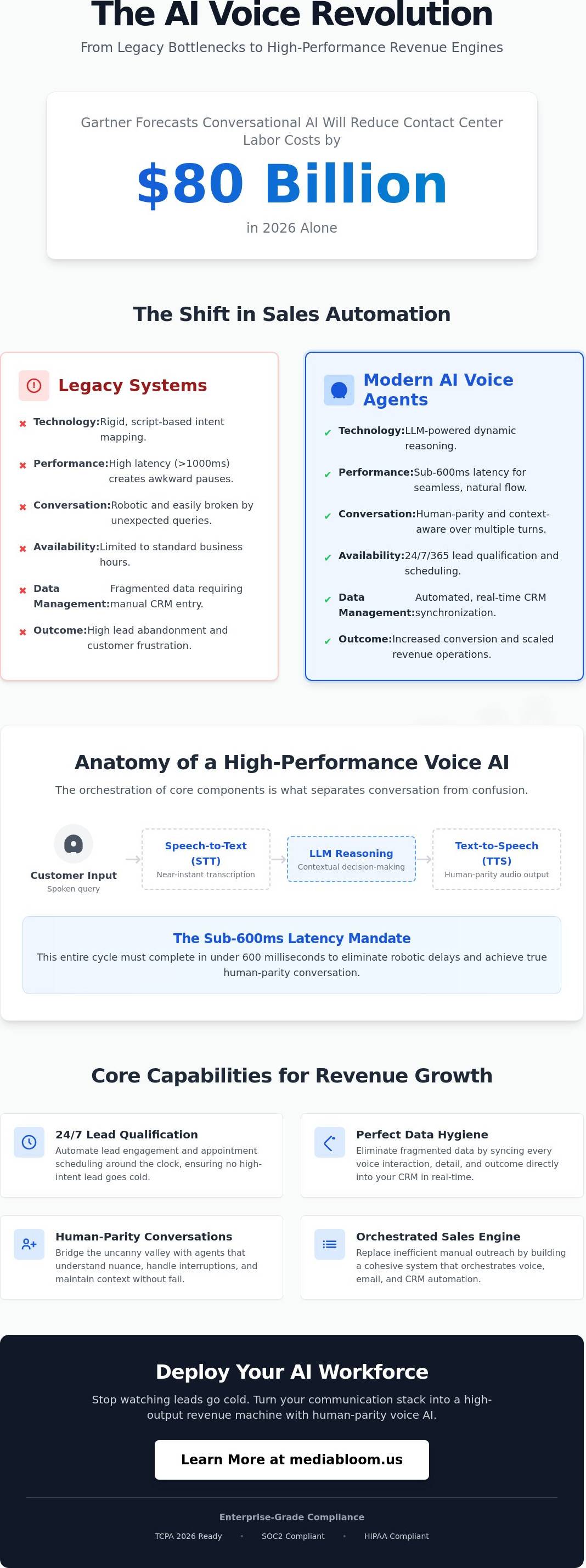
Gartner forecasts that conversational AI will reduce contact center labor costs by $80 billion in 2026 alone. This isn't a speculative prediction; it's a current shift in how high-performance sales engines operate. If you're still relying on legacy BPOs or manual outreach, you're likely watching leads go cold while your cost per acquisition skyrockets. Deploying a sophisticated ai voice agent is no longer a luxury for the tech-obsessed. It's the foundational architecture required to eliminate lead friction and maintain a competitive edge in a market that demands instant response.
You already know the frustration of fragmented data and slow follow-up times that kill conversion rates. It's an expensive bottleneck that prevents true scalability. This guide provides the strategic blueprint to master human-parity automation. You'll learn how to deploy agents that qualify leads 24/7, maintain perfect data hygiene in your CRM, and drive measurable revenue growth. We'll break down the technical requirements, regulatory compliance standards like the 2026 TCPA rulings, and the exact steps to turn your communication stack into a high-output revenue machine.
Key Takeaways
- Stop settling for legacy IVR and switch to LLM-powered entities that achieve true human-parity through advanced reasoning.
- Identify why sub-600ms response times are non-negotiable for maintaining natural conversation flow and engagement.
- Scale revenue operations by deploying an ai voice agent to handle 24/7 lead qualification and automated appointment scheduling.
- Eliminate fragmented data by syncing every voice interaction directly with your CRM system for perfect hygiene.
- Build a high-performance sales engine that orchestrates voice, email, and CRM automation to replace manual, inefficient outreach.
Defining the 2026 AI Voice Agent: Beyond the "Bot" Stigma
The era of the frustrating, robotic "press one" menu has ended. In its place, the modern ai voice agent has emerged as a high-performance revenue architect. This is not a simple script runner. It is a sophisticated, LLM-powered entity capable of real-time reasoning and human-parity conversation. Defining the AI Voice Agent in 2026 requires looking past the "bot" stigma of the previous decade. Today's technology moves beyond keyword matching to provide a seamless, authoritative interaction that mirrors a top-tier sales professional. It functions as a strategic layer within your sales stack, designed to eliminate lead friction and accelerate the journey from first contact to closed deal.
Third-generation voice AI integrates emotional intelligence as a core capability. It detects nuance. It senses urgency. It responds to frustration with professional composure. This shift from scripted responses to dynamic reasoning allows the agent to navigate complex sales cycles without the rigid constraints of legacy systems. You are no longer deploying a recording; you are deploying an automated reasoning engine that understands the "why" behind a customer's query.
The Death of the Touch-Tone Menu
Traditional IVR systems are conversion killers. High-intent leads abandon these systems almost immediately, viewing them as barriers rather than bridges. When a prospect hears a human-like voice that understands their specific query without a menu, brand trust scales instantly. The uncanny valley is the psychological discomfort felt when an artificial entity appears almost, but not quite, human; 2026 technology bridges this gap through sub-600ms latency and emotive prosody. This eliminates the robotic friction that previously stalled automated outreach. It creates a frictionless entry point for every lead, ensuring that your first impression is one of technical mastery and operational excellence.
LLM-Based Reasoning vs. Intent Mapping
Legacy bots relied on intent mapping, a rigid framework that failed the moment a customer went off-script. Generative AI has replaced this with LLM-based reasoning. This allows an ai voice agent to handle edge cases, manage interruptions, and maintain context over multi-turn conversations. Intent mapping is no longer sufficient for enterprise-grade communication. Modern agents retain data across the entire interaction, ensuring that every detail is captured and synced with the CRM. This is the difference between a tool that talks and a system that sells. By utilizing dynamic reasoning, the agent can pivot strategies mid-call based on the prospect's responses, mirroring the flexibility of a human agent at a fraction of the cost.
The Technical Architecture of High-Performance Voice AI
Building a high-performance ai voice agent requires more than just a connection to a large language model. It demands a tightly integrated machine designed for speed and precision. The architecture rests on three foundational pillars: Speech-to-Text (STT) for near-instant transcription, LLM Reasoning for contextual decision-making, and Text-to-Speech (TTS) for human-parity output. Every millisecond matters. In the Technical Architecture of Voice AI, the orchestration of these components determines whether a conversation feels natural or mechanical. For enterprise-level deployments, security protocols such as SOC2 and HIPAA compliance aren't optional. They are the baseline for protecting sensitive lead data and maintaining digital integrity within your revenue operations.
To move beyond basic automation, modern systems utilize Streaming RAG (Retrieval-Augmented Generation). This allows the agent to process incoming audio while simultaneously searching internal databases for the correct answer. It eliminates the "think time" that plagues inferior systems. The result is a system that doesn't just talk; it thinks and reacts with the speed of a seasoned sales professional.
Latency: The Difference Between Conversion and Confusion
Latency is the silent killer of conversion. A delay of just 100ms can trigger a "bot" realization, causing prospects to disengage instantly. To maintain human-parity, your system must achieve a sub-600ms response time across the entire stack. This isn't just about raw speed. It's about infrastructure. High-performance engines utilize edge computing and optimized model weights to handle peak traffic without performance degradation. If your response time lags, you lose the psychological edge required to build trust. Achieving these technical benchmarks ensures the transition between listening and speaking is imperceptible. Organizations seeking to optimize these complex workflows often implement custom AI automations to bridge the technical gap and ensure consistent output.
Knowledge Sync and Real-Time Data Access
Static scripts are a relic of the past. Modern agents use Streaming RAG to access your product databases or internal documentation in real-time. This ensures the agent isn't just guessing; it's citing verified facts. Auto-Sync capabilities allow the agent to pull updated inventory, pricing, or calendar availability directly from your primary sources. To prevent hallucinations, we implement strict logic guardrails that limit the agent's reasoning to your verified data. This creates a secure, accurate, and high-velocity communication channel that never goes off-brand. It transforms the ai voice agent from a simple messenger into a knowledgeable consultant capable of closing gaps in the sales cycle.
Strategic Use Cases: Turning Conversations into Revenue
Deploying an ai voice agent isn't a technical experiment. It's a strategic overhaul of your revenue engine. While many organizations focus on the novelty of the technology, elite sales teams focus on the output. The economics of this shift are staggering. Human agent costs typically range from $7 to $12 per call; an AI-driven interaction drops that cost to approximately $0.40. This isn't just a marginal improvement. It's a fundamental change in how you calculate customer acquisition costs. By 2026, 80% of businesses plan to integrate this technology, moving away from high-cost human BPOs toward automated systems that don't sleep, don't deviate from the script, and don't miss follow-ups.
High-performance architectures now favor a hybrid model. Your automated system manages Tier 1 inquiries, high-volume event registrations, and initial lead outreach. When a conversation hits a threshold of complexity, the system executes a seamless transfer to your human closers. This ensures your most expensive talent only speaks to qualified, high-intent prospects who are ready to buy. It's about maximizing the ROI of every minute your team spends on the phone.
Inbound Lead Qualification at Scale
The "5-Minute Rule" remains the most critical predictor of conversion in sales. If you don't respond to a lead within five minutes, your chances of qualifying them drop by 400%. An ai voice agent eliminates this delay entirely. It provides an immediate, 24/7 response that qualifies leads using BANT (Budget, Authority, Need, Timeline) or your specific custom frameworks. Businesses are successfully replacing 10-person SDR teams with a single AI engine that handles thousands of concurrent calls without performance degradation. This creates a high-velocity pipeline where every inbound inquiry is met with an authoritative, human-parity response that secures the next step in the sales cycle.
Outbound Sales and Cold Outreach
Outbound outreach in 2026 requires technical precision and strict regulatory adherence. Following the FCC "One-to-One Consent" rule that became effective on January 27, 2026, businesses must maintain explicit consent for every contact. Within these guardrails, AI agents deliver personalization at a scale humans can't match. By pulling real-time data from your CRM, the agent tailors the opening, the value proposition, and the rebuttals to the prospect's specific history. Rebuttal engines now process common objections with surgical accuracy, using logic guardrails to ensure the agent remains professional and persuasive. This level of consistency ensures that your outbound engine produces predictable, scalable revenue without the high churn associated with human cold-calling teams.
Beyond simple outreach, these systems manage complex calendar synchronization and 24/7 appointment scheduling. They sync directly with your sales team's availability, booking meetings and sending confirmation emails instantly. This eliminates the back-and-forth friction that often kills deals before they start. Whether it's following up on a webinar registration or re-engaging a cold lead, the automation stays relentless, ensuring no revenue is left on the table.
Integration and Orchestration: The RevOps Perspective
A high-performance ai voice agent functions as a precision data entry engine. While human agents struggle with consistent documentation, automated systems capture every nuance with total accuracy. The transition from "talking bot" to "data architect" separates experimental tech from enterprise-grade revenue operations. By utilizing function calling, the agent triggers complex actions in external applications while the conversation is still active. Whether it's checking live inventory or updating a lead's preference in real-time, the orchestration happens instantly. This technical mastery ensures your communication stack functions as a unified, high-velocity machine.
Post-call analytics provide the visibility required for continuous optimization. The system generates automated call summaries and sentiment analysis, identifying the prospect's emotional state and key pain points. Verbal insights no longer sit in a silo. They flow directly into your broader sales strategy; this allows for data-driven decisions based on actual verbal interactions. To maximize this capability, businesses often require professional CRM automation setup to ensure the data architecture is robust enough to handle high-volume inputs.
The Seamless CRM Workflow
Manual data entry is a productivity killer that costs sales teams hours of valuable outreach time. An integrated ai voice agent eliminates this bottleneck by executing automated deal stage updates based on specific call outcomes. If a lead qualifies during the conversation, the system moves the deal forward, assigns a task to a human closer, and logs the transcript immediately. These agents ensure 100% CRM data hygiene by removing the human error associated with manual logging and subjective interpretation. Every field is populated with verified data, creating a single source of truth for your entire organization through platforms like HubSpot and other enterprise-grade systems.
Automated Multi-Channel Follow-Up
The "Voice-to-Inbox" bridge is a critical component of modern lead nurturing. Within 30 seconds of a call ending, the system can send a personalized recap email that references specific points discussed during the conversation. Rapid follow-up reinforces the interaction and keeps the momentum high. You can also trigger SMS nurturing sequences based on specific keywords identified by the agent's reasoning engine. If a prospect mentions a specific pain point, the follow-up logic adjusts automatically. The result is a cohesive automated workforce that never lets a lead slip through the cracks. It's a relentless, multi-channel engine designed for one purpose: scaling your revenue without increasing your headcount.
Deploying an AI Workforce: The MediaBloom Advantage
MediaBloom functions as the strategic architect of your automated sales engine. While many platforms provide raw components and expect you to manage the engineering, we deliver a fully operational revenue machine. This "Done-For-You" model covers the entire spectrum of deployment, from high-level prompt engineering to complex CRM integration. You don't just get an ai voice agent; you get a synchronized system where AI voice agents, AI chatbots, and automated lead nurturing work in total harmony. This ecosystem ensures that no prospect is left behind. It bridges the gap between initial contact and a closed deal through a unified communication stack that operates with relentless consistency.
Scalability is the primary differentiator of our approach. Moving from a single agent to an automated workforce of a thousand requires zero additional overhead. You can handle sudden spikes in lead volume without hiring a single human staffer. This level of operational flexibility allows you to dominate your market by responding to every opportunity with surgical precision and speed. We build the infrastructure that allows your business to grow without the traditional constraints of labor costs and training cycles.
Custom AI Automations for Enterprise Growth
Generic, off-the-shelf agents fail because they lack the nuance of specialized industries. A one-size-fits-all approach leads to high abandonment rates and damaged brand trust. MediaBloom’s process involves training your ai voice agent on your specific brand voice, product documentation, and proprietary data. We build custom AI automations that understand your unique value proposition and handle industry-specific objections with authority. The ROI of professional orchestration far exceeds the results of a DIY platform setup. You aren't just buying software; you are investing in a scalable infrastructure designed for enterprise-level output and reliability. Our systems are engineered to integrate seamlessly into your existing revenue operations, ensuring that every automated interaction adds measurable value to your bottom line.
Ready to Scale? Your Automated Workforce Awaits
Operational excellence in 2026 is defined by how well you leverage automation. Relying on manual outreach is a liability that your competitors are already exploiting. Adopting AI voice technology is no longer an option for businesses that intend to lead their sectors. It's a fundamental requirement for staying competitive in a high-velocity market. MediaBloom provides the brain behind your complex operations, ensuring that your sales engine runs with maximum efficiency and zero friction. The future of revenue growth belongs to the architects of the automated workforce. Stop managing bottlenecks and start scaling your output today.
Scale your revenue with MediaBloom’s AI Voice Agents
The Architecture of Future Revenue
The transition from manual outreach to high-performance automation is no longer a strategic option; it's a competitive mandate. By mastering the technical pillars of low-latency communication and seamless CRM orchestration, you eliminate the friction that kills lead conversion. You've seen how a sophisticated ai voice agent can dramatically reduce interaction costs while maintaining perfect data hygiene. This is the foundation of a modern sales engine that scales without the overhead of traditional human BPOs. It's about replacing fragmented processes with a unified, high-velocity system that operates with surgical precision.
MediaBloom provides the technical mastery and strategic vision to turn these capabilities into measurable growth. We manage the complexities of full-service AI orchestration, ensuring your systems operate with enterprise-grade security and custom CRM integrations tailored to your specific workflow. It's time to stop managing bottlenecks and start building a relentless revenue machine. Your future as a market leader depends on the infrastructure you build today.
Build Your Automated AI Workforce with MediaBloom
Step into the next era of sales with confidence and watch your operations reach a new standard of excellence.
Frequently Asked Questions
Do AI voice agents actually sound like real humans?
Modern systems achieve human-parity through advanced text-to-speech engines that replicate natural intonation and emotive prosody. By maintaining sub-600ms latency, the ai voice agent eliminates the robotic pauses that previously signaled an automated system. This technical precision ensures prospects feel they're speaking with a competent professional. It bridges the psychological gap known as the uncanny valley, fostering immediate brand trust and engagement during the first point of contact.
How much does it cost to deploy an AI voice agent?
All-in costs for most deployments range from $0.12 to $0.45 per minute. This total is a sum of underlying services including Speech-to-Text, LLM reasoning, and high-quality Text-to-Speech. Small to medium-sized businesses typically spend between $300 and $2,500 per month depending on volume. This usage-based model allows organizations to scale their communication infrastructure without the fixed overhead of a traditional human-operated BPO.
Can an AI voice agent handle complex customer objections?
Sophisticated agents utilize generative reasoning to navigate objections with surgical accuracy. Unlike legacy bots that rely on rigid scripts, these systems process the context of a prospect's concern and deploy a relevant rebuttal in real-time. Logic guardrails ensure the agent remains within your brand's approved messaging framework. This consistency allows the engine to handle common pushback on pricing or timing more effectively than many junior sales representatives.
What is the difference between an AI voice agent and an IVR?
An IVR is a static, tree-based menu that forces callers through a series of "press one" prompts. In contrast, an ai voice agent is a dynamic reasoning engine that understands natural language. It doesn't require a menu because it can interpret the caller's intent directly. This shift from reactive routing to proactive conversation significantly reduces lead friction and improves the overall customer experience by providing instant, relevant responses.
How do AI voice agents integrate with my existing CRM?
Integration occurs through robust APIs and real-time function calling. The agent acts as a data architect, capturing every detail of the conversation and syncing it directly with platforms like HubSpot or other enterprise-grade CRM systems. It can automatically update deal stages, log call summaries, and trigger follow-up workflows based on the interaction's outcome. This creates a unified revenue operation where your lead data remains perfectly hygienic without manual entry.
Are AI voice agents legal for outbound cold calling in the US?
Outbound calling remains legal but requires strict adherence to federal regulations. Specifically, the FCC "One-to-One Consent" rule, which became effective on January 27, 2026, mandates explicit consent for each entity contacting a consumer. Marketing calls require prior express written consent, while informational calls require prior express consent. Compliance is a critical first step; penalties for TCPA violations are severe and scale rapidly across high-volume campaigns.
How long does it take to set up and train a custom AI voice agent?
The timeline for deployment depends on the depth of your brand's data and the complexity of your sales logic. Professional orchestration involves a methodical process of prompt engineering, knowledge base synchronization, and CRM mapping. While basic setups can be rapid, enterprise-grade agents require rigorous testing to ensure they handle specialized industry nuances with authority. This structured approach ensures the final engine is optimized for high-conversion revenue operations from day one.
Can an AI voice agent transfer a call to a human representative?
Seamless live transfers are a standard capability within a high-performance hybrid model. The agent can detect specific triggers, such as a request to speak with a manager or a high-complexity query, and execute a warm hand-off to a human closer. This ensures your most expensive human talent only engages with qualified prospects who are ready for a deep-dive discussion. It maximizes the efficiency of your entire sales workforce by filtering out low-intent inquiries.