
Did you know that in 2026, automated emails represent a mere 2% of total message volume yet generate a staggering 37% of all email-driven revenue? Most marketing leaders still struggle with the "batch and blast" trap. You see engagement rates plummeting while valuable customer signals sit idle in fragmented CRM silos. It's a common frustration: manual workflows that fail to scale and a marketing budget that feels more like a cost center than a growth driver.
You deserve a system that works as hard as your team does. This blueprint promises to help you master data-driven email marketing by transforming your outreach into an autonomous revenue engine. We'll show you how to leverage advanced AI-driven orchestration to convert raw data into a predictable sales pipeline. You'll discover the strategic architecture needed to integrate email services with automated lead nurturing, ensuring your marketing spend delivers the highest possible ROI. From technical authentication to hyper-personalization at scale, this is your roadmap to operational excellence and technical mastery.
Key Takeaways
- Shift your strategy from historical tracking to predictive intent signals to anticipate customer needs before they arise.
- Master data-driven email marketing by transforming your CRM into a high-performance engine room that powers every outbound interaction.
- Replace static lists with dynamic bucket-shifting to capture the 300% conversion increase offered by intent-based triggers.
- Audit your digital infrastructure to identify High-Value Actions (HVAs) that launch automated, high-converting workflows.
- Engineer a unified revenue architecture that seamlessly integrates AI voice agents, CRM automation, and email into a single autonomous system.
Defining the 2026 Standard for Data-Driven Email Marketing
In 2026, data-driven email marketing is no longer a peripheral strategy; it's the core infrastructure of any scalable revenue operation. We've moved beyond the era of looking at what customers did last month. Today's standard is an automated ecosystem powered by real-time behavioral signals that predict what they'll do next. If your outreach still relies on historical data, you're driving by looking in the rearview mirror. You need a system that anticipates needs before the customer even articulates them.
The Evolution from Batch-and-Blast to Precision Targeting
The "spray and pray" era is over. Modern algorithmic delivery has replaced manual scheduling with surgical precision. Your list size is a vanity metric. It doesn't matter how many people you reach if the message doesn't resonate at the exact moment of interest. Segment depth is the true measure of success. By building "Owned Revenue Engines" instead of relying on rented audience platforms, you secure your business against market volatility. You're no longer just sending mail; you're triggering specific outcomes based on individual user journeys. This precision ensures that every touchpoint moves a lead closer to a closed-won deal.
The Role of First-Party Data in a Privacy-First World
Third-party cookies have vanished, making your internal data more valuable than ever. In this privacy-first environment, zero-party data and first-party insights are your only reliable assets for growth. Your CRM must serve as the ultimate source of truth, capturing every interaction to refine your marketing automation for email. This isn't just about compliance; it's about building trust through extreme relevance. You're using data that the customer has willingly provided to make their life easier. Intent Signals represent the specific digital footprints, such as repeated pricing page visits or high-value content downloads, that indicate a lead is ready to buy. Intent Signals are the primary driver of 2026 conversion rates because they allow you to act exactly when the buyer's interest is at its peak.
The Three Pillars of High-Performance Revenue Architecture
Successful data-driven email marketing requires more than a collection of disconnected tools. It demands a unified architecture where every component serves a specific strategic purpose. Your CRM isn't just a database; it's the high-performance engine room of your entire outreach strategy. While standard tools merely collect data, a true revenue platform executes strategy by turning raw signals into autonomous actions. To scale in 2026, you must build your system on three foundational pillars: infrastructure, intelligence, and integration.
Pillar 1: Behavioral Data and Real-Time Triggers
Speed to lead is the primary differentiator in a crowded market. When a prospect visits your pricing page or downloads a whitepaper, the window for conversion is measured in minutes, not days. These behavioral signals must trigger immediate, automated sequences that meet the lead at their peak moment of interest. Static scheduling is a relic of the past; real-time response is the new baseline. By deploying sophisticated MediaBloom Solutions, you can ensure that your infrastructure reacts to intent with surgical precision. This level of responsiveness transforms your email channel from a passive broadcast tool into an active sales participant.
Pillar 2: Firmographic and Demographic Enrichment
Precision targeting depends entirely on the depth of your data. Generic "Dear First Name" tags no longer suffice. High-performance campaigns utilize data enrichment to tailor messaging based on industry, company revenue, and specific pain points. Research indicates that personalized content can lead to a 41% higher click-through rate, proving that relevance is the ultimate currency. However, this level of personalization is impossible without impeccable data quality in email marketing. Since Apple's Mail Privacy Protection has made traditional open rates less reliable, your intelligence must focus on engagement scoring and transaction-heavy metrics. Moving beyond basic demographics allows you to craft narratives like, "Since your firm is scaling its logistics division, you need a system that..." This level of specificity drives 6x higher transaction rates compared to generic outreach.
Pillar 3: Predictive Analytics and Lead Scoring
The final pillar is the integration of predictive intelligence. Modern systems use AI to analyze historical patterns and real-time actions to predict which leads are ready for a sales call and which require further nurturing. This automated lead scoring prevents sales friction by ensuring your team only spends time on high-intent prospects. It also connects your email engine to the rest of your sales stack. Imagine a scenario where a high engagement score automatically triggers an AI chatbot or an AI voice agent to initiate a discovery call. This seamless orchestration eliminates the manual gaps where leads typically fall through the cracks. If you're ready to move beyond manual workflows and build a self-sustaining growth machine, it's time to consult with our strategic architects about your infrastructure needs.
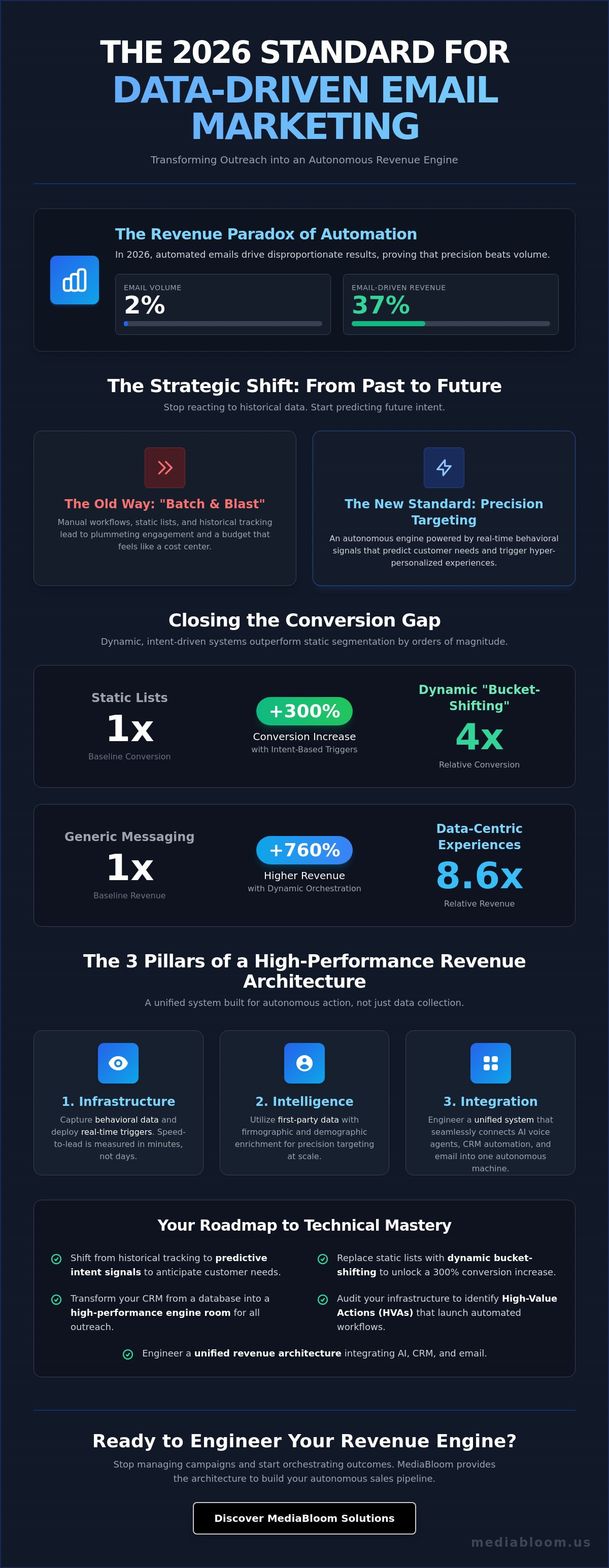
Static Segmentation vs. Dynamic Intent: The Conversion Gap
Manual list-pulling is a liability in a high-velocity market. If your strategy relies on static spreadsheets, you're competing with ghosts. Data-driven email marketing in 2026 requires automated bucket-shifting. This means prospects move between segments instantly based on their live behavior. Static segmentation treats your audience as a fixed point in time. Dynamic intent treats them as a moving target with changing needs. This shift is the foundational layer of a scalable sales machine that never sleeps.
The performance gap is undeniable. Intent-based triggers out-convert scheduled blasts by 300%. Why? Because they align with the buyer's current psychological state. A scheduled blast is an interruption. An intent-based trigger is a solution. When a lead interacts with specific high-value assets, the system must react immediately. Waiting until the next "newsletter day" is a recipe for missed opportunities and lost revenue. Real-time updates are non-negotiable because data decays at an alarming rate. Information about job titles, company size, and current needs changes constantly. Old data isn't just useless; it's dangerous for your deliverability and brand authority.
Why Static Lists Kill Your ROI
Sending the same generic offer to a CEO and a Junior Manager is a strategic failure. Their pain points, authority levels, and goals are entirely different. Static lists ignore these nuances, leading to irrelevant messaging and high unsubscribe rates. Stale data quickly results in high bounce rates. This damages your sender reputation, ensuring your future emails land in the spam folder. Your digital infrastructure must be clean. It must be agile. It must be accurate. Anything less is a waste of marketing spend.
The Power of Dynamic Journey Mapping
Dynamic journey mapping allows a lead to move through your funnel automatically. Every click and every engagement reshapes their path. If a prospect clicks a technical case study, the system shifts them into a deep-dive technical sequence. If they watch a demo, they move to a high-intent sales bucket. This level of automated lead nurturing significantly reduces the sales cycle by eliminating manual hand-offs and human delays. Our internal data shows that businesses utilizing these dynamic flows see a marked improvement in lead-to-close ratios. It ensures that the right message reaches the right person at the exact moment they need it. Context is the new currency of the inbox. By mastering this flow, you transform your email outreach from a cost center into an autonomous revenue engine.
Orchestrating the Machine: Implementing Data-Driven Workflows
Strategy without execution is merely a hallucination. To transform your outreach into a high-performance engine, you must move from high-level concepts to precise operational workflows. Data-driven email marketing requires a methodical implementation process that eliminates human error and maximizes technical efficiency. This isn't about sending more mail. It's about building a system that knows exactly when to strike. You can see how we've built these architectures for global leaders by reviewing our MediaBloom Case Studies.
The implementation follows a strict four-step protocol:
- Step 1: Audit Data Silos. Identify where your customer data is trapped. Fragmented data sitting unused in your CRM is a wasted asset. Your CRM must be the central command for all automation.
- Step 2: Define High-Value Actions (HVAs). Not every interaction is equal. A pricing page visit is a higher-intent signal than a blog post click. Define the specific triggers that will launch your automated sequences.
- Step 4: Hard-Data A/B Testing. Abandon "feelings" or "intuition." Test subject lines, send times, and CTA placements based on hard conversion data. If it doesn't drive revenue, it doesn't stay in the workflow.
Mapping the Customer Journey to Data Points
Precision requires mapping specific data points to the Awareness, Consideration, and Decision stages of the funnel. Awareness markers might include top-of-funnel content downloads. Consideration markers often involve repeated visits to solution pages. The most critical transition is bridging the gap between a marketing-qualified lead (MQL) and a sales-ready lead. By tracking these markers in real-time, your system shifts the narrative from education to closing without manual intervention. This ensures that your sales team only interacts with prospects who have already demonstrated a clear intent to buy.
Automating the Follow-Up Engine
Conversion is a game of persistence. The math is clear: most sales require 5 to 7 automated touchpoints before a prospect takes action. A single follow-up isn't a strategy; it's a missed opportunity. Your follow-up engine must be relentless and intelligent. For the final "Decision" phase, integrating AI voice agents provides the human-parity touch needed to secure the deal. These agents can handle discovery and scheduling at a scale that human teams simply cannot match. If your current follow-up process feels disjointed or manual, contact our team today to architect a high-output automation stack.
MediaBloom: Engineering Your Autonomous Revenue Engine
Your business doesn't need another marketing agency. It needs a strategic architect. At MediaBloom, we don't just manage campaigns; we engineer digital infrastructures that operate with surgical precision. By integrating AI voice agents, CRM automation, and data-driven email marketing into a single, cohesive engine, we transform your outreach from a manual burden into an autonomous revenue generator. This is the shift from tactical execution to operational excellence. We build the systems that allow your brand to scale without increasing headcount or overhead.
The 2026 landscape is unforgiving to those who hesitate. Waiting to automate isn't just a missed opportunity; it's the single biggest risk to your long-term growth. While competitors are stuck in the "batch and blast" era, our partners are deploying sophisticated workflows that react to intent in milliseconds. We provide the technical mastery and strategic vision required to stay ahead of the curve. Our approach ensures that every data signal is captured, analyzed, and converted into a tangible business outcome. You're not just sending messages. You're building a fortress of predictable revenue.
Beyond Email: The Automated AI Workforce
Email is the catalyst, but it's only one component of the machine. In our ecosystem, a high-intent email interaction doesn't just sit in an inbox. It feeds directly into our AI voice and chatbot solutions. If a lead clicks a high-value link, an AI voice agent can initiate a discovery call while the interest is still fresh. This creates a 24/7 automated sales team that never misses a lead, never takes a day off, and never forgets to follow up. By bridging the gap between digital messaging and verbal engagement, we eliminate the friction that typically kills conversions. Your sales stack becomes a unified front, operating with human-parity quality at machine-level speed.
Your Next Step Toward Operational Excellence
The time for passive learning has passed. The most successful organizations in 2026 are those that have already moved to execution. You've seen the blueprint for data-driven email marketing. You understand the pillars of high-performance architecture. Now, you must decide if you'll continue to manage fragmented tools or if you'll finally own a scalable system. MediaBloom is ready to architect your future. Don't let your data go to waste while your competitors outpace you. Book your strategy briefing and see the machine in action today.
Own the Future of Revenue Operations
The transition from manual outreach to an autonomous revenue engine isn't just a technical upgrade. It's a strategic necessity. By mastering data-driven email marketing, you replace guesswork with precision and static lists with dynamic intent. You've seen how a unified architecture; combining custom CRM automation for high-growth teams with AI voice agents that deliver human-parity performance; creates a system that never sleeps. This is the blueprint for operational excellence. It ensures that every lead is nurtured and every signal is captured without human delay.
Your digital infrastructure should be your most valuable asset. Stop managing campaigns and start scaling systems that drive data-driven ROI optimization. The tools are ready. The strategy is clear. Now, the execution belongs to you. Build the machine that secures your market position and ensures your growth is both predictable and relentless. There's no limit to what your brand can achieve when your sales stack operates at peak efficiency.
Ready to automate your revenue? Contact MediaBloom for a custom AI strategy briefing.
The future belongs to the architects of automation. It's time to build your legacy.
Frequently Asked Questions
What is the first step to starting data-driven email marketing?
The first step is conducting a comprehensive audit of your existing data silos and CRM infrastructure. You can't build an autonomous engine on fragmented or inaccessible information. Identify where lead data is trapped and ensure your CRM acts as the single source of truth. Establishing this technical foundation is essential before deploying any advanced data-driven email marketing workflows. It ensures your system has the fuel it needs to operate.
How does data-driven email marketing differ from traditional automation?
Traditional automation relies on linear, time-based sequences that treat every recipient the same way. In contrast, data-driven strategies utilize dynamic intent signals to trigger real-time, individualized experiences. While traditional systems "send better emails," data-driven architectures build an autonomous revenue engine that reacts to live behavioral changes. This shift from static lists to dynamic journey mapping is what drives the massive conversion increases seen in modern frameworks.
What specific data points are most important for B2B email marketing?
Focus on high-value intent signals and firmographic enrichment. Important markers include repeated visits to pricing pages, whitepaper downloads, and specific job title changes within target accounts. In 2026, tracking these High-Value Actions (HVAs) is more critical than monitoring vanity metrics like open rates. These data points allow you to bridge the gap between marketing-qualified leads and sales-ready prospects automatically without manual intervention from your team.
Can small businesses implement data-driven strategies without a huge budget?
Small businesses can achieve significant results by focusing on high-impact, automated lead nurturing triggers rather than broad, expensive campaigns. Start by automating the most critical touchpoints in the customer journey, such as abandoned carts or demo requests. By prioritizing precision over volume, smaller teams can build a scalable sales machine that delivers a higher ROI. Efficiency is the ultimate equalizer when you don't have an enterprise-level marketing spend.
How does AI improve data-driven email campaign performance?
AI optimizes performance by handling complex orchestration tasks that are impossible to manage manually. It enables hyper-personalization at scale, predictive lead scoring, and send-time optimization based on individual user habits. By 2026, it's expected that up to 75% of email strategy operations will be AI-driven. This technology ensures your outreach remains relevant, timely, and aligned with the recipient's current stage in the buying cycle, drastically improving engagement rates.
Is data-driven email marketing compliant with privacy laws like GDPR and CCPA?
Compliance is a foundational technical requirement in 2026. Data-driven systems prioritize first-party and zero-party data, which is information customers willingly share. Adhering to GDPR requires explicit, unambiguous opt-in consent, and fines for non-compliance can reach up to €20 million or 4% of annual global turnover. Using data-driven email marketing correctly actually enhances privacy by ensuring users only receive highly relevant content they've expressed a clear interest in receiving.
How often should I audit my email marketing data for accuracy?
Data accuracy should be monitored in real-time through automated CRM integrations to prevent the decay of data. If real-time monitoring isn't possible, a deep-dive audit must occur at least quarterly. Stale data leads to high bounce rates and damages your sender reputation. Maintaining a clean database is non-negotiable for ensuring your emails bypass the "Intelligent Inbox" filters and reach the primary folder where they can actually drive revenue.
What is the expected ROI for a fully automated, data-driven email system?
Email marketing continues to deliver an exceptional ROI, typically generating between $36 and $42 for every dollar spent in 2026. Some high-performance retail and e-commerce sectors report returns as high as $45 per dollar. Automated emails account for only 2% of total volume but drive approximately 37% of all email-generated sales. These figures demonstrate that shifting to an autonomous revenue architecture is a high-yield investment for any growth-oriented business.