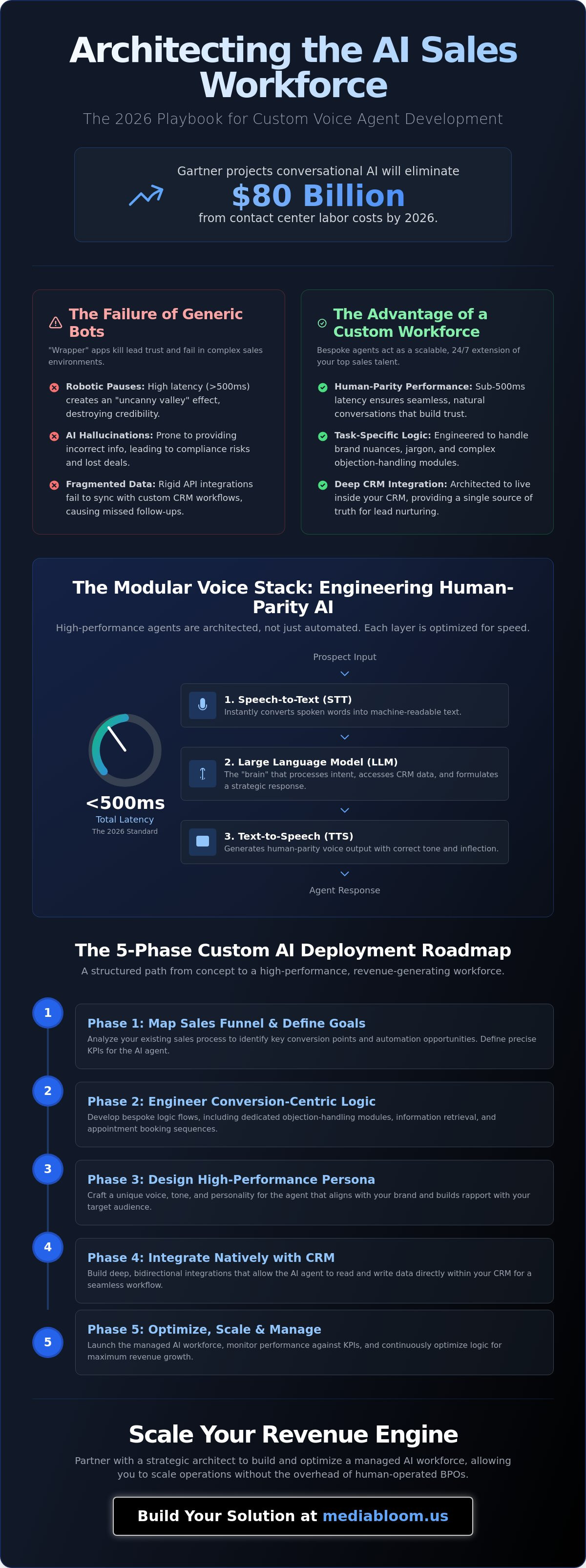
Sounding human is no longer the benchmark for success in automated sales; it's the bare minimum. High-performance revenue teams have moved beyond generic bots that kill lead trust with robotic pauses and disconnected workflows. They are now prioritizing custom ai voice agent development to architect conversion-centric logic engines that live directly inside their CRM. Gartner projects that conversational AI will strip 80 billion dollars from contact center labor costs by the end of 2026. This shift isn't just about automation. It's about building a scalable, 24/7 workforce that consistently outperforms traditional BPOs.
You already know that high latency and fragmented data are the fastest ways to lose a prospect's interest. This guide provides the definitive roadmap to mastering bespoke voice agents that drive measurable revenue growth and seamless lead nurturing. We'll break down the 2026 technical requirements, critical regulatory compliance standards like the Colorado AI Act, and the exact architecture needed to turn your digital infrastructure into an autonomous sales machine.
Key Takeaways
- Move beyond generic wrapper apps by prioritizing custom ai voice agent development to handle complex, task-specific business logic.
- Master the Modular Voice Stack to eliminate conversational pauses; this ensures your automated workforce achieves true human-parity performance.
- Implement advanced conversion architecture that utilizes dedicated objection-handling modules to turn simple interactions into measurable revenue growth.
- Deploy a structured five-phase roadmap to map your sales funnel and engineer a high-performance persona that lives inside your CRM.
- Partner with a strategic architect to build and optimize a managed AI workforce, allowing you to scale operations without the overhead of human-operated BPOs.
The Strategic Shift: Why Custom AI Voice Agent Development is Non-Negotiable
Custom ai voice agent development represents a fundamental transition from simple automation to the engineering of bespoke, task-specific communication engines. In the high-stakes sales environment of 2026, generic "wrapper" apps are no longer sufficient. These basic tools lack the depth to handle complex business logic or maintain the sophisticated persona required for enterprise-level transactions. True custom development involves architecting a solution from the ground up, ensuring every interaction aligns with specific revenue goals and operational requirements. It's an architecture, not just an app.
The current benchmark for success is defined by two non-negotiable metrics: human-parity voice quality and sub-500ms latency. Anything slower creates an "uncanny valley" effect that immediately kills lead trust. To bridge this gap, developers utilize intelligent agents designed to process natural language with the speed and nuance of a top-tier sales professional. This isn't just about sounding human. It's about reacting with the same strategic precision as your best closer. If your agent pauses to think, the prospect has already checked out.
To better understand the practical application of this technology, watch this helpful video:
The Failure of Generic Voice Bots
Pre-built agents struggle because they are designed for the average, not the exceptional. They lack the training data necessary to navigate brand-specific nuances or complex industry jargon. In unconstrained sales environments, these generic tools are prone to "hallucinations," providing incorrect information that can lead to compliance disasters or lost deals. Standard API integrations in off-the-shelf software are often too rigid. They can't push or pull the deep level of data required to sync perfectly with a customized CRM workflow, leading to fragmented lead records and missed follow-ups.
The Competitive Advantage of a Bespoke Workforce
A custom-built AI workforce offers a level of scalability that human-operated BPO services cannot match. These agents provide an unwearied, 24/7 sales presence that never suffers from fatigue or inconsistent performance. By replacing traditional call centers with architected AI systems, businesses lower their cost-per-acquisition while maintaining total control over the customer experience. You can explore how these high-performance systems are implemented by visiting MediaBloom Solutions. This strategic shift allows your human team to focus on high-level strategy while the AI handles the heavy lifting of lead nurturing and meeting booking.
Architecting the Engine: Core Components of Human-Parity Voice AI
High-performance custom ai voice agent development relies on three distinct layers working in perfect synchronicity: Speech-to-Text (STT), the Large Language Model (LLM), and Text-to-Speech (TTS). This modular approach allows for surgical precision in optimization. While generic bots bundle these into a single, slow process, an architected solution treats them as high-speed components of a larger revenue engine. The orchestration layer acts as the conductor, managing the data handoffs between these modules in milliseconds. It ensures that the system doesn't just speak, but thinks and reacts based on real-time CRM inputs.
Latency management is the single most important technical metric for establishing trust. In a sales conversation, a one-second delay signals a lack of competence or, worse, an artificial presence. The 2026 standard for human-parity performance is sub-500ms latency. Achieving this requires a lean stack and optimized stream processing. If your technical architecture can't handle real-time interruptions, your conversion rates will suffer. Speed is the foundation of authority.
LLM selection depends entirely on your specific sales use case. GPT-4o provides rapid, versatile responses suitable for high-volume lead qualification. Claude 3.5 offers superior logical reasoning for complex B2B negotiations. Llama 3 serves as a powerful open-source foundation for businesses demanding total data sovereignty. Each choice impacts the final output of your custom ai voice agent development project, affecting everything from cost to conversational nuance.
Speech-to-Text (STT) and Text-to-Speech (TTS) Excellence
Sales-focused agents require high-fidelity TTS providers capable of delivering high-energy tones that command attention. Flat, robotic voices kill momentum. You need emotional prosody, the rhythmic and intonational patterns of speech that convey confidence. Simultaneously, ultra-fast STT is non-negotiable for interruption handling. If a prospect speaks, the agent must stop immediately. This requires a duplex communication stream that processes audio in real-time, preventing the awkward conversational overlaps that define low-tier bots.
The Brain: LLM Fine-Tuning for Sales
Base models are essentially raw materials. To build a high-performance closer, you must implement Retrieval-Augmented Generation (RAG). This ensures the agent pulls accurate product data from your internal knowledge base rather than hallucinating facts. System prompting is the next step, where you define the persona, authority level, and conversational boundaries. This process transforms a general-purpose model into a specialized sales asset. For a deeper dive into these technical frameworks, review The Definitive Guide to AI Voice Agents. If you are ready to architect your engine, speak with a strategic consultant today.
Strategic Logic Design: Building a Voice Agent That Actually Converts
Logic is the fuel that powers your revenue engine. While basic bots follow linear scripts, high-performance custom ai voice agent development requires a shift toward conversion architecture. This design philosophy treats every interaction as a strategic move toward a specific goal. You aren't just building a bot that can answer questions; you're architecting a closer that understands context, intent, and timing. By prioritizing goal-oriented scripting, you ensure the agent remains focused on the primary objective, whether that's qualifying a lead or securing a slot on a calendar.
Building rapport requires more than just a human-sounding voice. It demands "active listening" cues programmed directly into the logic. These cues, which include brief affirmations like "I understand" or "That makes sense," signal to the prospect that their input is being processed in real-time. This creates a psychological bridge of trust. When combined with the low-latency stack discussed earlier, these logic modules transform a digital tool into a sophisticated sales partner that prospects actually want to engage with.
Objection Handling and Sales Psychology
A true sales asset must handle resistance without losing momentum. Effective custom ai voice agent development maps common objections, such as price concerns, timing issues, or authority gaps, into dedicated logic modules. The agent doesn't just provide a canned response. It utilizes contextual memory to reference previous points in the conversation, maintaining an authoritative yet helpful stance that mirrors the MediaBloom standard. This ensures your brand voice remains consistent even when the conversation becomes difficult.
CRM Integration: The Key to Automated Lead Nurturing
Your voice agent shouldn't operate in a vacuum. It must be an extension of your digital infrastructure. High-performance agents pull real-time data from platforms like HubSpot or Salesforce to personalize the pitch and push updated lead scores immediately after the call. This seamless integration allows for automated post-call actions, such as triggering a meeting confirmation or a secondary nurture sequence. Integrating Email Marketing for Sales creates a multi-channel engine that continues the conversation long after the phone is hung up.
The 5-Step Roadmap to Deploying a Custom AI Workforce
Execution is where vision transforms into revenue. Successful custom ai voice agent development follows a rigid, five-phase architectural roadmap designed to ensure stability and high-performance output. This isn't a simple software installation. It's the construction of a digital sales department. By following a structured deployment strategy, you minimize technical debt and maximize the speed at which your automated workforce begins booking meetings.
- Phase 1: Discovery and Workflow Mapping. Identify exactly where AI fits in your funnel and map the logic of your highest-performing human reps.
- Phase 2: Logic and Prompt Engineering. Build the core sales persona, ensuring the agent maintains authority and follows conversion architecture.
- Phase 3: Integration and Infrastructure. Connect the agent to your phone lines via SIP trunks and establish deep hooks into your CRM.
- Phase 4: Red-Teaming and Stress Testing. Deliberately try to break the agent's logic to find edge cases before they reach a live prospect.
- Phase 5: Deployment and Continuous Optimization. Launch the pilot and use real-world call data to scale the system's efficiency.
Discovery: Mapping the High-Impact Use Cases
Start by identifying repeatable communication tasks that currently drain your human resources. Inbound lead qualification often provides the fastest ROI, as it ensures 100% of leads are contacted within seconds. Contrast this with outbound cold calling strategies, which require more aggressive objection handling and persistence. You must define clear success metrics for the pilot phase. Focus on tangible outcomes like the number of qualified meetings booked per 100 calls rather than vanity metrics like total minutes spoken. This clarity allows you to prove the concept before scaling the infrastructure.
Optimization: The Feedback Loop
The work doesn't end at deployment. High-performance custom ai voice agent development requires a continuous feedback loop driven by call transcripts. By analyzing where prospects drop off, you can surgically refine the agent's logic and objection-handling modules. During the initial rollout, "human-in-the-loop" monitoring is essential. This involves strategic architects reviewing call recordings to ensure the persona remains on-brand and compliant with evolving regulations. To see this roadmap in action, you can Watch a Demo of our current systems. Once you're ready to build your automated workforce, book a strategic deployment session with our team.
Scaling Your Revenue Engine: Why MediaBloom is Your Strategic Architect
MediaBloom isn't a software vendor; we are the strategic architects behind your digital infrastructure. While self-serve platforms leave the heavy lifting of custom ai voice agent development to your internal team, we provide a fully managed revenue engine. We build, monitor, and optimize your automated workforce to ensure peak performance at every stage of the funnel. This partnership eliminates the inconsistencies of human-operated BPOs, replacing them with a reliable, high-output system that scales across the entire United States without the friction of traditional labor overhead. It's a professional-grade solution for enterprise-level growth.
True scalability requires more than a single tool. It demands a synchronized operation where AI voice agents, automated lead nurturing, and CRM automation setup work as a single unit. We position your voice agents as the front line of a broader revenue architecture. This ensures that every lead generated by our high-performance systems is handled with the same level of technical mastery and sales precision. You don't just get a bot; you get a strategic partner focused entirely on your bottom line. We handle the complexity so you can focus on the results.
Beyond the Bot: A Holistic Revenue Strategy
Successful execution involves integrating voice agents into a comprehensive Ad Management strategy. This creates a closed-loop system where high-intent traffic from paid media is immediately engaged by an authoritative AI persona. The synergy continues with automated lead nurturing that maintains momentum while your human team focuses on high-level strategy. This isn't theoretical. Our results are documented across multiple industries, showing measurable ROI through bespoke automation. You can review the evidence of our technical efficacy in the MediaBloom Case Studies.
Your Next Move in the AI Revolution
The transition to an automated sales workforce is no longer a future projection; it's the current standard for high-performance organizations. Visionary leaders recognize that custom ai voice agent development is the foundation of a modern, scalable business. The future of sales belongs to those who prioritize authority, reliability, and custom-built logic over generic, off-the-shelf solutions. It's time to move beyond the limitations of legacy systems and adopt a conversion-centric architecture. Contact MediaBloom Today to begin architecting your high-performance AI workforce.
Dominate the Future of Automated Revenue
High-performance sales operations in 2026 demand more than just basic automation. They require a sophisticated, architected approach to custom ai voice agent development that prioritizes human-parity quality and sub-500ms latency. You've seen how modular stacks and conversion-centric logic transform cold leads into booked meetings. This isn't a peripheral tool; it's the primary engine of your digital infrastructure. Success hinges on seamless CRM and sales pipeline automation that keeps your data clean and your follow-ups immediate.
By deploying custom-built conversion logic tailored to your specific brand, you secure a competitive edge that generic wrappers simply can't provide. It's time to replace legacy systems with a scalable, unwearied workforce that operates with the precision of your top closers. The shift toward an autonomous sales force is no longer optional; it's the new standard for operational excellence. Architect Your AI Workforce with MediaBloom and start scaling your revenue engine today. You have the roadmap. Now, build the machine.
Frequently Asked Questions
How long does custom AI voice agent development typically take?
Production-ready systems typically require a minimum of three weeks for full deployment. Pilot projects can be executed in as little as six days to two weeks depending on the complexity of your workflow. This timeline includes the architecture setup, stress-testing, and the refinement of conversion logic before the system reaches live prospects.
Can a custom AI voice agent truly handle complex sales objections?
Yes, custom agents utilize dedicated objection-handling modules to navigate resistance regarding price, timing, or authority. By mapping your top closers' logic into the system, the agent maintains an authoritative stance while referencing previous conversational context. This ensures a high-energy response that keeps the lead moving toward a booking without losing momentum.
What is the difference between a custom AI voice agent and a standard chatbot?
Standard chatbots are text-based and often follow rigid, linear paths. Custom ai voice agent development focuses on creating duplex communication engines that handle real-time interruptions and emotional prosody. While chatbots manage basic data entry, voice agents act as an autonomous sales workforce capable of high-fidelity verbal negotiation and rapport building.
How does an AI voice agent integrate with my existing CRM?
Integration occurs through secure API hooks that allow the agent to pull lead data and push call outcomes in real-time. This setup enables automated post-call actions like updating lead scores or triggering secondary nurture sequences. By connecting directly to your digital infrastructure, the agent ensures your sales pipeline remains accurate without manual human intervention.
Is AI voice technology advanced enough to pass as a human in 2026?
Voice technology in 2026 has achieved human-parity through sub-500ms latency and high-fidelity TTS architecture. These systems use emotional prosody to mimic human speech patterns, making them indistinguishable from professional reps in most sales scenarios. The focus has shifted from merely sounding human to executing the strategic logic behind the conversation.
What are the ongoing costs associated with a custom AI voice agent?
Ongoing costs involve per-minute usage fees for voice AI services and management fees for system optimization. Industry data indicates per-minute costs at scale typically range between $0.05 and $0.15. These expenses are significantly lower than the overhead associated with human-operated BPO services or maintaining a large internal call center staff.
How do you ensure data security and compliance with custom AI development?
Security is maintained through encrypted data transmission and strict adherence to regulations like the Colorado AI Act and TCPA. Custom ai voice agent development allows for the implementation of disclosure protocols and consent management within the conversational flow. This ensures your automated workforce remains compliant with federal and state mandates while protecting sensitive prospect information.
Can I use a custom AI voice agent for outbound cold calling?
You can use voice agents for outbound calling provided you comply with FCC rulings regarding prior express written consent. In February 2024, the FCC ruled that AI-generated voices require specific disclosures and consent for mobile numbers. Strategic architects build these compliance checkpoints directly into the agent's logic to protect your brand from regulatory risk.