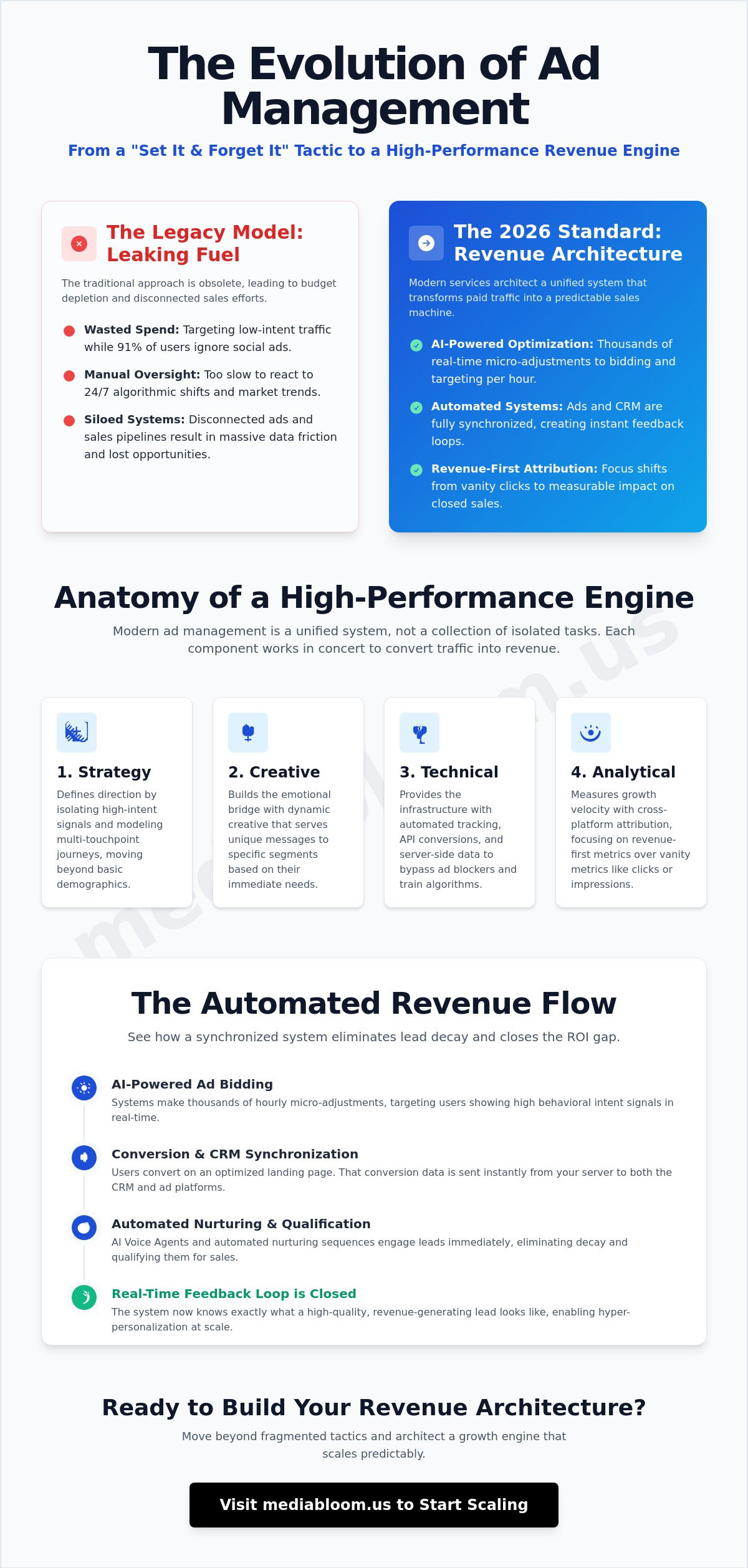
Your ad account isn't a marketing tool; it's a high-performance engine that is currently leaking fuel. With 91% of users now ignoring social ads and new regulations like Oregon's geolocation law restricting targeting, the old "set it and forget it" model is obsolete. You've likely felt the sting of wasted spend on low-intent traffic while struggling to keep pace with relentless algorithmic shifts. It's frustrating to watch the disconnect grow between marketing leads and closed sales. Modern ad management services have evolved to solve this by moving far beyond simple click-buying.
Success in this environment requires a strategic architect to build the automated systems that convert traffic into revenue. This article shows you how elite ad management services integrate AI and CRM automation to transform paid traffic into a scalable sales machine. You'll discover how to build a predictable pipeline and maximize ROI through automated optimization. We will explore the shift from vanity metrics to revenue-first attribution, ensuring your digital infrastructure is built for the high-velocity demands of the 2026 marketplace.
Key Takeaways
- Move beyond the "set it and forget it" era by treating paid acquisition as a dynamic, strategic orchestration of conversion technology.
- Architect a high-performance growth engine by integrating modern ad management services with high-intent audience modeling and technical precision.
- Replace manual oversight with AI-powered real-time bidding to identify winning creative patterns and close the ROI gap instantly.
- Eliminate lead decay by synchronizing your ad infrastructure with AI Voice Agents and automated nurturing systems.
- Transform fragmented marketing tactics into a unified revenue architecture that scales predictably through CRM automation.
The Evolution of Ad Management Services in 2026
In 2026, ad management services have transitioned from simple media buying into the strategic orchestration of paid acquisition and conversion technology. It's no longer enough to just place an ad and hope for the best. You must build a digital infrastructure that captures intent and funnels it directly into revenue. Modern Online advertising requires a technical mastery of platform algorithms that change weekly, not quarterly. Success depends on how well your ads talk to your sales systems.
The "set it and forget it" philosophy is dead. Relying on static campaigns in a high-velocity market leads to rapid budget depletion and negative ROI. High-frequency AI-driven optimization now handles the heavy lifting. These systems make thousands of micro-adjustments to bidding and targeting every single hour. This shift ensures that every dollar spent is fighting for the highest possible return in real-time. Ad management is now the heartbeat of your broader sales pipeline, not a standalone experiment.
To better understand the technical shift in this industry, watch this helpful video:
Why Traditional Agencies Are Falling Behind
Many legacy firms still rely on human-only monitoring. This approach fails in a 24/7 digital environment where trends shift in seconds. A creative-only focus is equally dangerous. If your agency ignores the technical requirements of modern platforms, your beautiful ads won't ever reach the right audience. Siloed marketing departments create massive friction. This lack of integration leads to a hidden cost where valuable data isn't shared across the sales pipeline, resulting in missed opportunities and disconnected customer journeys.
The 2026 Standard for Paid Acquisition
Elite performance requires real-time feedback loops between your ads and your CRM systems. When a lead converts in your sales system, that data must flow back to the ad account instantly to train the algorithm. This is how ad management services achieve hyper-personalization at scale. We use dynamic creative optimization to serve unique messages to specific segments based on their immediate needs. Cross-platform attribution is no longer optional. It is the only way to measure true ROI across a fragmented buyer journey that spans multiple devices and platforms.
The Anatomy of a High-Performance Ad Management Engine
High-performance ad management services operate as a unified system, not a collection of isolated tasks. This engine consists of four core components: Strategy, Creative, Technical, and Analytical. Strategy defines the direction while Creative builds the emotional bridge to your audience. Technical provides the infrastructure, and Analytical measures the velocity of your growth. High-intent keyword research serves as the primary fuel. We move beyond broad, expensive search terms to isolate specific phrases that signal a prospect is ready to transact right now. By focusing on these high-intent signals, we eliminate wasted spend on curiosity seekers.
Landing page architecture is often the weakest link in the ad ecosystem. An ad only starts the conversation; the landing page must finish it. We treat every page as a conversion machine that mirrors the ad's specific promise. This requires seamless integration of automated tracking pixels and API-based conversion sharing. By sending conversion data directly from your server to the ad platform, you eliminate the data loss caused by ad blockers and browser restrictions. This feedback loop is essential for teaching the platform's algorithm exactly what a winning customer looks like.
Strategic Planning and Audience Modeling
Behavioral intent signals have replaced basic demographics in 2026. We don't just target "CMOs." We target "CMOs currently researching AI Voice Agents." This precision requires multi-touchpoint journeys that nurture leads long before the first click occurs. We align every creative asset with the specific pain points of your target ICP. This ensures your message resonates deeply and drives high-quality traffic that is actually ready to talk to sales. If your current strategy feels disjointed, you might want to consult with a revenue architect to realign your funnel.
Technical Infrastructure and Tracking
Privacy laws in states like Kentucky, Indiana, and Oregon have made standard tracking obsolete. Server-side tracking is now the only way to maintain data integrity and bypass browser-level restrictions. This technical foundation ensures 100% data accuracy for your algorithmic learning models. When the AI receives clean, unfiltered data, it optimizes your budget with surgical precision. This isn't just about reporting; it's about giving the machine the right signals to scale without hitting a ceiling. You can view our case studies to see how this technical infrastructure stabilizes ROI for enterprise-level campaigns.
Algorithmic Efficiency vs. Manual Oversight: Solving the ROI Gap
Traditional ad management is effectively dead. If you're still relying on a human analyst to manually adjust bids once a day, you're losing money to faster, smarter competitors. Modern ad management services leverage AI-powered real-time bidding (RTB) to make decisions in milliseconds. These systems don't just react to past performance; they anticipate future trends by processing millions of data points simultaneously. This level of speed is impossible for human teams to replicate, and it's the only way to maintain a competitive edge in 2026.
Automated systems identify winning creative patterns with surgical precision. While a human might take days to realize a specific headline or visual asset is driving higher conversions, an AI detects the trend after the first hundred impressions. This rapid feedback loop allows you to kill underperforming ads before they drain your budget. It isn't about surrendering brand control. It's about empowering your vision with a level of agility that manual oversight simply cannot provide. Automation handles the data heavy lifting, ensuring your brand stays relevant in a volatile market.
The Power of Predictive Budget Allocation
Budgeting models now predict where your next dollar will generate the most impact. These systems automatically shift budget toward high-performing segments while simultaneously identifying "dead zones" where engagement has stalled. This prevents your capital from being trapped in low-yield placements that look good on paper but fail to convert. Predictive budget allocation is the high-velocity engine of modern ROAS.
Human Strategy: The Architect of the Machine
Strategic expertise remains the most critical component of the revenue engine. You are the architect who sets the "rules of engagement" and defines the brand's creative soul. Automation handles the repetitive, data-heavy execution, which frees your best talent to focus on high-level strategic pivots and market expansion. This synergy ensures your campaigns remain both technically efficient and emotionally resonant. To see how this integrates with your broader funnel, see our guide on Email Marketing for Sales.
Beyond the Click: Integrating Ad Management with Sales Automation
Purchasing traffic is a liability if your conversion infrastructure is broken. Most ad management services focus entirely on the front end, leaving you with a pile of leads that never reach a sales representative. This creates a massive disconnect. You need a unified revenue architecture where paid ads and sales automation function as a single, synchronous unit. The click is not the goal; the closed deal is. Every campaign must be built with a pre-configured follow-up sequence that activates the moment a user engages. Without this, you're just subsidizing the ad platforms with your profit margins.
We architect a seamless hand-off between the paid ad and your automated sales sequence. This ensures that the momentum generated by a high-impact creative isn't lost in a manual inbox. By integrating AI Voice Agents into the workflow, we enable your system to respond to ad leads in seconds, not hours. This immediate engagement captures the prospect at the peak of their intent. Explore our AI Voice Agent Guide to see how we achieve human-parity automation at scale.
Immediate Response: The AI Advantage
Lead decay happens in minutes. If a prospect clicks an ad and doesn't receive a response within five minutes, the likelihood of conversion drops by 80%. AI agents stop this decay by initiating a conversation instantly. These systems qualify ad traffic through conversational AI before it ever hits your sales team. This filters out low-intent window shoppers and creates a high-energy, high-conversion entry point for every qualified lead. You stop paying for "interest" and start paying for "appointments."
CRM-Centric Ad Management
Sophisticated ad management services don't just look at platform metrics; they look at your CRM data. We feed actual sales data back into the ad platforms to optimize for "Value" rather than just "Clicks." This allows the algorithm to find more users who look like your highest-paying customers. We automate follow-up sequences based on the specific ad the user clicked, ensuring the messaging remains consistent throughout the entire journey. This builds a unified revenue engine that scales predictably without the need to add headcount. If you're ready to bridge the gap between marketing and sales, you should connect with our automation team to audit your current funnel.
Scaling Your Revenue Architecture with MediaBloom
MediaBloom functions as the strategic architect of your automated sales machine. We don't just deliver ad management services; we construct the foundational infrastructure that powers your entire revenue engine. By synchronizing precision acquisition with AI Voice Agents and deep CRM automation, we dismantle the operational silos that typically stifle enterprise growth. Our methodology prioritizes operational excellence and tangible ROI over superficial performance indicators. We've mastered the art of ignoring vanity metrics to focus exclusively on scalable, predictable revenue.
It's time to transition from a passive observer of market volatility to an active scaler of your own market share. You need a partner that understands the machinery of growth and the technical requirements of a privacy-first digital landscape. We build the systems that allow you to outpace competitors who are still stuck in manual workflows. Our goal is to ensure your advertising spend is an investment in a permanent, high-performance asset rather than a temporary spike in traffic. We provide the brain behind your complex operations, ensuring every lead is captured and nurtured with surgical precision.
Our Results-Oriented Methodology
Our methodology is built on a foundation of data-driven acquisition paired with high-performance automation. We develop customized workflows engineered for national scalability, ensuring your lead handling capabilities grow at the same pace as your ad spend. This isn't a generic service; it's a technical blueprint designed specifically for your target ICP and sales cycle. We ensure every component of your marketing stack communicates perfectly. If you want to identify the friction points in your current funnel, contact us for a professional strategy audit of your revenue operations.
The Future of Your Pipeline Starts Here
Cease the drain on your capital caused by fragmented, manual systems that fail to meet the high-velocity demands of 2026. The difference between stagnant growth and explosive scaling is often just a matter of infrastructure. You have the opportunity to close that gap immediately. We invite you to watch a demo and witness our AI workforce in action. See exactly how we transform raw paid traffic into a high-intent sales machine. Adopting integrated ad management services is no longer a luxury. It's a necessity for survival in a landscape dominated by algorithmic speed. Your future revenue depends entirely on the architecture you choose to build today.
Dominate the 2026 Digital Marketplace
The transition from manual media buying to an automated revenue architecture is no longer optional. It's the standard for survival. You've seen how modern ad management services must function as the core of your sales engine; bridging the gap between an initial click and a final closed deal. Success in this landscape requires a focus on technical infrastructure, real-time algorithmic adjustments, and the total elimination of lead decay through immediate AI-driven engagement. Stagnation in a high-velocity market is a choice that leads to wasted capital.
MediaBloom delivers the national scale expertise and technical mastery required to stabilize your growth. Our approach prioritizes AI-driven ROI optimization and seamless CRM integration, ensuring every data point strengthens your competitive position. You don't have to settle for fragmented systems that leak revenue. It's time to build a foundation that scales predictably and operates with surgical precision. Architect your high-performance sales engine with MediaBloom today and secure your future in an automated world.
Frequently Asked Questions
What are ad management services and why does my business need them?
Ad management services represent the strategic orchestration of paid acquisition and conversion technology. Your business needs them to navigate the 2026 algorithmic landscape where manual bidding is no longer effective. These services provide the technical infrastructure to turn traffic into a scalable sales machine. They ensure your budget is allocated toward high-intent users rather than curiosity seekers who never convert.
How much do ad management services typically cost for high-growth companies?
Costs for these services vary based on the complexity of your revenue architecture and total monthly ad spend. High-growth companies often encounter pricing models based on a percentage of spend, typically ranging from 10% to 20% across the industry. Some providers offer flat-fee structures for specific budget tiers. You should evaluate the total value of integrated automation and CRM setup when considering the investment required for your engine.
Can AI-powered ad management improve my ROAS significantly?
AI-powered systems improve ROAS by executing real-time bidding and predictive budget allocation with surgical precision. These tools identify winning creative patterns and high-performing audience segments in milliseconds. By eliminating wasted spend in dead zones and focusing on high-intent signals, AI ensures your capital works harder. This level of efficiency is impossible to achieve through manual human oversight alone.
What is the difference between PPC management and comprehensive ad management services?
PPC management is a tactical focus on buying clicks; ad management services are an architectural focus on generating revenue. PPC often stops at the click. Comprehensive services integrate the entire funnel, including landing page architecture and automated lead nurturing. This ensures that the traffic you buy actually converts into a measurable sales pipeline rather than just vanity metrics.
How do ad management services integrate with my existing CRM?
Integration occurs through automated tracking pixels and API-based conversion sharing. This creates a real-time feedback loop where your CRM tells the ad platform exactly which leads resulted in sales. This data trains the algorithm to find higher-value prospects. It also allows for automated follow-up sequences that are triggered by the specific ad a user clicked, ensuring a seamless journey.
How long does it take to see results from a new ad management strategy?
Initial data collection begins instantly, but algorithmic stabilization typically requires 14 to 30 days. During this period, the AI learns your audience's behavioral patterns and optimizes bidding strategies. You'll see incremental improvements in lead quality during the first month. Full-scale revenue acceleration usually occurs once the technical infrastructure and feedback loops are fully calibrated for your specific market.
Is ad management necessary if I already have an in-house marketing team?
Specialized ad management services complement in-house teams by providing technical mastery and 24/7 algorithmic oversight. While your team focuses on high-level brand strategy and creative direction, ad management provides the machinery for execution. It bridges the gap between marketing vision and technical reality. This allows your human talent to focus on strategic pivots while the AI handles high-frequency optimization.
What platforms should a modern ad management service cover?
A modern service must cover traditional search and social platforms while expanding into Connected TV (CTV) and Digital Out-of-Home (DOOH) advertising. These channels represent the fastest-growing segments of the digital market in 2026. Effective management requires a cross-platform approach that uses first-party data to maintain targeting precision across all devices and environments, bypassing the limitations of third-party cookies.