Multi-channel lead outreach means contacting a prospect across two or more channels, email, LinkedIn, phone, SMS, or chat, using a coordinated sequence rather than random, disconnected attempts. The channels matter less than the coordination between them. Teams that treat outreach as an engineered system, where each touch references what happened before it and timing adjusts to buyer behavior, consistently outperform teams that simply fire the same pitch across more platforms.
That distinction, orchestration over volume, is the entire premise of this guide. A rep who sends five emails and five LinkedIn messages with zero connection between them isn’t running multi-channel outreach. They’re running five isolated channels at once, and prospects notice the disconnect immediately.
The channels that make up a functional B2B sequence typically include:
- Email for scalable, recordable first contact and follow-up
- LinkedIn for profile-led trust building and warm engagement
- Phone for real-time qualification and closing conversations
- SMS for fast, high-intent follow-up after a signal
- Website chat for capturing and routing inbound interest instantly
Get the sequencing right, and you’ll see it in reply rates. Get it wrong, and you’ve just built five parallel spam campaigns.
Key Takeaways
Multi-channel lead outreach works when orchestration, not the number of channels, controls timing, sequencing, and message continuity across every touch.
| Point | Details |
|---|---|
| Orchestration beats channel count | Coordinate timing and context across channels instead of adding more platforms without a shared strategy. |
| Assign each channel a role | Use email for scale, LinkedIn for trust, phone for closing, and SMS or chat for fast follow-up on intent. |
| Build adaptive sequences | Let engagement signals, not fixed calendar days, decide when the next touch fires. |
| Protect data hygiene | Verify contacts and maintain enrichment coverage before adding them to an active sequence. |
| Consider an integrated platform | Mediabloom’s AI voice agents and chatbots orchestrate email, phone, SMS, and chat under one context, enabling sub-60-second engagement on inbound leads. |
Table of Contents
- Multichannel vs. Omnichannel: What’s the Real Difference?
- Which Channels Actually Belong in a B2B Sequence?
- How Do You Sequence and Orchestrate Multi-Channel Touches?
- What Tech Stack Do You Need to Run This Well?
- What Metrics Actually Prove Multichannel Outreach Is Working?
- What Mistakes Break Multichannel Programs, and What Compliance Rules Apply?
- What Does an Orchestrated Sequence Look Like in Practice?
- See Multi-Channel Orchestration Built for Speed-to-Lead
- Sources
- FAQ
Multichannel vs. Omnichannel: What’s the Real Difference?
The terms get used interchangeably, but they describe two different levels of coordination. Multichannel outreach means using several channels, often with some shared strategy, but each channel can operate with its own cadence and its own view of the prospect. Omnichannel outreach connects every channel through a unified data layer, so a reply on LinkedIn instantly updates the email sequence, and a phone call logs context the chatbot can reference three days later.
Multichannel is flexible and easier to stand up. Omnichannel requires tighter systems but delivers consistency at scale. Most B2B teams start multichannel and grow into omnichannel as their tech stack and data hygiene mature.
Here’s how the two approaches actually compare:
| Dimension | Multichannel | Omnichannel |
|---|---|---|
| Channel coordination | Loosely connected, manual handoffs | Fully synced through shared data |
| Data visibility | Siloed per channel or tool | Centralized, updated in real time |
| Buyer experience | Can feel repetitive or disjointed | Feels like one continuous conversation |
| Setup complexity | Lower, faster to launch | Higher, needs integration work |
When is multichannel the right call? If you’re an SDR team running your first structured sequences, multichannel with clear handoff rules gets you most of the benefit without the infrastructure lift. Omnichannel becomes necessary once volume climbs past a few hundred active prospects and manual coordination starts dropping context between touches.
Which Channels Actually Belong in a B2B Sequence?
Not every channel deserves a slot in your sequence. Each one should play a specific tactical role, and stacking channels without assigning them a job is how sequences turn into noise.
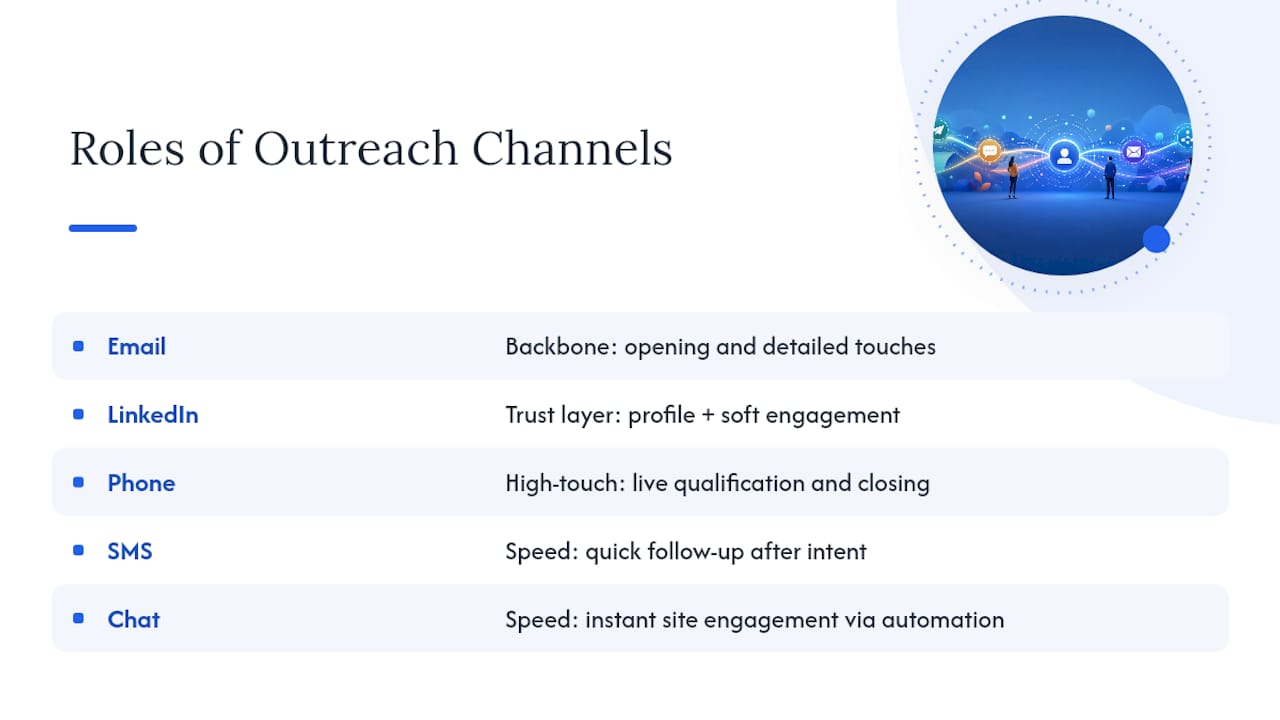
Email remains the backbone. It’s the most scalable channel you have, and it creates a written record the prospect can forward internally, a real advantage in B2B deals where a champion needs to sell the meeting to a boss. Use email for the opening move and for any touch that benefits from detail: a case study link, a specific metric, a calendar link.
LinkedIn functions as the trust layer. A connection request or comment on a prospect’s post does something email can’t: it puts a face and a professional history in front of them before you ask for their time. A pragmatic starting triad of email, LinkedIn, and phone gives most B2B teams both scale and reach without overextending into channels they can’t personalize well.
Phone is your highest-touch closer. It’s where qualification actually happens in real time, objections surface immediately, and tone carries information that text never will. Reserve calls for prospects who’ve shown some engagement already, a reply, an open, a LinkedIn view, so the call doesn’t feel cold.
SMS and website chat serve speed, not depth. These channels win when a prospect has just shown intent, downloaded a resource, replied to an email, or landed on a pricing page, and you need to respond before that intent cools. A chat automation layer that engages the moment someone lands on your site captures interest email simply can’t move fast enough to catch.
Some channels should be left out entirely. If your buyer persona skews toward executives who never check LinkedIn messages, don’t force that channel into the sequence just because best practices say so. And if your list quality is poor, adding channels only multiplies the damage of bad targeting.
Pro Tip: Match message length to the channel’s native format. A four-paragraph pitch dropped into a LinkedIn message reads as a mismatch before the prospect even finishes the first line, cut it to two sentences and let the profile do the trust-building work.
How Do You Sequence and Orchestrate Multi-Channel Touches?
Sequencing is where most programs succeed or fail. The channels can be right and the messaging can be sharp, but if the timing and order are wrong, the sequence still reads as scattered.
Three principles govern good orchestration:
- Let intent set the pace, not the calendar. A prospect who opens three emails in one day deserves a faster next touch than one who’s gone silent for two weeks. Sequences built around fixed day intervals ignore the signal sitting right in front of you.
- Assign each channel a distinct role and stick to it. Email opens and informs, LinkedIn builds familiarity, phone closes. When every channel tries to do the same job, the buyer gets the same pitch three times and starts filtering you out.
- Build in adaptivity. Orchestration platforms can shift the next touch automatically when a prospect engages on any channel, moving a call up the queue after an email open, or pausing SMS after a LinkedIn reply. Manual sequences can mimic this with simple branching rules.
Message continuity matters just as much as timing. Touch three should never repeat the pitch from touch one. Reference what happened: “Saw you opened the case study, here’s the two-minute version” reads as attentive. Sending the identical value proposition for the fourth time reads as automation with no one watching it.
Here’s how two common cadences differ in practice:
| Element | AE outreach to a VP of Product | SDR outreach to a mid-market buyer |
|---|---|---|
| Day 1 | Personalized email referencing a specific product decision | Email with a relevant case study link |
| Day 3 | LinkedIn connection request, no pitch | LinkedIn comment on a recent post |
| — | Follow-up email with a data point | Second email, different angle |
| — | Phone call, timed to a LinkedIn profile view | SMS if email opened but not replied |
| — | Final email offering a specific meeting slot | Phone call to qualify and book |
The AE sequence runs slower and leans on LinkedIn signals because executive buyers respond to timing that feels observant, not aggressive. The SDR sequence moves faster and layers in SMS because mid-market buyers tend to self-select faster once interest is triggered. Embedding a scheduling link, Calendly is a common choice, into the final touch removes a step between “yes, let’s talk” and a meeting on the calendar.
What Tech Stack Do You Need to Run This Well?
Orchestration only works if your systems actually talk to each other. A sequence that looks coordinated on paper falls apart the moment a rep has to manually check four tabs to know what a prospect did yesterday.
The minimum stack looks like this:
- CRM as the system of record for every interaction and deal stage
- An engagement or orchestration platform that sequences touches and triggers channel switches based on rules
- Data enrichment to keep contact details, titles, and firmographics current
- A dialer or contact center platform for phone-based touches at scale, cloud contact center tools are a common category here, often paired with quality headsets to keep call audio clean during high-volume days
- Analytics to track performance across channels in one dashboard instead of five
Data hygiene is the part teams underestimate. Verified emails, deduplicated records, and consistent enrichment coverage aren’t administrative housekeeping, they’re the difference between a sequence that adapts intelligently and one that sends a phone call touch to a number that was disconnected two years ago. Set a standing rule: no contact enters an active sequence without a verified email and a confidence score above your team’s threshold.
Integration patterns matter as much as the tools themselves. When your CRM, engagement platform, and enrichment source sync in real time, a reply on one channel can pause or redirect every other touch instantly. Without that sync, you’re running parallel systems that occasionally happen to agree with each other. Chat automation tied into the same outreach infrastructure can also capture inbound replies and feed them straight back into the sequence logic, closing a loop that manual handoffs usually leave open.

What Metrics Actually Prove Multichannel Outreach Is Working?
Three numbers matter more than the rest: reply rate, meetings booked per sequence, and pipeline created. Everything else is a supporting signal that helps you diagnose why those three numbers move.
Track these operational metrics alongside the primary ones:
- Deliverability rate across email and SMS, since a sequence with strong messaging still fails if half the emails land in spam
- Enrichment coverage, the percentage of contacts with verified, current data
- Intent-utilization rate, how often a touch actually fires in response to a real signal rather than a fixed schedule
Sequences that prioritize outreach using intent signals, website visits, content downloads, job changes, tend to show stronger response and conversion patterns than sequences built purely off static contact lists. That’s the operational case for building intent-utilization tracking into your dashboard from day one, not adding it later as an afterthought.
Testing should move in a specific order. Start with message variations within a single channel, subject lines, opening lines, call scripts. Once you’ve found a message that performs, test channel order next: does phone before LinkedIn outperform LinkedIn before phone for this persona? Only after both are stable should you test timing intervals, since timing changes are the hardest to read cleanly if your messaging is still shifting underneath them.
A simple A/B design: split your list in half, hold the channel mix constant, and vary only the day-3 touch, email follow-up versus SMS. Run it for at least two full sequence cycles before calling a winner.
What Mistakes Break Multichannel Programs, and What Compliance Rules Apply?
Most multichannel programs don’t fail because of bad messaging. They fail because of coordination gaps that compound over time.
The recurring failure patterns:
- Uncoordinated messaging, where email, LinkedIn, and phone touches contradict each other because no one owns the full sequence view
- Channel overuse, hitting a prospect on three channels in 24 hours because no one checked what already went out
- Stale data, sequences running against contacts who changed jobs, companies, or phone numbers months ago
- No pause logic, continuing a sequence after a prospect has already replied or booked a meeting
Deliverability risk deserves its own attention. Sending high volumes of near-identical emails from a single domain, or hitting SMS carriers with unsolicited texts, can get a domain flagged or a number blocked well before a human ever complains. Warm up new sending domains gradually, rotate messaging enough that spam filters don’t pattern-match your sequence, and respect opt-outs immediately across every channel, not just the one where the prospect unsubscribed.
TCPA rules govern SMS and phone outreach in the United States, and platform terms of service on LinkedIn restrict connection request volume and automation behavior. Neither of those is legal advice, and specific compliance obligations depend on your jurisdiction and how your program operates, so build your consent and opt-out processes with input from counsel rather than assuming a competitor’s approach is safe to copy.
Pro Tip: Before adding a new channel to any sequence, ask who owns the “stop” logic. If no single system can halt every remaining touch the moment a prospect replies, you don’t have a multichannel sequence yet, you have four sequences that happen to run in parallel.
What Does an Orchestrated Sequence Look Like in Practice?
A workflow that shows this clearly: inbound lead capture, immediate AI-driven engagement, then a sequenced follow-up across email, phone, and chat that all reference the same initial signal.
The flow typically runs like this, leveraging advanced AI-driven tools like AI for Shopify Stores to enable immediate engagement and personalized follow-ups:
- A prospect fills out a form or triggers a chat widget on a website
- An AI voice agent or chatbot engages within seconds, before the lead has closed the tab
- Qualification questions run automatically and the answers populate the CRM record
- Follow-up touches across email and SMS reference the specifics of that first conversation, not a generic template
Sub-60-second engagement on inbound leads is the benchmark worth building toward. Speed at that first moment of contact tends to correlate directly with higher meeting-booked rates, because interest that isn’t captured immediately decays fast, often within minutes. A case study on Fifth Avenue Leads shows how orchestrating that first response with sequenced follow-up reduces the manual tab-jumping that normally slows a rep down between channels.
The mechanical benefit is straightforward: when a system owns the handoff between channels, a rep no longer has to manually check whether a lead already got an email, whether the chatbot logged an answer, or whether the phone queue duplicates outreach that email already covered.
Why Do Teams Stall at Activity Instead of Building a System?
Most sales teams don’t lack channels. They lack the connective layer that makes those channels behave like one conversation instead of five separate ones. It’s an easy trap: adding a channel feels like progress, and it shows up as a line item in a QBR deck, while building the orchestration behind it feels invisible and harder to justify.
But the orchestration is where the actual lift lives. A rep manually tracking five channels in five tabs will always lose context somewhere, and that lost context is what a prospect notices as inconsistency. Teams that shift investment from “more channels” to “better coordination between the channels they already have” tend to see the reply-rate movement that channel expansion alone rarely delivers.
If your team hasn’t tested a fully orchestrated sequence yet, that’s the experiment worth running before you add another channel to the mix.
— MediaBloom
See Multi-Channel Orchestration Built for Speed-to-Lead
Mediabloom runs the orchestration layer this guide describes, not as a concept, but as a working platform. AI voice agents, chatbots, and sequenced email and SMS touches operate from one shared context, so a lead who chats on your website at 2 a.m. gets the same continuity a rep would give them at 2 p.m., without the manual handoffs that usually break multichannel programs.

The platform connects to over 600 CRM and sales tools, so the sequencing logic described throughout this guide, intent-first timing, adaptive channel order, message continuity, runs automatically instead of depending on a rep remembering to check five tabs. Companies like Miracle Ear and 1-800 Accountant have used this exact approach to generate many monthly leads with faster response times than manual sequencing allows. If you want to see how this plays out for a business closer to your size, the case studies page breaks down results across several industries, or you can get in touch to walk through what an orchestrated sequence would look like for your pipeline.
Sources
- Multi-Channel Outbound: How Modern Teams Win More Meetings
- Omnichannel lead generation: How to turn outreach into a high-converting system
- Why a Multi-Channel Approach to Outbound Sales Is a Must
- Multi-Channel Outreach: Definition, Channels & AI-Orchestrated Sequences — Definition | Knowlee Glossary
FAQ
What Does Lead Outreach Mean?
Lead outreach is the process of initiating and following up on contact with a potential buyer to move them toward a sales conversation, typically through email, calls, social messaging, or text.
What Does Multichannel Mean in Marketing?
In marketing, multichannel means engaging prospects or customers across more than one platform, such as email, social media, and phone, usually with some shared strategy but not always a fully synced data layer.
Can You Give an Example of Multichannel Marketing?
A common example is a sequence where a prospect gets an opening email, a LinkedIn connection request days later, and a follow-up call once they’ve engaged with either touch, each channel playing a distinct role in the same overall sequence.
What Is Multichannel Communication?
Multichannel communication is the use of two or more distinct platforms, like email, SMS, and chat, to reach the same audience, with the goal of meeting people on whichever channel they respond to fastest.
How Is Multi-Channel Lead Outreach Different From Cold Calling Alone?
Cold calling relies on a single channel and a single moment of contact, while multi-channel lead outreach layers phone calls into a broader sequence that includes email, LinkedIn, and chat, so a missed call isn’t a dead end.