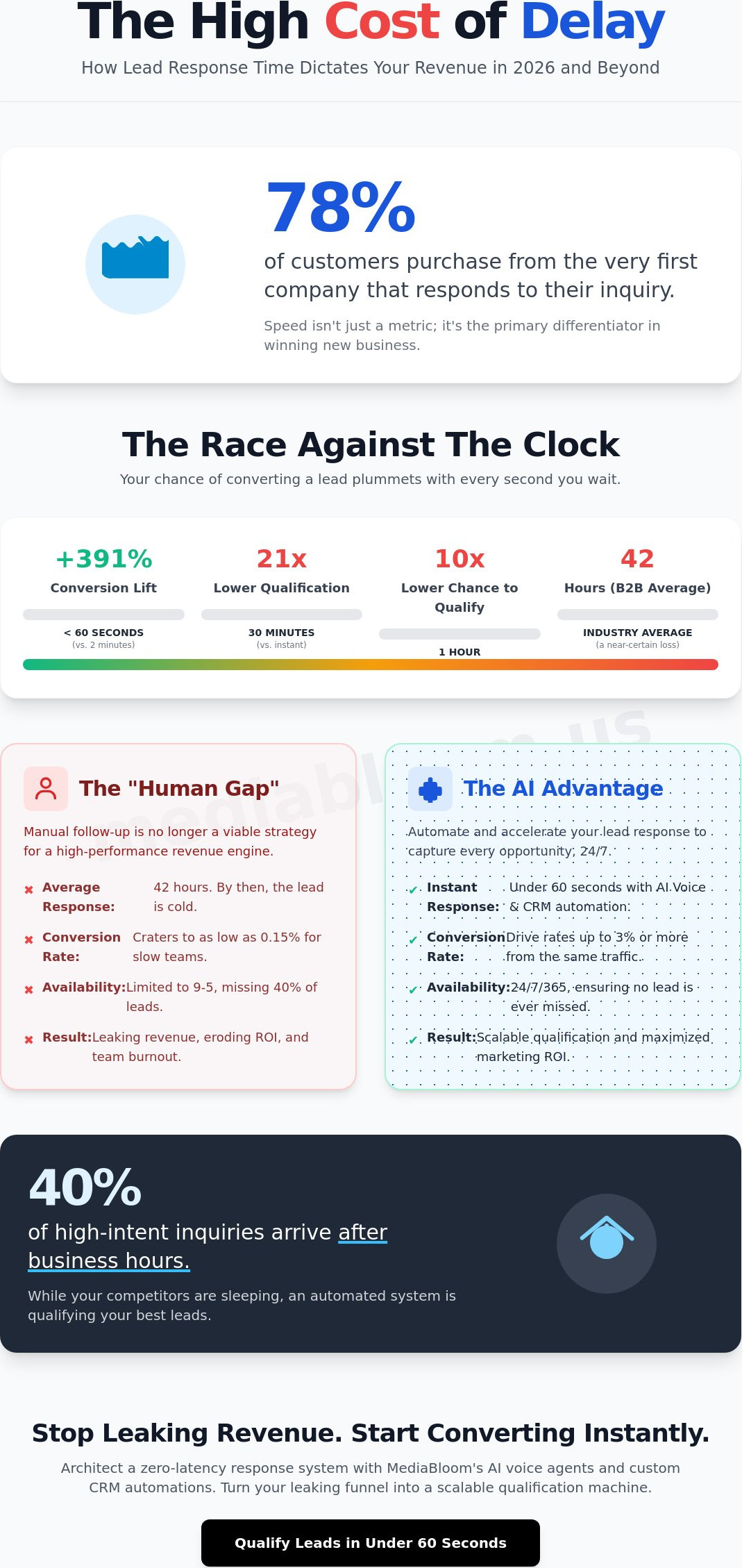
78% of customers buy from the company that responds first. If your team takes the B2B average of 47 hours to follow up, you're effectively handing your market share to faster competitors. The mathematical cost of slow lead response time is staggering; responding within sixty seconds can increase conversions by 391% compared to waiting just two minutes. You've likely felt the pressure of rising Cost Per Lead while ROI stagnates, leaving your sales engine stalled and your team burnt out from manual outreach.
It's clear that human-speed follow-up is no longer a viable strategy for a high-performance revenue engine. This guide breaks down the precise financial impact of lead latency and promises a clear ROI justification for shifting to an automated infrastructure. We'll show you how to architect a zero-delay system using AI voice agents and custom AI automations to qualify leads in under a minute. You'll learn to capture the 40% of high-intent inquiries that arrive after business hours and turn your leaking funnel into a scalable qualification machine.
Key Takeaways
- Quantify the precise cost of slow lead response time by mapping the conversion decay curve against your current customer acquisition costs.
- Learn why the 2026 gold standard for lead engagement has compressed to sub-60 seconds to secure the critical first-responder advantage.
- Identify the structural failures of manual sales outreach and how human-scale delays are systematically eroding your marketing ROI.
- Architect a high-performance response engine that leverages AI Voice Agents and CRM automation for instantaneous, human-parity lead qualification.
- Implement a scalable framework to capture high-intent inquiries from every channel, ensuring no revenue-generating opportunity is left to stagnate.
Quantifying the Cost of Slow Lead Response Time: Beyond the Missed Call
Lead Response Time (LRT) is the critical pulse of your revenue engine. It represents the exact interval between a prospect's form submission and your first meaningful engagement. In the high-velocity markets of 2026, the cost of slow lead response time is no longer just a missed opportunity; it's a direct tax on your marketing budget. While previous eras prioritized a five-minute follow-up, the current benchmark is sub-60 seconds. This acceleration is driven by a fundamental shift in buyer behavior where speed is equated with competence. If your response isn't near-instant, you're signaling a lack of operational maturity.
Effective Lead management requires more than just collecting data. It demands immediate action. Data shows that 78% of customers buy from the company that responds first. If you aren't the first to the phone, you've already lost nearly four-fifths of your potential market. Speed is the only differentiator that your competitors cannot easily replicate without the right architecture. By the time a human rep picks up a lead from three hours ago, the prospect has likely already moved down the funnel with a faster provider.
The Psychology of the Modern Prospect
Prospects operate within a tight "Window of Intent." Their interest level peaks at the moment of submission and begins a rapid decay. Research indicates that the likelihood of qualifying a lead drops 10x after the first hour of silence. This isn't just about memory; it's about trust. When a brand remains silent, it creates a vacuum. Your competitors are waiting to fill it. In the mind of a modern buyer, your delay acts as a silent referral to the next company on their list. They don't wait for late arrivals. They seek the path of least resistance and fastest gratification.
Industry Benchmarks for 2026
The disparity between average performance and elite execution is vast. The national average response time still hovers around 42 hours, a figure that spells certain death for conversion rates. In contrast, top-tier firms achieve human-parity responses in under a minute. Expectations vary by sector, but the trend is universal. In Real Estate, a delay of ten minutes often means the prospect has already booked a viewing with another agent. For SaaS providers, a slow response signals a lack of technical agility. In Professional Services, latency suggests your firm is too disorganized to handle their account. Ultimately, LRT is the primary predictor of sales velocity. Reducing this metric is the fastest way to lower the cost of slow lead response time and reclaim leaking revenue.
The Mathematics of Delay: How Every Minute Erases Your ROI
Revenue doesn't just disappear when you're slow to respond; it's systematically erased by the minute. When you analyze the statistical drop-off between a one-minute and a thirty-minute response, you see a catastrophic collapse in lead-to-opportunity ratios. The math is brutal. Responding within one minute can increase conversions by 391% compared to waiting just sixty seconds longer. By the time thirty minutes pass, your chances of qualifying that lead have already plummeted by 21 times. This isn't a minor inefficiency. It's a fundamental breakdown of your sales engine that doubles your cost per acquisition overnight.
Slow response times act as a force multiplier for CAC inflation. If you spend $5,000 on high-intent Google or Meta ads but allow those leads to sit for an hour, you're effectively burning your capital. A slow-responding team often sees conversion rates as low as 0.15%, while an automated, instant-response system can drive that same traffic to a 3% conversion rate. According to foundational research from Harvard Business Review, the window of opportunity is so brief that most companies are disqualified before they even dial the number. Every minute of latency represents a direct withdrawal from your potential Lifetime Value (LTV).
Calculating Your Lead Latency Tax
To understand the true cost of slow lead response time, you must apply a simple formula: Total Leads x Conversion Drop-off x Average Contract Value (ACV). If your manual process causes a 50% drop in qualification compared to an instant AI response, you're losing half of your potential revenue before the first conversation even happens. This "latency tax" sabotages your paid ad spend, making even the best creative campaigns look like failures on paper. Auditing your current response systems is the first step toward recovering lost revenue and stabilizing your ROI.
The "Ghosting" Effect
Slow response is a silent tax on your marketing budget. Approximately 50% of leads go "dark" if they aren't contacted within the first ten minutes of submission. These prospects don't just disappear; they find your competitor. This creates a cycle of sales rep "chase time," where your team spends hours leaving voicemails for leads that have already moved on. High-performance organizations eliminate this friction by ensuring the connection happens while the prospect's intent is at its absolute peak. When you bridge the gap between submission and engagement, you stop the leakage and start scaling with precision.
The "Human Gap": Why Manual Follow-Ups Are Killing Your Close Rate
Relying on human speed is a strategic gamble you're destined to lose. Even the most motivated sales teams are bound by biological and operational constraints. They sleep. They take lunch breaks. They get stuck in internal meetings. While your reps might be incentivized to dial quickly, the reality is that manual lead routing often adds fifteen to thirty minutes of hidden lag. Time kills the most sales deals according to Forbes; yet most businesses still rely on people to bridge the gap between a form submission and a phone call.
Working harder isn't a scalable solution for 2026 growth. You can't hire your way out of a system that is fundamentally broken. When you factor in the cost of slow lead response time, the overhead of human-operated BPO services becomes impossible to justify. These services lack the sub-second speed required to capture modern prospects who expect instant engagement. The "Human Gap" is where your marketing budget goes to die. High-intent inquiries cool off while waiting for a manual notification to trigger a dial. If your system depends on a human being "checking their inbox," you've already lost the race to the lead.
The Inconsistency of Manual Outreach
Performance variance is the enemy of predictability. Top-performing reps might hit their targets, but the rest of the team often struggles with "cherry-picking" leads when volume spikes. Humans naturally gravitate toward the easiest-looking opportunities. This leaves complex or "cooler" leads to rot in the CRM. Statistics show that 63% of companies never respond to leads at all. The manual burden is simply too high. Human persistence is also notoriously low. Most reps give up after two attempts; however, data confirms that conversion often requires five to seven touchpoints to secure a meeting.
The Infrastructure Bottleneck
Fragmented CRM workflows create data silos that paralyze your outreach. Before a rep can even make the first dial, they often have to navigate manual data entry. They wait for a lead to sync across multiple platforms. This friction is a primary driver for the cost of slow lead response time. Modern revenue operations require an architecture that eliminates the middleman. Relying on manual entry or human-operated BPO services for initial qualification is an obsolete strategy. It leaves you trailing behind competitors who have automated their entire ingestion-to-engagement pipeline with AI voice agents and custom AI automations.
Architecting a Zero-Latency Response System
Eliminating the cost of slow lead response time requires a shift from human-dependent workflows to a machine-driven architecture. You can't solve a millisecond problem with a minute-based workforce. To secure the first-responder advantage, your revenue engine must be built for sub-second execution. This isn't just about speed; it's about building a predictable system that qualifies leads while their intent is at its absolute peak. A zero-latency system functions as a continuous loop of ingestion, engagement, and optimization.
- Step 1: Real-Time Ingestion. Centralize every lead source into a high-speed data pipeline. Whether a lead originates from Google Ads, Meta forms, or your website's AI Chatbots, the ingestion must be instantaneous. Any delay here creates a bottleneck that no amount of downstream speed can fix.
- Step 2: AI Voice Agent Deployment. Trigger an outbound call via AI Voice Agents within seconds of submission. These agents deliver human-parity conversations, qualifying the prospect's needs and intent without the variance of a human rep.
- Step 3: Automated CRM Handoff. Route only the "sales-ready" opportunities to your human closers. The system should automatically update your CRM and book appointments, ensuring your team only speaks with high-intent prospects.
- Step 4: AI-Driven Analytics. Use continuous feedback loops to refine your scripts. AI call analytics identify where prospects drop off, allowing you to optimize the engagement engine in real time.
The Tech Stack for Instant Engagement
Your architecture is only as strong as its integrations. A high-performance stack connects AI Voice Agents directly to your core CRM, whether you use HubSpot, GoHighLevel, or other enterprise platforms. This seamless CRM automation setup ensures that lead data flows without friction, eliminating manual entry errors and further reducing the cost of slow lead response time. For a deeper dive into the mechanics of this technology, read The Definitive Guide to AI Voice Agents. Automated lead nurturing then takes over, maintaining a warm pipeline through synchronized email and SMS sequences.
Beyond the First Call: Automated Nurturing
Persistent automation is the foundation of modern lead follow-up. If a prospect doesn't answer the first call, the system shouldn't stop. A multi-channel "blitz" combines AI Voice, SMS, and Email within the first five minutes to maximize contact rates. This persistent approach handles "no-answers" automatically, re-attempting contact at optimized intervals. You don't have to worry about reps forgetting to follow up or losing interest in older leads. The system remains relentless, driving every inquiry toward a definitive outcome. You can build your zero-latency system today to stop the leakage and start capturing every dollar of your marketing spend.
MediaBloom: Eliminating Response Lag with AI Voice and CRM Automation
MediaBloom exists to solve the critical failure points in your sales funnel. We don't just provide tools; we architect the entire revenue engine. By deploying custom AI Voice Agents that sound indistinguishable from humans, we transform sluggish follow-up processes into high-performance assets. In one instance, we helped a partner transform a 4-hour response lag into a consistent 30-second win. This level of technical precision is the only way to permanently eliminate the cost of slow lead response time and secure your market position against faster-moving rivals.
Scalability is foundational to our systems. Whether your marketing campaigns generate 10 leads or 10,000, our infrastructure maintains the same instant response quality across the board. There is no hiring curve. There is no training lag. Your sales operations remain lean, efficient, and ready to engage every prospect at the peak of their interest. By removing the variability of human performance, we provide a predictable baseline for your revenue growth. You can finally stop worrying about whether your team is dialing fast enough and start focusing on the quality of the closing conversation.
Custom AI and CRM Workflows
Our methodology centers on bespoke CRM integrations that remove all manual friction from your daily operations. We build direct, automated pipelines between your lead sources and your engagement tools. This architecture eliminates the heavy overhead and high turnover associated with human-operated BPO services while simultaneously increasing your qualification quality. When you remove the middleman, you stop losing revenue to the clock. Every lead is processed with the same level of intensity and accuracy, ensuring your CRM remains a source of truth rather than a graveyard of missed opportunities.
The Future of Sales Operations
The window for digital transformation is closing. Companies that fail to implement AI-driven response systems by 2027 will likely be priced out of the market by competitors with significantly lower acquisition costs. Efficiency is the new competitive advantage. MediaBloom keeps your sales team focused on high-value closing activities instead of the demoralizing task of chasing unresponsive leads. It's time to stop the leakage and start scaling with a system designed for the next decade of sales. Schedule your AI Automation Audit with MediaBloom to stabilize your funnel and reclaim your ROI.
Secure Your Competitive Advantage in a Zero-Latency Market
The data is irrefutable. Speed is the primary differentiator in the 2026 sales landscape. You've seen how the conversion decay curve erases ROI within minutes and how manual human gaps create a persistent tax on your growth. To scale, you must move beyond the limitations of manual dialing and fragmented workflows. Implementing a zero-latency architecture isn't just an upgrade; it's a fundamental requirement for survival. High-growth organizations are already leveraging automation to capture the 40% of high-intent leads that arrive after hours while competitors are offline.
MediaBloom specializes in building these high-performance engines. We architect custom AI Voice Agents with human-parity conversation and specialized CRM automation setup to ensure no lead is left to stagnate. By automating your lead nurturing and qualification, we help you eliminate the cost of slow lead response time and keep your sales team focused on high-value closing. It's time to stop the leakage and reclaim your marketing ROI. The infrastructure for exponential growth is within reach. Audit your lead response engine with MediaBloom and start building the future of your revenue operations today.
Frequently Asked Questions
What is the ideal lead response time for B2B sales in 2026?
The elite standard is now sub-60 seconds. Because prospects often engage in multi-tab browsing, they're likely submitting forms to your competitors simultaneously. Securing a connection in under a minute ensures you anchor the conversation while the problem is still top-of-mind. Delaying this engagement significantly increases the cost of slow lead response time by allowing a faster rival to claim the prospect's attention first.
How does slow lead response time affect my Google Ads ROI?
Latency creates a disconnect between your marketing spend and your sales outcomes. When high-intent traffic doesn't receive an immediate callback, your "Cost Per Opportunity" skyrockets even if your "Cost Per Click" remains low. This inefficiency forces you to spend more on top-of-funnel traffic to compensate for the leads that go cold. Rapid response preserves your capital by ensuring every paid click has the highest possible chance of conversion.
Can AI voice agents really handle complex sales inquiries?
Modern agents utilize advanced branching logic and contextual memory to manage multi-turn discovery calls. They don't just read static scripts; they listen for specific intent and adjust their responses based on the prospect's input. This allows them to qualify leads on technical requirements and budget before the data ever reaches your human team. They function as a sophisticated first line of defense for your sales pipeline.
What is the "Speed to Lead" rule?
This rule dictates that the value of a lead is highest at the moment of submission and decays exponentially with every passing minute. It's a fundamental law of revenue operations that prioritizes immediacy over almost every other variable. In a market where 78% of buyers choose the first responder, following this rule is the most effective way to protect your market share from more agile competitors.
How much does it cost to automate lead response?
The investment for automation is scaled to the complexity of your lead flow and the depth of your CRM integrations. High-performance firms view this as a strategic reallocation of budget rather than an added expense. By reducing the cost of slow lead response time, the system typically pays for itself through recovered revenue that would have otherwise leaked out of the funnel. It's a capital-efficient way to achieve 24/7 coverage without hiring additional staff.
Why is the first 5 minutes so critical for lead conversion?
This window represents the peak of "Mental Availability." The prospect is still focused on the specific pain point that drove them to your site. After five minutes, they've often moved on to other tasks or meetings, making it significantly harder to re-engage them. Capturing them within this window ensures your brand is associated with speed and reliability from the very first touchpoint.
What happens if my sales team is too busy to call leads immediately?
When your team is at capacity, high-intent leads inevitably rot in your CRM. This creates a cycle of "chase time" where reps spend their days leaving ignored voicemails for leads that have already cooled off. AI Voice Agents solve this by acting as a persistent bridge, handling the initial outreach and qualification instantly. This keeps your pipeline moving so your reps only spend time on calls that are likely to close.
How do AI voice agents integrate with my existing CRM?
AI Voice Agents connect to your technology stack through native API integrations and secure webhooks. They synchronize data with platforms like HubSpot and GoHighLevel, ensuring that every interaction is logged in real time. This replaces manual entry and prevents data silos from forming within your revenue operations. By automating this handoff, you ensure your sales team always works from a unified, up-to-date lead profile.