For every dollar you invest in sales automation, you should expect an average return of $8. That is an 800% ROI that most human-centric sales teams struggle to replicate as labor costs continue to climb. You likely feel the pressure of rising headcount costs and the frustration of seeing high-value leads fall through the cracks because a manual follow-up was six hours too late. It's a common bottleneck in traditional revenue operations that drains your bottom line. Building a rock-solid business case for sales automation is no longer just about saving time; it's about shifting from a fragile, manual workflow to a resilient, autonomous revenue engine. To streamline this process, platforms like GrowthGrid allow you to generate comprehensive business documents and strategic plans with AI-powered efficiency.
In this guide, you'll learn how to construct a high-impact case that secures executive buy-in by replacing expensive BPO services with high-performance AI infrastructure. We will break down a clear ROI framework, explore the roadmap for seamless CRM integration, and show you how to scale your output without adding a single seat to your payroll. This is your blueprint for operational excellence and exponential growth in a competitive market.
Key Takeaways
- Transition from fragile, human-dependent pipelines to a resilient, autonomous architecture that scales without increasing headcount.
- Develop a compelling business case for sales automation by quantifying the 8:1 ROI potential and the significant cost savings of AI over traditional BPO.
- Deploy AI Voice Agents to handle inbound qualification and outbound prospecting with high-energy consistency and zero turnover.
- Eliminate operational bottlenecks through custom CRM automation and workflow designs that mirror your most successful sales logic.
- Secure executive buy-in by presenting a clear roadmap for replacing manual follow-up delays with automated lead nurturing and precision infrastructure.
The Strategic Imperative: Why Sales Automation is the Core of Modern Revenue Operations
Sales automation is no longer a peripheral toolset for managing contacts. It is the foundational architecture of a high-performance revenue engine. To build a compelling business case for sales automation, you must view it as a shift from human-dependent pipelines to autonomous systems that operate with surgical precision. Manual sales processes represent the single greatest bottleneck to enterprise scaling in 2026. Every minute a lead sits untouched is a minute of revenue lost to decay. Market dominance now belongs to the organizations that can achieve near-instantaneous speed to lead through automated response layers that never sleep.
This transition aligns with the "Growth as a Service" model, which Spring Agency identifies as a key strategy for building a predictable B2B growth engine in 2026.
To better understand how this transformation impacts your bottom line, watch this breakdown of the automation journey:
From Task Automation to Autonomous Workforces
Modern systems have evolved beyond simple if-this-then-that workflows. We've moved into the era of AI-driven decision engines that process complex intent signals in real time. These 2026-level AI capabilities allow for high-energy, human-parity interactions that don't suffer from fatigue or inconsistent performance. AI Voice Agents now maintain a constant sales presence, ensuring that prospect qualification happens the moment a lead is generated. This isn't just about doing tasks faster; it's about deploying an autonomous workforce that executes your sales logic with total reliability and zero turnover.
The Opportunity Cost of Inaction
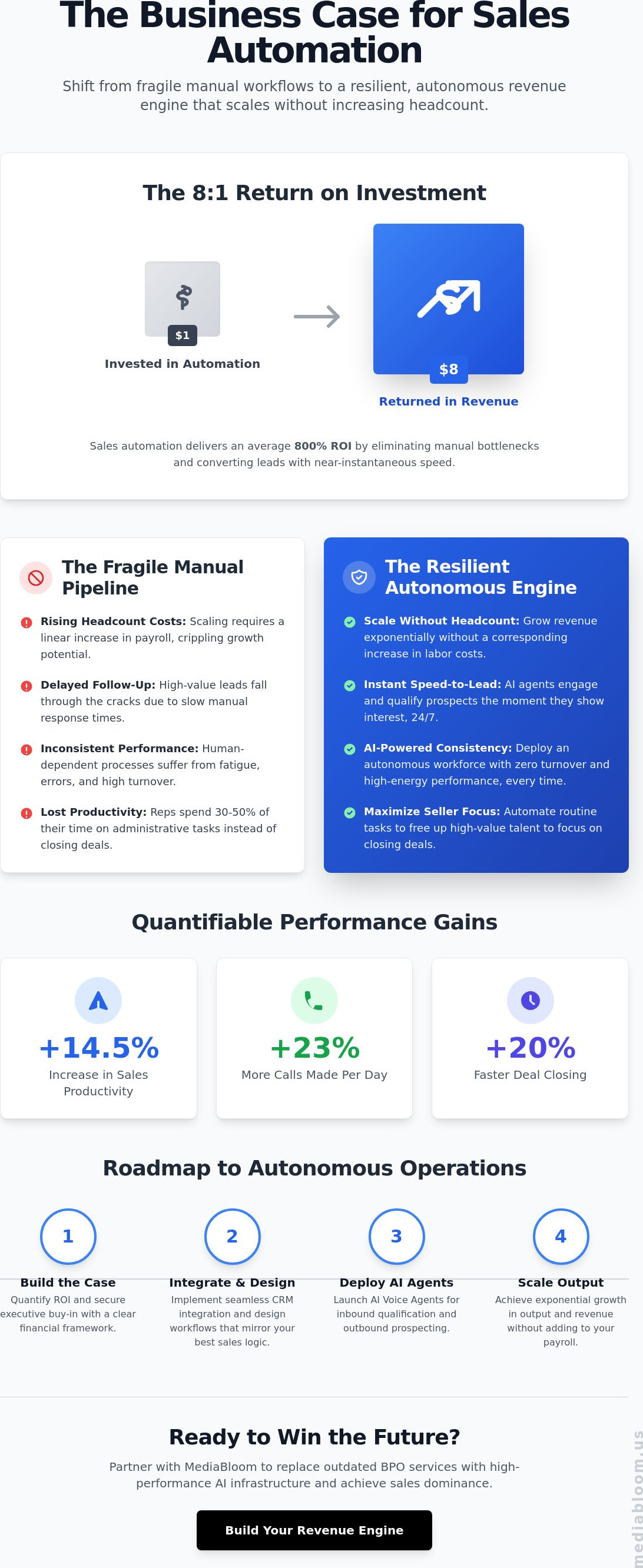
The financial impact of lead decay is staggering. For every dollar invested in sales automation, companies are seeing an average return of $8. Conversely, those relying on manual follow-up often lose qualified prospects to faster, more agile competitors. Sales teams using automation are 14.5% more productive, making 23% more calls per day and closing deals 20% faster. If your data is fragmented across manual spreadsheets or outdated CRM entries, your executive forecasting is likely built on guesswork. Competitors utilizing custom AI automations are out-bidding and out-converting manual teams by leveraging real-time market signals. The true cost of delaying your strategy isn't just the software licensing; it's the compounding loss of market share.
Quantifying the ROI: The Financial Framework for Sales Automation
Quantifying the financial impact of your infrastructure is the most critical step in building a business case for sales automation. You aren't just buying software; you're investing in a high-yield asset. Research shows that for every dollar invested in sales automation, companies see an average return of $8. This 800% ROI stems from a combination of direct cost reduction and aggressive revenue acceleration. By replacing massive, human-operated BPO services with AI-powered infrastructure, you eliminate the overhead of recruitment, training, and the inevitable high turnover associated with manual sales centers.
Efficiency gains provide an immediate boost to your bottom line. Most sales representatives spend between 30% and 50% of their time on administrative tasks, data entry, and manual follow-ups. Automation reclaims this lost time, allowing your high-performers to focus exclusively on closing. This shift doesn't just improve morale; it drives a 14.5% increase in productivity across the board. Additionally, the value of data integrity cannot be overlooked. Automated CRM systems ensure that 100% of lead interactions are captured, providing the clean data necessary for accurate executive forecasting and strategic pivots.
Key Metrics for the Business Case
To secure board-level approval, you must speak the language of the CFO. Focus on these three pillars:
- CAC Reduction: Automated lead nurturing lowers your Customer Acquisition Cost by engaging prospects through low-cost, high-frequency touchpoints.
- LTV Expansion: Consistent, automated upsell sequences ensure that no revenue is left on the table, increasing the Lifetime Value of every account.
- Lead-to-Close Velocity: Automated funnels close deals 20% faster by removing the friction of manual scheduling and delayed responses.
If you're ready to see how these metrics apply to your specific operation, you can request a custom ROI analysis from our team.
The ROI Calculation Formula
Operational Scalability: Replacing Human BPO with AI Voice Agents
Scaling a sales operation through traditional human-operated BPO services is a high-risk gamble. Human call centers suffer from chronic turnover, often exceeding 30% annually, which creates a cycle of constant recruitment and sunk training costs. Every time a rep leaves, your institutional knowledge walks out the door. AI Voice Agents eliminate this volatility by providing a stable, high-performance workforce that never tires and never quits. This shift from variable human performance to predictable machine output is a central pillar of any modern business case for sales automation.
The AI Voice Agent Advantage
Modern Natural Language Processing (NLP) has effectively dismantled the "impersonality myth." In 2026, AI agents interact with human-parity nuance, handling complex objections in real-time with surgical precision. They maintain 100% script adherence and brand voice consistency, ensuring your message is never diluted by a "tired" rep. These agents provide instant qualification of inbound leads, moving prospects through the funnel before the competition even checks their inbox. To understand the full technical scope of these systems, read our definitive guide to AI Voice Agents.
Eliminating the BPO Middleman
The Roadmap to Implementation: CRM Integration and Workflow Design
- Phase 1: The Operational Audit. We begin by identifying data silos and bottlenecks where leads currently stall. You can't automate a broken process; you must first map every friction point in your current funnel.
- Phase 2: Custom Logic Design. This phase focuses on building custom AI and CRM workflows. We design the decision trees that dictate how your AI agents and nurturing sequences interact with prospects.
- Phase 3: Infrastructure Deployment. We launch the heavy machinery. This includes deploying AI Voice Agents for qualification and activating automated lead nurturing sequences across email and chat.
- Phase 4: Continuous Optimization. Post-launch, the focus shifts to data-driven refinement. We utilize precision ad management and email marketing services to ensure your top-of-funnel volume matches your automated processing capacity.
Custom CRM Workflows: The Backbone of Automation
Out-of-the-box automation settings rarely survive the complexities of enterprise sales. To win, you need custom logic that mirrors your most successful human interactions. Our CRM automation setup integrates AI agents directly into platforms like HubSpot and Salesforce. This ensures a seamless "hand-off" where AI qualifies the lead and automatically schedules a meeting for your human closers. It eliminates manual data entry and ensures your sales reps step into every call with a fully updated lead profile.
Risk Mitigation and Quality Control
In 2026, compliance is a foundational requirement, not an afterthought. Your automation strategy must account for the Colorado AI Act, which takes effect on June 30, 2026, and California’s ADMT rules regarding pre-use notices. We mitigate risk by building "Human-in-the-Loop" triggers for high-value deal intervention. This allows your team to monitor AI performance through real-time sentiment analysis and analytics. Maintaining data accuracy is also a legal necessity under GDPR, as contact data decays at a rate of 25% to 30% per year. Our systems include automated data cleansing to keep your infrastructure compliant and your forecasting accurate.
If you're ready to move from planning to execution, book your infrastructure audit here to begin your transformation.
Winning the Future: Partnering with MediaBloom for Sales Dominance
Execution is the final hurdle in establishing a winning business case for sales automation. You've identified the bottlenecks. You've calculated the ROI. Now, you need a strategic architect capable of building the engine that will drive your revenue for the next decade. MediaBloom doesn't just provide software; we design the foundational infrastructure that allows your business to out-pace and out-convert the competition. We move beyond the limitations of generic SaaS tools to deliver a custom-built revenue machine tailored to your enterprise logic.
The MediaBloom Difference
Generic automation platforms often fail because they lack the nuance required for high-stakes enterprise sales. MediaBloom specializes in high-energy, human-parity AI that maintains your brand’s authority in every interaction. We bring deep expertise in complex CRM integrations, ensuring that your data flows seamlessly across national-scale operations. Our focus remains entirely on your bottom-line results. We prioritize systems that drive tangible ROI, transforming your sales department into a lean, profit-generating powerhouse that operates with surgical precision.
Launch Your Automated Workforce
Transitioning to an autonomous sales model doesn't have to happen overnight. We recommend starting with a targeted pilot program designed to prove the business case for sales automation within a specific segment of your funnel. This allows you to witness the efficiency gains and lead-to-close velocity improvements firsthand before scaling to a full-stack sales machine. Once the pilot confirms the value, we provide the roadmap to expand these automated workflows across your entire organization.
The window for early-adopter advantage is closing as competitors move toward AI-driven infrastructure. Secure your market position by deploying a system that scales with your ambition rather than your headcount. If you're ready to move from theory to high-performance reality, Contact MediaBloom to build your custom sales engine and take command of your revenue future.
Architect Your Autonomous Revenue Engine
MediaBloom serves as the strategic architect for this transformation. We specialize in custom AI logic designed for enterprise scale and provide full-stack integration across your CRM and digital ad platforms. Whether you are looking to deploy specialized AI Voice Agents or optimize your entire lead nurturing sequence, we have the mastery to ensure your bottom line reflects the results. The future of revenue isn't manual. It's automated, precise, and ready for you to lead. Your path to operational excellence starts with a single, high-impact decision.
Build Your Business Case with a MediaBloom Expert
Frequently Asked Questions
How do I calculate the ROI for sales automation?
ROI is calculated using the formula (Projected Revenue Increase + Operational Savings) / Total Investment Cost. You must factor in the average $8 return for every dollar spent on automation as documented in 2026 benchmarks. A complete business case for sales automation includes quantifying reclaimed administrative time, which often accounts for 30% to 50% of a rep's workday. These efficiency gains translate into higher output without expanding your current payroll.
Will sales automation replace my entire sales team?
Automation doesn't replace your sales team; it replaces their administrative burden. High-performance organizations use AI to handle routine qualification and lead nurturing, allowing human closers to focus exclusively on high-intent prospects. This shift transforms your sales department from a high-turnover cost center into a lean closing machine. You aren't cutting talent; you're maximizing the revenue-generating potential of your best performers. It's about scaling output, not just reducing headcount.
What is the biggest risk when implementing sales automation?
The greatest risk is automating a broken or poorly defined sales process. If your workflow logic is flawed, automation will simply scale your inefficiencies at a faster rate. Successful implementation requires a deep audit of current bottlenecks and data silos before deploying any custom AI automations. Ensuring your CRM data is accurate is also critical, as contact data decays by 25% to 30% annually. Clean data is the prerequisite for a successful engine.
How long does it take to see results from an automated sales engine?
You can expect to see operational efficiency gains within the first 30 days of deployment. Reclaiming sales rep time and improving speed to lead happens almost immediately once automated nurturing sequences are active. Full financial ROI typically manifests within three to six months as the automated pipeline matures. During this time, higher lead-to-close velocities and increased call volumes begin to significantly impact your monthly revenue reports and overall market share.
Can AI voice agents really sound like human sales reps?
Modern AI Voice Agents achieve human-parity through advanced Natural Language Processing that handles complex objections in real-time. These systems maintain 100% script adherence and consistent brand energy, which human reps often struggle to sustain during long shifts. In 2026, the technology is sophisticated enough to conduct nuanced, high-stakes conversations. These interactions result in qualified appointments without the robotic feel or latency issues associated with legacy voice systems.
What CRM platforms are best for sales automation integration?
Salesforce and HubSpot remain the gold standards for seamless automation integration. These platforms offer robust APIs that allow for deep CRM automation setup, connecting your AI agents directly to your lead records. For national-scale enterprises, custom-built CRM solutions also provide the flexibility needed for proprietary sales logic. The most effective platform is one that supports real-time data flow and provides your team with a unified, automated view of the entire customer journey.
How does sales automation improve lead qualification?
Automation improves lead qualification by ensuring every prospect is engaged within seconds of contact. AI agents and chatbots qualify leads 24/7, removing the human delays that cause many leads to fall through the cracks in manual systems. This creates a high-velocity funnel where only the most qualified prospects reach your human sales team. By filtering out low-intent traffic automatically, you significantly increase your conversion rates and overall sales team productivity.
Is sales automation compliant with data privacy laws?
Compliance is a foundational component of modern sales infrastructure. A professional business case for sales automation must account for regulations like the Colorado AI Act and GDPR. Our systems are built to ensure data accuracy and privacy by keeping sensitive information within your secure CRM ecosystem. Automation actually reduces compliance risk by eliminating the human error often associated with manual data handling. It ensures your outreach remains within the legal boundaries of 2026 standards.