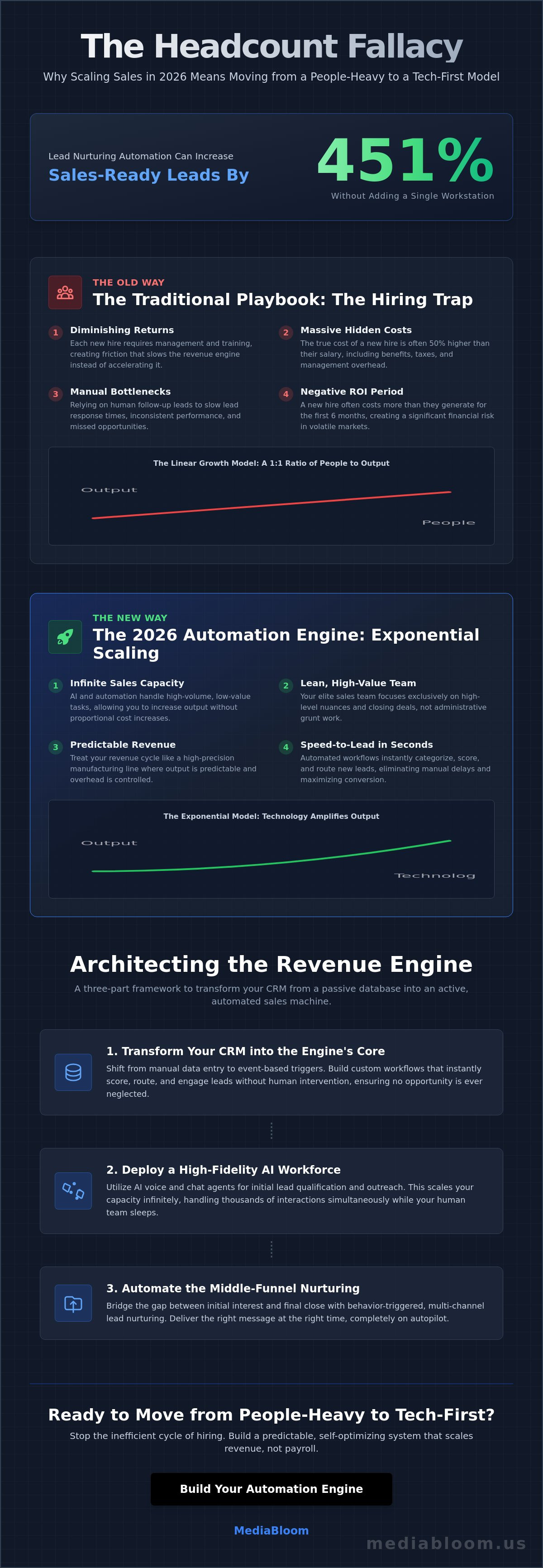
Lead nurturing automation can increase your sales-ready leads by 451 percent without adding a single workstation to your office. For the modern executive, the traditional logic that revenue growth requires a linear increase in payroll is officially obsolete. You've likely felt the friction of scaling sales without increasing headcount while watching your cost-per-acquisition climb with every new hire. It's an inefficient cycle that creates manual follow-up bottlenecks and limits your operational ceiling.
Key Takeaways
- Identify the hidden fiscal drains of traditional hiring and why linear payroll growth often results in diminishing ROI.
- Transform your CRM from a passive database into an active revenue engine using event-based triggers and automated workflows.
- Discover the 2026 framework for scaling sales without increasing headcount by deploying high-fidelity AI voice and chat agents for lead qualification.
- Bridge the gap between initial interest and the final close with behavior-triggered, multi-channel lead nurturing sequences.
- Execute a tech-first transition by auditing your current sales process and identifying high-volume, low-value tasks ready for immediate automation.
The Headcount Fallacy: Why Hiring More Reps Isn't Scaling
The traditional growth model is broken. Many executives fall into the "Hiring Trap" by assuming that doubling the sales team will automatically double the revenue. It rarely works that way. In reality, scaling sales without increasing headcount is the only way to maintain healthy margins as competition intensifies. Adding more human labor introduces diminishing returns. Each new hire requires management, training, and cultural integration. These are friction points that slow down your revenue engine rather than accelerating it.
Recruitment isn't just a one-time fee; it's a massive drain on executive time. Onboarding a new rep takes months of focus from your top performers. This creates a hidden productivity tax on your existing elite talent. When you factor in benefits, payroll taxes, and the necessary management layers, the true cost of a new hire is often 50 percent higher than their base salary. For most firms, this math simply doesn't scale in a volatile market.
In 2026, enterprise health is no longer measured by the size of the office. It's measured by revenue per employee. High-performance firms are moving toward Sales Process Engineering to build digital infrastructure that offers infinite sales capacity. This shift allows you to treat your revenue cycle like a high-precision manufacturing line where output is predictable and overhead is controlled.
The Mathematical Reality of Sales Bloat
Consider the break-even point for a new sales hire. Between the initial training and the ramp-up gap, a human hire often costs more than they generate for the first six months. This period of negative ROI is a significant risk. If the economy shifts or market conditions change, those fixed labor costs become a dangerous liability. You can't downsize a payroll as easily as you can pause an automated workflow or adjust an AI agent's parameters.
Linear Growth vs. Exponential Scaling
Human-led models are inherently linear. One rep can only make a finite number of calls or send a set number of emails per day. To get more output, you must add more input in the form of people. This is a 1:1 ratio that kills profitability over time. Exponential models use technology to handle the heavy lifting. Automation manages the volume while humans handle the high-level nuances of the deal. Sales scaling is the ability to increase volume without proportional cost increases.
Architecting a Repeatable Revenue Engine with CRM Automation
Stop viewing your CRM as a digital filing cabinet. In a high-performance sales environment, your CRM is the central nervous system of the entire operation. It's the brain that dictates every move your revenue engine makes. Most organizations fail because they treat these platforms as passive databases where data goes to die. Scaling sales without increasing headcount requires a transition from manual data entry to event-based triggers that drive action without human intervention.
This architectural shift ensures that no prospect is ever neglected. When a lead interacts with an ad or opens an email, the system instantly categorizes, scores, and routes that lead. Automation eliminates the bottleneck of manual follow-ups. By building these protocols directly into your infrastructure, you create a fail-safe environment where speed-to-lead is measured in seconds. It allows your current team to focus on closing while the machine handles the logistics.
Data hygiene is the fuel for this engine. Inaccurate records lead to broken workflows and brand damage. Maintaining a clean, automated database is essential for the predictive analytics required in 2026. A tech-first sales environment demands that data is updated in real-time, ensuring your outreach is always relevant and your forecasting is always precise.
Building Custom CRM Workflows That Sell
Mapping the customer journey is the first step toward true automation. Every touchpoint must have a corresponding trigger. We use lead scoring to filter noise from signal, ensuring your elite closers only engage with high-value prospects. Implementing MediaBloom's custom CRM automation services provides the structural integrity needed to handle massive lead volume without adding management overhead. It's about building a system that sells independently of your headcount.
The End of Manual Lead Enrichment
Sales reps often waste hours researching LinkedIn profiles and company websites. This admin load is a silent killer of productivity. Modern CRM setups automate the collection of firmographic and technographic data the moment a lead enters the system. Real-time enrichment allows for hyper-personalized outreach that feels human but is entirely algorithmic. Automated systems can free up approximately 20 percent of a seller's capacity. This isn't just about saving time; it's about maximizing the raw output of your existing talent. If you're ready to audit your current stack for these efficiencies, connect with our technical architects to discuss your roadmap.
Deploying an AI Workforce: Scaling Outreach with Voice and Chat Agents
Scaling is no longer about recruitment. It's about architecture. By 2026, the standard for high-performance outreach has shifted from human-heavy call centers to high-fidelity AI voice agents. These systems offer human-parity interaction, allowing you to execute complex discovery calls and lead qualification at a fraction of the traditional cost. While human-operated BPO services often suffer from high turnover and inconsistent performance, AI agents provide a fixed-cost, infinite-scale solution. Data indicates that 81 percent of sales teams have already integrated or are experimenting with AI to drive these efficiencies.
The primary advantage of a digital workforce is the "Always-On" capability. Lead decay is a silent revenue killer. Most human teams struggle to respond to new inquiries within the critical five-minute window, especially after hours. AI agents solve this by engaging every lead in seconds, regardless of the time or volume. This ensures your sales pipeline remains fluid and active 24/7, 365 days a year. It's the most effective strategy for scaling sales without increasing headcount while simultaneously lowering your cost-per-acquisition.
AI Voice Agents: The New SDR
AI voice agents have effectively replaced the traditional Sales Development Representative for initial outreach. These systems can scale from 10 to 10,000 concurrent calls instantly, a feat impossible for human teams. They handle the grueling work of cold calling, discovery, and meeting booking, only passing "sales-ready" prospects to your elite closers. For a deep dive into the technical architecture of these systems, see The Definitive Guide to AI Voice Agents.
Chat Automation for Instant Qualification
Modern chat automation has evolved far beyond the basic "if-then" bots of the past. Intelligent, sales-trained AI chat agents now qualify traffic from paid ads with surgical precision. To ensure your visual assets are as optimized as your qualification process, visit CreativesConvert for automated ad design. They engage visitors, answer technical product questions, and book demos directly within the chat interface. By integrating these chat agents with your voice systems, you create a seamless multi-channel experience. This ensures that every prospect, whether they prefer typing or talking, is ushered through your funnel with zero friction and zero human intervention.
Automating the Middle Funnel: Lead Nurturing at Scale
Middle-funnel friction is the primary cause of revenue leakage in traditional sales models. If your elite closers spend their days chasing prospects who aren't yet ready to sign, your ROI is suffering. It's an expensive misuse of talent. Scaling sales without increasing headcount hinges on your ability to automate the bridge between initial interest and a closed deal. While the CRM acts as the brain and AI agents handle the top-of-funnel volume, the middle funnel requires a sophisticated, multi-channel ecosystem that responds to prospect behavior in real-time.
Behavior-Based Email Sequences
Dynamic sequences are the new standard for enterprise growth. Your email infrastructure must adapt based on how a prospect interacts with your content. AI-driven copy optimization now allows for hyper-personalization across thousands of leads simultaneously. This ensures that every message resonates with the specific pain points of the individual persona. Static "set it and forget it" nurturing is a relic of the past that fails to account for the dynamic nature of 2026 buyer behavior.
Multi-Channel Synchronization
True scale requires a unified front across all digital touchpoints. By combining email marketing, SMS, and AI voice follow-ups, you create a persistent presence that human teams cannot replicate. This multi-channel approach ensures a consistent brand voice while meeting the prospect wherever they are most active. Automated follow-ups are proven to shorten sales cycles by 30 percent or more. This efficiency allows your existing team to focus exclusively on high-probability closing opportunities. If you're ready to build this infrastructure, schedule a consultation with our automation architects to see how we can streamline your middle funnel.
Implementation Strategy: Moving from People-Heavy to Tech-First Sales
Transitioning from a legacy, people-heavy model to a high-output digital architecture requires a calculated roadmap. It's not a simple software update; it's a fundamental shift in how your organization generates revenue. Scaling sales without increasing headcount is the direct result of replacing manual labor with automated systems that don't fatigue or deviate from the script. The goal is to build an infrastructure where your human talent is reserved exclusively for the most complex, high-stakes interactions. This tech-first approach demands a clean break from the "more bodies" mindset that has historically limited enterprise growth.
The core of this strategy involves selecting a high-performance stack. Your CRM functions as the central brain. AI voice agents act as your tireless SDRs. Automated lead nurturing systems manage the middle funnel. For enterprise-scale businesses, Ommni provides the essential product data management needed to keep digital operations running without manual friction. By integrating these components, you create a self-optimizing engine. Start by piloting the AI workforce on a single channel, such as inbound qualification. This allows you to prove the ROI before a full-scale rollout across all outreach departments. It's a methodical progression that ensures operational stability while you dismantle the overhead of traditional sales models.
Re-skilling your human team is the final, critical component. Your top reps must transition from prospectors to strategic closers. They should no longer spend their time on discovery calls or manual follow-ups. Instead, they focus on high-level negotiations and relationship architecture. This shift maximizes their unique human value and significantly increases your revenue per employee, which is the primary metric for enterprise health in 2026.
Phase 1: The Automation Audit
Identifying bottlenecks is the first step toward true scale. You must audit your current sales funnel to find high-volume, low-value tasks that drain your team's energy. Determine which touchpoints require genuine human empathy and which favor algorithmic efficiency. High-speed lead qualification and initial outreach belong in the automated column. Strategic deal structuring and final closings belong to your elite humans. Set clear KPIs for this new machine, focusing on speed-to-lead and the reduction of manual admin time. This audit provides the blueprint for your digital transformation.
Phase 2: Deployment and Optimization
Seamless integration is non-negotiable. Your AI agents must sync perfectly with your existing CRM to maintain a single source of truth for all prospect data. This prevents data fragmentation and ensures your automated outreach is always based on the latest interaction. Monitor the performance of your AI workforce daily. Use real-time data to refine scripts, adjust triggers, and optimize the customer journey. This iterative process keeps the system sharp and responsive to market shifts. To see how these integrated components function as a unified revenue engine, you can watch a demo of these systems in action.
Future-Proof Your Revenue Architecture
The era of scaling through linear hiring is over. You've seen the roadmap for 2026. Architecting a repeatable revenue engine requires a fundamental shift from manual labor to high-performance digital infrastructure. By deploying AI voice agents with 99 percent human-parity and custom CRM workflows designed for enterprise scale, you eliminate the productivity tax inherent in traditional sales teams. This is the only sustainable path for scaling sales without increasing headcount, as demonstrated by The Modern Medicare Agency, while simultaneously driving down your cost-per-acquisition.
You now possess the implementation strategy to transition from a people-heavy model to a tech-first operation. It's time to stop chasing volume with payroll and start driving it with precision systems. The technology is established. The framework is proven. The competitive advantage belongs to the architects who build first. Ready to scale your sales engine? Book a consultation with MediaBloom today. We have a proven track record in reducing CAC while increasing volume for elite sales organizations. Build the future of your revenue machine today.
Frequently Asked Questions
Is it really possible to scale sales without any new hires?
Yes. It is entirely possible by shifting from a labor-heavy model to a systems-first architecture. Scaling sales without increasing headcount is achieved by automating high-volume tasks like lead qualification and initial outreach. This approach allows your existing elite team to focus exclusively on high-stakes negotiations. You aren't just saving on payroll; you're building an infinite capacity engine that operates without human fatigue or performance variance.
Will AI voice agents sound like robots to my customers?
Modern high-fidelity voice agents have achieved near-perfect human parity. These systems utilize advanced Large Language Models to reason through objections and adapt their tone in real-time. They pass the Turing test for standard sales discovery calls. Customers experience a fluid, professional interaction that feels entirely natural. This ensures your brand reputation remains secure while your outreach volume explodes across your entire market.
How much does it cost to implement a full sales automation system?
Implementation costs are an investment in operational excellence rather than a fixed expense. While specific fees depend on your technical requirements and lead volume, the primary focus should be on the dramatic reduction in cost-per-acquisition. Moving from human-led SDR teams to an automated workforce typically results in a significant reduction in interaction costs. This shift transforms your sales department from a cost center into a high-efficiency revenue machine.
Do I need to replace my current CRM to start automating?
Replacing your CRM is rarely necessary for automation. Most enterprise-grade platforms function as a capable "brain" when configured correctly. The priority is establishing custom CRM automation setup and event-based triggers that drive data between your AI agents and nurturing tools. We focus on optimizing your current infrastructure to ensure a single source of truth without the disruption of a full platform migration.
What happens to my existing sales team when we automate?
Your human team evolves into a squad of strategic closers. Automation strips away the grueling admin load and repetitive prospecting tasks that lead to burnout. By re-skilling your top performers to handle complex relationship architecture, you maximize their output. Your best people spend their time where they are most effective: closing deals and architecting high-value partnerships that drive long-term revenue growth.
How long does it take to see an ROI from sales automation?
ROI often manifests in the first quarter of deployment. You'll see an immediate drop in lead decay and a significant increase in speed-to-lead. Automated lead nurturing has been shown to increase sales-ready leads by 451 percent. These efficiency gains compound quickly, allowing you to recover implementation costs through increased conversion rates and lowered labor overhead within months of the initial rollout.
Can AI handle complex B2B sales cycles or only simple products?
AI excels at managing the complexity of B2B funnels. While humans handle the final strategic negotiations, AI agents manage the persistent follow-ups, technical queries, and discovery phases that define long sales cycles. This ensures your pipeline remains active across multiple channels. Scaling sales without increasing headcount in B2B requires this hybrid model where tech handles the volume and humans handle the nuance.
What is the first step to scaling sales without increasing headcount?
The first step is a comprehensive automation audit. You must map your current customer journey and identify every high-volume, low-value task that currently creates a bottleneck. Once these friction points are identified, you can architect a tech-first roadmap. This involves selecting your core stack of AI voice agents and nurturing tools to build a repeatable, self-optimizing revenue engine designed for 2026.