Omnichannel lead nurturing means tracking every lead in a single, unified profile and coordinating email, SMS, chat, voice, and ads so each channel picks up exactly where the last one left off. The business case is direct: leads convert faster, and sales reps receive full context at handoff instead of a cold transcript. This guide breaks down the architecture, the channel playbook, the KPIs that matter, and where AI-enabled orchestration now does the heavy lifting.
TL;DR:
- Effective omnichannel lead nurturing requires a unified profile that continuously updates behavioral data across all channels to prevent repeated questions and dropped context.
- Key KPIs to track include the MQL-to-SAL conversion rate, stage velocity, and booked appointments, with attribution models needed to accurately measure impact.
- Building a reliable system involves establishing a single customer view, an orchestration layer for routing and triggers, and regular score calibration to reflect current buyer behavior.
- Common failures like channel conflict, stale scoring, and operational handoff gaps can be fixed through proper integration, suppression rules, and enforcing full context transfer at handoff.
- Implementing AI-driven orchestration platforms significantly reduces setup time, improves response speed, and maintains continuous context across chat, voice, and email interactions.
Table of Contents
- What Omnichannel Lead Nurturing Actually Means
- Why Omnichannel Nurturing Moves the Revenue Needle
- Which Channels Should Carry the Nurture, and When?
- What Architecture Does Omnichannel Nurturing Require?
- How to Build an Omnichannel Nurture Program, Step by Step
- Which Metrics Prove the Program Is Working?
- What Goes Wrong (and How to Fix It Before It Costs You Pipeline)
- How AI-Enabled Orchestration Puts This Into Practice
- Where to Invest First When You’re Rolling This Out
- Get Faster Speed-to-Lead With a Managed Omnichannel Platform
- Sources
- FAQ
What Omnichannel Lead Nurturing Actually Means
Omnichannel lead nurturing is the practice of engaging a lead across multiple channels using one shared record of who they are, what they’ve done, and what they need next. The “omni” part is the operative word: every channel reads from and writes to the same customer context, so a lead who opens an email on Monday and calls the sales line on Wednesday doesn’t have to re-explain themselves.
That distinguishes it from multichannel marketing, where email, SMS, and ads run as separate programs with separate data. Multichannel means you’re present in several places. Omnichannel means those places talk to each other.
Picture a lead who downloads a pricing guide from a landing page. In a multichannel setup, that download might trigger a generic email drip, while a separate ad campaign keeps retargeting them with the same message they already ignored, and a call center agent who eventually reaches them has no idea the guide was ever downloaded. In an omnichannel setup, that download updates the lead’s unified profile immediately. The email that follows references the guide by name. If the lead doesn’t open it within 48 hours, an SMS nudges them instead of another email. If they call in, the agent already sees the download, the emails, and the SMS in one timeline. No repeated questions, no dropped context, no wasted touch.
Why Omnichannel Nurturing Moves the Revenue Needle
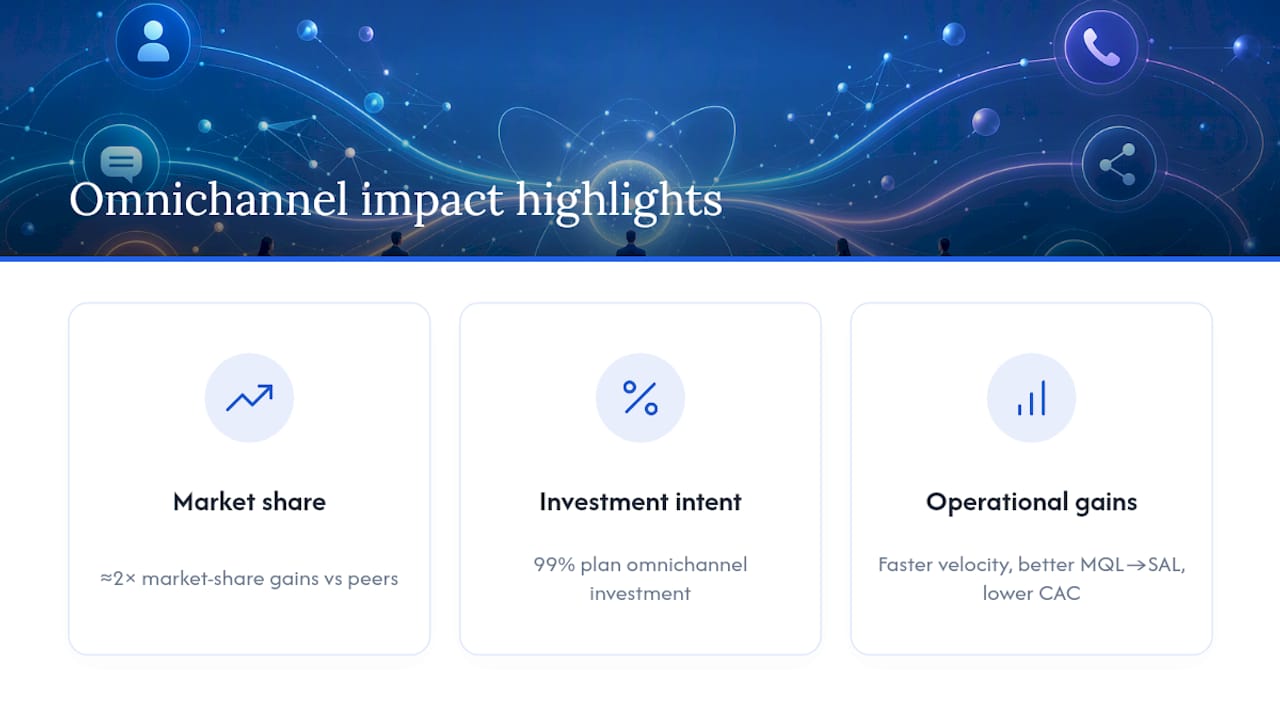
The performance gap between coordinated and siloed engagement shows up directly in market-share data. McKinsey’s research on B2B growth finds that top-performing B2B companies who blend digital self-serve options with human sales touchpoints report roughly two times the market-share gains of their peers, along with stronger customer feedback on the overall buying experience. Buyers now expect to move between a website, a sales call, and a support chat without repeating themselves, and companies that deliver that expectation are pulling ahead.
Investment intent backs this up at scale. NielsenIQ and Forrester found that 99% of business leaders plan to invest in omnichannel intelligence platforms, driven by faster adaptability and measurably better customer experience outcomes.
On the ground, teams running true omnichannel nurture typically see three concrete shifts: faster pipeline velocity as leads move through fewer dead-end touches, higher MQL-to-SAL qualification rates because scoring reflects cross-channel behavior instead of one channel’s partial view, and lower customer acquisition cost since fewer leads go cold from mistimed or duplicate outreach. McKinsey also notes that companies stacking personalization, hybrid sales, and omnichannel intelligence together see multiplier effects rather than gains from any single tactic alone.
Which Channels Should Carry the Nurture, and When?
Each channel earns its place in the sequence by doing one job well. Email remains the workhorse for education. It’s the right channel for whitepapers, case studies, and multi-step content that builds a buyer’s understanding over days or weeks. SMS is for urgency. Appointment reminders, limited-time offers, and “did you see this?” nudges perform better as a text than as email number four in someone’s inbox. Chat captures intent the instant it appears, letting a site visitor ask a pricing question without waiting for a form to be reviewed. Voice, especially AI-driven voice agents, handles qualification and appointment booking, where a real conversation resolves ambiguity that a static form cannot. Paid ads keep a brand visible to leads mid-consideration, and direct sales outreach closes the loop once a lead crosses a qualification threshold.
Coordination between these channels follows a few consistent patterns:
- Escalation: an unopened email after 48 hours triggers an SMS instead of a second identical email.
- Fallback: a chat conversation that goes unanswered for 24 hours routes to an outbound call.
- Parallel touches: a high-intent lead (say, one who requested a demo) gets simultaneous SMS confirmation and a calendar link by email, rather than one channel waiting on the other.
The rule that ties all of this together: no channel should ever ask a lead for information another channel already collected. If a chatbot captured company size and budget range, that data needs to appear on the voice agent’s screen the moment the call connects, not get re-asked from scratch.
Pro Tip: Audit your current nurture flows for repeated questions across channels. If a lead has to tell your chatbot, your email form, and your sales rep the same three facts, you don’t have an omnichannel program. You have three disconnected ones wearing the same logo.
What Architecture Does Omnichannel Nurturing Require?
Four components have to work together, and skipping any one of them is why most “omnichannel” programs quietly fail.
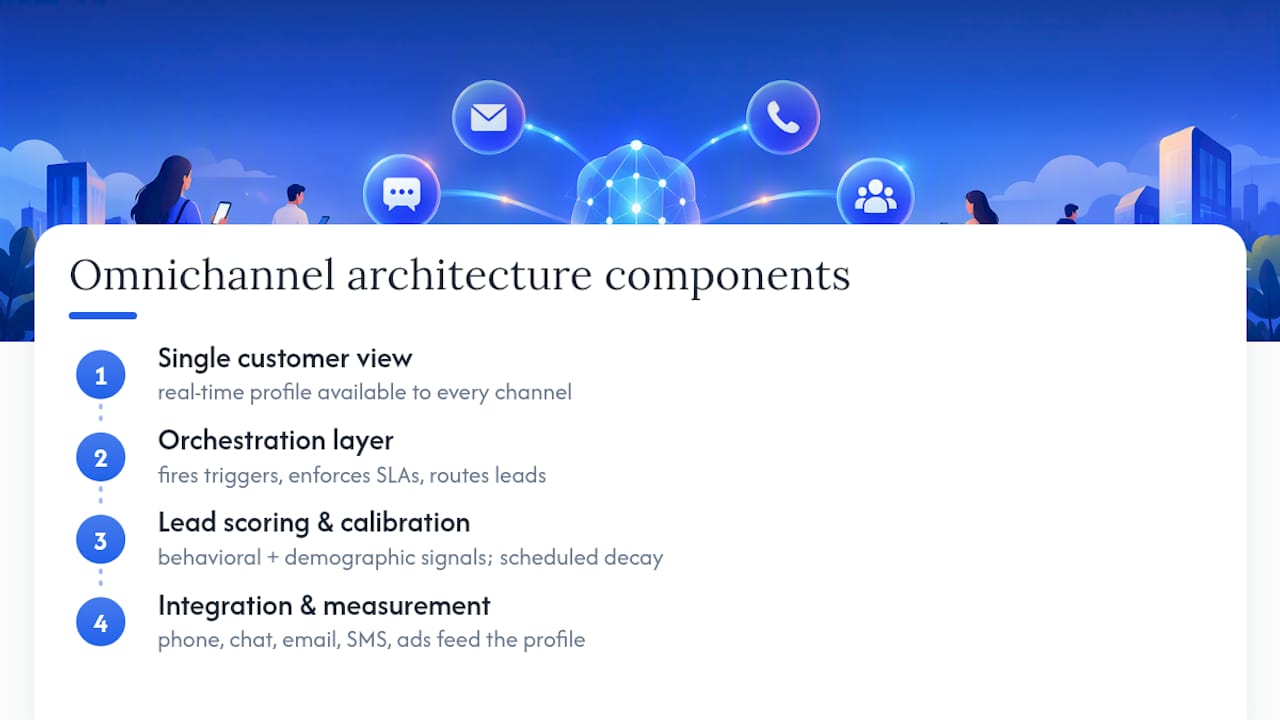
A single customer view, sometimes built on a customer data platform, sits underneath everything. It’s different from a CRM: a CRM tracks deals and contacts as records a rep updates manually, while a unified profile continuously ingests behavioral data (email opens, ad clicks, chat transcripts, call outcomes) in real time and makes it available to every channel simultaneously.
An orchestration layer sits on top of that data and makes the routing decisions. This is the system that fires triggers (“lead visited pricing page twice”), enforces SLAs (“route to a rep within 5 minutes”), and writes context back into the CRM so the next human touch has full history. Without this layer, enrichment, routing, and scheduling gaps become the point where nurture programs quietly stop converting engagement into pipeline, even when the content itself is strong.
Lead scoring blends behavioral signals (page visits, email engagement, chat activity), demographic fit (title, company size), and account-level intent. Static scoring models decay in accuracy fast: a model tuned to last year’s buyer behavior misjudges this year’s leads. Score decay should run as a scheduled process that subtracts points from inactive leads, paired with a formal quarterly calibration loop reviewing MQL-to-SAL acceptance rates against actual closed-won characteristics.
Calibration reality: 99% of business leaders surveyed by NielsenIQ and Forrester plan to invest in omnichannel intelligence platforms specifically because static, uncalibrated systems can’t keep pace with buyer behavior.
Finally, integration checklist items you cannot skip: phone and voice systems, chat widgets, email service providers, SMS gateways, ad platform pixels, and analytics all need to feed the same profile. Partial integration creates the exact silos omnichannel nurturing is supposed to eliminate.
How to Build an Omnichannel Nurture Program, Step by Step
- Audit the current buyer journey. Map every touchpoint a lead hits from first click to closed deal, and mark where information gets lost or repeated between channels. Most audits turn up at least one point where sales and marketing use different definitions of “qualified.”
- Segment leads and define intent thresholds. Group leads by fit (industry, company size, role) and by behavior (content consumed, pages visited, response speed), then set explicit score thresholds that trigger a channel change or a human handoff.
- Design the journey with channel rules built in. Specify which channel leads each stage, what triggers escalation, and what SLA governs the handoff to a human rep. A journey without an SLA is a journey nobody owns.
- Implement the automation and routing. Connect your orchestration layer to every channel on your integration checklist, and confirm that context writeback into the CRM actually happens, not just that leads get routed.
- Enforce the SLA and test the handoff. Run a real lead through the full flow and time how long it takes a rep to see complete context after a routing trigger fires. If it’s more than a few minutes, that’s your first fix.
- Test and recalibrate on a cadence. Run A/B tests on message timing and channel sequence, review stage-velocity reports monthly, and recalibrate lead scoring quarterly.
Pro Tip: Start the audit with your slowest stage, not your favorite channel. Teams instinctively want to add a new channel to fix a conversion problem, but the fix is usually removing a handoff delay in a stage that already exists.
McKinsey’s research on B2B outperformers reinforces step 3 in particular: companies that combine hybrid sales, personalization, and sales technology see compounding gains, which means the journey design step is worth more time than most teams give it.
Which Metrics Prove the Program Is Working?
A handful of KPIs tell you whether omnichannel nurturing is actually converting engagement into revenue, rather than just generating activity.
- MQL-to-SAL conversion rate: the clearest signal that scoring and handoff are aligned with what sales considers qualified.
- Stage velocity: how long leads sit at each pipeline stage; a sudden slowdown usually points to a broken handoff, not a bad lead.
- Pipeline created: total qualified pipeline value attributable to nurture-touched leads over a given period.
- Time-to-MQL: how quickly a new lead reaches marketing-qualified status, a direct measure of nurture efficiency.
- Booked appointments: the most concrete downstream outcome, and the number that ties nurture activity to sales capacity.
Proving which touches actually drove these outcomes requires attribution, not guesswork. Multi-touch attribution models normalize and de-duplicate touchpoint data across channels, letting you assign credit across an email, an ad impression, and a sales call instead of crediting whichever touch happened last.
None of these numbers mean anything if the underlying data is dirty. Run regular deduplication passes, verify that channel data is actually writing back to the unified profile (not just logged in a channel-specific tool), and audit a sample of “converted” leads monthly to confirm the CRM status matches what actually happened on a call.
What Goes Wrong (and How to Fix It Before It Costs You Pipeline)
Three failure patterns show up more than any others. Channel conflict happens when email, SMS, and ads run on separate calendars with no shared suppression list, so a lead gets three different offers in the same hour. The fix is a single orchestration ruleset with recipient-level suppression logic that governs every channel, not one rule per tool.
Stale scoring creeps in when a model built a year ago still governs today’s routing decisions. Leads that went cold months ago keep scoring as “hot” because nothing ever subtracts points for inactivity. Score decay run on a scheduled basis, combined with quarterly calibration against real closed-won data, keeps the model honest.
Operational handoff failures are the quietest killer. A lead hits the qualification threshold, gets routed to a rep, and the rep opens a CRM record with none of the chat history, email engagement, or call notes attached. Enrichment and routing gaps at the moment of handoff are consistently where well-designed nurture content stops converting into actual meetings. Enforcing a strict SLA and requiring full context writeback on every routing event closes this gap.
How AI-Enabled Orchestration Puts This Into Practice
This is where automation stops being theoretical. Mediabloom’s platform runs AI voice agents alongside chatbots and SMS and email automation on one orchestration layer, so a lead’s context follows them from a chat conversation into a phone call without a rep ever asking “can you remind me what you were looking for?”
Some businesses have used this kind of integrated setup to generate a large volume of monthly leads, with speed-to-lead automation cutting the gap between a lead raising their hand and a human (or AI agent) responding. The Vision Law case study shows how a single vertical applies this same architecture to book qualified appointments directly from inbound inquiries. The operational benefit isn’t a new channel. It’s consistent context across every channel already in play, which is the difference between a nurture program that generates activity and one that generates booked appointments.
Where to Invest First When You’re Rolling This Out
If you’re building this from scratch, resist the urge to add a new channel before your data is clean. Data hygiene and orchestration come first: a unified profile that actually captures every touch, wired to routing logic that enforces a real SLA. A fifth channel on top of broken plumbing just multiplies the mess.
Once that foundation holds, make stage velocity and speed-to-lead visible KPIs your revenue leadership actually reviews, not metrics buried in a dashboard nobody opens. And treat quarterly scoring calibration as a fixed calendar event, the same way you’d treat a board meeting. Skip a quarter, and your scoring model quietly starts lying to you.
— MediaBloom
Get Faster Speed-to-Lead With a Managed Omnichannel Platform
Building the architecture in this guide from scratch, a CDP, an orchestration layer, voice agents, chat, and CRM writeback, takes most in-house teams months of integration work before a single extra appointment gets booked. Mediabloom compresses that timeline by giving you AI voice automation, chatbots, and SMS and email orchestration already wired into one system, with CRM integrations built for 600+ platforms so your existing sales stack doesn’t need to be rebuilt.

For teams specifically fighting response-time delays, the Speed to Lead AI solution routes and responds to new leads before they go cold, and Reactivation AI picks up leads already sitting dormant in your CRM. Both plug into the same unified context this guide describes, so a lead who called last month and messaged your chatbot this week gets one continuous conversation, not two disconnected ones. If you want to see how the orchestration layer actually behaves on a live lead, watch a demo to see voice, chat, and SMS handoffs happen in real time.
Sources
- The new B2B growth equation
- Omnichannel intelligence for the win (NielsenIQ/Forrester)
- Types of lead scoring models and best practices
- Your Marketo nurture program is running. But is it actually working?
FAQ
What Does Lead Nurturing Mean?
Lead nurturing is the ongoing process of building a relationship with a prospect through relevant, timed communication until they’re ready to buy, as explained in this Lead nurturing explained: Boost conversions with effective strategies guide. In an omnichannel context, that communication moves across email, SMS, chat, and voice using one shared profile of the lead’s behavior and needs.
What Are the Four C’s of Omnichannel?
Definitions vary across sources, but a commonly cited version centers on consistency (the same message and tone everywhere), continuity (context carrying across channels), convenience (letting the lead choose their channel), and coordination (channels working from shared data rather than in isolation). The underlying goal across every version is the same: no channel operates as an island.
What Are the Best Practices for Lead Nurturing?
The core practices are segmenting leads by both fit and behavior, mapping content to buyer-journey stage, enforcing a fast speed-to-lead SLA, and calibrating your scoring model on a quarterly basis rather than letting it run static. Multi-touch attribution is also essential for knowing which touches actually drive conversions versus which just add noise.
What Are the Four Pillars of Omnichannel?
Most frameworks converge on four pillars: a unified customer profile, consistent messaging across channels, real-time data synchronization between systems, and seamless handoffs between digital and human touchpoints. McKinsey’s research ties the human handoff pillar specifically to market-share gains among B2B outperformers.
How Much Does an Omnichannel Platform Like Mediabloom Cost?
Pricing for Mediabloom’s AI voice, chatbot, and orchestration platform is available directly on its site rather than published as a flat rate, since deployment scope varies by business. You can review current options and request pricing through Mediabloom’s solutions page.