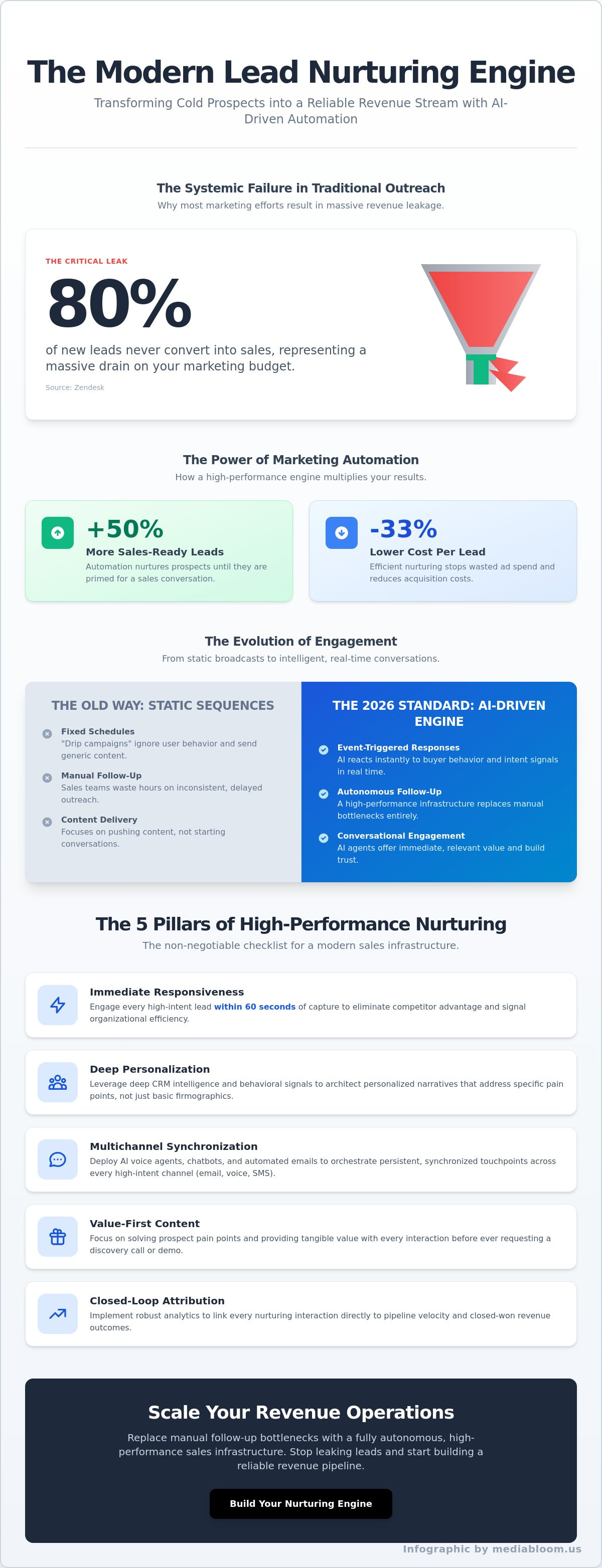
Zendesk reports that 80% of new leads never convert into sales. This massive leakage represents a systemic failure in traditional outreach. You've likely felt the impact: low email open rates, leads falling through the cracks, and sales teams wasting hours on unqualified prospects. To stop this drain, you need an architecture built on modern lead nurturing best practices. It's frustrating to watch potential revenue vanish because your follow-up speed is inconsistent, but your growth depends on a more precise, scalable infrastructure.
Breaker Blog notes that effective marketing automation generates 50% more sales-ready leads at a 33% lower cost. This article provides the high-performance strategies and AI-driven workflows needed to transform cold prospects into loyal revenue drivers. We'll preview how to build a fully autonomous nurturing engine that integrates real-time responsiveness and deep CRM intelligence. You'll learn to shorten your sales cycles, boost lead-to-opportunity conversion rates, and ensure no prospect is ever left behind again. This is the blueprint for turning digital interactions into a reliable revenue stream.
Key Takeaways
- Transition from static drip sequences to event-triggered AI responses to engage prospects within 60 seconds of lead capture.
- Leverage deep CRM intelligence to architect personalized narratives that address specific behavioral signals rather than basic firmographics.
- Master lead nurturing best practices by implementing intent-based segmentation and AI-driven lead scoring models.
- Deploy AI voice agents and chatbots as core components of a multichannel engine to maintain persistent engagement across every high-intent touchpoint.
- Scale revenue operations by replacing manual follow-up bottlenecks with a fully autonomous, high-performance sales infrastructure.
The Evolution of Lead Nurturing: Why Static Sequences Are Obsolete
Lead nurturing is the strategic architecture of trust-building interactions. It isn't a passive activity; it is a high-velocity engine designed to move prospects through the lead management lifecycle. While legacy systems relied on "drip campaigns" that pushed generic content on a fixed schedule, modern lead nurturing best practices demand event-triggered AI responses. These systems react to buyer behavior in real time, transforming a cold database into a dynamic revenue pipeline. Success in 2026 requires moving beyond simple content delivery toward a model of continuous, automated value.
Prioritize speed as your ultimate conversion factor. In the current sales environment, a delay of even ten minutes is an invitation for your prospect to find a competitor. Your CRM must function as the central nervous system of this operation. It captures digital body language, analyzes intent, and triggers immediate engagement. If your system cannot respond within 60 seconds of a lead capture event, you are essentially throwing away your marketing budget. High-performance sales teams treat every second of delay as a direct hit to their bottom line.
To better understand the mechanics of automated engagement, watch this helpful video:
The Shift from Content Delivery to Conversational Engagement
Modern buyers have developed a permanent immunity to generic newsletters and automated "drip" sequences. They ignore the predictable "just checking in" emails that clutter their inboxes. Instead, they demand real-time conversational engagement. They engage with sophisticated AI agents that offer immediate, relevant value based on their specific pain points. Integrating lead nurturing best practices into your conversational strategy ensures that your brand remains competitive in a market that values speed over everything else. This shift toward human-parity communication is the non-negotiable 2026 standard for enterprise sales. The psychological impact of an instant, intelligent follow-up is profound; it signals that your organization is architected for efficiency and reliability.
The Cost of Inaction: How Poor Nurturing Erodes Ad ROI
Stop treating follow-up as a manual task; it acts as a silent tax on your organizational growth. When you invest in high-level ad management services, every lead carries a specific acquisition cost. Manual follow-up delays create a massive revenue leak, often causing lead-to-opportunity rates to plummet. Zendesk reports that 80% of new leads never convert into sales, a failure often rooted in slow response times and inconsistent follow-up. High-performance nurturing serves as a force multiplier for your paid acquisition spend. It ensures that the expensive traffic you capture today doesn't evaporate tomorrow due to human friction or operational bottlenecks.
The 2026 Lead Nurturing Checklist: 5 Non-Negotiable Pillars
High-growth sales operations don't rely on luck. They operate on an effective lead nurturing framework built for speed and precision. To maintain a competitive edge, your strategy must move beyond basic follow-ups. You need a systematic approach that handles high lead volumes without sacrificing quality. Use this checklist to audit your current lead nurturing best practices and identify where your revenue engine is leaking potential. If your system lacks these core pillars, you're likely ceding market share to more agile competitors.
- Immediate Responsiveness: Engage leads within 60 seconds of capture.
- Deep Personalization: Tailor the narrative using specific CRM data points.
- Multichannel Synchronization: Orchestrate touchpoints across email, voice, and SMS.
- Value-First Content: Solve pain points before requesting a discovery call.
- Closed-Loop Attribution: Link every interaction directly to revenue outcomes.
Pillar 1 & 2: Speed and Personalization at Scale
Speed is the primary differentiator in 2026. Deploying AI voice agents allows your system to handle initial qualification calls instantly, ensuring no prospect waits for a human representative. This immediate touch increases conversion rates by catching leads while their intent is at its peak. Couple this speed with deep personalization. Stop sending generic templates. Instead, use dynamic content blocks in your email marketing for sales to reflect the prospect's recent website behavior or industry-specific challenges. Ask yourself: Does your system respond while the prospect is still on your site? If not, you're already behind.
Pillar 3, 4 & 5: Synchronization and Measurement
True omnichannel orchestration means your voice agent knows exactly what your last email said. There is no excuse for disjointed communication. Your CRM must sync these touchpoints to create a unified buyer journey. While conversion rates are important, you must also measure Lead Velocity. This tracks how quickly prospects move from lead capture to a closed deal. Are you measuring Lead Velocity alongside conversion rates? Analyze this metric. It reveals bottlenecks in your automated sequences. Use these insights to audit your "dead lead" database. Often, these prospects just need a different value proposition to reactivate. If you're ready to refine your technical infrastructure, you can connect with our team to discuss custom automation setups. Mastering these lead nurturing best practices ensures your sales engine runs at peak efficiency around the clock.
Advanced Segmentation: Architecting the Precision Nurture
Static lists are the graveyard of high-growth sales. Modern lead nurturing best practices demand an architecture that evolves in real time based on prospect behavior. While legacy systems segment by static firmographics like industry or job title, high-performance engines prioritize intent. You must track digital body language, identifying exactly when a prospect moves from casual research to active evaluation. This requires a dynamic Ideal Customer Profile (ICP) that updates as new data flows through your CRM. It isn't a static document; it's a living blueprint of your most profitable opportunities.
Deploy sophisticated lead scoring models that go beyond simple page views. Incorporate AI interaction sentiment to gauge a lead's readiness. If an AI chatbot detects high-urgency language or specific technical queries, the score should reflect that shift immediately. Equally critical is the implementation of negative scoring. Disqualify low-value leads who exhibit non-buyer behavior, such as repeatedly visiting your careers page or consuming only entry-level educational content. This ensures your sales team focuses exclusively on high-probability revenue drivers. Research from Breaker Blog in 2026 indicates that objectively qualifying leads through scoring can boost organizational win rates by over 20%.
Intent-Based Triggers: The Key to Timing
Intent-based triggers serve as the catalyst for high-conversion outreach. These triggers fire when a prospect completes a high-value action, such as viewing your pricing page multiple times in a single day or finishing a full demo video. Automation allows for a seamless hand-off from a marketing nurture path to a direct sales intervention. When a lead hits a specific intent threshold, your system should automatically trigger an AI voice agent call or alert a sales representative. This precision ensures you engage exactly when the prospect is most receptive to a solution. Targeted email segmentation based on these behaviors can increase click-through rates by as much as 57%.
Aligning Nurture Paths with the Buyer Journey
Your communication must mirror the prospect's psychological state. Successful lead nurturing best practices dictate a three-tiered approach to content delivery:
- Top of Funnel (TOFU): Focus on educational content. Build authority by framing the prospect's problem and providing high-level insights without a hard sell.
- Middle of Funnel (MOFU): Deliver solution comparisons and case studies. This stage is about building trust and proving your technical mastery through tangible outcomes.
- Bottom of Funnel (BOFU): Deploy direct calls to action. Use risk-mitigation content, such as implementation timelines or ROI calculators, to remove final friction points.
This structured progression moves leads through the funnel with logical, automated momentum. It replaces guesswork with a methodical, rapid progression that mimics the speed of the technology driving your business.
The Multichannel Engine: Integrating AI Voice, Chat, and CRM
Modern sales cycles are no longer linear. They're chaotic, multichannel, and demand constant presence. Integrating lead nurturing best practices into a unified engine requires more than just an email sequence; it requires a synchronized architecture of AI voice, chat, and CRM automation. This infrastructure ensures your brand remains active exactly where the prospect lives. By treating these channels as a singular, cohesive system, you eliminate the friction that causes leads to stall in the pipeline. A unified data view is the only way to ensure sales and marketing teams operate from a single source of truth.
CRM workflow automation serves as the glue holding these disparate channels together. It triggers the right message at the right time, preventing the redundant outreach that frustrates high-value prospects. When your CRM identifies a high-intent action, it should instantly orchestrate the next touchpoint, whether that is an automated email or a conversational AI intervention. This level of technical mastery transforms a standard sales process into a high-performance revenue machine. It replaces manual guesswork with a methodical, rapid progression designed for enterprise-level scaling.
AI Voice Agents: The New Frontier of Nurturing
Stop settling for static outreach. AI voice agents represent the ultimate nurture tool for high-volume pipelines, capable of performing sophisticated "nurture calls" to check in on prospects without human fatigue. It is important to understand that AI voice agents are not "robocalls" but sophisticated conversationalists designed to understand nuance and provide immediate value. They bridge the gap between digital interaction and human connection at a scale previously impossible. You can deploy AI voice agents to handle initial discovery or follow-up calls, ensuring your brand maintains human parity around the clock. For organizations looking to build custom agent architectures, exploring tailored solutions is the first step toward operational excellence.
Synchronizing the Inbox and the Phone
Timing is the difference between a conversion and a rejection. A high-performance strategy involves following up a high-value email with an AI-driven "did you receive this" call within minutes of an open notification. This multichannel synchronization reinforces your message and dramatically increases the likelihood of engagement. Using automated lead nurturing solutions allows you to manage this cross-channel timing with surgical precision. Ensuring brand voice consistency across text-based and voice-based automation is critical for building trust. If you are ready to architect a high-performance multichannel engine, contact our team to begin your transformation. Mastering these lead nurturing best practices is the only way to maintain a competitive advantage in an AI-first market.
Scaling Your Revenue Engine with MediaBloom
Manual lead nurturing is the primary bottleneck to enterprise scaling. It relies on human consistency, which inevitably falters as lead volume increases. In contrast, an automated engine never sleeps, never forgets a follow-up, and never misses a behavioral signal. MediaBloom acts as the strategic architect of these high-performance systems. We don't just provide tools; we build the foundational infrastructure that allows your business to dominate its market. By implementing lead nurturing best practices through a technical lens, we transform your sales process from a series of manual tasks into a fully orchestrated revenue engine. This shift is essential for staying competitive in a market that demands instant responsiveness and technical mastery.
Custom AI Workflows for Modern Brands
MediaBloom specializes in the deep technical integration required for modern revenue operations. Our approach begins with a comprehensive CRM automation setup, ensuring your central nervous system is primed for high-velocity data processing. We provide "done-for-you" deployments of AI voice agents and AI chatbots that integrate directly into your existing workflows. These agents handle the heavy lifting of initial qualification and persistent follow-up, freeing your sales team to focus on closing high-value deals. You can explore our case studies to see the tangible outcomes we've delivered for brands across various industries. Our focus remains entirely on operational excellence, output reliability, and the long-term scalability of your digital infrastructure. We ensure that every component of your sales machinery works in perfect synchronization.
Next Steps: Audit Your Nurture Engine
Identifying the biggest bottleneck in your current funnel is the first step toward optimization. Whether it's slow response times, fragmented data silos, or inconsistent follow-up, these gaps represent lost revenue that your competitors are ready to capture. Applying lead nurturing best practices means building a system that eliminates these points of friction automatically. We invite you to contact MediaBloom to architect your automated future and see a diagnostic demo of our AI-driven nurturing systems. We'll show you how to replace manual effort with a high-performance communication engine. Stop managing leads and start orchestrating growth. Automation isn't a luxury; it's the price of entry in 2026.
Architecting Your Automated Revenue Future
The era of passive drip campaigns has ended. High-growth sales operations now rely on a technical infrastructure that prioritizes immediate responsiveness and behavioral intent. By implementing these lead nurturing best practices, you transition from managing a database to orchestrating a high-performance engine. You've seen that immediate engagement within 60 seconds and deep CRM synchronization are no longer optional. They are the foundation of enterprise-level scaling in 2026.
MediaBloom provides the technical mastery required to build this future. We combine proprietary AI voice technology with custom CRM workflow architecture to deliver results-driven revenue operations. Stop letting qualified leads evaporate due to human friction or inconsistent follow-up speeds. It's time to deploy a system that scales with your ambition and maintains human parity across every touchpoint. Watch a Demo of the AI Nurturing Engine in Action and begin your transition to a fully autonomous sales pipeline. Your scalable future is ready for deployment.
Frequently Asked Questions
What is the most effective lead nurturing channel in 2026?
Multichannel orchestration is the most effective approach for modern sales. Relying on a single channel creates a single point of failure in your revenue engine. High-growth teams use a synchronized system that combines AI voice agents, targeted email, and real-time chatbots. This ensures your brand engages prospects on their preferred platform at the exact moment of high intent, maximizing the probability of conversion.
How many touchpoints are required for an effective lead nurture sequence?
Effective sequences typically require between 8 and 12 touchpoints to secure a conversion. However, the quality and timing of these interactions matter more than the raw volume. Modern lead nurturing best practices prioritize event-triggered responses over arbitrary schedules. A single AI-driven call following a high-intent signal is often more valuable than five generic emails sent over a month.
Can AI voice agents really nurture leads as well as humans?
AI voice agents excel at initial qualification and persistent follow-up at a scale humans cannot match. They provide human-parity conversational engagement without the fatigue or delays inherent in manual outreach. While human reps remain essential for closing complex, high-value deals, AI agents ensure every lead is touched within 60 seconds. This persistent, automated presence prevents prospects from cooling off or moving to a competitor.
What is the difference between drip marketing and lead nurturing?
Drip marketing is a static sequence of pre-scheduled messages sent regardless of prospect behavior. Lead nurturing is a dynamic, responsive architecture that adjusts based on real-time data and intent signals. Nurturing uses CRM intelligence to tailor the narrative and timing of every interaction. It focuses on building trust through relevance, whereas drip marketing often relies on blind persistence.
How do I measure the ROI of my lead nurturing efforts?
Measure ROI by tracking Lead Velocity and lead-to-opportunity conversion rates. You must link every automated interaction back to specific revenue outcomes using closed-loop attribution. Analyze the cost reduction achieved by replacing manual follow-up tasks with automated systems. A successful engine demonstrates a clear correlation between automated touchpoints and a significantly shortened sales cycle.
Is lead nurturing only for B2B companies?
Lead nurturing is essential for any business with a high-consideration purchase cycle, including B2C sectors like real estate or financial services. Any transaction requiring trust and education benefits from an automated engagement engine. While B2B sales cycles are often longer, B2C brands use these systems to manage high lead volumes and maintain brand authority during the decision-making process.
How do I prevent my automated emails from going to spam?
Prevent spam filters by prioritizing technical authentication and high-relevance segmentation. Use protocols like SPF, DKIM, and DMARC to verify your domain's authority. Beyond technical setup, lead nurturing best practices dictate sending value-first content that prospects actually open and engage with. High engagement rates signal to providers that your emails are wanted, which maintains your sender reputation and ensures inbox delivery.