If your sales team is still manually logging calls or chasing leads in 2026, you aren't running a business; you're managing a museum. Most organizations treat their CRM as a static filing cabinet, but high-performance enterprises have moved toward a more aggressive reality using custom crm automation. You likely feel the friction of slow response times and rigid, off-the-shelf workflows that crumble under the weight of complex sales cycles. It's a common pain point. Manual follow-up is inconsistent, and messy data sets are currently sabotaging your scalability.
This article provides the strategic blueprint to transform your digital infrastructure. You'll discover how to engineer a self-sustaining pipeline that delivers instant lead responses and predictable revenue growth without hiring more staff. We'll examine the shift toward agentic AI, the implications of new 2026 data privacy regulations like the California Delete Act, and the technical architecture required to build a CRM that functions as a fully autonomous revenue machine. It's time to stop managing software and start deploying a high-velocity sales engine.
Key Takeaways
- Identify why static databases are operational liabilities and how engineered data flows define the high-performance sales engine of 2026.
- Master the three structural pillars of custom crm automation to build an infrastructure capable of autonomous action execution.
- Recognize the functional ceilings of native platform tools and why sophisticated sales cycles require bespoke logic triggers.
- Leverage AI Voice Agents and Chatbots to automate data entry and lead qualification, ensuring zero-latency response times.
- Adopt an "Architecture First" approach to deploy a self-sustaining revenue machine that scales without increasing operational overhead.
The Evolution of Custom CRM Automation in 2026
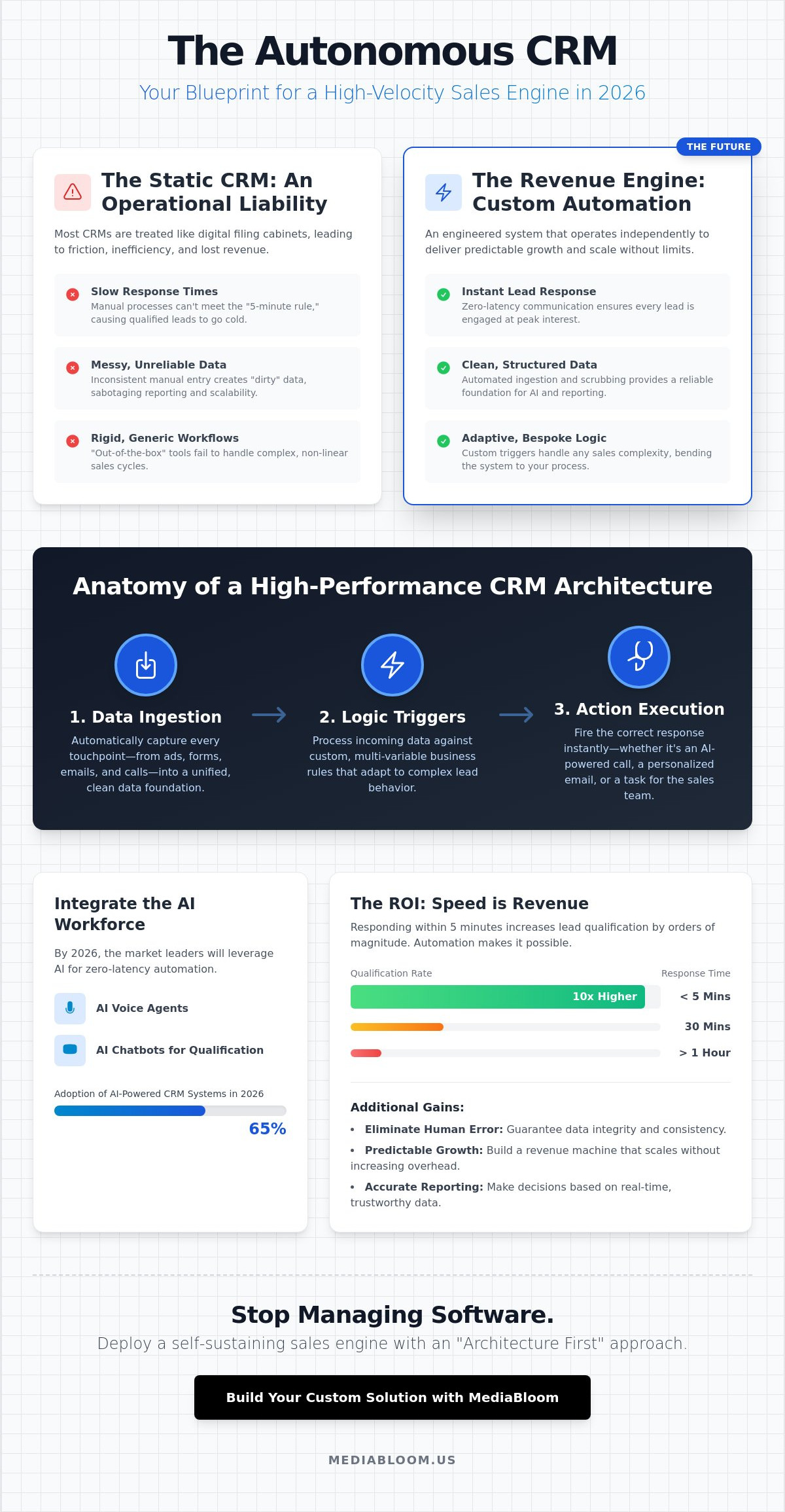
The landscape of Customer relationship management (CRM) has undergone a radical transformation. No longer a simple digital Rolodex, it's now the central engine for Revenue Operations (RevOps). High-growth firms have realized that "static" databases are operational liabilities. If your data just sits there waiting for a human to act, you're losing money. True custom crm automation involves the bespoke engineering of data flows and communication triggers that operate independently of human intervention. It's the difference between a static map and a self-driving car.
To visualize how high-performance workflows function within a modern system, watch this technical breakdown:
Basic automation relies on rigid templates. These are the standard "if-this-then-that" rules found in common software packages. They're fine for simple tasks. However, they lack the dynamic logic needed to navigate the complexities of 2026's buyer journeys. Custom architecture allows for multi-variable triggers. It adapts to how a lead actually behaves, not just how you hope they behave.
Why Out-of-the-Box Solutions Fall Short
Generic workflows can't handle non-linear sales cycles. Most "out-of-the-box" tools assume a straight line from lead to sale. Real life is messy. Leads go cold, then reappear on different channels months later. Rigid systems force your team into manual workarounds. These silos create "dirty" data and fragmented reporting. When your system is too stiff, your team stops using it. Custom-built logic provides the flexibility required for enterprise scalability. It ensures the system bends to your unique process, not the other way around. This architectural integrity is what separates market leaders from those struggling with administrative debt.
The ROI of a Fully Automated Sales Machine
Efficiency translates directly to the bottom line. Consider the "5-minute rule." Responding to a lead within five minutes increases the likelihood of qualification by orders of magnitude. A manual process can't guarantee that speed. An automated one can. Beyond speed, you're eliminating the high cost of human error in data management. Accurate reporting becomes a byproduct of the system, not a chore for the sales team. Custom crm automation is the architectural bridge between raw lead data and closed-won revenue. It builds a foundation where growth is predictable, not accidental.
The Anatomy of a High-Performance CRM Architecture
High-performance CRM isn't about custom fields or a pretty dashboard. It's a strategic architecture. It functions through three core layers: data ingestion, logic triggers, and action execution. Ingestion captures every touchpoint across your digital footprint. Triggers process that data against your specific business rules. Execution fires the response. Without this structured engine, you don't have an automated system; you have a glorified spreadsheet. It's the difference between a manual process and a self-sustaining revenue machine.
Success depends on a clean data foundation. In 2026, 65% of businesses have adopted CRM systems with AI features. To leverage AI-powered automation capabilities, your data must be structured and deduplicated in real-time. Custom crm automation handles this by scrubbing incoming data before it ever hits your sales pipeline. This ensures that your lead scoring and prioritization models are based on reality, not noise. When your data is clean, your automation is precise. When it's messy, you're just automating failure at scale.
Architecture also requires seamless cross-platform synchronization. Silos are the enemy of growth. Modern systems use APIs and webhooks to ensure your CRM talks to your ad platforms, email servers, and fulfillment software. When a lead interacts with a specific ad, the CRM should update instantly. This synchronization allows for a unified view of the customer journey. If you're ready to bridge the gaps in your current stack, you can consult with our technical architects to map out a custom solution.
Lead Nurturing and Pipeline Management
Automating the journey from first touch to post-purchase is no longer optional. High-performance systems use behavioral triggers to move deals through the pipeline. If a prospect downloads a whitepaper or views a pricing page, the deal stage updates automatically. No manual clicks required. This ensures consistent CRM Lead Nurturing: Automating the Customer Journey across every segment. It keeps your pipeline moving while your sales team focuses entirely on high-value closing activities.
Advanced Data Orchestration and Reporting
Custom automation feeds real-time data directly into executive dashboards. Stop wasting hours on manual reporting. Automated aggregation pulls metrics from every corner of your tech stack. This allows for predictive analytics that forecast future revenue with high precision. By 2030, the global CRM market is projected to exceed $100 billion. Investing in orchestration now ensures you aren't left behind by competitors who can see their numbers in real-time. You need visibility to make high-stakes decisions.
Bespoke Engineering vs. Built-in CRM Tools
Native automation tools in platforms like HubSpot or Salesforce are engineered for the masses. They prioritize broad accessibility over technical precision. While these built-in features are sufficient for basic task management, they often hit a functional ceiling when faced with complex, non-linear sales cycles. High-performance teams eventually find themselves restricted by the rigid boundaries of "out-of-the-box" workflows. Relying solely on native tools often leads to the "Frankenstein" effect. This occurs when businesses stack dozens of generic plugins and third-party connectors to bridge functional gaps. The result is a fragile, high-latency infrastructure that is prone to failure whenever a single component updates its API.
The most common objection from leadership is: "Can't my internal team just set this up themselves?" While your team understands your business, they are rarely experts in systems architecture. DIY setups often focus on immediate patches rather than long-term scalability. This creates a massive technical debt. Professionally engineered systems, however, are built with a "clean code" philosophy. They replace a web of disconnected plugins with a unified, modular backend. This professional approach ensures that your custom crm automation remains stable as you scale from hundreds of leads to hundreds of thousands. The long-term maintenance costs of a DIY system, plagued by frequent breaks and manual data reconciliations, far outweigh the initial investment in a robust, engineered solution.
When to Invest in Custom CRM Automation
The Strategic Advantage of Proprietary Workflows
Owning your logic is a competitive moat. When you rely on the same generic workflows as your competitors, you're playing by their rules. Custom engineering allows you to adapt to market shifts faster through a modular backend. Harvard Business Review reports that AI integration in sales can lead to 40-60% cost reductions and a 50% increase in leads. These aren't just incremental gains; they're transformative shifts in operational capacity. Implementing a Custom CRM Automation Setup for High-Growth Teams ensures that your technology stack is an asset that drives growth, rather than a legacy system that hinders it.
Integrating the AI Workforce: Voice and Chat Synergy
In 2026, the high-performance sales engine relies on an integrated AI workforce. This is the pinnacle of custom crm automation. Your CRM should act as the central brain, while AI Voice Agents and Chatbots serve as the hands and mouth of the operation. This synergy ensures that no lead is ever left waiting. When a prospect interacts with an AI Chatbot, the system doesn't just store a transcript. It analyzes the conversation in real-time to determine if the lead is ready for a human closer. If the qualification criteria are met, the handoff is instantaneous. This architecture eliminates the friction that typically kills deals during the transition from marketing to sales.
This intelligent infrastructure uses CRM data to drive hyper-personalization. When an AI Voice Agent initiates a call, it pulls historical context from the database. It knows the prospect's industry, previous objections, and current deal stage. This creates a human-parity experience at a scale that was previously impossible. Verified data shows that businesses adopting AI-featured CRMs are 83% more likely to exceed their sales goals. You aren't just saving time; you're deploying a system that learns and adapts to every lead interaction.
AI Voice Agents as CRM Data Collectors
Manual call logging is an antiquated practice that drains sales productivity. Modern AI agents update CRM fields the moment a call ends. They utilize sentiment analysis and intent tagging to categorize leads with clinical precision. This creates a "clean" data foundation for your entire RevOps strategy, ensuring that your reporting is always accurate and up-to-date. To understand the full scope of this technology, read The Definitive Guide to AI Voice Agents.
The Automated Follow-Up Loop
Multi-channel automation is the standard for 2026. A truly automated loop triggers specific actions across voice, chat, and email based on CRM engagement signals. If a lead opens an email but doesn't reply, the system can trigger an AI voice agent to follow up with a brief, personalized check-in. This ensures brand consistency across every touchpoint. You're building a persistent presence that never forgets a lead and never misses an opportunity. If your current infrastructure lacks this level of coordination, it's time to consult with our automation architects to build a custom solution.
Scaling Operations with MediaBloom’s Custom Solutions
MediaBloom functions as the strategic architect for national enterprises that refuse to be throttled by manual processes. We don't just "install" software. We engineer the digital infrastructure that allows your business to scale without the friction of human error. Our "Architecture First" approach to custom crm automation ensures that every logic trigger and data flow is designed to maximize output. In a market where CRM systems deliver an average ROI of $8.71 for every dollar spent, the difference between a generic setup and a high-performance engine is the difference between survival and dominance.
Replacing human-operated BPO services with a managed AI workforce is the most significant operational shift you can make in 2026. Human teams are inconsistent. They require management and are subject to the limitations of manual data entry. Our custom AI automations, including AI Voice Agents and Chatbots, execute your strategy with clinical precision. This isn't just about saving time; it's about building a foundation that supports exponential growth. Transitioning from manual work to automated excellence requires a partner who understands the underlying mechanics of revenue operations. MediaBloom provides that technical mastery.
Our Bespoke Implementation Process
Every engagement begins with a comprehensive infrastructure audit. We identify the silos and bottlenecks that are currently draining your resources. From there, we move into the strategic design of revenue-generating workflows. We don't waste time on simple "task" automation that offers marginal gains. We focus on the high-impact sequences that move the needle on your bottom line. To see how we've transformed operations for other high-growth firms, view our case studies to see high-energy results. Our deployment is methodical, ensuring a seamless transition from your legacy systems to a modern, automated stack.
Next Steps: Building Your Scalable Sales Machine
The window for gaining a competitive advantage through AI is closing. Competitors are already moving toward agentic enterprises. You must audit your current pipeline for automation gaps today. Look for the points where leads go cold or where data entry slows down your closers. The urgency of adopting custom crm automation cannot be overstated. If you are ready to stop managing software and start leading an automated workforce, it's time to act. You can watch a demo of our systems in action or book a strategy session to begin your architectural overhaul.
Dominate the Automated Frontier
The transition to an agentic enterprise is no longer a future projection; it's a present requirement for market leadership. You've seen how a high-performance architecture replaces manual friction with clinical precision. You understand that "built-in" tools often hit a functional ceiling that only bespoke engineering can break through. By integrating AI voice and chat agents directly into your core systems, you create a self-sustaining pipeline that captures and qualifies leads with zero latency. Implementing custom crm automation is the single most effective way to decouple your revenue growth from your headcount.
MediaBloom stands as your strategic architect. We specialize in custom AI workflows engineered for national scale and seamless AI voice agent CRM integration. Our expertise extends to managed ad management and email marketing services, building the systems that drive measurable results. It's time to stop managing administrative debt and start deploying a high-velocity revenue engine. Scale your operations—Contact MediaBloom for a Custom Automation Strategy. Secure your position at the forefront of your industry; the future of sales is autonomous.
Frequently Asked Questions
What is the difference between CRM and custom CRM automation?
A CRM is a static repository for data; custom crm automation is the engineered logic that acts on that data. While a standard CRM requires manual input and navigation, an automated system triggers communications, updates deal stages, and manages lead flows independently. It transforms a filing cabinet into an autonomous revenue generator that executes your strategy without human intervention.
How much does it cost to implement custom CRM automation in 2026?
Industry data for 2026 shows custom CRM development ranges from $20,000 for basic systems to over $200,000 for complex enterprise platforms. Implementation costs for mid-market platforms typically fall between $25,000 and $100,000. These figures reflect the infrastructure investment required to build a bespoke system rather than renting a generic, limited toolset.
Can custom CRM automation work with my existing software stack?
Yes, custom automation is designed to unify your existing tech stack through APIs and webhooks. High-performance systems act as a central nervous system, connecting your ad platforms, email servers, and fulfillment software. This architectural approach eliminates data silos and ensures real-time synchronization across all operational channels. Your current tools become more valuable when they're part of a synchronized engine.
How long does it take to see ROI from a custom CRM setup?
Most businesses see productivity gains immediately, while financial ROI typically tracks with your sales cycle length. CRM systems deliver an average ROI of $8.71 for every dollar spent. By automating lead response times and nurturing, you capture revenue that's usually lost to human delay or inconsistent follow-up. The system starts paying for itself by closing the gaps in your pipeline.
Will custom automation make my sales process feel impersonal?
Automation actually increases personalization by leveraging deep CRM data that humans often overlook. AI-driven systems use historical interactions and behavioral signals to tailor every message to the specific prospect. This ensures your communications are relevant and timely. It feels more personal than a generic, manual follow-up sent days too late by a busy representative.
What is the role of AI voice agents in CRM automation?
AI voice agents function as the frontline workforce for data collection and lead qualification. They update CRM fields instantly after calls and perform sentiment analysis to tag prospect intent. This eliminates manual logging and ensures your sales team only spends time on leads that have been pre-qualified by the system. It's the ultimate tool for maintaining a clean, actionable database.
How do I know if my business is ready for custom CRM engineering?
Your business is ready when manual workarounds and data silos begin to bottleneck your growth. If your team spends more time managing software than closing deals, you've reached the complexity threshold. Custom crm automation is the solution for organizations that have outgrown the rigid boundaries of "out-of-the-box" templates and need a system that scales with their unique workflows.
Does MediaBloom provide ongoing support for custom automations?
MediaBloom provides comprehensive setup and strategic architecture for all custom AI and CRM automations. We ensure your system is built for long-term scalability and operational excellence. Our focus is on maintaining the integrity of your revenue engine so your team can focus entirely on high-value output. We build the infrastructure that allows your business to operate at peak performance.