Your human sales desk is currently losing 30% of your potential revenue before the first word is even spoken. While manual teams struggle with high churn and inconsistent follow-up, the industry benchmark for human call costs has climbed as high as $5.60 per interaction. Calculating the roi of ai voice agents isn't just about shaving pennies off your overhead; it's about reclaiming the 27% of missed leads that die in your CRM every weekend. You've likely felt the frustration of watching expensive leads go cold because your team couldn't scale as fast as your market opportunity.
We agree that the rigid ceiling of human-operated services is the primary bottleneck to your 2026 growth targets. This guide provides the precise metrics and formulas you need to quantify the financial impact of AI voice agents and automated workflows on your bottom line. You'll master a defensible ROI framework that demonstrates how to slash cost-per-acquisition while maintaining 24/7 engagement. We're moving beyond theoretical benefits to analyze hard data; we'll examine the 331% average three-year ROI and the rapid 90-day payback period that defines the new standard in sales profitability.
Key Takeaways
- Shift your financial perspective from defensive cost-cutting to an aggressive revenue-expansion model that treats automation as a high-yield profit engine.
- Identify and eliminate "leaky buckets" in your CRM by replacing inconsistent manual follow-up with persistent, automated lead nurturing sequences.
- Master the 5-step framework to quantify the roi of ai voice agents by calculating the delta between human BPO ceilings and infinite AI scalability.
- Leverage the "Speed-to-Lead" multiplier to ensure every inbound inquiry hits the critical 5-minute conversion threshold for maximum profitability.
- Build a defensible financial case for stakeholders that proves how AI engines scale your pipeline without the exponential overhead of human staffing.
The Fundamentals of Calculating Sales Automation ROI
Quantifying the Return on investment (ROI) for sales technology has evolved from a simple accounting exercise into a strategic necessity. At its core, the formula is the ratio of net profit generated to the total automation investment. However, executive leadership must distinguish between the defensive "Cost-Saving" model and the aggressive "Revenue-Generating" model. Manual sales processes operate as friction-heavy engines with a fixed capacity. When your human team hits their limit, your growth plateaus. In contrast, an AI-driven architecture provides an infinite floor for lead engagement.
Calculating the roi of ai voice agents requires a shift in perspective. You aren't just purchasing a software tool; you're deploying a foundational architectural component for your 2026 revenue operations. This transition allows you to move from a linear growth model to an exponential one. By automating the front end of your sales pipeline, you ensure that every dollar spent on lead generation is backed by a system that never sleeps, never fatigues, and never misses a follow-up.
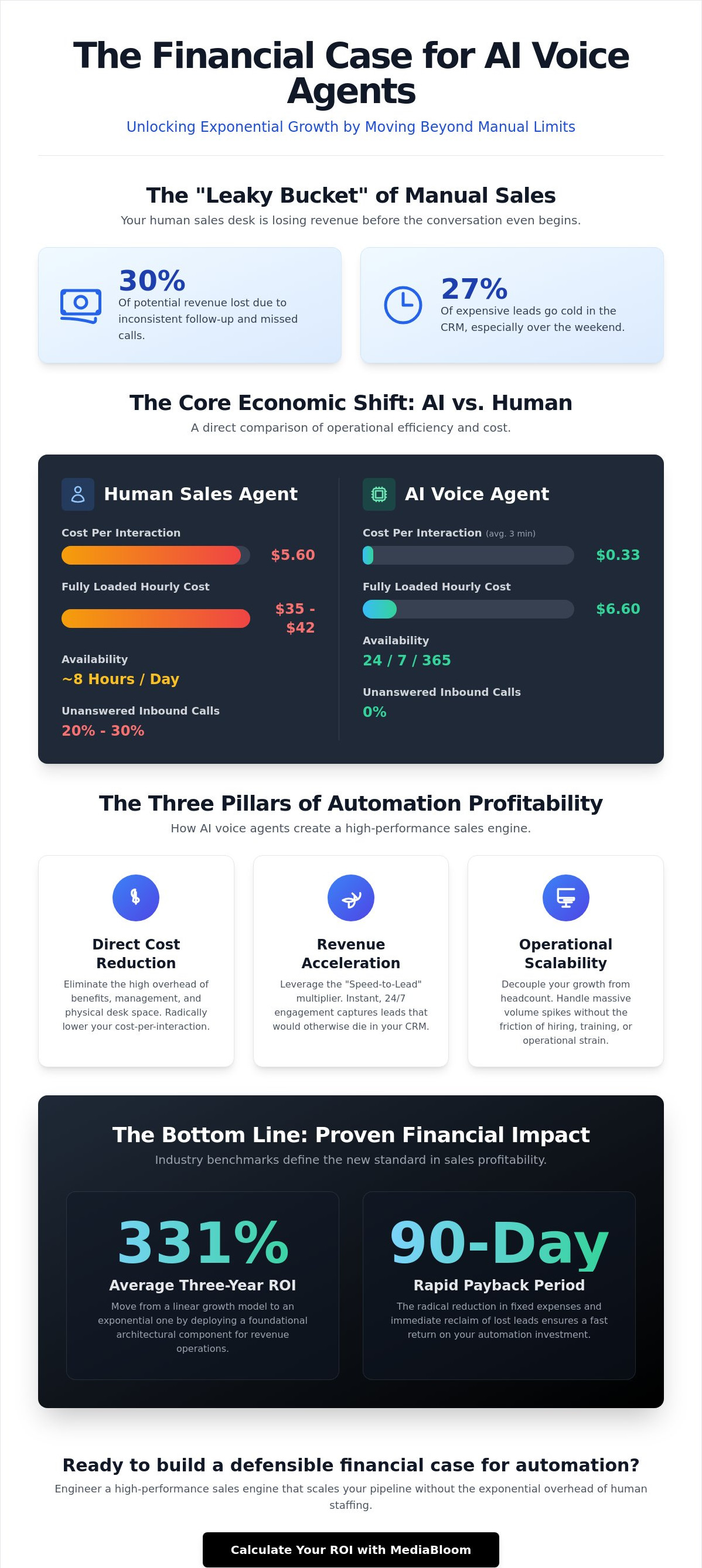
To visualize the economic shift between manual operations and automated systems, review this performance breakdown:
Why Traditional ROI Models Fail in 2026
Simple time-tracking is insufficient for measuring a sophisticated AI workforce. Traditional models often overlook the "Efficiency Gap," which is the revenue lost when human agents fail to respond to leads within the critical five-minute window. Industry data shows 20% to 30% of inbound calls go unanswered in manual environments. AI voice agents close this gap entirely. You're no longer measuring how much time a tool saves a human; you're measuring the total output of an automated system that replaces high-churn, low-efficiency manual tasks.
The Three Pillars of Automation Profitability
- Direct Cost Reduction: The all-in rate for an AI voice agent is approximately $0.11 per minute. This stands in stark contrast to the $35 to $42 fully loaded hourly cost of a US-based human agent. You're eliminating the overhead of benefits, management, and physical desk space.
- Revenue Acceleration: Speed-to-lead is your most powerful multiplier. By providing instant, 24/7 engagement, you capture leads that would otherwise die in your CRM. Persistent, automated nurturing ensures high-value prospects stay in the funnel until they're ready to close.
- Operational Scalability: Decouple your growth from headcount. With AI Voice Agents, you can handle volume spikes without the friction of hiring or training. This creates a scalable engine where increased lead flow results in predictable revenue rather than operational strain.
Quantifying Hard and Soft Cost Savings: AI vs. Human BPOs
Traditional sales operations are often anchored by the exorbitant costs of human labor. A US-based sales representative carries a fully loaded cost between $35 and $42 per hour once you factor in benefits, management overhead, and physical infrastructure. This creates a high baseline for every interaction. In contrast, the roi of ai voice agents is driven by a radical reduction in these fixed expenses. While a human agent's cost per call ranges from $2.70 to $5.60, an automated system operates at a fraction of that investment. This financial delta allows you to reallocate capital from maintenance to growth.
Beyond payroll, manual sales teams suffer from "leaky buckets" in their lead nurturing sequences. Industry data confirms that 20% to 30% of inbound calls are unanswered or abandoned in human-centric environments. These are not just missed connections; they're lost revenue opportunities that inflate your effective cost per lead. By implementing a custom CRM automation setup, you eliminate the "Hidden Tax" of manual data entry and ensure that every prospect is logged, tracked, and engaged instantly. This architectural shift is essential for understanding sales automation as a profit driver rather than a line-item expense.
The Automated AI Workforce vs. Traditional BPO
The most significant advantage of an automated workforce is the elimination of the 40-hour work week ceiling. AI voice agents provide 24/7 uptime without the management fees or attrition rates associated with human BPO services. You gain a "zero-training-drift" advantage. Your automated agents never forget the script, never lose energy, and never require a performance improvement plan. While human staffing for 24/7 coverage can cost up to $240,000 annually, an AI equivalent scales for a fraction of that price. This permanence ensures your sales engine remains operational even when your competitors' offices are closed.
Reducing Cost Per Lead (CPL) and Acquisition (CPA)
Automated follow-ups drive down your CPA by maximizing the value of every lead generated through your ad spend. When you integrate AI lead filtering, you stop wasting high-value human time on unqualified prospects. We've documented significant automation cost savings in digital ad management by using AI to qualify leads in real-time. This efficiency ensures your human closers only speak with bottom-of-funnel opportunities. If you're ready to audit your current sales efficiency, you should speak with our automation architects to identify where your pipeline is leaking profit.
The Revenue Expansion Formula: Why Speed-to-Lead is Profit
Speed-to-lead is the most critical multiplier in your revenue engine. In a high-velocity sales environment, the first five minutes after an inquiry are the difference between a closed deal and a dead lead. Research indicates that conversion rates drop by 400% if the response time exceeds ten minutes. While human teams struggle to maintain this pace, the roi of ai voice agents is anchored in their ability to provide instantaneous engagement. They eliminate the latency that kills your marketing budget. Every second saved in response time translates directly into higher throughput and captured revenue.
Your CRM is likely a graveyard for leads that were never properly resurrected. Most companies focus only on the newest inquiries, leaving thousands of dormant records untouched. Utilizing AI voice agents allows you to extract fresh value from these existing assets. These systems can process thousands of dormant contacts in hours, identifying high-intent signals and re-engaging prospects who were previously considered lost. This "Lead Resurrection" strategy turns a sunk marketing cost into a new stream of high-margin profit.
Converting the Unreachable: Persistency at Scale
Human sales reps typically abandon a lead after two or three unsuccessful attempts. However, data suggests that the highest conversion rates often occur on the 6th, 7th, or 8th follow-up. This is where manual teams fail due to burnout and perceived rejection. Automated agents maintain perfect persistency. They execute rigorous follow-up sequences without fatigue, ensuring your brand stays top-of-mind. By achieving human-parity in these interactions, you maintain a high standard of quality while scaling your outreach to levels that were previously impossible. This relentless consistency is a primary driver for the roi of ai voice agents in complex B2B sales cycles.
Increasing Lifetime Value (LTV) Through Automated Engagement
Maximizing revenue requires looking beyond the initial transaction. High-performance sales engines use automated cross-selling and up-selling triggers built into custom CRM workflows to drive long-term growth. When a customer interaction occurs, the system identifies opportunities for expansion in real-time. This instant response builds brand loyalty and increases the total lifetime value of every account. AI chatbots ensure that no high-intent signal goes unanswered, providing a seamless bridge between customer interest and revenue capture. By automating these engagement points, you create a self-sustaining system that grows your bottom line without increasing your operational friction.
How to Calculate Your Sales Automation ROI in 5 Steps
Calculating the roi of ai voice agents requires a transition from general estimates to architectural precision. You must treat your sales pipeline as a high-performance engine where every friction point represents a financial loss. To build a defensible business case for stakeholders, you need a structured framework that captures both immediate labor savings and long-term revenue acceleration. Follow these five steps to audit your current infrastructure and project your future profitability.
- Step 1: Audit Manual Sales Costs. Aggregate the fully loaded expenses of your current team. Include base salaries, benefits, and the significant costs associated with agent churn and recruitment.
- Step 2: Determine Automation Stack Costs. Calculate the total investment required for your new workforce. This includes software licensing, initial implementation fees, and the internal resources needed for ongoing management.
- Step 3: Quantify Revenue Lift. Estimate the additional profit generated by eliminating lead abandonment and achieving a sub-five-minute response time. This is your "Speed-to-Lead" multiplier.
- Step 4: Calculate Net Gain. Subtract your total automation costs from the combined value of your operational savings and your projected revenue lift.
- Step 5: Finalize the ROI Percentage. Divide your net gain by the total automation cost to determine your final return on investment.
The Essential ROI Formula for Sales Leaders
The standard equation for measuring the roi of ai voice agents is: [(Gains from Automation - Cost of Automation) / Cost of Automation] x 100. While this formula provides a clear numerical output, you must also weight "Soft Gains" to see the full picture. Improved data accuracy, enhanced brand reputation from instant responses, and reduced management fatigue are critical variables. ROI is the primary metric for sales infrastructure health; it dictates your ability to scale without collapsing under operational complexity.
Factoring in the Implementation and Ramp-Up Period
Year 1 ROI often looks different than long-term system profitability due to initial setup requirements. A custom CRM automation setup is the fastest way to accelerate your time-to-value. By integrating your AI agents directly into your existing data architecture, you eliminate the manual "hand-off" friction that slows down traditional deployments. Set realistic KPIs for your first 90 days, focusing on call abandonment rates and lead engagement volume. Once the engine is tuned, your margins will expand as the system handles higher throughput with zero incremental labor cost. If you're ready to run these numbers for your specific pipeline, contact our automation architects for a personalized ROI audit.
Engineering a High-Performance Sales Engine with MediaBloom
MediaBloom stands as the strategic architect for enterprises ready to transition from manual bottlenecks to automated dominance. We don't just provide tools; we build integrated revenue engines designed for technical mastery and operational excellence. Maximizing the roi of ai voice agents requires more than a simple software subscription. It demands a structural overhaul of your revenue operations. Our AI Voice Agent services serve as the primary driver of this expansion, replacing the rigid ceiling of traditional staffing with a fluid, scalable infrastructure. Generic, out-of-the-box software often creates technical debt. Our custom-built workflows ensure your technology stack remains an asset rather than an anchor.
The competitive advantage of a MediaBloom engine lies in its precision. We invite you to examine our real-world performance data, where the delta between manual effort and automated output is clearly defined. You've seen the formulas and the potential for 24/7 engagement. Now, it's time to deploy the infrastructure that makes those numbers a reality. We focus on the architecture of growth, ensuring that every component of your sales stack is optimized for maximum throughput.
Custom AI Workflows Designed for Maximum Output
Bespoke CRM integrations are the foundation of our approach. We eliminate the operational friction that typically occurs when disparate systems fail to communicate. Our human-like AI agents maintain your high brand standards at scale, delivering a consistent experience that human BPOs cannot replicate. We operate on a strict "No-Human-BPO" philosophy. This allows you to scale your operations without the exponential increase in headcount, training costs, or management complexity. Your sales engine becomes a permanent, high-performance asset that grows alongside your ambitions.
Next Steps: From Calculation to Execution
Theoretical math only takes your business so far. True market leadership is defined by execution. The roi of ai voice agents becomes a tangible competitive edge only when moved from a spreadsheet into a live environment. We encourage you to transition from calculation to action through a strategic pilot program. By combining high-performance automation with our expert ad management, we ensure your sales engine is constantly fed with high-intent leads. The move toward an automated workforce is a strategic necessity for 2026. Contact MediaBloom today for a tailored ROI assessment and take command of your revenue trajectory.
Secure Your Competitive Advantage in the Automated Economy
Transitioning from manual labor to an automated revenue engine is no longer a luxury; it's the baseline for 2026 market dominance. You've analyzed the metrics. You've seen how shifting to an AI workforce captures the 27% of leads that typically die in a human-operated CRM. Maximizing the roi of ai voice agents requires more than just software. It demands a strategic partner capable of engineering high-performance systems that scale without friction. Legacy sales models are hitting a rigid ceiling, but your growth doesn't have to.
MediaBloom delivers the infrastructure needed to outpace the competition. We combine human-parity AI voice technology with bespoke CRM automation architecture to generate proven results in high-growth sales pipelines. Stop managing human attrition and start scaling your revenue throughput with a system that never sleeps. The math is clear, and the technology is ready. Take the first step toward a more profitable, automated future today.
Contact MediaBloom to Calculate Your Potential ROI
Frequently Asked Questions
How long does it take to see a positive ROI from sales automation?
Most organizations achieve a positive return on their investment within 60 to 90 days of deployment. A Forrester Consulting study confirmed that a composite organization achieved a full payback period in under six months. This rapid turnaround is driven by the immediate reduction in labor costs and the capture of revenue from previously missed leads.
Can sales automation ROI be calculated for small teams, or is it only for enterprises?
ROI is measurable and impactful for any team with a consistent lead flow regardless of its size. While enterprises see massive total labor cost reductions, smaller teams benefit from the ability to handle volume spikes without hiring additional staff. The math remains consistent because the primary goal is maximizing revenue throughput per lead generated.
What are the biggest "hidden costs" that can lower my automation ROI?
Poor CRM integration and data silo management are the primary hidden costs that erode profitability. If your automated workflows aren't mapped correctly to your existing sales pipeline, you lose efficiency during the hand-off to human closers. Technical debt from generic software that lacks custom logic can also increase long-term maintenance expenses.
How do AI voice agents compare to human cold callers in terms of cost-effectiveness?
AI voice agents are significantly more cost-effective, operating at a fraction of the expense of human callers. A typical four-minute AI call costs approximately $0.44. In contrast, the industry benchmark for a human agent's cost per call ranges from $2.70 to $5.60. This allows for a massive increase in call volume without a proportional increase in budget.
Will sales automation decrease my customer satisfaction scores?
Automation typically increases satisfaction scores by providing instant, 24/7 engagement that human teams cannot match. Industry data indicates that 20% to 30% of business calls go unanswered in manual environments. By eliminating wait times and answering every inquiry immediately, you improve the customer experience and strengthen your brand perception.
What metrics should I track to monitor the ongoing ROI of my CRM automation?
Track your cost-per-acquisition (CPA), call abandonment rates, and lead-to-opportunity conversion speed. Monitoring the roi of ai voice agents also requires analyzing the volume of recovered missed calls that were previously lost to voicemail. These metrics provide a clear view of how the system is expanding your total revenue throughput.
Is the initial setup fee for custom AI automation worth the investment?
Custom setup is essential for achieving high-parity performance and long-term reliability. Bespoke architectures eliminate the operational friction found in generic, out-of-the-box tools. This initial investment ensures your automated engine integrates seamlessly with your specific sales architecture, which significantly accelerates your overall time-to-value.
How does automated lead nurturing impact the ROI of my paid ad campaigns?
Automated nurturing maximizes the value of your paid media spend by ensuring no lead is wasted due to slow follow-up. AI agents execute the 6th, 7th, and 8th follow-up attempts that human teams often skip. This persistency drives down your overall CPA and increases the roi of ai voice agents by converting prospects who would otherwise be abandoned.