AI Phone Agents Are Production-Ready. Most Deployments Aren’t.
AI phone agents can handle real customer calls and generate measurable ROI today, but only when telephony, scale, and compliance get validated before launch. The technology itself is commercially viable for defined use cases: appointment booking, outbound notifications, and lead qualification all work reliably when the underlying platform runs on production-grade integration and compliance controls. Where deployments fail is not the model. It’s everything wired around it.
That means one caution up front: don’t let an AI phone agent make binding financial promises or issue complex medical guidance without a human in the loop. Those calls carry legal and clinical exposure that no current voice AI system should own alone.
Here’s what to do next:
- Scope a pilot that mirrors real call volume, not a demo environment.
- Test against your actual telephony trunk, not a temporary provisioned number.
- Run concurrency tests before you sign anything long-term.
Pro Tip: Ask any vendor for documented latency and concurrency test results before you evaluate a single conversation transcript. The transcript tells you if it sounds good. The load test tells you if it will survive Monday morning.
Key Takeaways
AI phone agents deliver measurable ROI for defined use cases, but production success depends on validating telephony, concurrency, and compliance before launch, not after.
| Point | Details |
|---|---|
| Pick bounded use cases first | Appointment booking, reminders, and lead qualification carry the best ROI with the lowest legal risk. |
| Test on the real trunk | A provisioned test number tells you nothing about production telephony performance. |
| Require documented load tests | Ask for concurrency and latency results under realistic peak-call conditions before accepting a pilot. |
| Treat compliance as engineering | TCPA, HIPAA, and PCI requirements need audit trails and consent artifacts built into the system, not added later. |
| Consider a managed platform | Mediabloom combines voice agents, chatbots, and compliance-ready processes into one deployment path from pilot to production. |
Table of Contents
- What a Production-Ready AI Phone Agent Platform Must Provide
- Which Business Problems Do AI Phone Agents Solve Best?
- Why Pilots Fail at Scale
- A Pre-Launch Checklist Before You Accept Any Pilot
- How AI Voice Agent Pricing Actually Works
- The Compliance Gates You Cannot Ignore
- MediaBloom’s Approach to Production-Grade Deployment
- Post-Launch Monitoring and Continuous Improvement
- Security Risks Beyond Compliance Checklists
- Designing Voice AI Conversations That Actually Work
- Scaling Challenges for Enterprise Deployments
- Timeline From Pilot to Full Production
- Primary Sources for Technical and Regulatory Claims
- What the Data Actually Says About Voice AI Readiness
- Ready to Move From Pilot to Production?
- Sources
- FAQ
What a Production-Ready AI Phone Agent Platform Must Provide
Every credible AI voice agent runs on four technical building blocks, and if a vendor can’t clearly explain all four, that’s your first red flag. Streaming speech-to-text (STT) converts caller audio to text in real time. A large language model with function calling reasons over that text and triggers actions like checking a calendar or pulling account data. Streaming text-to-speech (TTS) turns the response back into audio. An orchestration layer bridges all three to the telephony network itself, usually over SIP trunking.
The gap between a demo and a deployable system shows up in the plumbing around those four blocks. Look for low-latency streaming paths (audio moving token-by-token rather than waiting for full sentences), real-time monitoring and observability dashboards, model versioning so you can roll back a bad update, and the ability to swap out any single component (ASR, LLM, or TTS) without rebuilding the whole stack.
Guardrails matter just as much as raw capability. A serious platform should include:
- A claim-auditor layer that checks generated statements against policy before they reach the caller’s ear.
- Retrieval grounding, so factual answers pull from verified data instead of the model’s own guesswork.
- Token-level streaming straight to TTS, which keeps response latency low enough to feel conversational.
- Full audit trails logging what was said, when, and why the system said it.
Combining STT, LLM reasoning, and TTS into one coordinated pipeline is what turns a phone call into structured, actionable data, and organizations running mature stacks report 30%+ operational efficiency gains and measurably higher booking rates as a result.
Which Business Problems Do AI Phone Agents Solve Best?
Not every call center problem belongs on an AI phone agent yet, and pretending otherwise is how pilots turn into cautionary tales. The highest-ROI use cases share one trait: clear intent, bounded outcomes, and low legal risk per interaction.
- Inbound support and triage. Answering common questions, routing calls, and handling after-hours volume without adding headcount.
- Appointment scheduling and rescheduling. Voice AI appointment booking works well because the task is transactional: check availability, confirm a slot, send a reminder.
- Outbound notifications and reminders. An outbound AI voice agent calling to confirm appointments or flag overdue payments handles repetitive, script-driven outreach at volume.
- Lead qualification. An inbound AI voice agent that asks qualifying questions and routes hot leads to a rep in real time shortens the sales cycle meaningfully.
Expect measurable containment rates (the share of calls resolved without a human), booking uplift on scheduling tasks, and faster SLA response times on inbound queues.
Keep humans on anything involving binding financial commitments, contract terms, or medical advice beyond basic triage. Those categories need a person’s judgment and a person’s liability, not a language model’s best guess.
Why Pilots Fail at Scale
Almost every failed voice AI deployment fails for the same reason: it worked fine on a temporary test number and fell apart the moment it touched the real telephony environment. This is the telephony integration gap, and it’s the single most predictable cause of stalled rollouts.

A provisioned test number tells you almost nothing about how the system behaves under your actual SIP trunk, your carrier’s call routing, or your peak-hour call volume. Enterprises routinely succeed at pilots and then stall before production because nobody stress-tested the infrastructure layer, not the model layer.
Before accepting any pilot as proof of readiness, require these four tests:
- True SIP/trunk validation on your production line, not a sandboxed number.
- Component-level concurrency limits (how many simultaneous calls each piece of the stack, from STT to TTS, can actually handle).
- Latency measurement under realistic load, not a quiet test environment.
- Geographic redundancy and failover testing, so a regional outage doesn’t take your phone lines down with it.
| Test Type | What It Reveals |
|---|---|
| SIP/trunk validation | Whether the platform performs on your real carrier setup, not a demo line |
| Concurrency limits | How many calls each component can handle before quality degrades |
| Latency under load | Whether response times hold steady during peak call volume |
| Failover and redundancy | Whether an outage in one region takes down the entire system |
Also confirm the vendor can swap ASR, TTS, or LLM providers without a full rebuild. That flexibility isn’t a nice-to-have. It’s what keeps you from being locked into a single provider’s pricing or performance ceiling two years from now.
A Pre-Launch Checklist Before You Accept Any Pilot
Treat this as acceptance criteria, not a wish list. If a vendor can’t check every box, you’re not looking at a production-ready platform.
- Test on the actual production trunk, using concurrency and latency scenarios that mirror your real peak-minute call volume.
- Verify structured handoff payloads to human agents, including conversation summary, detected intent, extracted entities, and an emotional escalation flag.
- Confirm logging and retention policies, DTMF masking for payment data, and BAA or PCI controls wherever they apply.
- Require a claim-auditor on every utterance bound for text-to-speech, with a documented fallback for when retrieval returns nothing.
Documented test results for concurrency, latency, and retrieval success matter more than any vendor’s sales deck. If a system can’t retrieve a fact, it should escalate the call instead of guessing.
Pro Tip: Ask specifically what happens when retrieval comes back empty. A platform that admits “I don’t have that information, let me connect you” is more production-ready than one that always sounds confident.
How AI Voice Agent Pricing Actually Works
Most vendors price around per-minute compute costs, but that’s rarely the whole bill. Real production budgets also include telephony carrier fees, storage for call recordings and audit logs, integration and engineering time, and post-call analytics.
Costs tend to climb between pilot and full production for predictable reasons: higher concurrency requirements, richer retrieval systems pulling from larger knowledge bases, and compliance features like DTMF masking or air-gapped STT for regulated data.
A rough ROI comparison helps frame the decision: if a human agent costs $20 to $25 an hour fully loaded, and an AI phone agent achieves a strong containment rate on routine calls at a fraction of that per-minute cost, the math favors automation fast, particularly for high-volume, repetitive call types. Organizations combining STT, LLM, and TTS into one stack report efficiency gains north of 30% in real deployments, which is where the ROI case gets concrete rather than theoretical.
- Per-minute compute is the baseline cost, not the total cost.
- Telephony, storage, and compliance tooling scale with volume and regulation.
- Engineering and integration time is a real, often underestimated, line item.
The Compliance Gates You Cannot Ignore
Compliance failures carry per-call penalty exposure, which makes this the single most expensive area to get wrong. TCPA rules require prior express written consent (PEWC) documentation, clear AI disclosure to the caller, and do-not-call list scrubbing before any outbound call goes out. The FCC’s 2024 ruling classifying AI-generated speech as an “artificial voice” under TCPA rules increased documentation requirements industry-wide.
HIPAA and BAA obligations kick in the moment a call touches protected health information. That often means air-gapped STT or a signed business associate agreement with your speech vendor. PCI guidance for payment calls typically requires DTMF masking at the carrier layer so card numbers never reach a transcript or a model.
- Confirm PEWC documentation and AI disclosure scripts before any outbound campaign launches.
- Require a signed BAA wherever PHI is discussed.
- Mandate DTMF masking for any call involving payment data.
- Avoid voiceprint-only authentication in states with biometric privacy laws like Illinois’ BIPA.
Per-call legal exposure under TCPA makes audit trails and consent artifacts a first-class engineering requirement, not an afterthought bolted on after launch.
MediaBloom’s Approach to Production-Grade Deployment
Mediabloom builds its voice agents around the same principle this guide argues for: production readiness is a compliance and infrastructure problem first, a conversational-quality problem second. Clients including Miracle Ear and 1-800 Accountant have used Mediabloom’s platform to generate over 10,000 monthly leads through integrated voice, chat, and SMS automation.
A managed deployment through Mediabloom includes real telephony integration rather than a sandboxed test line, TCPA-ready outbound processes, HIPAA-aware handling for regulated industries, and omnichannel follow-up that keeps leads warm across SMS, email, and chat.
- Ask for concurrency and latency test results before evaluating conversation quality.
- Request documented compliance processes, not just a checkbox claim.
- Confirm structured handoff to your team when a call needs a human.
Pro Tip: Whatever vendor you evaluate, including Mediabloom, ask to see a case study with real deployment metrics before you sign anything.
Post-Launch Monitoring and Continuous Improvement
Launch day isn’t the finish line. It’s the point where the real data starts arriving, and the platforms that stay useful are the ones set up to act on it.
Track containment rate weekly, not monthly. A sudden dip usually means a knowledge base gap, a new call type the system wasn’t trained on, or a telephony issue upstream. Monitor latency continuously, since a creeping increase in response time often signals a scaling problem before it becomes an outage.
Review call transcripts on a rolling sample, not just the ones that trigger a complaint. Patterns in successful calls reveal phrasing that works, and patterns in abandoned calls reveal where callers give up. Feed both back into prompt and retrieval updates on a regular cadence, ideally biweekly during the first quarter after launch.
Set up alerting for anomalies: a spike in escalations to human agents, an unusual jump in call duration, or a drop in successful bookings. These are early warning signs of a retrieval database going stale or an integration silently failing.
Version every prompt and model update, and keep a rollback path ready. Voice AI systems drift as underlying models get updated by providers, and a change that improves one call type can quietly degrade another. Regular A/B testing on script variations, especially for outbound campaigns, tends to surface incremental gains that compound over months. Treat the first 90 days post-launch as an active tuning period, not a victory lap.
Security Risks Beyond Compliance Checklists
Passing a compliance audit doesn’t mean the system is secure. Voice AI introduces attack surfaces that traditional phone systems never had to worry about, and fraud prevention deserves its own line item in any deployment plan.
Voice cloning and deepfake audio are a growing concern for any system that uses voice biometrics for authentication. Relying on voiceprint alone to verify a caller’s identity is a risk, since cloned voice samples have become easier to generate. Layer voice authentication with a second factor: a PIN, a callback verification, or knowledge-based questions that don’t rely on audio alone.
Data privacy extends beyond HIPAA and PCI scope. Call recordings and transcripts often contain sensitive information even in “non-regulated” industries: addresses, family details, financial stress signals. Encrypt data at rest and in transit, restrict who inside your organization can access raw transcripts, and set retention policies that delete recordings once their business purpose is served rather than keeping everything indefinitely.
Prompt injection is a newer risk specific to LLM-driven systems: a caller who understands how the model works can potentially manipulate it into ignoring its instructions. Guardrail layers, like the claim-auditor classifier mentioned earlier, help catch this before a manipulated response reaches a caller or triggers an unintended action.
- Require multi-factor verification, never voiceprint-only authentication.
- Encrypt call data at rest and in transit as a baseline, not an upgrade.
- Set retention limits and enforce them automatically.
Designing Voice AI Conversations That Actually Work
Good dialogue design is the difference between a caller who completes their task and one who hangs up frustrated. The best AI voice receptionist experiences share a few traits that have nothing to do with the underlying model and everything to do with conversation design.
Keep the opening short. Callers don’t want a paragraph of disclosure before getting to their reason for calling. State clearly that they’re speaking with an AI assistant, then get to the point.
Build explicit error recovery paths. When the system doesn’t understand a response, it should ask a clarifying question rather than guessing or looping the same prompt. Three failed attempts at understanding should trigger an automatic handoff to a human, not a fourth guess.
Design for interruption. Real conversations involve callers cutting in mid-sentence, correcting themselves, or answering a different question than the one asked. A system that can’t handle a caller talking over it feels robotic immediately, regardless of how natural the voice sounds.
Avoid over-scripting. Rigid decision trees break the moment a caller says something unexpected, which happens constantly in real calls. Function-calling LLMs handle this better than legacy IVR logic because they reason about intent rather than matching keywords.
Resources on humanizing AI-generated responses offer useful guidance here: natural pacing, appropriate pauses, and avoiding overly formal phrasing all shape whether a caller trusts the voice on the other end.
Scaling Challenges for Enterprise Deployments
What works for 500 calls a day doesn’t automatically work for 50,000. Scaling a voice AI deployment surfaces bottlenecks that never appear in a controlled pilot, and resource planning needs to account for them well before volume climbs.
Concurrency is the first wall most teams hit. Every component in the stack, from STT to the LLM to TTS, has its own concurrency ceiling, and those ceilings rarely match. A platform that handles 200 simultaneous ASR streams but only 50 simultaneous LLM calls will bottleneck at the lower number regardless of how the rest of the system performs.
Knowledge base scale is the second challenge. A retrieval system built for a single product line doesn’t automatically scale to an enterprise catalog spanning dozens of departments. Retrieval accuracy tends to degrade as the knowledge base grows unless the underlying indexing and search architecture were built with that growth in mind from the start.
Geographic distribution matters once call volume spans time zones or regions. A single data center serving a nationwide deployment introduces both latency and single-point-of-failure risk. Redundancy across regions isn’t optional at enterprise scale.
Staffing shifts too. Scaling an AI phone agent deployment doesn’t eliminate headcount needs. It shifts them toward prompt engineering, escalation-queue management, and ongoing quality review, roles that didn’t exist in a traditional call center.
Timeline From Pilot to Full Production
Most enterprise voice AI deployments move through four distinct phases, and skipping ahead is where things break.
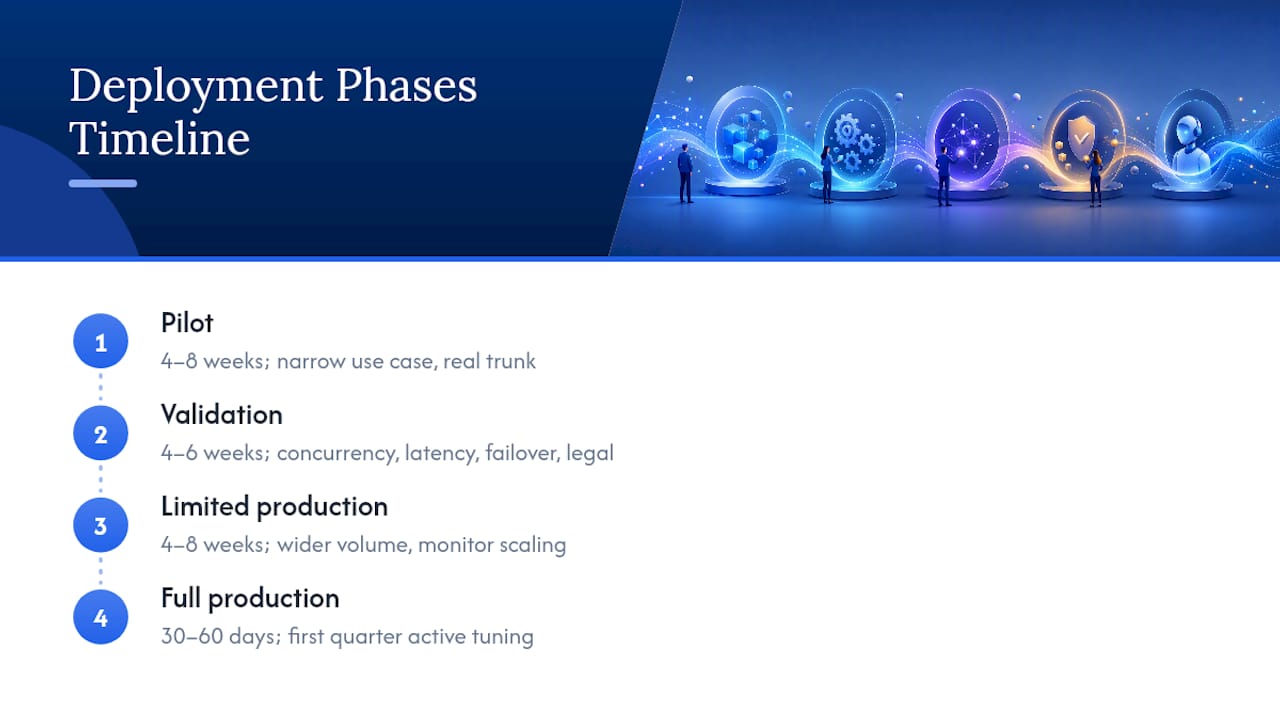
The pilot phase typically runs four to eight weeks and covers a narrow use case, like appointment reminders for a single location, tested on a real (not sandboxed) trunk. The goal here is proving the concept works technically, not proving it scales.
The validation phase follows, usually another four to six weeks, focused entirely on the tests outlined earlier: concurrency limits, latency under load, failover behavior, and compliance sign-off from legal. This phase gets skipped more often than any other, and it’s the one most responsible for pilots that never make it to production.
The limited production phase expands the use case to a wider call volume or additional locations, typically over four to eight weeks, while monitoring closely for the scaling issues covered above. This is where concurrency ceilings and retrieval accuracy problems tend to surface first.
Full production rollout comes last, once the limited phase has run clean for a defined period, usually 30 to 60 days, without major incidents. Even at full rollout, treat the first quarter as an active tuning period rather than a set-and-forget system.
Total time from pilot kickoff to full production realistically runs four to six months for most enterprise deployments. Vendors promising faster timelines are usually skipping the validation phase, which is exactly where the AudioCodes analysis found most production failures originate.
Primary Sources for Technical and Regulatory Claims
- Why enterprise voice AI projects stall before production — AudioCodes
- Voice agent compliance: TCPA, HIPAA, PCI — SoftwareSeni
- AI voice agent challenges and solutions — DianApps
- Voice AI compliance: consent and recording laws — PyAI
What the Data Actually Says About Voice AI Readiness
The conventional pitch for AI phone agents focuses on the wrong variable. Most vendor demos sell conversational quality, how natural the voice sounds, how smoothly it handles small talk, when the actual determinant of success is almost entirely on the infrastructure side. That’s the uncomfortable truth this research keeps surfacing: model quality has become a commodity, and the technology stalls or succeeds based on telephony integration, concurrency limits, and whether legal signed off on the consent flow.
That means the standard procurement question, “does the voice sound realistic,” is close to irrelevant. The question that predicts success is “what happens at 200 concurrent calls during a Monday morning spike,” and almost no vendor volunteers that answer unprompted.
Buyers should prioritize demanding documented load-test results over sitting through another polished demo call. A vendor that hesitates when asked for concurrency numbers is telling you something important, and it isn’t good news. The businesses getting real ROI from voice AI right now are the ones that treated the compliance and infrastructure layer as the product, not an afterthought bolted onto a good-sounding chatbot.
— MediaBloom
Ready to Move From Pilot to Production?
Most vendors will sell you a convincing demo. Few will show you documented concurrency and latency test results before you sign a contract, and that gap is exactly where most AI phone agent deployments stall. Mediabloom closes it by building the telephony integration, TCPA-ready consent flows, and compliance processes into the platform from day one, rather than treating them as a phase-two upgrade.

Mediabloom’s all-in-one platform pairs AI voice agents with chatbots and multi-channel follow-up across SMS, email, and chat, backed by integrations with more than 600 CRM platforms. Clients like Miracle Ear and 1-800 Accountant have used it to generate over 10,000 monthly leads without expanding headcount. If you’re evaluating vendors for a production deployment, start by reviewing the Fifth Avenue Leads case study to see the process end to end, then request a pilot scoped to your actual call volume and compliance requirements.
Sources
- Why enterprise voice AI projects stall before they reach production — AudioCodes
- How AI voice is transforming customer experience and business operations — NetSapiens
- Voice agent compliance: TCPA, HIPAA, PCI and what comes next — SoftwareSeni
- AI voice agent challenges and how to solve them — DianApps
FAQ
Is There an AI Agent That Can Make Phone Calls?
Yes. Outbound AI voice agents can place calls for appointment reminders, notifications, and lead follow-up, and inbound agents can answer, triage, and route calls without a human on the line for routine requests.
How Much Does an AI Phone Agent Cost?
Pricing typically runs on a per-minute compute basis plus telephony, storage, and integration costs, and total production spending grows with concurrency needs and compliance features like DTMF masking or air-gapped STT.
What Is the Best AI Phone Agent?
The best option depends on your use case, but a strong platform combines streaming STT, LLM reasoning, and TTS with proven telephony integration and compliance controls. Mediabloom offers this as an integrated platform with documented client outcomes and omnichannel follow-up built in.
Is There a Free AI Phone Agent Available?
Some providers offer limited free trials or low-volume tiers for testing, but production-grade deployments with real telephony integration, concurrency support, and compliance controls require a paid plan.