AI objection handling means an AI system recognizes what a lead is pushing back on, answers from approved facts, and moves the conversation toward a booked appointment or a signed case. For a law firm, roofer, HVAC company or insurance agency, the value is speed and consistency: the lead who says “too expensive” or “call me next month” gets a real answer in seconds, and nothing sits unanswered until Monday. At MediaBloom, we build and run this as part of our AI voice agents, speed-to-lead and reactivation systems, so your team gets booked appointments instead of a tool to manage.
TL;DR
- AI objection handling works in four moves: detect the objection, classify it, answer from approved material, and log the result in your CRM.
- Most objections in local service sales fall into a few buckets: price, timing, trust, “I need to talk to someone” and “stop contacting me”. Each bucket needs its own response and routing.
- The AI should answer only from facts you approve. Anything it cannot support goes to a person.
- The objection is only handled when the CRM shows it: stage updated, follow-up scheduled, appointment booked or contact suppressed.
- We deliver this done-for-you: the AI agents, the CRM build and the booking, run by one team.
Table of Contents
- What AI objection handling actually is
- How the AI detects and answers an objection
- Common objections and how an AI should route them
- Ground every answer in proof, not polish
- Special note for personal injury and MVA law firms
- When a person should take over
- Connecting objection handling to your CRM and calendar
- Revive old leads with objection handling
- How to measure whether it works
- Why done-for-you beats assembling it yourself
- Put it to work with MediaBloom
- Our perspective
- FAQ
- Sources
What AI objection handling actually is
An objection is any reply that stops a lead from moving forward. “We already have a contractor.” “What does it cost?” “I’m not sure I need a lawyer.” “Text me later.” Human setters handle these every day, and the quality swings with the person, the hour and the workload.
AI objection handling automates the first line of that work. Published guidance describes the same basic loop: the system reads the incoming reply, identifies the intent, matches it to approved responses and sends the answer automatically or after human review, then logs the interaction and creates follow-up tasks.
Two different things get called by this name, and the difference matters for your business:
- Rep coaching. Software listens to a live call and shows your salesperson a suggested answer. The prospect only hears the human.
- Autonomous follow-up. An AI voice agent, text agent or chatbot talks to the lead directly, answers, and books the appointment.
Owners with a lead problem usually need the second. Leads from paid ads, web forms and missed calls go cold quickly, and a coaching prompt does nothing for a call nobody picked up. Our AI voice agents handle inbound and outbound calls, and our setters and texting systems cover the follow-up that happens between calls.
How the AI detects and answers an objection
Behind a good response there is a repeatable sequence. Here it is step by step, with where each step tends to break.
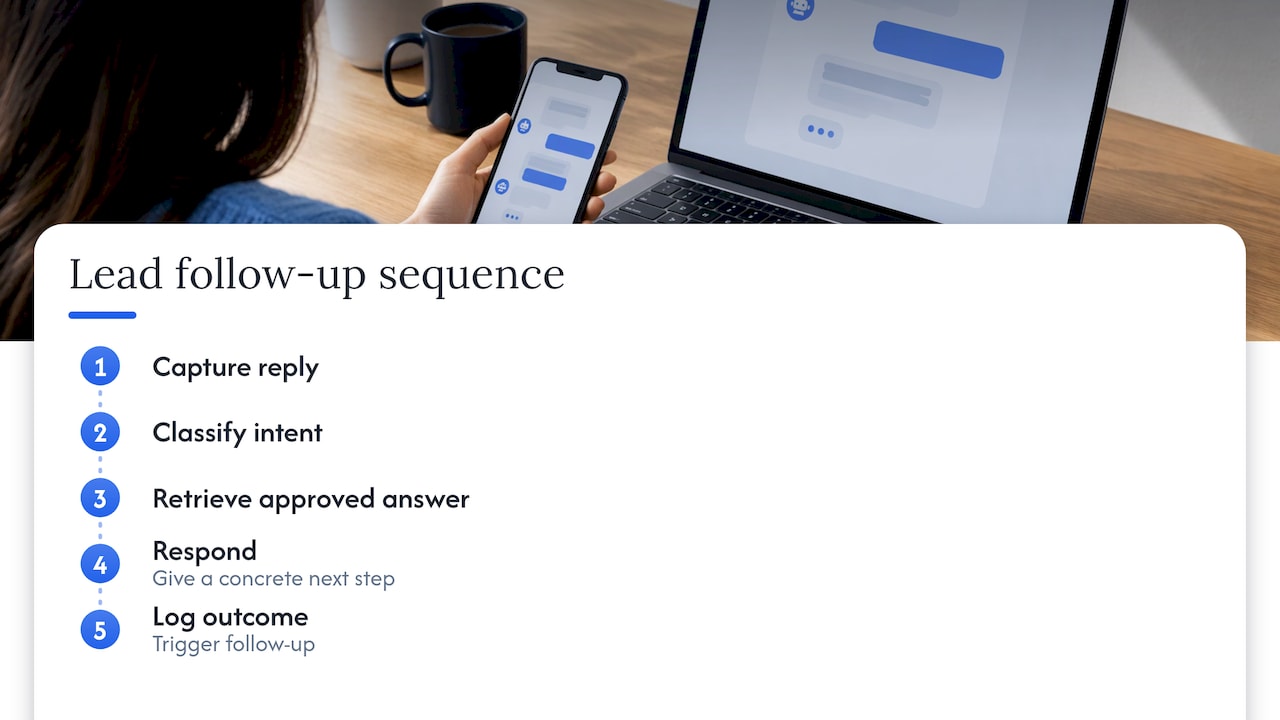
1. Capture the reply in any channel
The lead answers by voice, text, email or chat. The system needs the words, either as a transcript of a call or the message text. Where it breaks: a noisy phone line or a heavy accent can cause a misheard word, and a misheard objection gets the wrong answer. Short confirming questions (“Just to check, is the timing the issue?”) cover this.
2. Classify the intent
The AI decides which bucket the reply belongs to. One published breakdown lists price, timing, competitor preference, lack of authority, security or compliance concerns, and no interest or opt-out as separate categories with separate routing, not one generic rebuttal. Where it breaks: indirect objections. “Let me think about it” often hides a price or trust worry, so the agent should ask one gentle question before pitching.
3. Pull the approved answer
The AI retrieves your approved facts: service area, what an estimate includes, financing options, how intake works, what happens after a signed agreement. It writes the reply from those. Where it breaks: if the AI is allowed to improvise, it can invent a price, a timeline or a guarantee. The fix is simple and non-negotiable: when there is no approved answer, the agent does not guess. It asks a clarifying question or routes to a person.
4. Respond and steer to the next step
The answer always ends with a small, concrete next step: a time slot, a callback window, an estimate visit. An answer without a next step is just a conversation.
5. Log it and trigger follow-up
The objection type, the answer and the outcome go into the CRM. The stage changes, tasks are created, and the right sequence starts. This is the step most setups skip, and it is where leads leak.
Common objections and how an AI should route them
The table shows how we think about routing for the audiences we serve. It is a working framework, not a statistic.
| Objection | What the lead really needs | AI response | Human takes over when |
|---|---|---|---|
| “How much is this?” | A range or a reason the estimate is free | Explain what the estimate or consultation covers, using approved pricing language | The lead wants to negotiate or compare line items |
| “Not right now” | Respect and a reason to come back | Offer a specific callback time, set a nurture sequence | The lead has an urgent deadline, such as a storm-damaged roof or an injury claim window |
| “I already have someone” | A low-pressure reason to keep you in mind | Acknowledge, leave a short note, schedule a later check-in | The lead says the current provider is failing them |
| “Is this legit?” | Proof and a human voice | Share approved proof points, such as your Google rating and years in business | The lead asks for references or documents |
| “I need to ask my spouse” | A way to include the other person | Offer a time when both can talk, or send details to forward | Both decision-makers are ready to talk now |
| “Stop texting me” | Immediate compliance | Confirm, suppress the contact, update the CRM | Never needs a human to argue |
The last row deserves attention. An opt-out is not an objection to overcome. It is a stop signal, and the system should suppress the contact and update the CRM status instead of trying another angle.
Ground every answer in proof, not polish
The most common failure in AI objection handling is a fluent answer that is simply wrong. A confident voice stating a price your company does not charge costs you more than a missed call.
So build the answer library before you build the agent:
- List the ten objections you hear most, in the words customers actually use.
- Write the true answer to each, in two or three sentences.
- Attach the proof: your review rating, years in business, what the estimate covers, how scheduling works.
- Mark what must never be stated by the AI: exact quotes, guarantees, timelines you cannot promise.
- Define the escalation trigger for each objection.
Treat it as a proof problem first and a writing problem second. If the evidence is strong, plain wording works. If it is thin, polished wording does not rescue it.
Special note for personal injury and MVA law firms
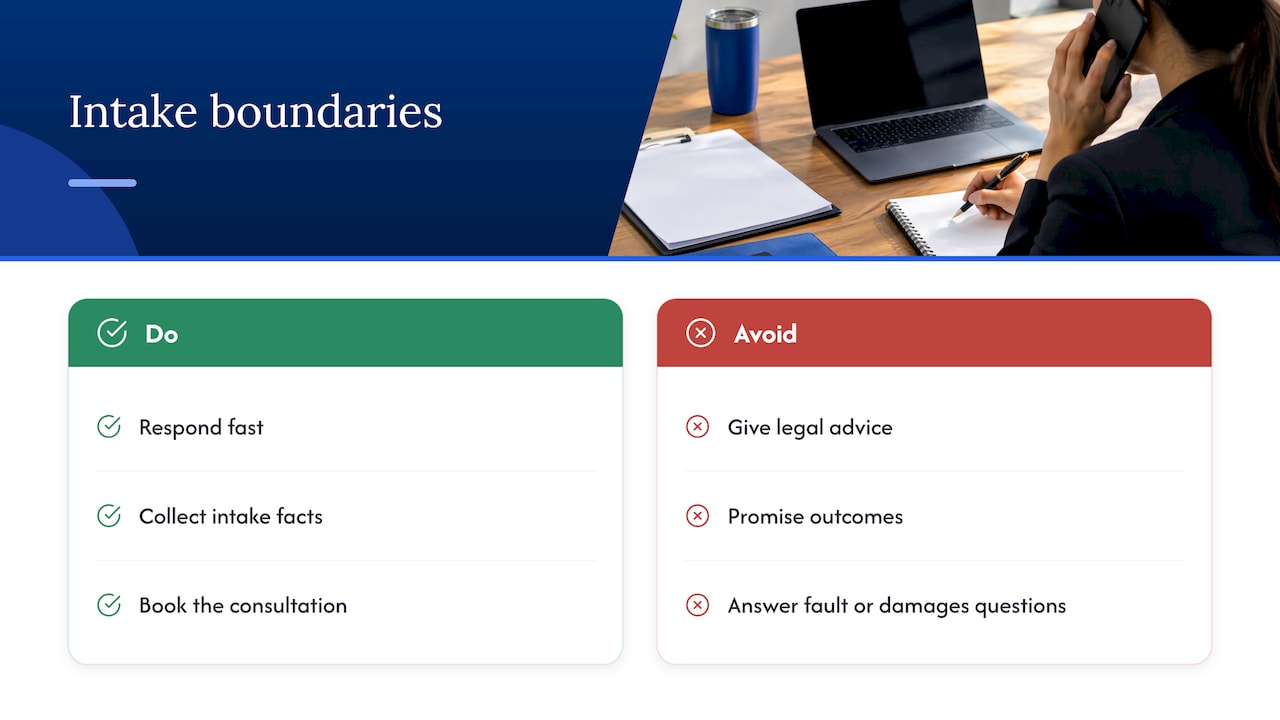
Intake conversations are sensitive. The person on the line may be hurt, stressed and talking to several firms. The AI’s job is to respond fast, collect the facts your intake team needs and book the consultation. It should not give legal advice, and it should not promise outcomes. Questions about fault, damages or what a claim is worth belong to your attorneys and intake staff, so those objections route straight to a person. Decisions about what the AI may say sit with your firm and your bar’s rules.
We run pay-per-signed-case acquisition for PI and MVA firms, where firms pay only for signed retainers, not leads, and our speed-to-lead and intake system for law firms covers the first response.
When a person should take over
Automation earns trust by knowing its limits. Set clear handoff rules:
- Negotiation. Any request to change price, terms or scope.
- Legal, contract or insurance-claim questions. Route immediately.
- Strong emotion. Anger, grief, fear or distress.
- Repeated confusion. Two failed clarifications in a row.
- High-value leads. A large commercial roof, a fleet account or a serious injury case deserves a human voice early.
The handoff should carry context. The person who calls back sees the transcript, the objection category and what was already promised. The lead should never have to repeat themselves.
Calls, texts and consent
Voice makes the rules tighter. In February 2024 the FCC ruled that AI-generated voices count as artificial voices under the Telephone Consumer Protection Act, which means outbound AI calls generally need the consent the law requires. Recording rules also vary by state, and some states require every party to agree to a recording. Your agent should announce itself appropriately and your consent language should be reviewed by your attorney. We build the workflows around your approved consent wording; legal sign-off on that wording stays with your counsel.
Connecting objection handling to your CRM and calendar
This is where most small businesses lose the value. An AI that answers well but leaves no trace gives you a nice conversation and no pipeline.
A clean setup does five things in your CRM:
- Tags the objection. Price, timing, trust, authority, competitor, opt-out. Keep the list short and stable so you can compare month to month.
- Moves the pipeline stage. “Not now” goes to a nurture stage with a date. “Booked” goes to scheduled. “Opt-out” goes to suppressed.
- Starts the right automation. A timing objection triggers a callback sequence. A trust objection triggers proof content.
- Creates a human task when the rules above are met.
- Books the appointment on the real calendar, checking availability so the lead is not double-booked.
If your CRM is GoHighLevel, this is exactly the pipelines-and-automations work in our CRM automation and GoHighLevel setup. Our AI appointment setter write-up explains how the booking side works, and our guide on sales AI integration practices goes deeper on connecting systems.
Revive old leads with objection handling
Your database already holds people who said “not now” months ago. That is a natural place for objection-aware AI: a reactivation message that references the earlier hesitation, answers it with approved facts and offers a time to talk. Our Reactivation AI is built for this, calling and texting past leads and booking the ones who respond.
How to measure whether it works
Track outcomes, not activity. A short scorecard:
- Reply-to-appointment rate. Of leads who respond, how many book?
- Booked-to-show rate. Do booked leads actually arrive?
- Results by objection type. Which buckets convert and which stall?
- Escalation rate. Too high means the answer library is thin. Near zero may mean the AI is handling things it should hand off.
- Time to first response. Seconds for the AI, versus hours for a busy office.
- Opt-out rate. A rising number signals messaging that is too pushy.
Review call transcripts weekly in the first month. Stale answers and missing objections show up quickly, and the library improves with each pass. You can estimate what faster response is worth with our new-lead AI setter ROI calculator.
Why done-for-you beats assembling it yourself
An objection-handling workflow touches the ad, the form, the voice agent, the text sequence, the CRM and the calendar. When different vendors own each piece, the gaps between them are where leads disappear, and nobody owns the result. One team building the whole chain means the objection you see in a transcript can change the ad, the script and the automation in the same week.
Put it to work with MediaBloom
MediaBloom is a Tampa, Florida digital marketing and AI agency. Since 2022 we have served 300+ businesses and hold a 4.8-star Google rating. We build the ads, the AI agents and the CRM, and our team books the appointments. Campaigns go live in days.
If your leads stall at “let me think about it,” start with our Speed to Lead AI: instant response, objection-aware follow-up and bookings straight to your calendar. For the full picture, see MediaBloom.

Our perspective
Most objection-handling advice is written for sales reps with a script and a quiet afternoon. Owners of law firms, roofing companies and agencies live in a different world: leads arrive at night, on weekends, mid-job, and the first reply decides who gets the appointment.
We think objection handling is a system problem, not a script problem. The answer matters, but so do the speed of the reply, the approved facts behind it, the handoff to a person and the CRM record afterward. Fix only one and the rest leaks.
That is why we build the whole chain: the ads that bring the lead, the AI that responds and handles the pushback, the GoHighLevel pipeline that tracks it, and the setters who book the appointment. One partner, one result to be accountable for.
For personal injury firms we apply the same logic to cases: you pay for signed retainers, not leads.
MediaBloom
FAQ
What are the basic steps of objection handling?
Listen to the full concern, acknowledge it, answer it with accurate facts, and confirm the answer landed. Then propose a next step. AI follows the same sequence, with added classification at the start and CRM logging at the end.
Can AI handle objections on a phone call?
Yes. An AI voice agent can take a call, recognize the objection, answer from approved material and book the appointment. Some tools only coach a human rep during a live call, so confirm which one you are getting. Complicated or emotional situations should transfer to a person.
Will AI say something wrong to my leads?
The risk comes from letting it answer without approved material. When the agent only uses facts you have signed off on, and routes anything uncertain to your team, wrong answers become rare and visible in the transcripts you review.
Which objections should stay with a human?
Price negotiation, legal or claim questions, contract terms, and any conversation where the lead is upset. For injury cases, anything touching fault or case value goes to your intake team or attorneys.
How fast can an AI objection-handling setup go live?
The time depends on your answer library, your CRM and your channels. We launch campaigns in days, and refine the objection answers as real conversations come in.
Sources
- FCC: AI-generated voices in robocalls are illegal under the TCPA
- How AI sales assistants handle objections and replies from prospects