
The best time to call a lead is within minutes of the lead raising a hand. For inbound leads (form fills, ad clicks, missed calls), the clock that matters is the one that starts when they submit. For cold lists, the data points to late morning and late afternoon in the prospect’s own time zone, on Tuesday through Thursday. In both cases, the call has to land inside the legal calling window, which for consumers is 8 a.m. to 9 p.m. local time at the number you dial.
That is the short version. The rest of this guide shows which windows have evidence behind them, which popular claims have not held up, and how to build a calling schedule that does not depend on a rep being at a desk. We built MediaBloom’s AI voice agents and Speed to Lead AI around this problem: the best slot is usually the one your team cannot staff.
TL;DR
- Inbound leads: call right away. Speed beats any time-of-day rule, and a fixed schedule is the wrong tool for someone who just asked to hear from you.
- Cold outreach: current datasets favor late morning (roughly 10 a.m. to noon) and mid to late afternoon (3 to 5 p.m.), Tuesday to Thursday, in the prospect’s local time.
- Legal floor for consumer numbers: no solicitation calls before 8 a.m. or after 9 p.m. at the called person’s location. Some states are stricter.
- Time zones are where teams get into trouble. Dial by the lead’s zone, not yours.
- Automated follow-up should space attempts across different times of day and switch channels, not repeat the same call at the same hour.
Table of Contents
- Two kinds of leads, two different answers
- Inbound leads: the best time is now
- What the data says about cold-call timing
- The legal window: when you may call
- Time zones: the mistake that costs the most
- Choosing times by business type
- Follow-up without overwhelming the lead
- Promo: let us run the calling for you
- Our perspective
- FAQ
- Sources
Two kinds of leads, two different answers
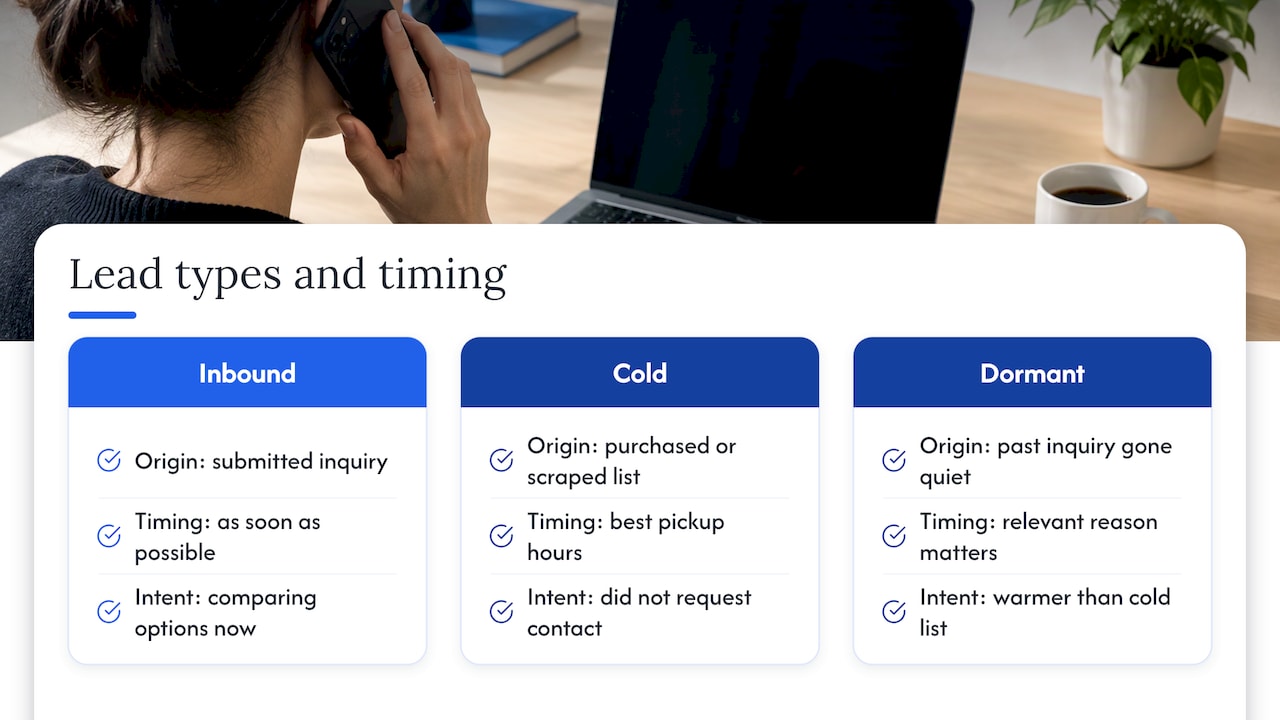
Most articles on this topic treat every phone number the same. They are not the same, and the right timing differs.
Inbound leads came to you. A homeowner filled out a roof inspection form. An accident victim clicked your ad. A driver requested an insurance quote. They are comparing options right now, probably on their phone, probably with two or three other businesses in the same tab. The best time to call is as soon as possible, at whatever hour they submitted, within legal limits.
Cold leads did not ask to hear from you. They come from a purchased list, a scraped database or an old outbound campaign. Here there is no moment of intent to catch, so you are looking for the hours when people are most likely to pick up.
Dormant leads sit between the two: people who inquired months ago and went quiet. They know your name, which makes them warmer than a cold list. Timing matters less than a relevant reason to call and a different channel from the one that failed before.
If you run a personal injury firm, a roofing company or an HVAC shop, nearly all of your paid-ad leads fall in the first group. That is why speed matters more to you than the afternoon-versus-morning debate.
Inbound leads: the best time is now
A lead who just submitted a form is as reachable as they will ever be. Every hour of delay lets a competitor, or a distraction, get there first. We have a full walkthrough on calculating the ROI of responding to every new lead in under a minute, which lets you put your own close rate and job value into the math rather than relying on a generic benchmark.
The practical problem is that leads do not arrive on office hours. Ads run in the evening. Storms and burst pipes happen on weekends. Accidents happen at night. A small team cannot call every one of those leads inside a minute.
There are three ways owners usually close that gap:
- Staff longer hours or a rotating after-hours rep. This works but is expensive and hard to sustain.
- Send an automatic text and let the lead wait for a callback. Better than silence, but the lead still waits.
- Have an AI voice agent call the lead as soon as the form is submitted, qualify them and book the appointment on your calendar. This is what our AI voice agents do, calling and texting 24/7, with the booking written back to your CRM.
For home services businesses specifically, see how AI speed-to-lead for home services is set up.
What the data says about cold-call timing
Cold-call timing studies disagree, and the disagreement is instructive.
One 2025 B2B cold-calling dataset reported that Wednesday was the best day, with a 0.95% positive-outcome rate against 0.51% on Friday, roughly 1.9 times better. By hour, it found late afternoon strongest (1.47% at 6 p.m., 1.05% to 1.22% between 3 and 4 p.m.), while the 9 to 11 a.m. window sat lower at 0.65% to 0.83%. A separate analysis of more than 300 million calls found the best success rates between 11 a.m. and noon and between 4 and 5 p.m. in the prospect’s local time. Both are summarized in this cold calling statistics roundup.
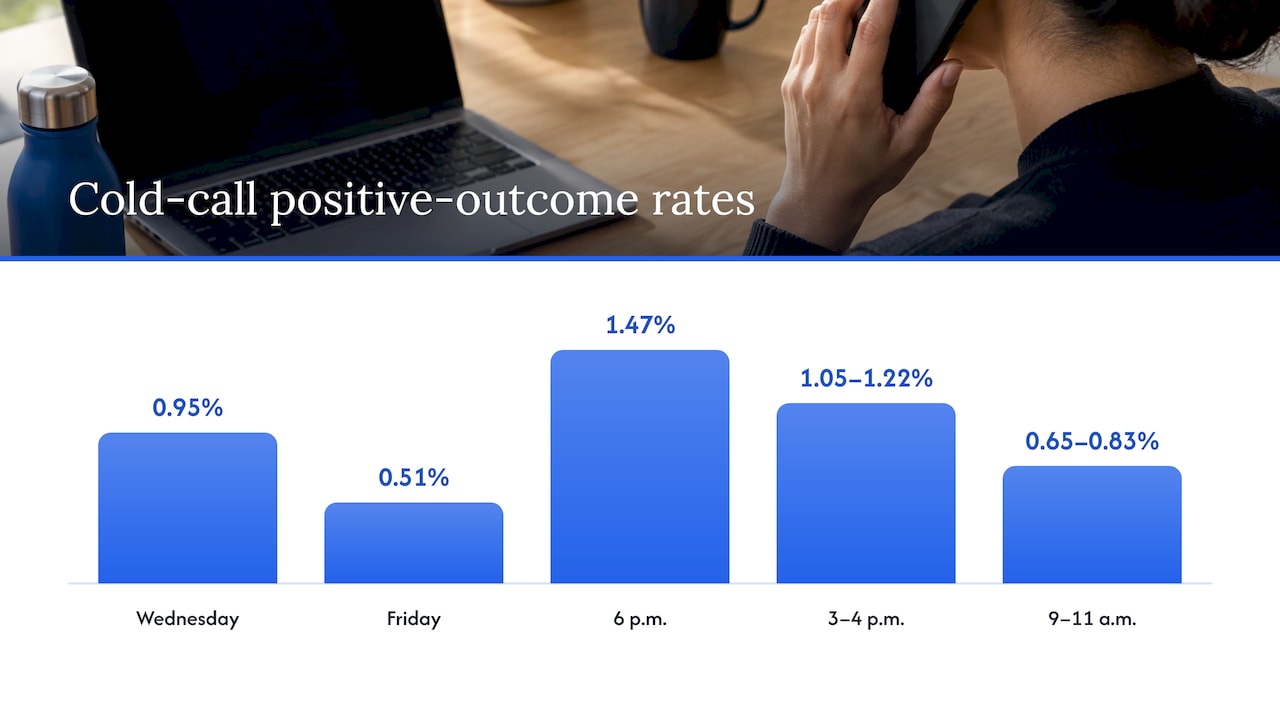
These datasets measure B2B outbound to business phones, so treat them as a starting point for your own testing, not a law of nature.
The 114% claim
You will often see that 4 to 6 p.m. is 114% better than mid-morning. That figure traces back to a 2007 study. A 2026 review of current cold-calling figures notes that today’s datasets do not support it as a universal rule: they put late morning at or near the top, and mid-week still beats Friday. Use the newer windows.
A working cold-call schedule
Pulling the overlap together, a sensible starting grid in the prospect’s local time:
| Window | Why it is worth a slot |
|---|---|
| 10 a.m. to noon | Late-morning strength shows up across several datasets |
| 3 to 5 p.m. | Strong afternoon results in both datasets above |
| Tuesday to Thursday | Mid-week beat Friday in the data |
| Early morning, lunch hour | Test last, with small volumes |
Then measure. Track connect rate and booked appointments by hour and weekday for your own list over a few weeks. Your industry, your lead source and your geography will shift the answer.
The legal window: when you may call
Timing advice means little if the call is not allowed. This part is general information, not legal advice. For your specific program, talk to your attorney or compliance adviser.
For consumer and mobile numbers, the federal calling window is 8 a.m. to 9 p.m. in the called person’s local time, per this TCPA calling hours guide. The guide also notes that state rules may set narrower windows. Our glossary page explains what the TCPA is in plain terms: the Telephone Consumer Protection Act, the federal law governing calls and texts to consumers.
State rules can be tighter. Maryland’s Stop the Spam Calls Act, effective January 1, 2024, bans solicitation calls between 8 p.m. and 8 a.m. in the called party’s time zone, caps calls at three per 24 hours on the same subject, and requires prior express written consent when an automated system dials or a recorded message is used, per TCPA.com’s Maryland summary. The same page reports a private right of action added April 25, 2024, with damages of the greater of $500 or actual damages, trebled for willful or knowing violations.
Two takeaways for a calling schedule:
- Build your windows around the strictest rule that applies to the number you are dialing, not the one in your home state.
- Business-to-business calls to a business line are treated more lightly than calls to consumers or personal mobile numbers, but a founder’s cell phone is both. Apply the consumer rules there.
Consent matters as much as the clock. Leads who filled out your form and agreed to be contacted are in a very different position from numbers on a purchased list. Before any dialing, it also pays to validate the phone number so you are not calling disconnected lines or landlines you meant to text.
Time zones: the mistake that costs the most
A team that starts dialing at 8:30 a.m. Eastern reaches the Pacific coast at 5:30 a.m. local. That is before the 8 a.m. federal limit, and a long way before a normal pickup hour.
The overlap that is safe across all four mainland time zones runs from 11 a.m. to 9 p.m. Eastern, unless your dialer holds each number until its own 8 a.m. That is the example from the same calling-hours guide cited above.
A simple routine:
- Store the lead’s time zone at capture, from the area code, ZIP code or the form’s address field.
- Tag every record with that zone in the CRM.
- Set call windows per zone, so a lead in Phoenix and a lead in Boston are each called inside their own good hours.
- Remember that area codes follow people who move. A ZIP code from the form is usually more reliable than the area code of a mobile number.
This is straightforward in a CRM that supports time-zone-aware automations. Our CRM automation and GoHighLevel setup covers building that logic into your pipelines so calls and texts only fire inside the right window.
Choosing times by business type
Personal injury and MVA law firms
Injury leads are urgent and emotional. Many come in the evening or overnight from ads, right after an accident or after a day dealing with insurers. The lead who submits at 9:40 p.m. wants a human-sounding response now, not a callback at 9 a.m. along with three other firms. Instant outreach followed by a scheduled call inside the legal window is the right structure. Our pay-per-signed-case model for PI and MVA firms is built around this: firms pay only for signed retainers, not leads.
Roofing, HVAC and home services
Homeowners often submit while at work or after dinner. Mornings before 8 a.m. are off limits for solicitation, and the lead’s phone may be on silent at midday. Respond immediately to any request, then retry at different parts of the day: late morning, early evening and a weekend slot if the first attempts miss.
Insurance agencies
Quote requests are often comparison shopping, so the first call wins disproportionately often. Renewal and cross-sell calls to existing customers do better when timed around their policy dates, not a generic hour. Our page on AI outbound calling for insurance agencies shows how outbound is structured for that use case.
B2B outbound
For business prospects, start with the late-morning and late-afternoon windows above and test. The cold outbound campaigns for B2B companies page lays out the approach, and our glossary entry covers what cold calling is if your team is new to it.
Follow-up without overwhelming the lead
A single call rarely connects. A barrage of calls annoys people and can break state frequency caps like the three-calls-in-24-hours limit in Maryland. The answer is a cadence that varies timing and channel.
A pattern that holds up for inbound leads:
- Minute zero: call, and text immediately if there is no answer.
- Same day: one more call at a different time of day, such as early evening.
- Next day: a call in the late-morning window and an email.
- Days 3 to 7: short, spaced attempts alternating call, text and email, each with a reason to respond (a quote ready, an open appointment slot).
- Stop rules: end the sequence when the lead books, replies, or asks not to be contacted, and honor opt-outs on every channel.
The principle is to spread attempts across different hours and days, because a lead who missed you at noon is often free at 6 p.m. This is a starting framework to adjust to your own results and to the rules where your leads live.
Doing this by hand across hundreds of leads is where follow-up leaks. Leads fall out of a pipeline stage, a rep forgets the second attempt, or a text goes out at 7 a.m. in another time zone. Automation fixes that when the sequence, the windows and the stop rules are built into the CRM.
Old leads deserve the same discipline. Our Reactivation AI reaches back into your existing database, calling and texting past inquiries and booking appointments from the ones who respond.
Promo: let us run the calling for you
We are a Tampa, Florida digital marketing and AI agency. We have worked with 300+ businesses since 2022 and hold a 4.8-star Google rating. Our approach is done-for-you: we build the ads, the AI agents and the CRM, and our team books appointments. For calling, that means AI voice agents and speed-to-lead follow-up that call, text and book 24/7, with the sequence and windows configured by us rather than left for your staff to maintain. See Speed to Lead AI to get started.

If your leads come from paid ads, our Ads Management service pairs the campaigns with the follow-up, so one partner covers lead generation, AI follow-up and CRM and nothing falls between vendors.
Our perspective
Most owners ask us for the best hour to call. We answer with a different question: how many of your leads get a call at all inside the first few minutes?
Timing studies on cold calls are useful for list work. But for a business running paid ads, the lead already told you the moment. A form fill at 9:40 p.m. is the best time to call, and no schedule built around office hours can honor that.
That is why we build the system rather than hand over software. The ad generates the lead, an AI voice agent calls and texts, the CRM holds the time zone and the stop rules, and appointments land on your calendar. Our team books the appointments, so nothing depends on someone remembering to follow up.
For personal injury firms, we take it one step further: you pay only for signed retainers, never for leads.
MediaBloom
FAQ
Is 8 a.m. a reasonable time to call someone?
For consumer numbers, 8 a.m. is the earliest federal limit, measured in the called person’s local time. It is legal but not always the best moment, and some states set stricter windows. Many teams start a little later and favor late morning.
What is the best day to call leads?
For cold B2B outreach, mid-week (Tuesday to Thursday) outperformed Friday in the datasets above. For inbound leads, the best day is the day they submit.
How many times should I call a lead?
There is no single number. Spread attempts across different times and channels over about a week, stop when the lead responds or opts out, and check state caps on call frequency such as Maryland’s limit of three calls in 24 hours on the same subject.
Can an AI voice agent call leads outside business hours?
An AI voice agent can call at any hour, but the legal windows still apply. The calling hours rules cover the time of day at the lead’s location, so scheduling by time zone is part of the setup. Consent requirements for automated calls are also stricter in some states, so confirm your program with your attorney.
Sources
- Cold calling statistics roundup
- Cold calling statistics 2026: 50 figures with their sources
- TCPA cold calling rules and calling hours guide
- Maryland telemarketing and robocall laws