AI appointment-setting can cut cost-per-booked-call 3 to 10x versus human SDRs and pay back in 30 to 60 days, but only when three conditions hold: a validated offer, a human-tested script, and a closer team that actually converts booked calls. Skip any one of those and the same technology stalls out. One 15-day reactivation test turned $457 in AI spend into 22 booked calls at roughly $20 per booking, which closed $6,800 in revenue.
The three conditions matter because AI amplifies whatever process it’s plugged into:
- Validated offer — the product or service already converts when a human sells it.
- Proven script — qualification logic has been tested on real calls before automation.
- Converting closer — someone on the other end can actually turn a booked call into revenue.
Key Takeaways
| Point | Details |
|---|---|
| Three conditions gate ROI | A validated offer, a human-tested script, and a converting closer must all be in place first. |
| Real numbers exist | A 15-day reactivation test turned $457 into $6,800 in closed revenue, a 14.9x return. |
| Speed beats almost everything | Responding within 5 minutes instead of 30 raises qualifying odds by roughly 21x. |
| Cost gap is wide | AI cost-per-booked-call runs $15–$50 versus $100–$300 for human SDRs. |
| Pilot small, review weekly | Test 200–500 leads over 30–60 days with weekly transcript reviews before scaling. |
| MediaBloom fits the framework | Its omnichannel platform and 600+ CRM integrations are built to meet all three success conditions with done-for-you onboarding. |
Table of Contents
- AI Customer Service ROI Examples From Real Deployments
- How Do You Calculate AI Customer Service ROI?
- When Does AI Appointment Setting Actually Pay Off?
- What Does a 6-Week AI Setter Pilot Look Like?
- How MediaBloom Applies This ROI Framework
- AI Customer Service ROI Versus Traditional Methods
- Case Studies by Industry and Company Size
- Connecting AI Setters to Your CRM and Sales Stack
- What the Data Actually Tells Revenue Leaders
- See Your Potential ROI Before You Commit
- Sources
- FAQ
AI Customer Service ROI Examples From Real Deployments
Numbers travel better than promises, so start with three that hold up under scrutiny.
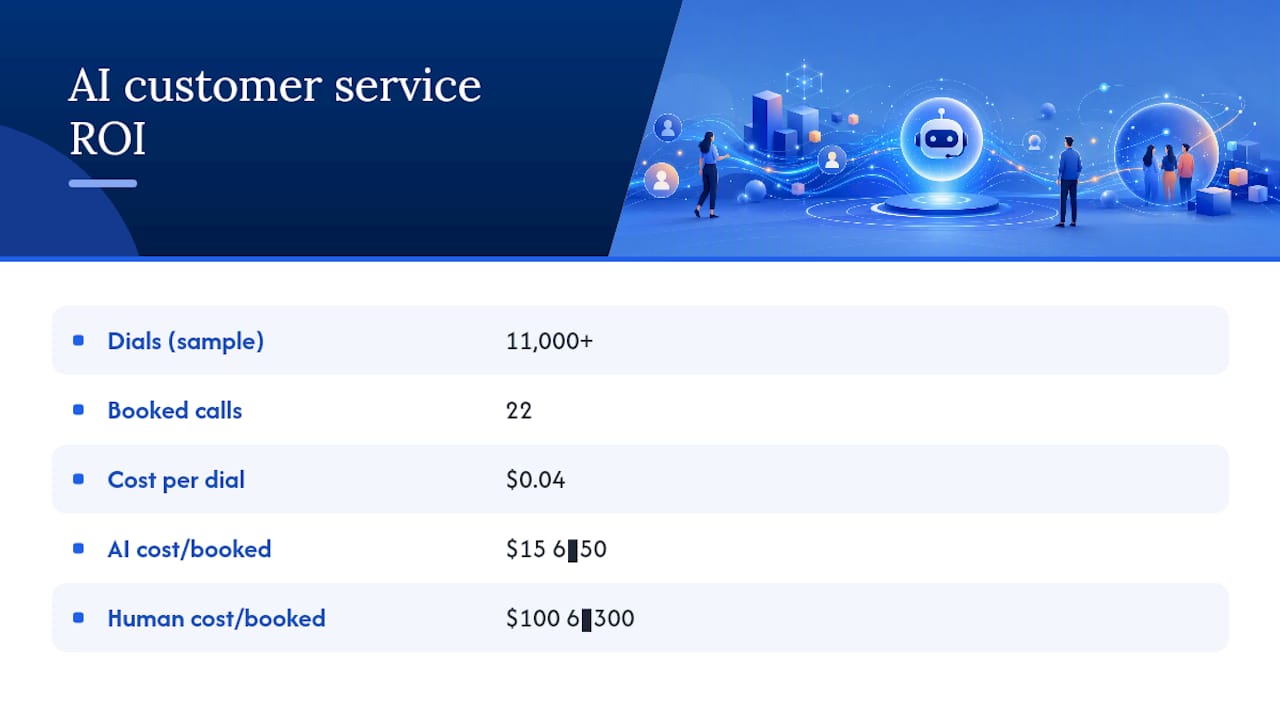
The BeaverMind reactivation case is the clearest example available: a dormant lead list got 11,000+ AI-driven dials over 15 days, producing 542 connections and 22 booked calls at an average cost of $0.04 per dial. Two of those bookings closed for a combined $6,800, against the AI spend, yielding a strong ROI on a campaign that ran for two weeks with no new lead acquisition cost. The blueprint applies directly to any business sitting on a CRM full of contacts who went cold.
Industry data backs the pattern at scale; learn more about the rise of generative AI in customer service and its impacts in the broader industry here. Speed is the biggest lever most companies underuse: contacting a lead within 5 minutes instead of 30 minutes raises the odds of qualifying that lead by roughly 21x, according to InsideSales/LRM research cited by industry benchmarks. Yet the average company takes about 42 hours to respond to a web lead, per Harvard Business Review data in that same report. AI setters close that gap because they respond in seconds, not days. Reactivation campaigns specifically book a small single-digit percentage of contacted dormant leads, with top-performing lists achieving higher rates.
Scenario modeling from a side-by-side ROI framework puts AI cost-per-booked-call between $15 and $50, compared with $100 to $300 for human SDRs handling the same qualification work. A voice bot deployment guide recommends piloting 200 to 500 leads with 30 to 60 days of optimization, and reports connect rates around 11.47% in strong deployments. None of these figures are outliers. They’re what you should expect when the three conditions above are already in place.
How Do You Calculate AI Customer Service ROI?
The math isn’t complicated, but it requires honest inputs. Before you model anything, gather these numbers:
- Monthly lead volume — how many leads currently enter your pipeline each month.
- Current response time and cost-per-booked-call — what a human SDR or your current process costs you today, fully loaded (median SDR on-target earnings run around $80,000, per Bridge Group data).
- Average sale price (ASP) — your typical deal value once a booked call closes.
- Expected conversion uplift — a conservative estimate of how much faster response and better qualification improves booking rates.
- AI platform and usage fees — monthly subscription plus per-minute or per-message costs, plus one-time setup amortized over the pilot period.
From there: incremental bookings = (uplift % × monthly leads) minus your baseline. Incremental revenue = incremental bookings × ASP × close rate. Payback period = one-time setup cost ÷ monthly net gain. Twelve-month ROI = (annual incremental revenue minus annual AI cost) ÷ annual AI cost.
At 200 leads a month with a modest uplift, most small businesses recover setup costs inside two months. At 1,000 leads, the platform economics improve because fixed platform fees get spread across more bookings, pushing cost-per-call toward the lower end of the range.
When Does AI Appointment Setting Actually Pay Off?
The three conditions from the opening aren’t boilerplate. Each one has a specific failure mode. A validated offer means people already say yes to it on a human-led call; automating an unproven pitch just automates rejection faster. A proven script means the qualification logic (BANT or a similar framework) has already worked on real conversations. A converting closer means your team can turn a booked call into revenue. Without one, AI just moves the bottleneck upstream.
High-fit scenarios include inbound-heavy businesses, home services, real estate, and SaaS demo requests. AI setters excel at inbound qualification, SMS-first scheduling, and after-hours coverage, but they struggle with complex, multi-stakeholder enterprise sales where trust-building takes weeks, not minutes. High-trust medical and legal categories also need more human touch before automation makes sense.
Watch for these red flags before you pilot anything:
- A CRM with duplicate or outdated records.
- Fewer than 50 leads per month (platform fees rarely pencil out below that).
- No calendar integration for real-time booking.
- No clear escalation path when a lead asks something the AI can’t answer.
Pro Tip: Run 50 to 100 leads through your proposed script manually first. If a human closer can’t convert them at an acceptable rate, no amount of automation will fix the underlying offer problem.
What Does a 6-Week AI Setter Pilot Look Like?
A structured pilot removes most of the guesswork. Here’s the sequence that keeps a rollout on schedule:
- Weeks 1 to 2: Validate the script on 200 to 500 leads with human oversight before full automation. Confirm the offer converts at the rate you expect.
- Week 2: Wire sub-60-second speed-to-lead webhooks, connect calendar booking, and set up CRM tag routing for booked, interested-no-book, and no-fit outcomes.
- Weeks 3 to 4: Launch the full pilot. Track connect rate, cost per booked call, show rate, and payback progress weekly.
- Weeks 5 to 6: Review call transcripts, run A/B tests on script variations, and tighten qualification questions based on what’s actually converting.
The optimization loop doesn’t stop at week six. Weekly transcript reviews catch drop-off points a dashboard alone won’t show, and small script tweaks compound over a quarter.
Pro Tip: Assign one person to own the weekly transcript review. Pilots that treat optimization as a shared responsibility usually see it done by nobody.
How MediaBloom Applies This ROI Framework
MediaBloom’s platform is built around the same conditions this framework demands: omnichannel voice and chat, 600+ CRM integrations, rapid response deployment, and compliance readiness for regulated industries including TCPA and HIPAA-adjacent use cases. Clients including Miracle Ear and 1-800 Accountant have used the platform to generate over 10,000 monthly leads combined, with done-for-you onboarding replacing the manual setup most teams underestimate.
- Omnichannel coverage across voice, SMS, email, and chat from a single chatbot automation layer.
- Sub-minute response times built to capture the speed-to-lead advantage this article covers.
- Pre-built CRM routing so booked, interested, and no-fit leads land in the right pipeline stage automatically.
- Compliance-ready infrastructure for insurance, healthcare, and financial services verticals.
A platform meets the three success conditions when the offer, the script, and the closing team are already validated. MediaBloom’s role is removing the technical friction between that validated process and full automation, not replacing the validation itself.
Typical pilot timelines mirror the 6-week framework above, with most clients seeing measurable KPI movement inside the first 30 days.
AI Customer Service ROI Versus Traditional Methods
Traditional SDR teams remain the default for many mid-market companies, and for good reason: a trained human handles nuance and objection-handling that automation still can’t fully replicate. But the cost structure tells a different story once volume enters the picture. Fully-loaded SDR compensation averages around $80,000 a year, which puts human cost-per-booked-call in the $100 to $300 range.
The gap widens with response time. A human SDR working a normal schedule can’t match an AI system that responds in under a minute, any hour, any day.
Traditional methods still win in categories requiring deep relationship-building or complex, multi-touch enterprise negotiation. AI doesn’t replace a skilled closer. It replaces the manual triage work that keeps skilled closers from spending time on leads that were never going to convert. The strongest setups blend both: AI handles inbound qualification and after-hours coverage, while humans focus on qualified conversations that are already warm.
For companies evaluating sales team efficiency gains from AI, the realistic comparison isn’t AI versus humans. It’s AI-assisted triage versus a fully manual funnel that leaks leads every hour a lead sits unanswered.
Case Studies by Industry and Company Size
ROI patterns shift depending on vertical and scale, and lumping every business into one benchmark misleads more than it helps.
Small businesses with 200 to 300 monthly leads (home services, local healthcare practices, boutique agencies) see the fastest relative payback because setup costs amortize quickly against a lean existing process. These businesses often have no dedicated SDR at all, so the comparison isn’t AI versus human. It’s AI versus no qualification system whatsoever.
Mid-market companies running 1,000 or more leads a month, particularly in SaaS and B2B services, see the largest absolute revenue impact because incremental booking gains multiply across a larger base. A SaaS company converting even a modest uplift in demo bookings at scale sees real revenue movement inside a single quarter.
Insurance agencies and real estate brokerages sit in a distinct category: high lead volume, time-sensitive inquiries, and a strong fit for after-hours automation since buyers often browse and inquire outside business hours. Complex enterprise sales, by contrast, rarely show clean ROI from automation alone. The sales cycle involves too many stakeholders for a script, however proven, to carry the full qualification load.
Connecting AI Setters to Your CRM and Sales Stack
Integration quality determines whether any of the numbers above actually materialize. A well-modeled ROI framework means nothing if booked calls don’t land on a closer’s calendar or if lead status doesn’t sync back to the CRM in real time.
Start with tag-based routing: every AI-qualified lead should carry a status (booked, interested-no-book, no-fit) that syncs automatically so no one wastes time re-qualifying a lead the AI already scored. Calendar integration needs to be two-way. If a prospect books a slot through the AI system and that slot doesn’t block on the closer’s calendar instantly, double-booking erodes trust fast.
Webhook speed matters more than most teams realize. The 21x qualification lift from fast response only holds if the technical wiring between lead capture and AI outreach actually fires in seconds, not minutes. A discovery call script that’s already validated with human reps translates directly into the AI’s qualification logic, so that step shouldn’t be skipped even when the integration itself is straightforward.
Most platforms with 600+ pre-built CRM connections handle the common stacks (Salesforce, HubSpot, Zoho) without custom development. The harder integration work is usually process, not code: deciding who owns escalations, what counts as “qualified,” and how fast a human needs to step in when the AI hits a question it can’t answer.
What the Data Actually Tells Revenue Leaders
Most advice on AI appointment setting treats the technology as the variable that matters most. It isn’t. A validated offer times AI equals faster growth. An unproven offer times AI equals faster, cheaper failure.
The conventional pitch oversells the “set it and forget it” angle. Every credible case study involves weekly transcript review, script iteration, and a human closer ready to convert what the AI books. Skip that maintenance loop and performance decays within a month.
If you’re evaluating this now, prioritize the script validation step before anything else. Test it on 50 to 100 leads manually. If a human can’t close at an acceptable rate using that exact script, automating it only accelerates the wrong outcome. Get the offer and script right first. The technology is the easy part.
See Your Potential ROI Before You Commit
Mediabloom removes the two biggest cost centers in appointment-setting automation: building integrations from scratch and staffing a team to manage them. Where a typical AI vendor hands you a dashboard and leaves the CRM wiring to your IT team, Mediabloom’s done-for-you onboarding connects voice, chat, SMS, and email into one system with 600+ CRM integrations already built.

A typical pilot runs on the same 6-week timeline outlined above, with platform access, setup, and initial script validation included in onboarding. Clients like Miracle Ear and 1-800 Accountant have used this exact framework to scale past 10,000 monthly leads without adding headcount. Early KPI movement (connect rate, cost per booked call, show rate) is usually visible inside the first 30 days, matching the payback windows referenced throughout this guide.
Review the detailed case study results from a recent deployment, browse the full case study library for examples closer to your industry, or reach out through the contact page to scope a pilot sized to your monthly lead volume.
Sources
- AI Appointment Setters: Do They Actually Work? (2026 Review) | Lead Systems Go Blog
- AI Appointment Setting Statistics 2026: 20+ Verified Numbers on Speed, Show Rates and SDR Economics - Leads Now AI
- Voice Bots for Lead Qualification: ROI Framework | Kyzo AI Blog
FAQ
How Fast Can I See ROI From an AI Appointment Setter?
Most well-configured pilots show measurable payback within 30 to 60 days, assuming the offer and script are already validated.
What’s a Realistic Cost-per-Booked-Call for AI Versus Human SDRs?
AI systems typically run $15 to $50 per booked call, compared with $100 to $300 for human SDRs doing the same qualification work.
How Many Leads Do I Need for AI Appointment Setting to Make Sense?
Below roughly 50 leads a month, platform fees rarely pencil out. Most credible pilots start with 200 to 500 leads over a 30 to 60 day window.
Does MediaBloom Handle the CRM Integration Work?
Yes. MediaBloom includes done-for-you onboarding with 600+ pre-built CRM integrations, so most common sales stacks connect without custom development.
What Happens if My Offer or Script Isn’t Validated Yet?
Automating an unproven offer or script accelerates failure rather than success. Test it manually on 50 to 100 leads with a human closer before adding automation.