Yes, a WhatsApp chatbot can drive real sales when it is built for qualification and conversion, not just replies. Businesses running WhatsApp against a structured flow see faster lead-to-conversation rates and shorter sales cycles than email or web forms deliver. The fastest path combines a tight qualification sequence, CRM sync, built-in conversion triggers like booking or payment links, and a clean handoff to a human rep at the right moment, as detailed in how to automate lead generation for insurance agents. MediaBloom builds this exact stack as a managed deployment, so teams skip the trial-and-error phase entirely.
TL;DR:
- WhatsApp chatbots with structured qualification flows can significantly shorten sales cycles and improve lead conversion compared to email or web forms.
- Keeping qualification questions to five or fewer and providing structured handoff summaries to reps enhances conversion rates and responsiveness.
- Deployment methods vary from DIY API integration to managed services, with pilot projects taking around two to four weeks and full-scale integrations lasting several months.
- High performance depends on personalization, timely escalation, and clear KPIs like qualification completion and time-to-reply, with 98% open rates and 67% resolution rates being typical benchmarks.
- Costs include Meta’s message fees, platform subscriptions, and development or managed service fees, with returns justified by even modest increases in qualified leads on high-value deals.
Table of Contents
- What Does a WhatsApp Sales Chatbot Actually Do?
- Where the Chatbot Fits in Your Sales Funnel
- Cloud API, BSPs, or a Managed Platform: Which Setup Fits?
- Best Practices for Flows, Personalization, and Handoff
- What KPIs Should You Track, and What’s a Good Benchmark?
- How Long Does Setup Take, and What Does It Cost?
- How MediaBloom Implements WhatsApp Chatbots for Sales Teams
- The Pilot Mistakes That Cost Teams the Most Time
- Sources
- FAQ
What Does a WhatsApp Sales Chatbot Actually Do?
A basic auto-reply answers “are you open?” A real sales chatbot runs multi-step conversations that capture variables, branch based on answers, and route the lead toward a rep or a booking link. That distinction is the whole ballgame for sales teams evaluating chatbot integration for sales.
The primary use cases sales teams deploy against WhatsApp include:
- Lead capture from ads, QR codes, or website widgets that route straight into a qualification sequence.
- Abandoned-cart recovery for e-commerce, sending a nudge with a direct checkout link.
- Appointment booking that checks availability and confirms a slot without a rep touching the calendar.
- B2B lead nurturing, where the bot scores intent over several messages before flagging a rep.
The upside shows up in the numbers. WhatsApp business messages see roughly 98% open rates, and chatbots on the platform resolve about 67% of customer queries without a human ever stepping in. That combination, high visibility plus automated resolution, is why WhatsApp sales automation outperforms channels where messages sit unread for days.
Where the Chatbot Fits in Your Sales Funnel
A WhatsApp sales chatbot should own specific funnel stages, not attempt to close every deal solo. The structure that works follows five stages, mirroring the 24/7 funnel model most implementation guides recommend:
- Entry — the bot greets, confirms intent, and captures the initial context (ad source, product interest).
- Qualification — four to five questions max, using quick-reply buttons instead of open text wherever possible.
- Nurture — for leads not ready to buy, the bot shares relevant content or answers objections on a delay.
- Conversion trigger — a booking link, payment link, or “talk to sales” button fires once intent crosses a threshold.
- Post-sale — automated onboarding messages, receipts, or upsell sequences.
Handoff mechanics matter more than most teams assume. When a bot escalates, it needs to send the rep a structured summary: qualification answers, an intent score, and the last two or three actions the lead took. A bare notification saying “new lead” forces the rep to dig through chat history and kills momentum.
Pro Tip: Cap qualification at five questions. Every question beyond that drops completion rates, and the fifth answer rarely changes how a rep prioritizes the lead anyway.
Cloud API, BSPs, or a Managed Platform: Which Setup Fits?
Three paths lead to a working WhatsApp sales chatbot, and the right one depends on your team’s technical bandwidth and how fast you need results.
- Developer route (WhatsApp Cloud API): Full control over flows and data, but you handle webhooks, token management, and template approvals yourself. Expect a genuine engineering commitment and a slower first launch.
- BSPs and inbox platforms: Business Solution Providers offer visual flow builders and shared inboxes, which shrinks build time and gives non-technical staff the ability to edit conversations. CRM connectors here are usually pre-built, which shortens the path to a working automated WhatsApp sales pipeline.
- Managed service: A provider like MediaBloom handles setup, ongoing flow optimization, and compliance groundwork (TCPA considerations, data handling), while your team focuses on scripts and offers instead of infrastructure.
Meta’s own Business Agent feature now lets eligible businesses deploy AI agents directly on WhatsApp to respond around the clock and gather customer information, which signals where the platform itself is heading. Availability is still limited to select markets, so check eligibility before building a roadmap around it, per WhatsApp’s own documentation on setup and data controls.
Best Practices for Flows, Personalization, and Handoff
Automation that feels robotic loses leads before qualification even finishes. The fix is not more features. It’s better conversation design.
Personalization starts with what the bot already knows. Pull in CRM history so returning leads aren’t asked questions you already have answers to, and keep message copy conversational rather than form-like. A bot that writes “What’s your budget range?” in five words converts better than one that opens with a paragraph of context before asking anything.
Handoff quality decides whether a qualified lead actually converts once a human takes over. A structured summary, covering qualification answers, an intent score, and the lead’s recent triggers, lets a rep engage in seconds instead of scrolling through a transcript. That single change is often the difference between a rep replying in two minutes versus twenty.
- Capture first name, use case, and timeline as variables early, then reference them later in the flow.
- Route by intent score: high-intent leads go straight to a rep; lower-intent leads stay in a nurture sequence.
- Set a reply SLA for reps once a handoff fires, ideally under five minutes during business hours.
- Let the bot continue handling FAQs and objections even after a rep is looped in, so nothing stalls.
Pro Tip: Introduce the human touch at peak engagement, right after a lead has answered two or three questions enthusiastically. Waiting too long to hand off lets interest cool; handing off too early wastes a rep’s time on someone still browsing.
Timing the escalation is its own skill. A bot should keep the conversation going through objections and FAQs, but the moment a lead asks about pricing specifics, contract terms, or requests a callback, that’s a clear signal to summon a person rather than let a script fumble it.

What KPIs Should You Track, and What’s a Good Benchmark?
Sales teams running WhatsApp automation need to watch a small set of numbers, not a dashboard full of vanity metrics. The ones that actually predict revenue impact:
| KPI | What it measures | Reference benchmark |
|---|---|---|
| Opt-in rate | % of contacts who agree to WhatsApp messaging | Varies by acquisition channel |
| Qualification completion | % who finish the full Q&A sequence | Higher with 4–5 questions vs. longer flows |
| Handoff-to-meeting conversion | % of escalated leads who book | Improves with structured handoff payloads |
| Time-to-first-human-reply | Minutes from handoff to rep response | Under 5 minutes recommended |
| Cost per interaction | Messaging + platform cost per conversation | Tracked against deal value |
WhatsApp’s baseline numbers give you a reference point: 98% open rates and 67% automated query resolution set the ceiling for what’s achievable. For e-commerce specifically, WhatsApp campaigns have shown abandoned cart recovery rates of 15% to 28%, well above typical email recovery rates. Instrument your CRM to tag every WhatsApp-sourced lead with a source field so pipeline attribution doesn’t get lost once the lead moves into your regular sales stages.
How Long Does Setup Take, and What Does It Cost?
A pilot WhatsApp sales chatbot, one campaign, one qualification flow, basic CRM sync, typically launches in two to four weeks. Enterprise rollouts with full CRM integration, multiple flows, and AI-driven qualification usually run several months, largely because template approvals and integration testing take longer at scale.
Budget for three cost components:
- Meta’s per-message fees, which vary by conversation category and region.
- BSP or platform fees, usually a monthly subscription tied to message volume or seat count.
- Development or managed service fees, covering flow design, integration work, and ongoing optimization.
A simple ROI model keeps the math honest: multiply your conversion lift by average deal value, then subtract implementation and messaging costs. If a chatbot lifts qualified-lead conversion by even a few percentage points on a $5,000 average deal, the messaging fees are a rounding error against the extra revenue.
How MediaBloom Implements WhatsApp Chatbots for Sales Teams
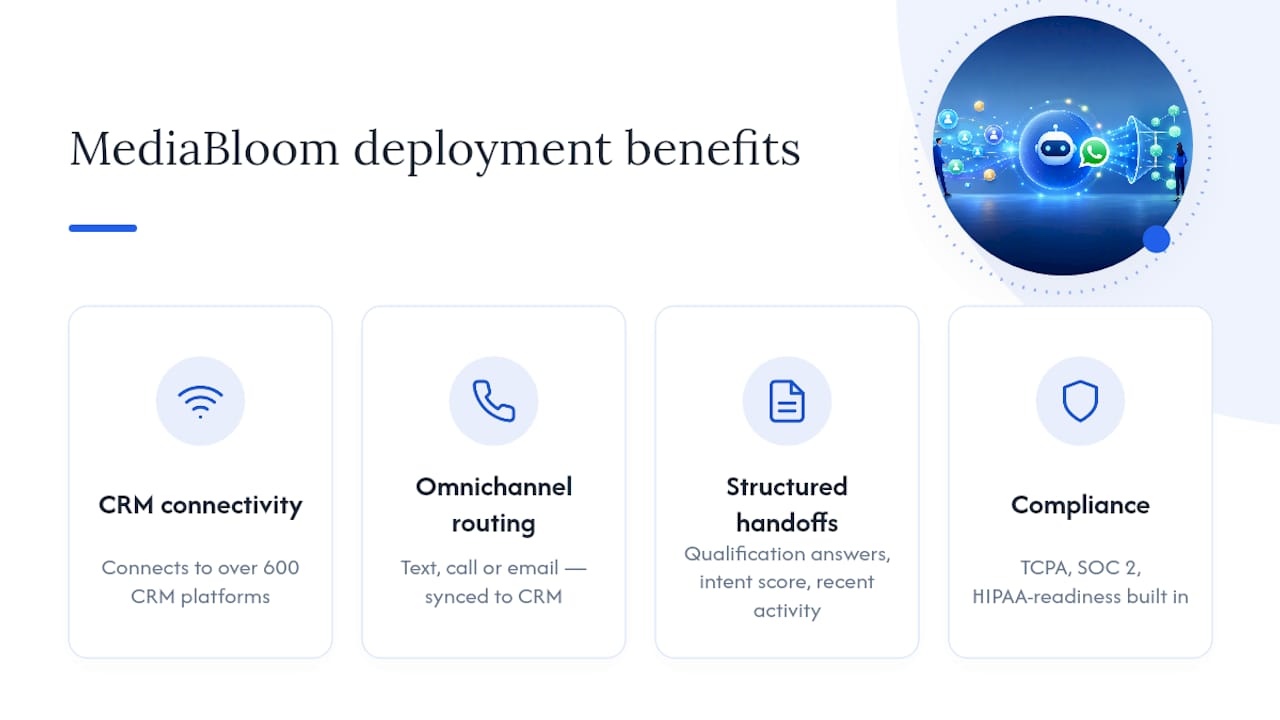
Building a WhatsApp sales chatbot in-house means juggling Cloud API tokens, CRM mapping, and message template approvals while still running your actual sales operation. MediaBloom removes that tradeoff entirely: our chatbot platform deploys alongside AI voice agents and multi-channel automation, so leads get qualified and routed whether they text, call, or email, all synced to the same CRM record.
MediaBloom connects to over 600 CRM platforms, which means your reps get structured handoff payloads (qualification answers, intent score, recent activity) inside the tools they already use, not a separate inbox to check. Compliance groundwork, TCPA, SOC 2, HIPAA-readiness where applicable, comes built into the deployment rather than bolted on after launch. Clients like Miracle Ear and 1-800 Accountant have used this same infrastructure to generate over 10,000 monthly leads. If your sales process involves B2B lead qualification specifically, the B2B lead generation chatbot build handles multi-question qualification and appointment booking out of the box.
See how this plays out in practice in the Fifth Avenue Leads case study, or browse the full library of case studies to see results across industries. Ready to see it running against your own funnel? Get in touch to scope a pilot.
The Pilot Mistakes That Cost Teams the Most Time
Most WhatsApp chatbot pilots fail for the same three reasons: sloppy opt-in governance that gets numbers flagged, handoff payloads that dump raw chat logs on reps instead of a clean summary, and qualification flows stretched to ten or twelve questions because someone wanted “just one more data point.”
Run your first pilot narrow. One campaign, three to five qualification questions, clean CRM field mapping, and a defined reply SLA for reps. Content, the actual message copy and question sequencing, is usually the bottleneck, not the underlying technology. Test one flow for two to four weeks, watch where leads drop off, and rewrite before you scale to a second campaign.
— MediaBloom
Sources
- WhatsApp Business statistics 2026 — SearchLab
- About using Meta Business Agent to chat with customers — WhatsApp Help Center
FAQ
Can I use a chatbot for WhatsApp Business?
Yes. WhatsApp Business supports automated flows through the Cloud API, BSP platforms, or Meta’s own Business Agent feature, and businesses commonly use these to handle lead capture, FAQs, and booking around the clock.
Which AI chatbot is best for sales?
The best option depends on whether you need a DIY build or a managed deployment. For B2B teams that want qualification, CRM sync, and human handoff without building the stack themselves, a managed platform like MediaBloom’s chatbot solution handles the full pipeline.
How do I use WhatsApp for sales?
Start by capturing leads through ads, QR codes, or your website, then run them through a short qualification sequence with quick-reply buttons before triggering a booking link or human handoff. Keeping the flow to four or five questions preserves completion rates.
How much does a WhatsApp chatbot cost?
Costs break into three parts: Meta’s per-message fees, BSP or platform subscription fees, and development or managed service fees for setup and optimization. A pilot deployment typically takes two to four weeks, while enterprise rollouts with full CRM integration run three to six months.