
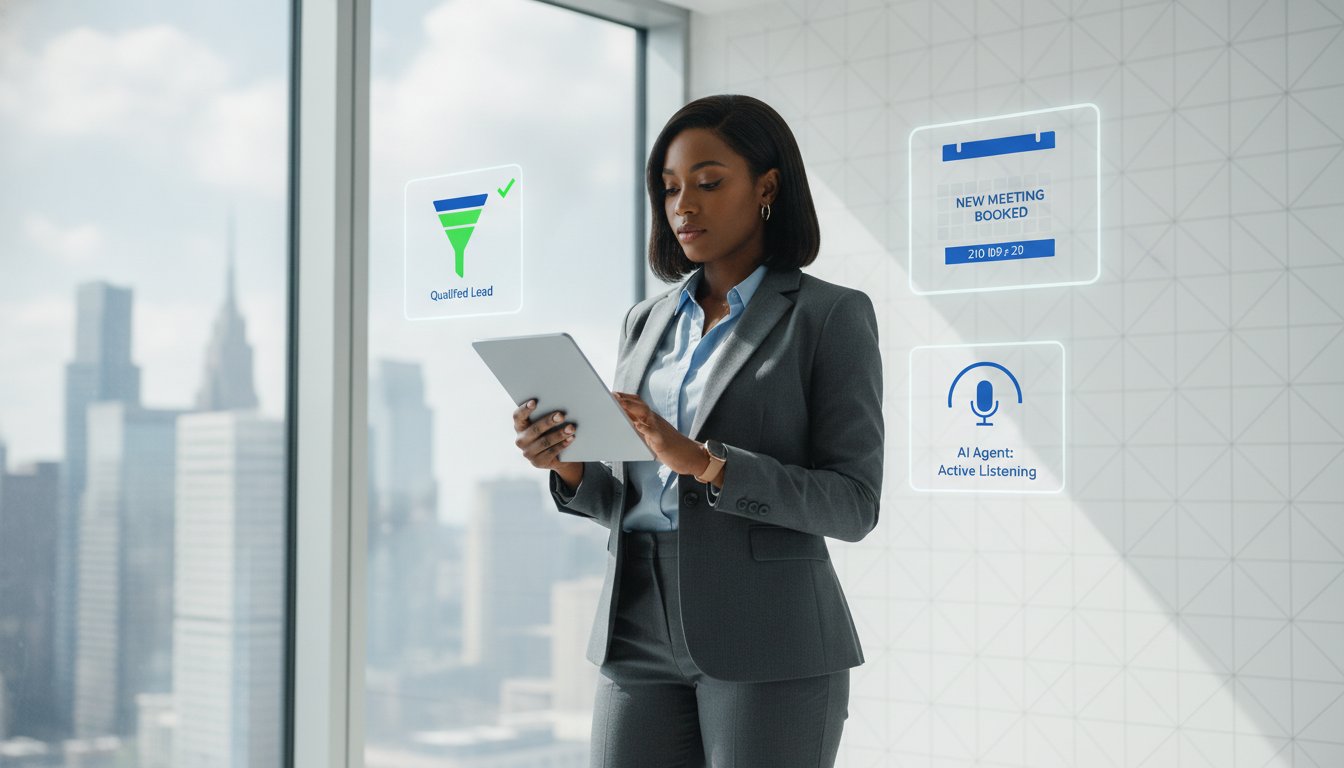
What if your most productive sales rep never slept, never requested a commission hike, and qualified every lead within seconds of their inquiry? For many firms, the traditional human sales model is reaching a breaking point. You're likely battling high SDR turnover and watching valuable leads go cold every weekend while your team recovers. It's an inefficient architecture that limits your growth. Deploying an AI sales agent for small business isn't just a tech upgrade; it's a strategic move to secure a 24/7 revenue engine. According to a 2026 Salesforce report, 87% of sales organizations have already integrated AI to solve these exact operational bottlenecks.
We agree that your time is better spent closing high-value deals than chasing unresponsive prospects or fixing CRM data entry errors. This guide provides the blueprint to deploy a custom AI workforce that qualifies leads, books meetings, and manages your systems with human-parity precision. We'll explore the shift toward autonomous agents and the specific 2026 regulatory requirements, such as the California and Texas AI laws, that you must navigate to build a predictable, scalable revenue machine.
Key Takeaways
- Understand the evolution from basic chatbots to autonomous agentic systems that plan and execute complex revenue tasks independently.
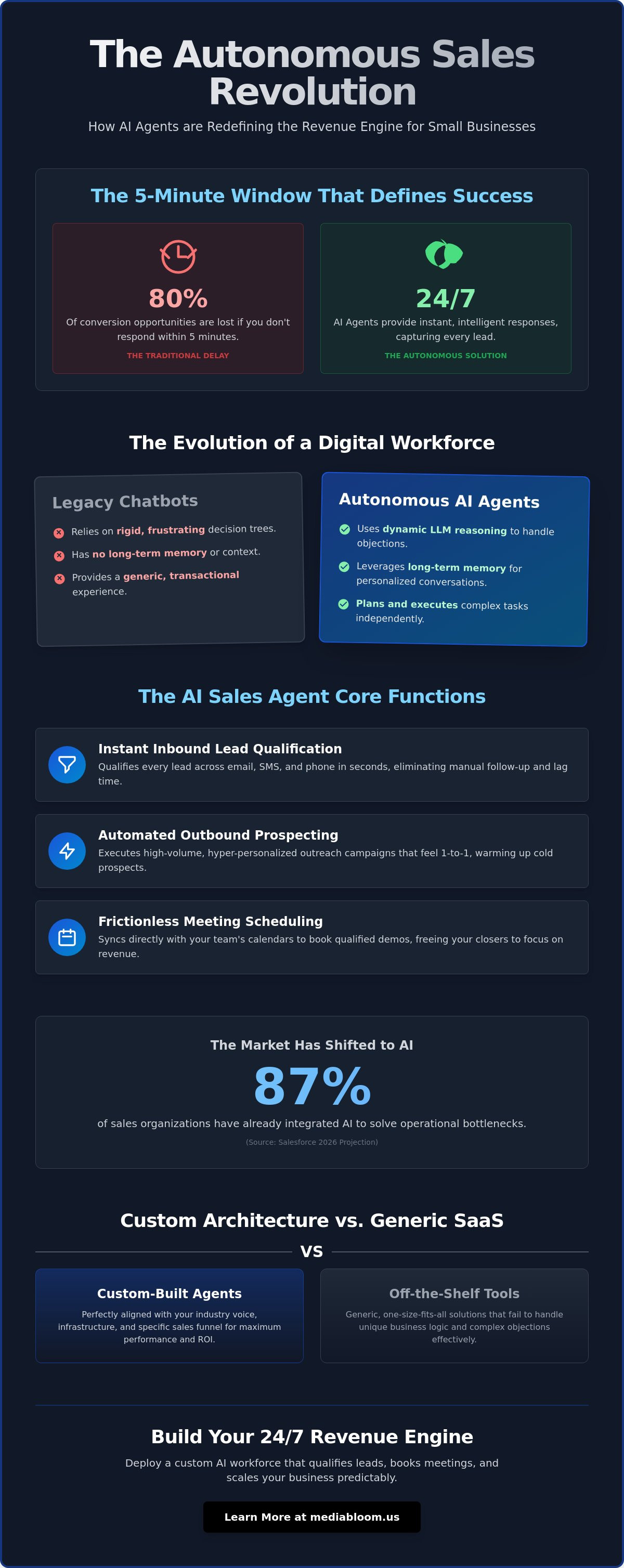
- Deploying an AI sales agent for small business ensures immediate response times, eliminating the critical 5-minute lead decay that kills 80% of conversion opportunities.
- Learn how custom voice and chat architectures utilize low-latency reasoning and emotional intelligence to manage human-parity interactions across email, SMS, and phone.
- Master the implementation process by auditing your sales funnel for bottlenecks and architecting a "Golden Path" for automated lead qualification.
- Discover why custom-built agents outperform generic, off-the-shelf SaaS tools by aligning perfectly with your specific industry voice and operational infrastructure.
What is an AI Sales Agent for Small Business? (Defining the Digital SDR)
An AI sales agent for small business is not just another piece of software in your tech stack. It's a sophisticated intelligent agent designed to function as an autonomous digital SDR. Unlike static tools that require constant manual input, these systems possess real-time reasoning capabilities. They qualify leads, manage multi-channel execution, and maintain CRM hygiene without human oversight. This is the foundation of a modern, automated workforce. It allows lean teams to compete with enterprise-level sales departments by leveraging high-performance digital infrastructure.
The 2026 market has shifted from basic automation toward "Agentic AI." We've moved beyond simple "if-then" logic. Modern agents plan their own workflows and execute tasks independently based on high-level objectives. They don't just follow a script; they understand intent. This independence allows a small business to deploy a revenue engine that scales vertically. You can increase your output without the high cost of scaling human sales teams or the friction of managing additional headcount. It's about operational excellence and predictable growth.
To better understand how these autonomous systems function within a modern revenue engine, watch this overview:
The Evolution from Static Chatbots to Autonomous Agents
Traditional chatbots are relics. They rely on rigid decision trees that often frustrate modern buyers who expect immediate, intelligent answers. Today, Large Language Models (LLMs) empower agents to handle complex objections with human-parity precision. These agents utilize long-term memory to recall past interactions and customer preferences. Every conversation becomes a personalized sales experience rather than a generic transaction. This cognitive capability is what separates a basic bot from a true digital SDR. It builds genuine rapport and moves prospects through the funnel with professional speed.
Key Capabilities of the 2026 AI Sales Workforce
The modern digital SDR executes three core functions with relentless efficiency. First, inbound lead qualification happens in seconds. Research indicates that a 5-minute delay in response can kill 80% of conversion opportunities. AI agents eliminate this lag entirely. Second, they manage outbound prospecting. They execute high-volume, hyper-personalized outreach across email and SMS channels. Finally, they handle the friction of meeting scheduling. By syncing directly with your calendar, these agents book qualified demos while your human closers focus on high-value deals. You can explore how these custom AI solutions integrate into your existing CRM to create a seamless, 24/7 sales pipeline.
The Core Mechanics: How AI Voice and Chat Agents Execute the Sales Cycle
Deploying an AI sales agent for small business requires a shift from viewing software as a tool to viewing it as infrastructure. Effective execution in 2026 relies on three mechanical pillars: sub-second latency, custom logic, and deep system integration. These agents don't just "talk" to prospects; they navigate complex sales environments by processing data in real time and executing multi-step workflows across your entire revenue stack. This technical mastery ensures that every interaction feels professional, intentional, and geared toward a specific conversion goal.
AI Voice Agents: Handling Real-Time Human-Like Conversations
Trust is won or lost in milliseconds. In a voice environment, any delay over 500 milliseconds triggers a "uncanny valley" response that kills rapport. High-performance voice agents utilize a specialized architecture to achieve sub-second response times, ensuring a natural conversational flow. By 2026, these systems have evolved to include emotional intelligence layers that analyze a caller's tone and inflection. If a prospect sounds frustrated, the agent adjusts its pitch and pacing to de-escalate. If they sound excited, the agent mirrors that energy to build momentum.
Modern voice tech also solves the problem of interruptions. Older bots would keep speaking until their script ended. Today's agents use full-duplex technology, allowing them to "listen" while they "speak." If a prospect interrupts with a question, the agent stops immediately, processes the new input, and pivots the conversation. This level of fluidity is essential for reducing sales friction and maintaining the professional standards of your brand.
Multi-Channel Lead Nurturing and CRM Synchronization
The sales cycle rarely ends with a single interaction. A cognitive AI sales agent for small business manages the entire follow-up ecosystem. Once a voice call concludes, the agent instantly triggers the next logical step. It might send a personalized SMS summary or an email sequence tailored to the specific objections raised during the call. This multi-channel approach keeps your brand top-of-mind without requiring manual intervention from your team. Utilizing AI for Small Business allows you to maintain this high-frequency outreach at a fraction of the cost of a traditional human-led BPO.
For this system to function, the CRM must remain the absolute source of truth. The AI updates lead status, logs detailed call notes, and sets follow-up tasks the moment a conversation ends. This eliminates the "data entry lag" that often plagues human sales teams. By integrating these agents into a broader strategy of CRM automation, you create a self-correcting revenue engine that captures every data point. If you're ready to stop losing leads to manual errors, consider architecting your custom sales workforce today.
To prevent "hallucinations"—where an AI might invent facts or pricing—we build agents with restricted logic. They are grounded in your specific documentation and brand guidelines. The "brain" of the agent only draws from verified data, ensuring it never promises a feature you don't offer or a price you haven't approved. It stays on brand, on message, and focused entirely on the "Golden Path" to a closed deal.
Evaluating the ROI: Why AI Agents Outperform Traditional BPO Services
Traditional Business Process Outsourcing (BPO) is a legacy solution for a modern problem. Relying on human-led call centers introduces variable costs, training lag, and the inevitability of human error. An AI sales agent for small business replaces this volatile overhead with a fixed, scalable digital workforce. While human teams struggle with high turnover and burnout, an automated system maintains peak performance indefinitely. This shift aligns with Gartner's view on the future of sales, which highlights the transition toward hyper-automated, data-driven revenue operations.
Speed is your most valuable currency. A 5-minute delay in responding to a prospect kills 80% of your conversion opportunities. In a competitive market, waiting for a human rep to log in and make a call is a strategic failure. AI agents eliminate this friction by engaging every lead within seconds. They provide a perfect, on-brand pitch every time. There are no "bad days" or missed cues. Every prospect receives an expert-level interaction that moves them closer to a close. This consistency is the foundation of a reliable revenue engine.
24/7 Lead Qualification: Never Miss a Midnight Inquiry
Your customers don't wait for your office hours. Capturing international leads or after-hours inquiries is impossible with a standard 9-to-5 team. An AI sales agent for small business remains active 24/7, ensuring that a midnight inquiry receives an immediate response. It filters out tire-kickers by asking qualifying questions in real time. This ensures your human closers only step in when a lead is high-intent and ready to buy. It creates a seamless, instant customer journey that builds immediate trust and authority.
Operational Excellence: Scaling Without Increasing Headcount
Scalability is the primary differentiator. If your lead volume spikes 10x tomorrow, a traditional BPO would require weeks of hiring and training to keep up. An AI system handles that surge instantly without a single additional hire. This allows you to redirect your best human talent from repetitive prospecting to high-value closing calls. The math of automation is clear. When you calculate your Cost Per Qualified Meeting (CPQM), the efficiency of a digital workforce far outweighs the cost of human labor. Implementing AI voice agents can drive productivity gains of 200% to 300% by augmenting your existing sales stack. It's not just about saving money; it's about architecting a system that grows as fast as your ambitions.
Implementation Strategy: Integrating AI Agents into Your Revenue Engine
Deploying an AI sales agent for small business is a structural transformation, not a simple software installation. Success requires a methodical approach that aligns your digital workforce with your existing sales culture. To build a high-performance system, you must follow a clear implementation roadmap designed for operational excellence. This isn't about replacing your team; it's about architecting a system that allows your best closers to focus on high-value interactions while the machine handles the friction of the funnel.
- Step 1: Audit the Pipeline. Identify specific bottlenecks where leads stall due to human bandwidth limitations or slow response times.
- Step 2: Design the Logic. Map the "Golden Path" for every conversation to ensure the AI drives toward a specific conversion objective.
- Step 3: Architect the Stack. Connect the agent to your CRM and marketing tools via API-first integrations for real-time data sync.
- Step 4: Red Teaming. Stress-test the AI against edge cases and complex objections to ensure brand safety and reliability.
- Step 5: Launch and Iterate. Deploy the agent and use real-world performance data to refine scripts and logic for continuous growth.
Mapping Your Sales Funnel for Automation
Begin by identifying repeatable conversations. These are the high-volume, low-complexity interactions that drain your human reps' energy and focus. By automating these tasks, you free your human talent to focus on high-stakes negotiations and relationship building. Define clear hand-off points where the AI agent transfers the lead to a human expert. Utilizing lead nurturing best practices ensures your AI logic remains persuasive and customer-centric throughout the journey. This architecture creates a seamless transition that maintains trust while significantly accelerating the sales cycle.
Ensuring Seamless CRM and Workflow Integration
Your revenue engine is only as strong as its data foundation. API-first architectures are essential for small business agility, allowing your AI sales agent for small business to communicate instantly with your existing tech stack. The agent handles the "busywork" that human reps often neglect. It logs call outcomes, sends follow-up documentation, and tags leads based on their qualification status. This automation prevents duplicate entries and ensures your CRM remains a pristine source of truth.
Logic design is the most critical phase of this deployment. You aren't just writing a script; you're architecting a decision engine. The "Golden Path" represents the ideal trajectory of a sales call, moving from initial engagement to a booked meeting. By mapping every branch of the conversation, you ensure the AI remains focused on the primary objective. During the "Red Teaming" phase, you should intentionally try to break the AI's logic with unexpected questions or hostile tones. This rigorous testing ensures that when the system goes live, it represents your brand with technical mastery and professional poise. If you're ready to build a more efficient pipeline, schedule a consultation to architect your AI sales workforce.
Choosing Your AI Partner: Why Custom Architectures Beat Off-the-Shelf Tools
Selecting the right technical partner is the final hurdle in architecting a resilient revenue engine. Many firms fall into the trap of "Generic SaaS" platforms. These off-the-shelf tools offer a seductive entry point but often deliver robotic, unmanaged interactions that erode brand trust. A generic AI sales agent for small business lacks the industry nuance and conversational depth required to handle sophisticated objections. To achieve human-parity results, you need a custom-architected system that is grounded in your specific data, brand voice, and operational logic.
Security and reliability are non-negotiable in 2026. Custom infrastructure ensures your customer data is protected by enterprise-grade encryption and remains within your private ecosystem. Unlike "black box" SaaS tools, a custom build allows for a "Human-in-the-Loop" management model. This means professional architects monitor your AI workforce, refining its performance based on real-world outcomes. You gain the efficiency of automation with the oversight of an expert consultant, ensuring your revenue machine never goes off the rails.
MediaBloom: Architecting Your Autonomous Revenue Engine
At MediaBloom, we don't just sell software; we build foundational business infrastructure. Our process begins with a custom CRM setup, ensuring your data flows seamlessly from the first touchpoint to the final close. We deploy high-energy AI voice agents that mirror your top-performing human reps. This holistic approach extends beyond the agent itself. We integrate sophisticated ad management services to feed your AI engine with a consistent stream of high-intent leads. This creates a closed-loop system where every dollar spent is tracked, optimized, and converted. If you want to see this technical mastery in action, you can watch our demo to witness the future of sales execution.
Final Verdict: Is Your Business Ready for an AI Sales Agent?
The "Cost of Inaction" is the greatest threat to your growth. As of 2026, 87% of sales organizations have already adopted AI to handle the friction of lead qualification and outreach. Your competitors are likely using an AI sales agent for small business to undercut your response times and capture market share while your team is offline. You don't need to overhaul your entire operation overnight. A "Pilot Program" approach allows you to automate a single high-impact workflow, such as after-hours lead qualification, before scaling vertically across your entire funnel.
The era of manual prospecting is over. The transition to an autonomous revenue engine is no longer a luxury for the elite; it is a requirement for staying competitive. If you are ready to stop losing leads to latency and start scaling with predictable precision, it is time to audit your current systems. Contact MediaBloom today for a custom automation audit and take the first step toward architecting your digital workforce.
Architecting Your 2026 Revenue Engine
The transition from manual prospecting to an autonomous digital workforce is a competitive necessity. Deploying an AI sales agent for small business eliminates the latency that kills conversions and secures a 24/7 presence in your market. Custom-built architectures outperform generic SaaS by integrating directly with your specific CRM logic and brand voice. This technical mastery allows you to scale revenue without the traditional overhead of human BPOs. It's about building a foundation for predictable, machine-like growth.
Success in 2026 requires a high-performance system that combines custom AI voice agents with human-parity latency and end-to-end lead nurturing automation. MediaBloom provides the infrastructure to bridge this gap, offering managed digital marketing to feed your pipeline while our autonomous agents manage the qualification. Move your best closers away from administrative busywork and focus them on high-value deal making. The technology is ready. Your infrastructure should be too.
Build Your Autonomous Revenue Engine with MediaBloom and take command of your growth today.
Frequently Asked Questions
Will an AI sales agent sound like a robot to my customers?
No, modern systems utilize low-latency reasoning and advanced text-to-speech engines to achieve human-parity conversational flow. By 2026, emotional intelligence layers allow these systems to mirror a prospect's tone and energy. If the sub-500ms response threshold is maintained, the interaction feels fluid and professional. It's about architecting a system that understands intent, not just keywords.
How much does it cost to implement an AI sales agent for a small business?
Implementation costs depend on your specific funnel complexity and integration requirements. Every deployment is a custom architectural project designed to replace the volatile overhead of human sales reps with fixed, scalable digital infrastructure. This investment covers the logic design, CRM mapping, and initial testing required to ensure the AI sales agent for small business functions as a reliable, 24/7 revenue engine.
Do I need to replace my current CRM to use an AI sales agent?
You don't need to replace your current CRM to deploy an autonomous sales workforce. High-performance agents utilize API-first architectures to integrate seamlessly with your existing infrastructure. The system acts as a digital layer that reads and writes data in real time. It ensures your CRM remains the absolute source of truth without requiring a disruptive platform migration.
Can an AI sales agent actually handle objections and 'sell' my product?
Yes, cognitive agents powered by Large Language Models can navigate complex objections with professional precision. By mapping a "Golden Path" for the conversation, the agent is trained to redirect skeptical prospects back toward your core value proposition. These systems don't just follow a script; they reason through queries to provide expert-level responses that drive toward a booked meeting or conversion.
How long does it take to set up a custom AI sales workforce?
A custom-architected sales workforce generally takes four to eight weeks to fully deploy. This timeline includes the initial sales funnel audit, logic design, CRM synchronization, and rigorous "Red Teaming" to ensure brand safety. While off-the-shelf tools offer faster setup, they lack the industry-specific nuance required for high-conversion performance and long-term scalability across your entire revenue stack.
Is my customer data safe when using AI sales agents?
Your customer data is protected through enterprise-grade encryption and private infrastructure. Every deployment must comply with the evolving regulatory landscape, including the 2026 California SB 942 and the Texas Responsible AI Governance Act. Choosing a professional partner ensures that your lead information remains confidential and that your automated processes meet all current legal standards for data privacy and synthetic content disclosure.
What happens if the AI agent makes a mistake during a call?
Restricted logic and "Human-in-the-Loop" management models are designed to prevent factual errors. If an AI sales agent for small business encounters a query outside its verified knowledge base, it is programmed to gracefully hand off the interaction to a human expert. This safeguard ensures that your brand reputation remains intact while the system continues to learn and optimize from every real-world interaction.
Can AI sales agents book meetings directly into my Google or Outlook calendar?
Yes, these agents integrate directly with Google and Outlook calendars to automate scheduling. Once a lead is qualified, the agent checks your real-time availability and books the meeting without any manual intervention. This eliminates the back-and-forth friction that often causes leads to go cold, ensuring your human closers wake up to a calendar full of high-intent demos.


