

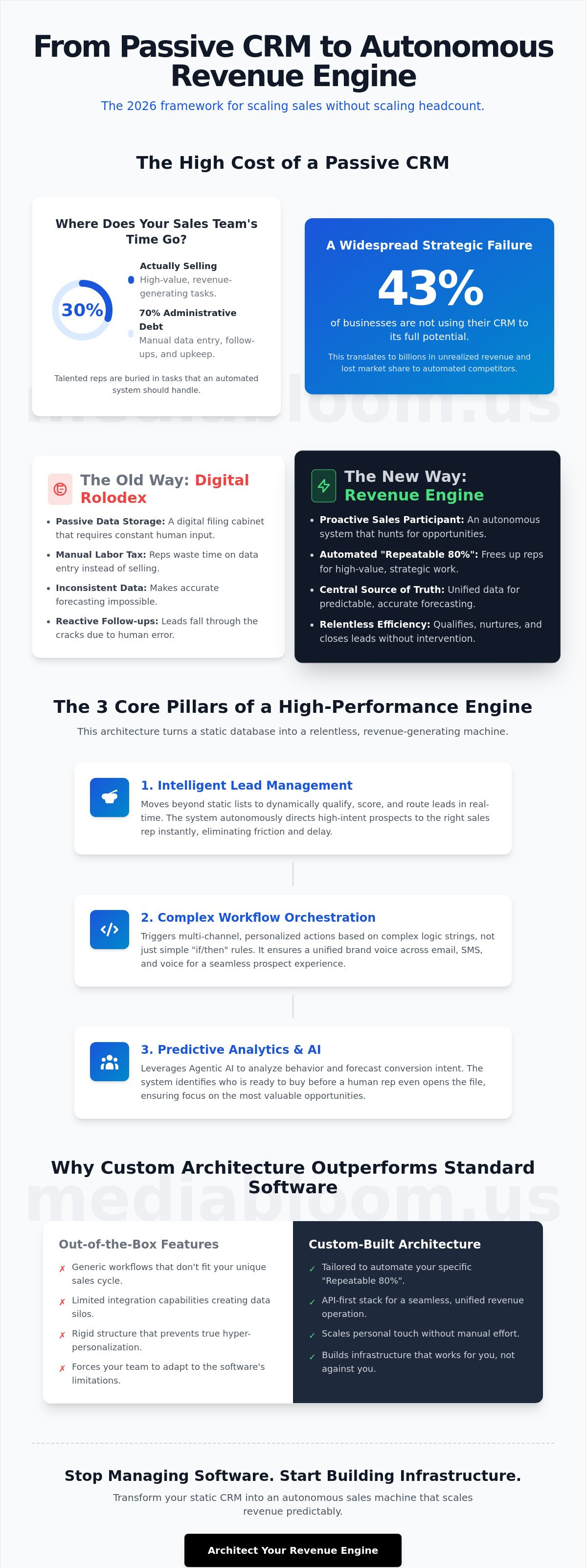
Your sales team is currently drowning in administrative debt while your competitors deploy a digital workforce that never sleeps. In 2026, crm automation is no longer just about organizing contact lists; it's about architecting an autonomous engine that qualifies, nurtures, and closes leads without human intervention. You likely recognize the frustration of seeing talented reps spend only 30% of their time actually selling. When leads fall through the cracks and inconsistent data makes accurate forecasting impossible, your CRM becomes a liability rather than a growth driver.
It's time to stop managing software and start building infrastructure. You can transform your static database into a high-performance autonomous sales machine that scales revenue predictably without adding to your headcount. This article outlines the strategic shift toward agentic AI and modular architecture. We'll explore how to create a seamless data flow across all marketing channels to ensure no prospect is ever ignored again. Prepare to move from manual data entry to a fully automated revenue engine that operates with technical precision and relentless efficiency.
Key Takeaways
- Master the transition from passive data storage to a proactive revenue engine that functions as a high-performance sales participant.
- Identify the "Repeatable 80%" of your sales cycle to implement crm automation workflows that accurately predict conversion intent.
- Scale your personal touch without manual effort by leveraging hyper-personalization strategies that drive relevance across every prospect interaction.
- Understand why custom-built architecture outperforms standard out-of-the-box software features when establishing your central source of truth.
- Build a scalable, API-first stack that seamlessly connects your CRM to every marketing channel for a unified and frictionless revenue operation.
Redefining CRM Automation: From Static Databases to Active Revenue Engines
The era of the passive database is over. In 2026, the global CRM market has surged to $71.5 billion, but the value isn't in the storage. It's in the execution. Most organizations treat their Customer Relationship Management (CRM) systems as digital filing cabinets. This approach is a strategic failure. High-performance firms have transitioned to a model where crm automation acts as a proactive sales participant. It doesn't just hold data; it hunts for opportunities. You're no longer just managing relationships; you're architecting an autonomous workforce. Industry data shows that 43% of businesses aren't using their systems to their full potential, leaving billions in unrealized revenue on the table. Transitioning from record-keeping to revenue-generating infrastructure is the only way to remain competitive in a high-speed market.
To better understand how these workflows function in a modern environment, watch this breakdown of proactive system management:
The Death of the "Digital Rolodex"
A passive CRM is a liability. It's a weight on your operations that demands constant manual feeding. Manual data entry is the silent killer of modern sales growth; it's a "manual labor tax" that strips your best reps of their selling time. Gartner predicts that 40% of enterprise applications will feature task-specific AI agents by the end of this year. If your system still requires a human to trigger every follow-up, you're operating at a massive disadvantage. You aren't just losing time; you're losing market share to competitors who have automated the "Repeatable 80%" of their sales cycle.
The 2026 Revenue Engine Framework
Building a scalable engine requires synergy between clean data, rigid logic, and agentic AI. It bridges the gap between marketing's lead generation and sales' closing efforts through seamless workflow orchestration. CRM automation is the strategic orchestration of customer data to trigger autonomous sales actions. This engine relies on three core pillars: intelligent lead management, complex workflow orchestration, and predictive analytics that forecast conversion intent. By centralizing these functions, you turn a static record-keeper into a relentless revenue-generating infrastructure. It's the difference between having a map and having a self-driving car. Explore how to architect these automation solutions to ensure your data finally works as hard as your sales team does.
The core pillars of this architecture work in concert to ensure your sales team only interacts with high-intent prospects:
- Lead management: Autonomous qualification and routing based on real-time behavior.
- Workflow orchestration: Triggering multi-channel actions based on complex logic strings.
- Predictive analytics: Identifying conversion intent before a human rep even opens the file.
The Architecture of High-Performance CRM Workflows
Efficiency in 2026 is defined by how little your human staff touches a lead before it's ready to buy. High-performance revenue engines are built on the "Repeatable 80%" principle. This involves identifying every predictable, manual task and offloading it to your digital infrastructure. Effective CRM automation isn't just about sending emails; it's about dynamic task assignment and multi-channel synchronization. Your engine must ensure parity across email, SMS, and voice channels so the prospect experiences a unified brand voice. When you route the right lead to the right resource instantly, you eliminate the friction that kills deals. This architectural precision allows your sales team to focus entirely on the high-value 20% of the sales cycle that requires human intuition.
Intelligent Lead Qualification and Scoring
Modern lead scoring has evolved beyond basic demographics. Static data points like job titles are now secondary to behavioral trigger points. Your system should track how a prospect interacts with your assets in real-time. Did they watch 80% of a demo? Did they visit the pricing page three times in 48 hours? These actions should trigger immediate score adjustments. Automating the "Hand-off" is critical. When a lead hits a specific threshold, the system must execute a seamless transition to a live rep. Compliance with the 5-minute rule is non-negotiable. Research consistently shows that responding to a lead within five minutes increases the likelihood of conversion by 100x compared to a 30-minute delay. If your team can't move that fast, your automation must do it for them.
Workflow Orchestration: The Logic Behind the Machine
The logic of your machine should mirror the instincts of your best salesperson. This requires building complex "If-Then" sequences that adapt based on prospect engagement. If a prospect ignores an email, the system might trigger a personalized SMS or a LinkedIn connection request. Automated follow-up systems must maintain persistence without becoming an annoyance. This level of sophistication often requires custom CRM automation to align with specific business nuances. Generic, out-of-the-box workflows rarely capture the complexity of enterprise sales cycles. By architecting bespoke logic, you ensure your engine remains relentless and relevant. If you're ready to audit your current infrastructure for these gaps, you can consult with our architecture team to identify immediate optimization opportunities.
Reliable workflow orchestration depends on three technical requirements:
- Logic Parity: Ensuring automated triggers match your actual sales playbooks.
- Data Integrity: Maintaining a clean, real-time sync between all integrated tools.
- Persistence Logic: Designing sequences that follow up until a definitive "yes" or "no" is reached.
Autonomous Lead Nurturing: Solving the "Human Touch" Paradox
The greatest barrier to full-scale automation is the fear of losing the "human touch." Many executives worry that removing a person from the loop creates a cold, robotic experience for the prospect. This is a legacy mindset. In 2026, the paradox has been solved through high-fidelity data integration and agentic logic. CRM automation now allows for hyper-personalization at a scale that no human team could ever replicate. It's about using every byte of data in your system to drive relevance, not just inserting a first name into a template. When your machine knows a prospect's specific pain points, past interactions, and current intent, it doesn't feel like a bot. It feels like a concierge.
AI Voice Agents: The New Frontier of CRM Execution
Voice is the ultimate test of human parity. AI voice agents have transformed from simple IVR systems into sophisticated conversationalists capable of handling complex qualification calls. These agents don't just talk; they listen and learn. They sync every interaction directly back into the CRM, ensuring your data is always current and actionable. By deploying these agents, you reduce your reliance on expensive, inconsistent BPO services. You gain a workforce that handles the initial outreach with technical precision, allowing your human closers to step in only when the deal is hot. This architecture ensures your brand authority remains intact while the machine handles the heavy lifting of the nurturing cycle.
Personalization Through Data, Not Templates
Authentic connection comes from context. The "Invisible Automation" strategy relies on using your CRM history to tailor every touchpoint so perfectly that the prospect never questions the source. If a lead downloaded a whitepaper on scalability, the next automated touchpoint should reference that specific topic and offer a logical next step. This isn't about templates; it's about dynamic content generation driven by the "Source of Truth" in your database. AI-driven crm automation maintains high-energy sales momentum without human fatigue. It keeps your outreach relentless and relevant, ensuring that your pipeline remains fueled by high-quality interactions 24/7. This level of operational excellence is the hallmark of a modern revenue engine.
To achieve this level of nurturing, your architecture must prioritize three elements:
- Contextual Relevance: Every message must reflect the prospect's current stage in the buyer's journey.
- Multi-Modal Consistency: Parity between voice, chat, and email interactions.
- Dynamic Triggers: Actions based on real-time behavior rather than static time-based schedules.
Building the Scalable Stack: Integration, Data, and AI Strategy
Architecture is the difference between a collection of disjointed tools and a unified revenue engine. To achieve full autonomy, your system must adhere to the "Source of Truth" principle. This involves centralizing data from every touchpoint into a single, accessible repository. Without this foundation, your crm automation workflows will trigger based on fragmented or conflicting information, leading to operational chaos. An API-first architecture is non-negotiable in 2026. It allows your CRM to communicate effortlessly with your ad management platforms and email marketing services, creating a closed-loop system where every dollar spent is tracked through to the final close. If your data isn't centralized, your automation isn't scalable.
The Integration Ecosystem
Success requires bridging the gap between top-of-funnel awareness and bottom-of-funnel conversion. By connecting ad management data directly to CRM outcomes, you gain visibility into which campaigns actually drive revenue, not just clicks. This connectivity ensures that your email marketing efforts are triggered by real sales milestones. Implementing AI sales pipeline management creates a closed-loop system that identifies bottlenecks before they impact your quarterly targets. This technical synergy allows the machine to adjust its outreach strategy based on the current health of the pipeline, ensuring a consistent flow of high-intent leads to your human closers.
Maintaining Data Integrity
Garbage data is the silent killer of even the most sophisticated engines. High-performance stacks utilize automated data cleaning and de-duplication protocols to maintain a pristine database. You must standardize input fields to ensure better machine learning outputs; inconsistent formatting leads to logic failures. This is where Revenue Operations (RevOps) becomes essential. Their role is to monitor the health of the automation engine, ensuring that data hygiene remains a priority. Modern crm automation requires constant oversight to prevent "data decay" from eroding your conversion rates. When your data is clean, your AI-driven logic can execute with surgical precision.
Security and compliance are now foundational architectural requirements. As of January 1, 2026, new comprehensive privacy laws are in effect in Indiana, Kentucky, and Rhode Island. Furthermore, the California Delete Act's centralized DROP platform is now operational, requiring data brokers and enterprises to process deletion requests with technical immediacy. Businesses are currently spending 30-40% more on privacy compliance than in 2023. Your stack must automate these compliance workflows to mitigate legal risk while maintaining operational speed. If your current infrastructure feels fragmented or non-compliant, you can connect with our technical architects to design a secure, integrated revenue stack that scales.
Beyond the Platform: Why Custom CRM Automation Architecture Wins
Software alone is not a strategy. Many organizations fall into the trap of believing that a premium CRM license automatically solves operational inefficiencies. In reality, out-of-the-box features are designed for the average user, not the high-performance enterprise. Strategic architecture is far more critical than the brand name on your software login screen. CRM automation reaches its full potential only when it's engineered to mirror your specific sales logic and revenue goals. If you rely solely on native, generic workflows, you're building your business on a foundation designed for your competitors. Future-proofing your revenue requires a bespoke approach that anticipates the next shift toward fully agentic AI systems.
The MediaBloom Advantage
MediaBloom doesn't just configure software; we engineer autonomous revenue engines. Our approach focuses on a custom CRM setup that aligns perfectly with your unique sales playbooks. We integrate AI chatbots and voice agents into a unified communication layer, creating a total solution that manages the entire lead lifecycle. This allows you to scale operations rapidly without the traditional overhead of adding headcount. You gain the power of a digital workforce that is precise, persistent, and perfectly synced with your central data repository. We build the infrastructure that allows your human talent to focus exclusively on high-value closing activities.
Your Next Steps Toward Autonomy
Transitioning to an autonomous model requires a methodical approach. Start by auditing your current manual bottlenecks to identify where your team is losing the most time. We recommend focusing on three critical areas for immediate ROI: automated lead qualification, instant multi-channel follow-up, and predictive pipeline alerts. These foundational blocks prove the value of crm automation while setting the stage for deeper integration. It's time to stop managing software and start building a scalable asset. Explore how to architect your 2026 revenue engine with MediaBloom and secure your position at the forefront of your industry.
A custom-engineered architecture provides three distinct competitive advantages:
- Operational Agility: The ability to modify workflows instantly as market conditions shift.
- Technical Parity: Ensuring your automation logic matches the sophistication of your best human performers.
- Scalable Efficiency: Increasing lead volume and conversion rates without a linear increase in operational costs.
Own the Future of Revenue Operations
The window for manual sales operations is closing. To maintain a competitive edge in 2026, you must evolve from managing a database to architecting a relentless, self-sustaining revenue engine. We've explored how high-fidelity data and agentic AI solve the human touch paradox. You now understand that custom crm automation architecture is the only way to achieve true operational excellence. Relying on standard software features leaves your growth to chance. Precision engineering and strategic orchestration are the new requirements for market leadership.
MediaBloom provides the technical mastery needed to build this infrastructure. Our results-oriented RevOps consulting ensures your sales logic is flawlessly executed by a digital workforce. We specialize in custom AI-driven CRM workflows and human-parity AI voice agent integration that scale your output without increasing headcount. It's time to stop fighting your tools and start leveraging a machine built for your specific goals. You have the vision to lead your industry; we have the blueprints to make it happen.
Architect Your Autonomous Revenue Engine with MediaBloom
Take the first step toward total sales autonomy today. Your high-performance future is waiting for its architect.
Frequently Asked Questions
What is CRM automation and how does it differ from standard CRM software?
CRM automation is the active orchestration of sales tasks, whereas standard software is a passive database. Standard systems store data; automation uses that data to trigger follow-ups, score leads, and update records without manual input. It shifts your system from a record-keeping tool to an autonomous sales engine that executes your playbooks 24/7. This transition ensures your data works for you rather than requiring constant manual feeding.
Can CRM automation really replace human sales follow-up?
It replaces the "Repeatable 80%" of follow-up tasks while maintaining high-fidelity personalization. By using AI voice agents and dynamic sequences, you handle initial qualification and persistent nurturing autonomously. This ensures humans only step in for high-value negotiations where intuition is required. It prevents leads from falling through the cracks due to slow human response times, ensuring a relentless and professional outreach cycle.
How much time can my team save by automating our CRM workflows?
Sales teams typically reclaim 70% of their day by automating administrative and repetitive tasks. Current data shows sales reps often spend only 30% of their time actually selling. Automating lead routing, data entry, and meeting scheduling eliminates the "manual labor tax." This allows your talent to focus exclusively on closing revenue and high-level strategy rather than getting bogged down in digital paperwork.
Is CRM automation secure enough for sensitive customer data?
Modern automation stacks are engineered with privacy-first designs to meet strict regulations like GDPR and the California Delete Act. As of 2026, new laws in states like Indiana and Kentucky require technical immediacy in data processing. Security protocols like end-to-end encryption and automated compliance workflows ensure your customer data remains protected. High-performance crm automation architecture prioritizes security as a foundational component of the revenue engine.
What are the most important features to look for in a CRM with automation?
Prioritize agentic AI capabilities, API-first architecture, and robust lead scoring models. Essential crm automation features include multi-channel synchronization, dynamic task assignment, and real-time behavioral triggers. Your system must be modular, allowing you to integrate best-of-breed tools like AI voice agents. This creates a seamless revenue stack that can adapt as your business logic and market conditions evolve over time.
How do I start automating my CRM if my current data is messy?
Start by implementing automated data cleaning and de-duplication protocols before activating complex workflows. You can't build a high-performance engine on a foundation of garbage data. Standardize your input fields and use RevOps strategies to audit your current database. Once your data is clean, you can layer on the logic that drives autonomous execution. Clean data is the fuel that allows your AI to operate with precision.
What is the ROI of implementing custom CRM automation?
The average return on investment for CRM is reported as $8.71 for every dollar spent. Custom architecture pushes this higher by reducing operational overhead and increasing conversion rates through technical precision. You scale revenue without adding headcount, creating a predictable growth model. The ROI manifests through reclaimed labor hours, improved lead retention, and the ability to handle a higher volume of prospects with zero friction.
Does CRM automation work for B2B high-ticket sales?
It is highly effective for B2B high-ticket sales by managing long, complex nurturing cycles with surgical relevance. High-ticket deals require consistent touchpoints over several months. Automation ensures your brand stays top-of-mind through hyper-personalized content and AI voice qualification. This prepares the prospect for a final, high-stakes conversation with your human closers. It maintains the momentum of the deal without human fatigue or oversight errors.


