

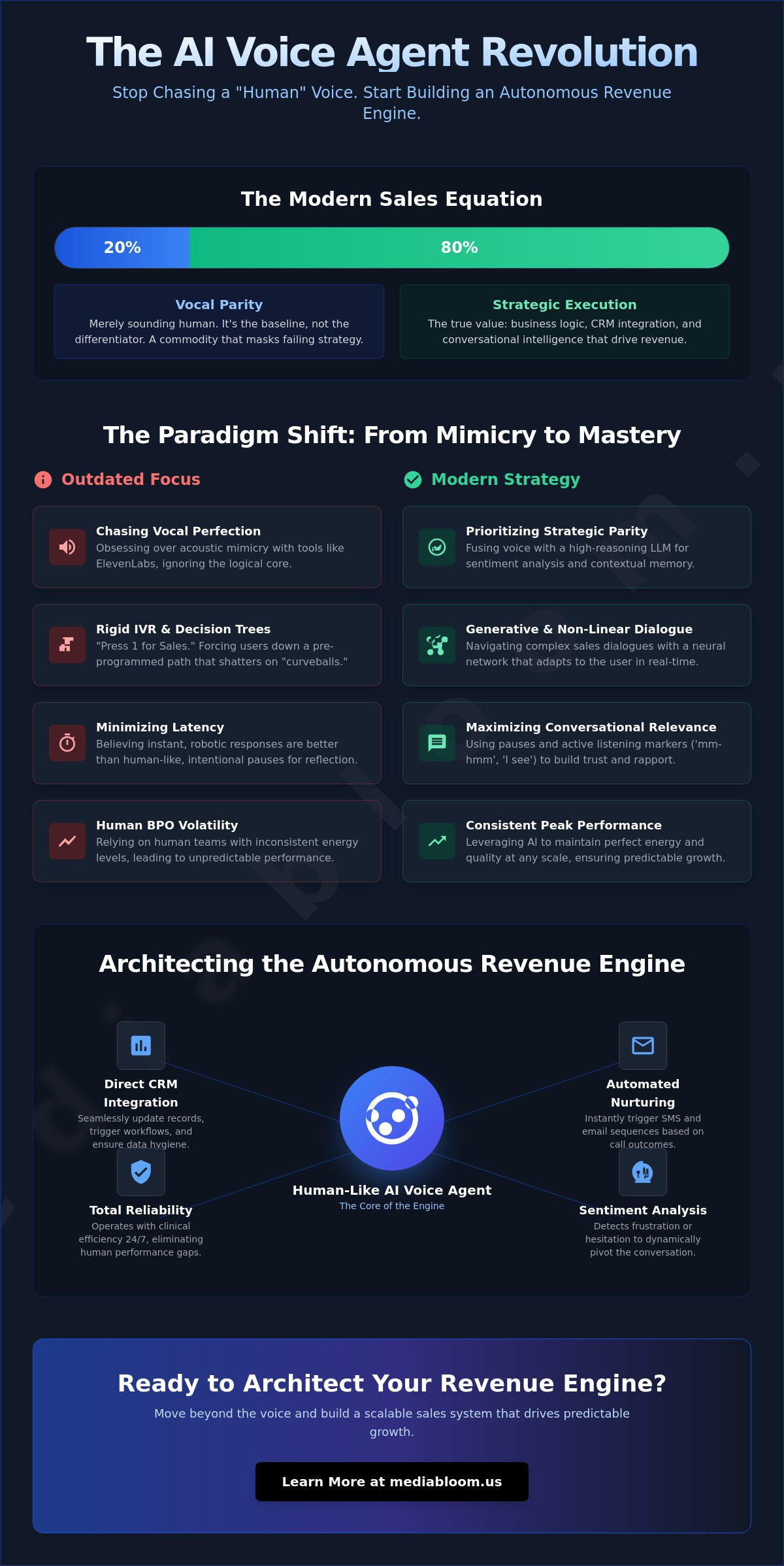
In 2026, deploying a human-like ai voice agent that merely sounds "real" is no longer a competitive advantage; it's a baseline requirement that often masks a failing strategy. Most companies remain obsessed with achieving human-parity audio, yet they continue to struggle with high lead costs and stagnant conversion rates. You've likely experienced the burnout of managing traditional BPOs or the frustration of prospects hanging up the moment they sense a lack of depth. Sounding human is only 20% of the sales equation. If your agent lacks the architectural backbone to handle complex business logic, you aren't building a sales engine. You're just generating noise.
It's time to stop chasing the "uncanny valley" and start focusing on revenue operations. This guide reveals how to move beyond simple mimicry to build a scalable sales system that sounds indistinguishable from a top-tier rep while executing seamless CRM updates. You'll learn why the industry has shifted from minimizing latency to maximizing holistic value. We will explore the technical and psychological frameworks required to turn your voice infrastructure into a high-performance revenue driver that operates with clinical efficiency and total reliability.
Key Takeaways
- Move beyond acoustic mimicry to prioritize contextual empathy and business logic. A perfect voice fails without a sophisticated neural network to guide the conversation.
- Replace rigid decision trees with generative agents capable of navigating complex, non-linear sales dialogues. Architect a human-like ai voice agent that handles objections with the fluidity of a top-tier rep.
- Shift focus from raw latency metrics to conversational relevance and intentional pauses. Simulating human reflection builds more trust than instantaneous, robotic responses.
- Transform your voice agent into a fully integrated revenue engine by connecting it directly to your CRM. Ensure every call triggers immediate workflows, including automated SMS and lead nurturing.
- Eliminate the performance volatility of human BPOs by leveraging AI that maintains peak energy at any scale. Achieve the perfect balance of high volume and consistent quality to drive predictable growth.
The 'Uncanny Valley' Myth: Why Sounding Human Isn't Enough
The Uncanny Valley has evolved. In 2026, it no longer refers to a visual mismatch in a CGI character; it describes the jarring disconnect between a flawless vocal performance and a hollow logical core. When you deploy a human-like ai voice agent, the sound of the voice is merely the skin of the operation. If the underlying logic is rigid, the illusion shatters instantly. Modern prospects don't hang up because of a synthetic accent. They disconnect because the agent fails to understand the nuance of their objection. They sense a lack of contextual empathy that no amount of high-fidelity Speech synthesis can fix.
Market leaders often fall into the commodity voice trap. Tools like ElevenLabs and Play.ht provide incredible vocal quality, but they are just the starting line. Relying solely on these tools is like buying a high-performance engine block without a transmission or fuel system. You have the sound of power, but no way to move the vehicle. In sales automation, the shift has moved decisively from 'human-sounding' to 'human-reasoning.' Your revenue engine requires a brain that can navigate the complexities of a discovery call, not just a mouth that can read a script.
To better understand this concept, watch this helpful video:
The Psychology of Trust in Voice Sales
Trust in high-stakes sales is fragile. The human brain is a highly tuned instrument for detecting 'scriptedness.' Even if the tone is perfect, a buyer's subconscious flags the absence of active listening markers. Real conversations are messy. They include 'mm-hmm' acknowledgments, subtle breathing patterns, and 'I see' affirmations. When an agent speaks with 'perfect' clarity and zero hesitation, it signals a lack of authenticity. For savvy B2B buyers, this perfection is a red flag. It suggests they are being processed through a machine rather than engaged by a partner.
Vocal Parity vs. Strategic Parity
We distinguish between vocal parity and strategic parity to define true performance. Vocal parity is the technical baseline; it is the ability to mimic human frequency and inflection. Strategic parity is the true differentiator. It is the ability to pivot a conversation based on real-time sentiment analysis and complex business logic. Successful implementation requires several key components:
- Sentiment Analysis: Detecting frustration or hesitation in a prospect's voice.
- Dynamic Scripting: Abandoning rigid paths for fluid, goal-oriented dialogue.
- Contextual Memory: Recalling details from earlier in the call to build rapport.
A human-like ai voice agent is a strategic fusion of low-latency TTS and high-reasoning LLM architecture.
Myth: AI Voice Agents Are Just Sophisticated IVR Systems
Many executives mistakenly categorize the modern human-like ai voice agent as a glorified Interactive Voice Response (IVR) system. This is a fundamental misunderstanding of the underlying technology stack. Traditional IVR relies on rigid, pre-programmed decision trees that force the user to adapt to the machine. In contrast, a generative AI agent utilizes a neural network to adapt to the user in real time. The "Press 1 for Sales" era is dead. Today, high-performance agents navigate non-linear conversations where prospects jump between topics, ask unexpected questions, or interrupt mid-sentence without breaking the system.
Handling "the curveball" is the true test of a scalable sales engine. When a prospect goes on a tangent about a specific pain point or asks about a niche integration, an IVR would either fail or loop back to a frustrating main menu. A sophisticated AI agent maintains the conversational thread. It processes the interruption, provides a relevant answer, and pivots back to the primary sales objective. This allows you to scale operations without the limitations of pre-recorded prompts or brittle, fragile scripts that break under the pressure of a real conversation.
From Decision Trees to Dynamic Reasoning
Large Language Models (LLMs) have entirely replaced the "if-this-then-that" logic that dominated the industry as recently as 2024. The critical differentiator is now "State Management." This ensures the agent maintains a persistent understanding of the conversation's history and the prospect's emotional state over long-form calls. We focus on how we architect custom AI and CRM workflows to ensure every interaction is grounded in real-time business data rather than static templates. This architecture allows the agent to reason through complex scenarios rather than just reacting to keywords.
Real-Time Objection Handling
Deploying a human-like ai voice agent in 2026 requires a shift from aggressive persistence to strategic value-add. Modern agents employ Retrieval-Augmented Generation (RAG) to pull specific data points or case study highlights during the call. This isn't just about sounding human. It's about being useful. By training your agent on your brand's unique "Battle Cards," you ensure it delivers precise rebuttals that feel like an expert consultation. It's a level of performance that human BPOs struggle to maintain across thousands of leads, as fatigue and script-dependency inevitably set in. If you are ready to upgrade your sales infrastructure, you can speak with our architecture team to begin the transition.
Myth: Real-Time Latency Is the Only Metric That Matters
The industry is currently trapped in a latency arms race. Engineers brag about sub-500ms response times as if speed alone solves the conversion problem. It doesn't. A human-like ai voice agent that delivers an irrelevant, robotic answer in 400ms is still a failure. High-performance sales require the "Thoughtful Pause." Real humans take a beat to process complex inquiries. By simulating this reflection, you build authentic rapport and signal that the agent is truly listening rather than just triggering a pre-set response.
Accuracy is the only metric that scales. Speed without precision leads to hallucinations and lost trust. Modern agents must prioritize predictive turn-taking to manage the flow of conversation naturally. This technology prevents the AI from talking over the prospect, a common flaw in early-generation bots. We focus on creating a fluid exchange where the agent anticipates the end of a sentence rather than just waiting for silence. Accuracy wins. Speed is secondary.
The Architecture of a 2026 Voice Call
The 2026 voice stack is a high-speed pipeline of STT, LLM, and TTS services. While most providers obsess over network latency, we focus on "Logic Latency." This is the time required for the system to reference your specific business rules and generate a high-intent response. Our systems are built to handle these complex calculations without sacrificing the flow of the call. Discover how we build a Definitive Guide to AI Voice Agents to help you navigate these technical requirements while scaling revenue.
Contextual Memory: The True Conversion Driver
Context is the true driver of conversion parity. An agent that remembers a lead's specific pain points from a CRM note or a LinkedIn interaction from last week will always outperform a faster, generic bot. We integrate CRM data into the first few seconds of every call to ensure the conversation is tailored to the individual. This turns a standard outreach attempt into a high-value consultation. Latency is a technical requirement, but context is a revenue requirement.
By leveraging deep integration, your human-like ai voice agent can reference specific details that a human rep might overlook. This level of personalization at scale is impossible with traditional BPOs or basic automation tools. It requires a strategic architect to build the data bridges between your lead sources and your voice infrastructure. When the agent knows who it's talking to, the conversation shifts from a pitch to a partnership.
The Cold Calling Myth: Can AI Truly Replace High-Energy Sales Reps?
The belief that cold calling requires a "human touch" to maintain high energy is a fading relic of the 20th century. While human reps suffer from burnout, rejection fatigue, and inconsistent performance, a human-like ai voice agent operates with clinical precision at all times. It doesn't have "off days." It doesn't get discouraged after a string of hangups. Instead, it delivers a high-energy, authoritative pitch on the first call and the thousandth call with identical efficacy. This allows your organization to finally bridge the gap between high volume and high quality without sacrificing brand integrity.
We advocate for a hybrid model where AI handles the heavy lifting of lead qualification and top-of-funnel outreach. This strategic architecture ensures your high-value human closers only spend time on calls with qualified prospects who have already been vetted by your autonomous systems. Addressing the ethics of this shift is straightforward. In accordance with 2024 FCC rulings, obtaining prior express written consent is a non-negotiable standard for outbound operations. Transparency isn't just an ethical choice; it's a regulatory requirement that builds long-term trust with your audience.
Eliminating the BPO Bottleneck
Managing human-operated BPOs has become a significant liability for fast-moving revenue teams. Traditional call centers are plagued by high turnover, inconsistent training, and slow response times. When you factor in the overhead of management and the variable quality of human reps, the cost-per-minute advantage of AI becomes an undeniable competitive edge. You can examine our case studies to see how leading enterprises have replaced manual outreach with automated systems to drive predictable growth and eliminate operational friction.
High-Energy Persistence Without the Ego
Persistence is the engine of outbound sales, but human ego often gets in the way of consistent follow-up. A human-like ai voice agent follows up ten or more times with perfect timing, driven by CRM triggers rather than emotional hesitation. It handles gatekeepers with the same professional poise it uses for C-suite executives. In 2026, your sales floor should never sleep. By deploying an autonomous outreach engine, you ensure that every lead is pursued with maximum energy 24/7. If you are ready to remove the human bottleneck from your top-of-funnel operations, book a strategic consultation with our team today.
Architecting the Autonomous Revenue Engine: Beyond the Voice
A human-like ai voice agent is merely the acoustic interface of a much larger machine. Without a deep connection to your data stack, you have a novelty, not a revenue engine. Your CRM acts as the central nervous system, providing the context and memory required to turn a simple conversation into a strategic business event. While the voice handles the "mouth" of the operation, the CRM provides the "brain" that directs every interaction based on historical data and real-time intent.
We established the MediaBloom Standard to ensure that no call exists in a vacuum. Every interaction must trigger a sequence of automated responses across multiple channels. This includes instant CRM updates, follow-up SMS messages, and personalized emails. This architecture ensures that the momentum generated during the call is immediately captured and processed, eliminating the manual data entry that slows down traditional sales teams. It's about building a system that works while your human reps focus on high-level strategy.
Integration goes beyond just logging calls. By feeding conversation data back into your Ad Management systems, you close the loop between marketing spend and sales outcomes. Your ads become smarter because they are optimized based on real-time feedback from high-intent voice interactions. This is how you build a self-correcting, autonomous revenue engine that scales without increasing overhead.
Seamless CRM Integration
Operational efficiency depends on the quality of your data. Modern agents provide automatic call summarization and sentiment tagging directly into platforms like Salesforce and HubSpot. This allows leadership to monitor trends across thousands of calls without listening to a single recording. High-intent signals trigger automated lead nurturing sequences, ensuring that warm prospects are moved through the funnel with zero latency. Learn more about CRM Automation setup to understand the technical requirements for this level of operational excellence.
The Future of Sales is Multi-Channel
Voice is most effective when it is part of a coordinated multi-channel attack. By synchronizing your agent with Email Marketing, you create a seamless experience for the prospect. Imagine a system where your human-like ai voice agent initiates a "warm call" the exact second a lead opens a high-value proposal email. This level of precision is the new standard for 2026. It ensures your brand is present at the moment of peak interest.
Stop treating AI as an experimental tool. It is time to deploy an automated workforce that outpaces, out-scales, and out-performs traditional models. The transition from testing to full-scale deployment is the final step in securing your market position. To see this infrastructure in action, you can Watch a Demo of the MediaBloom Revenue Engine today and begin your transition to an autonomous future.
Own the Future of Sales Automation
The era of treating voice technology as a standalone tool is over. Sounding human was the challenge of 2024; reasoning like a top-tier sales professional is the mandate of 2026. You've seen why a human-like ai voice agent fails without a sophisticated neural network and deep CRM integration. Success requires moving beyond acoustic mimicry to architect a system that understands context, handles objections with strategic parity, and updates your revenue operations in real time. Efficiency is no longer optional. It's the baseline for survival in a high-speed digital economy.
MediaBloom specializes in building these foundational engines. We provide custom LLM logic designed for high-stakes sales and seamless lead nurturing workflows that ensure no prospect is left behind. Whether you need national-scale deployment for enterprise revenue operations or deep CRM integration, we build the infrastructure that transforms voice into predictable growth. It's time to stop testing and start scaling. Scale Your Sales Pipeline with MediaBloom's AI Voice Agents and secure your competitive advantage today. The infrastructure for your growth is ready.
Frequently Asked Questions
Do human-like AI voice agents actually sound real in 2026?
Yes, modern human-like ai voice agent technology has achieved acoustic parity with human speech. By utilizing low-latency text-to-speech engines, these systems replicate human frequency, inflection, and natural breathing patterns. The industry focus has shifted from the sound of the voice to the depth of the reasoning and contextual empathy behind it.
Can an AI voice agent handle complex sales objections?
Advanced agents utilize Retrieval-Augmented Generation (RAG) to navigate complex objections in real time. They reference your specific brand battle cards and technical documentation to provide high-accuracy rebuttals. This moves beyond simple scripts into dynamic reasoning that maintains the conversational thread during high-stakes sales calls.
How much does it cost to develop a custom AI voice agent?
Development costs vary based on the complexity of your logic architecture and the volume of calls handled. Factors include the choice of Large Language Model, integration requirements with your CRM, and the depth of custom automation needed for post-call workflows. We focus on building scalable revenue engines tailored to specific enterprise operations.
Will my customers be upset if they find out they are talking to an AI?
Transparency builds trust when the agent provides immediate value. In 2026, prospects value efficiency and accuracy over the identity of the speaker. Compliance with FCC regulations requires clear disclosure for outbound marketing, which positions your brand as a professional, tech-forward leader that respects consumer time and privacy.
What is the best AI voice agent for cold calling?
The best agent is one that functions as a complete revenue engine rather than just a voice. It must handle non-linear conversations, manage interruptions, and trigger immediate CRM updates. Look for systems that prioritize strategic parity and high-reasoning capabilities over simple acoustic mimicry to ensure consistent conversion rates.
How do I integrate an AI voice agent with my existing CRM?
Integration is achieved through robust API connections and orchestration layers. This allows the human-like ai voice agent to pull lead data before a call and push summaries, sentiment tags, and next steps directly into Salesforce or HubSpot. It eliminates manual data entry and ensures your sales pipeline remains updated in real time.
Can AI voice agents make international calls with different accents?
Localized text-to-speech models support a wide range of languages and regional accents. This allows for national and international scale while maintaining a local presence. You can deploy specific vocal profiles that resonate with target demographics across different geographic markets to build rapport more effectively.
What happens if the AI voice agent hallucinates or gives wrong information?
We prevent hallucinations by using grounded logic and strict guardrails within the system architecture. By restricting the agent's knowledge base to your verified documentation through RAG, we ensure the agent only delivers accurate, brand-approved information. Reliability is the foundation of any automated sales workforce.


