Outbound sales calls and texts require prior consent before you dial or text, and the wrong dialer or a stale opt-out list can turn a single bad list into six figures of exposure. The FCC and FTC set the rules; per-contact statutory damages of $500 to $1,500 set the stakes. Three moves matter most right now: scrub every list against the National DNC Registry, document consent with a timestamp and disclosure text for every lead, and build a revocation process that shuts off contact within 10 business days.
TL;DR:
- Scrub all calling lists against the National DNC Registry and state overlays every 31 days to ensure compliance and prevent violations.
- Obtain prior express written consent for any marketing or telemarketing messages sent via autodialer or prerecorded voice, with proper disclosure language naming your company.
- Maintain immutable, timestamped records of consent, opt-outs, and revocations, and honor revocation requests within 10 business days to avoid penalties.
- Confirm caller ID accuracy, restrict calls to residential lines outside 8 AM to 9 PM, and include opt-out options in prerecorded messages to meet operational TCPA requirements.
- Use automated platforms that link consent capture, DNC scrubbing, and audit logging to reduce manual compliance gaps and support audits.
Table of Contents
- What Does the TCPA Cover for Sales Calls and Texts?
- Who Has to Comply With TCPA Rules?
- What Are the Core TCPA Requirements for Outbound Campaigns?
- How Do You Handle Do Not Call Lists and Revocation Requests?
- Auditing Purchased Leads and Vendor Consent Data
- What Are the Penalties for TCPA Violations?
- What Records Should You Keep for TCPA Compliance?
- What’s a Practical Pre-Launch and Ongoing Compliance Checklist?
- How MediaBloom Supports TCPA-Compliant Outbound Campaigns
- Compliance as Revenue Protection, Not a Cost Center
- Run Compliant Outbound Campaigns Without Building It Yourself
- Sources
- FAQ
What Does the TCPA Cover for Sales Calls and Texts?
The Telephone Consumer Protection Act, codified at 47 U.S.C. § 227, restricts autodialed calls, prerecorded or artificial voice calls, and unsolicited faxes. The FCC’s implementing rules under 47 C.F.R. § 64.1200 extend that scope to text messages, treating an SMS the same way the statute treats a voice call made with an autodialer.
For a sales organization, that means almost every channel you use to reach a new lead touches the TCPA in some way. Cold calls placed through a predictive dialer, ringless voicemail drops, appointment reminder texts, and even a single prerecorded message asking someone to call back all fall under the statute’s reach if the recipient hasn’t consented.
The TCPA doesn’t operate alone. The FTC’s Telemarketing Sales Rule (TSR) layers on additional disclosure and verifiable authorization requirements for telemarketing calls, particularly where a call involves a request for payment information. State telemarketing statutes often add their own wrinkles, too. Florida, for instance, requires prior express written consent for many autodialed calls regardless of federal exemptions. Treat federal law as the floor, not the ceiling, when a campaign touches multiple states.
Who Has to Comply With TCPA Rules?
Liability spreads far wider than the person dialing the phone. Sellers, telemarketers, third-party dialing vendors, and lead buyers can all be named in the same lawsuit, because courts look at who controlled the calling list, the script, and the decision to place the call.
If your sales team writes the script and approves the target list, you’re squarely on the hook even if a call center vendor physically places the calls. If you buy leads from a third-party generator and dial them yourself, you inherit whatever consent gaps exist in that data, whether you knew about them or not.
A useful marker: ask who benefits commercially from the call. Courts have held that a business “on whose behalf” a call is made can face liability even without direct involvement in dialing. That single phrase is why lead buyers can’t treat vendor contracts as a liability shield. Recent circuit rulings have also narrowed some FCC interpretations of consent scope, including a Fifth Circuit decision rejecting a one-to-one reading of prior express written consent. National sales organizations should still design to the stricter FCC standard rather than betting on favorable circuit law in every jurisdiction they call into.
What Are the Core TCPA Requirements for Outbound Campaigns?
Consent comes in two tiers, and mixing them up is one of the most common compliance failures in sales organizations. Prior express consent covers informational calls and texts, such as appointment confirmations or account service messages, and can often be inferred from the business relationship or from a customer providing their number. Prior express written consent is required for any call or text that includes a marketing or telemarketing message sent through an autodialer or prerecorded voice, and it requires a signed or electronically signed agreement that clearly discloses the consequences of consenting.
Sales teams frequently assume that if a lead filled out a web form, they’re covered for autodialed follow-up calls. That’s only true if the form’s disclosure language specifically named your company and described autodialed or prerecorded contact. Generic “contact me” checkboxes rarely meet the written-consent bar for telemarketing.
ATDS risk hasn’t gone away. The Supreme Court’s Duguid decision narrowed the legal definition of an autodialer, but circuit courts have split on how narrowly to read it, and some dialing platforms marketed as “manual” still trigger scrutiny if they retain automatic sequential dialing capability. Don’t assume your dialer is exempt just because a human clicks “call.” Confirm the platform’s technical architecture in writing from your vendor.
AI-generated and synthetic voices are treated as prerecorded or artificial voice messages under current FCC guidance, which means the same consent and disclosure rules apply. Any AI voice agent placing outbound sales calls needs prior express written consent when the call is telemarketing in nature, plus a clear identification of the calling business at the start of the message.
A few operational rules round out the requirements: caller ID must accurately identify the calling party, sales calls to residential lines generally can’t be placed before 8 AM or after 9 PM in the recipient’s time zone, and prerecorded messages must include a way to opt out during the call itself.
How Do You Handle Do Not Call Lists and Revocation Requests?
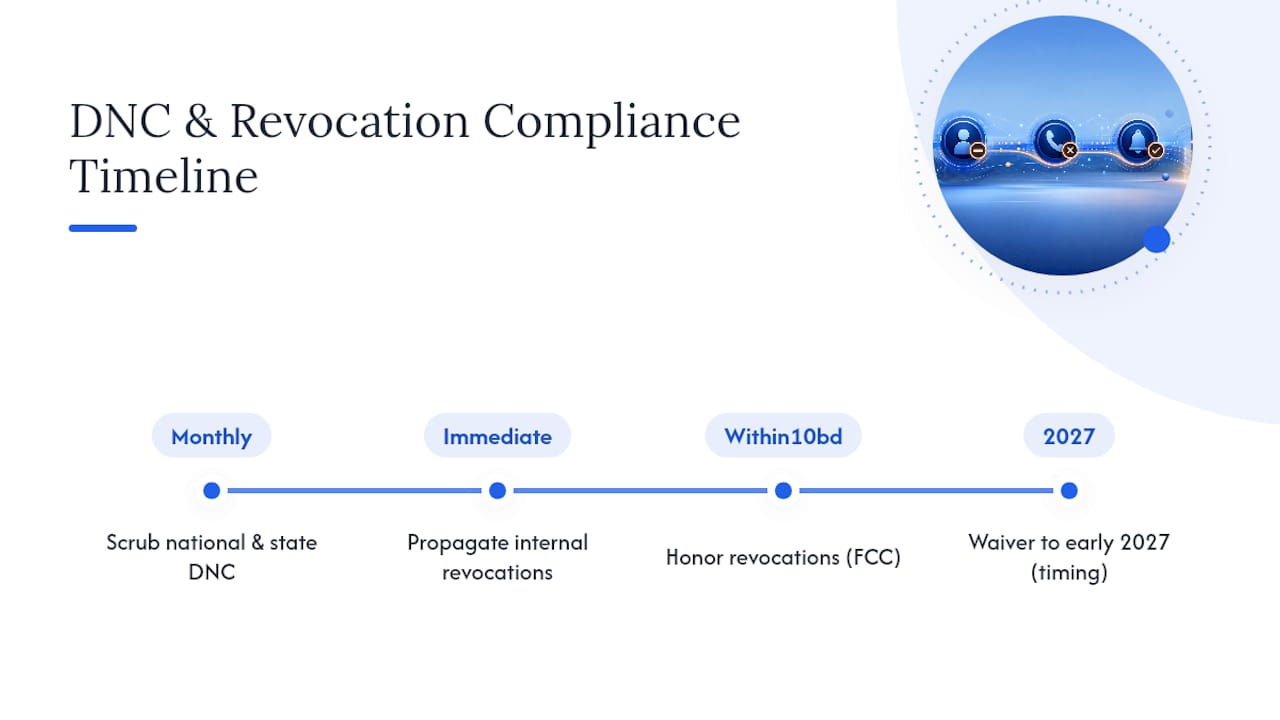
National DNC Registry scrubbing needs to happen at least every 31 days, and state DNC overlays in places like Texas and Pennsylvania add separate registries your compliance calendar has to track. A list that was clean 45 days ago isn’t clean today.
Internal do-not-call requests carry equal weight and need to propagate immediately across every system your team touches, not just the CRM. If a prospect asks a sales rep to stop calling and that request sits in a spreadsheet for a week before reaching the dialer, you’ve created a violation window.
The FCC allows companies to designate one official revocation method, such as replying “STOP” to a text or saying “remove me” on a call, but that designation has to be reasonable and clearly communicated. Once a revocation request comes in through any reasonable channel, the FCC requires it to be honored within 10 business days. The agency has also extended a waiver delaying a stricter revocation-scope requirement, pushing that particular deadline to early 2027, but that extension is a timing accommodation, not permission to ignore revocation requests in the meantime.
Build your stop-keyword handling now rather than waiting for the extended deadline to force the issue. A revocation process that only works when someone remembers to check a spreadsheet isn’t a process. It’s a liability waiting for a plaintiff’s attorney to find it.
Auditing Purchased Leads and Vendor Consent Data
Buying leads from a third party doesn’t transfer clean consent automatically. Consent collected by a lead generator often names only that generator, not your company, which means the disclosure language has to specifically authorize contact from named downstream buyers, or the consent doesn’t cover your calls at all.
Before dialing any purchased list, your vendor audit should confirm:
- The exact disclosure text the consumer saw at the point of opt-in, including whether your company is named as an authorized recipient
- Timestamp and capture method for each lead (web form, IVR, in-person, paper)
- IP address or phone metadata tied to the consent event where available
- Contractual language covering data retention periods, your audit rights, and vendor indemnities for consent scope
- Representations from the vendor about how broadly their consent language was written
Sample a portion of any new list before a full campaign launch. If the vendor can’t produce individual consent records on request, or the disclosure language is vague about who can call, treat that as a red flag rather than a formality to work around.
What Are the Penalties for TCPA Violations?
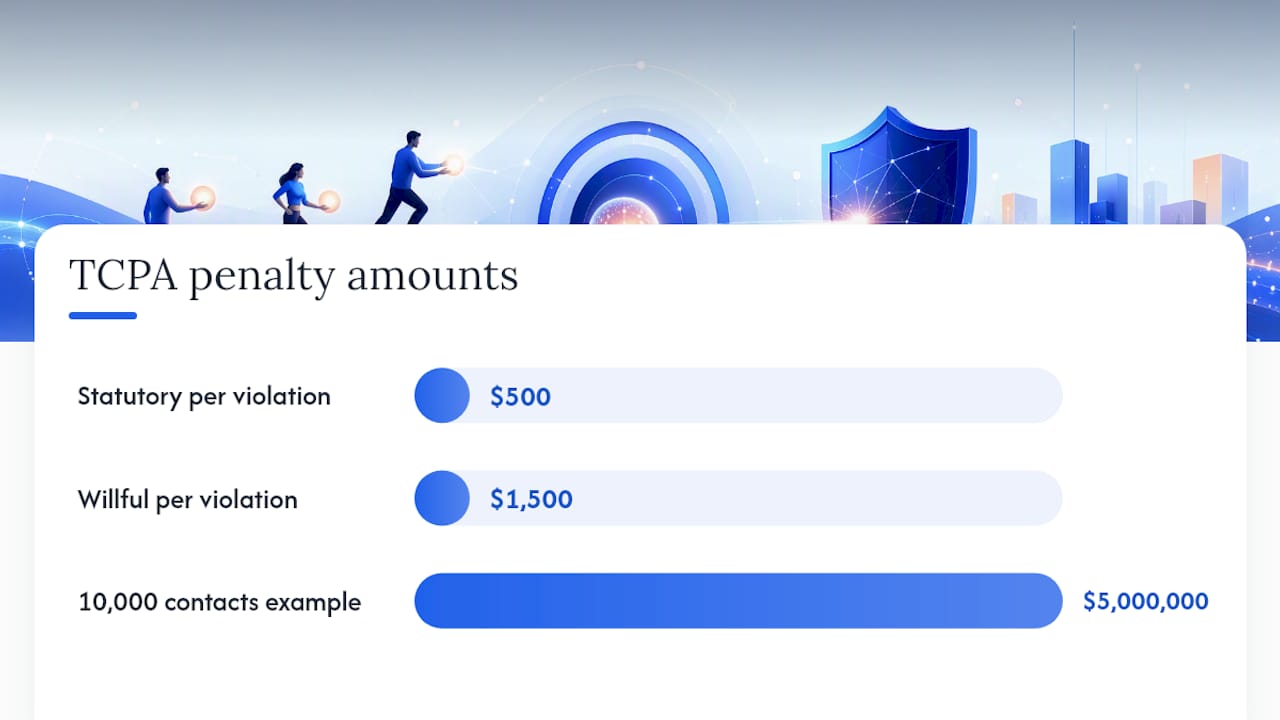
Statutory damages run $500 per violation, climbing to $1,500 per violation when a court finds the conduct willful or knowing. Each call or text generally counts as a separate violation, which is why a single bad list of 10,000 numbers dialed once can theoretically expose a company to $5 million in statutory damages before a court even considers actual harm.
That per-contact math is exactly what drives TCPA class-action settlement values into eight figures. Plaintiffs’ attorneys don’t need to prove financial loss. They need to prove the calls happened without valid consent, then multiply.
Claims under §227(b), covering autodialed and prerecorded calls, and §227©, covering DNC and internal do-not-call violations, work differently in practice. Section 227(b) claims typically require less proof of an ongoing pattern, while §227© claims often hinge on whether a consumer’s number was actually on the National DNC Registry or your internal list at the time of the call. Many defense strategies fail because a company can show consent for the call itself but can’t show the number wasn’t also flagged for DNC purposes.
State-level statutes can stack enhanced penalties on top of federal exposure, so a campaign that clears federal TCPA review isn’t automatically clear everywhere you’re calling.
What Records Should You Keep for TCPA Compliance?
Retain consent screenshots or form captures, exact disclosure text shown at the time of opt-in, timestamps, call and text logs, opt-out and revocation records, and periodic reassigned-number database queries. A five-year retention window is a common benchmark among call center compliance practices, aligning with typical statute-of-limitations exposure for telemarketing claims.
The practical architecture matters as much as the retention period. Consent records stored in a system that can be edited after the fact carry far less weight in litigation than immutable, timestamped logs tied directly to the lead record in your CRM. Vendor contracts should specify how long the vendor retains its own consent evidence and require it to be exportable to your counsel on short notice, not just available “on request” with no defined timeline.
What’s a Practical Pre-Launch and Ongoing Compliance Checklist?
Run this sequence before any campaign goes live, then repeat the ongoing steps on a fixed calendar:
- Scrub the calling list against the National DNC Registry and applicable state registries.
- Verify consent language for every record, confirming it names your company for telemarketing contact.
- Confirm your revocation disclosure and stop-keyword handling are active on every channel used.
- Check that caller ID displays accurately and matches your registered business identity.
- Repeat the DNC scrub every 31 days and re-run reassigned-number checks on older lists.
- Audit agent scripts and AI voice scripts for required disclosures, and monitor call drop rates for dialer-pacing issues that can signal ATDS risk.
Pro Tip: Set a recurring calendar reminder for your DNC scrub separate from your campaign launch calendar. Teams that tie scrubbing to launch dates instead of a fixed 31-day cycle almost always drift out of compliance on longer-running campaigns.
If you suspect a violation, pause the campaign immediately, pull a sample of consent records for the affected list, loop in counsel before making public statements, and correct both the list and the vendor contract that let the bad data through.
How MediaBloom Supports TCPA-Compliant Outbound Campaigns
Compliance controls only work if they’re built into the platform placing the calls, not bolted on afterward. The platform’s outbound infrastructure links consent capture directly to each lead record, integrates DNC scrubbing into campaign workflows, and maintains audit logs designed to hold up under the kind of scrutiny described above.
When evaluating any outbound platform, ask specifically to see: a consent record export tied to individual leads, immutable audit logs showing call and text history, automatic revocation propagation across voice, SMS, and CRM systems, and documentation of strong security controls. A vendor that can’t demonstrate these live in a demo isn’t ready for regulated outbound work, regardless of what the sales deck claims.
Compliance as Revenue Protection, Not a Cost Center
Sales leaders tend to treat TCPA controls as legal’s problem until a demand letter arrives, and by then the damage is already counted in dialed calls. I’d argue the healthier frame is revenue continuity: every clean list and documented consent record is protecting pipeline you already paid to build. Add a quarterly TCPA health check to your sales ops rhythm, owned jointly by sales, legal, and ops, not just legal alone.
— MediaBloom
Run Compliant Outbound Campaigns Without Building It Yourself
Most sales teams patch together DNC scrubbing, consent tracking, and revocation handling across three or four disconnected tools, then hope the gaps don’t show up in a demand letter. Integrated AI voice automation ties consent capture, DNC integration, and audit logging into a single system that places calls and sends texts, so the compliance evidence exists automatically instead of being reconstructed after the fact.
If your outbound program touches purchased leads, AI voice agents, or high-volume SMS campaigns, a platform built around documented consent linkage and audit trails removes a meaningful chunk of the manual audit work described above. For teams managing large volumes of automated marketing touches, pairing this with disciplined process reviews for your broader automation stack keeps compliance controls from drifting as campaigns scale. Watch a live demo of the AI voice agent to see consent tracking and revocation handling in action before your next campaign launch.
Sources
- FCC order / DOC-424844A1.pdf
- Telephone Consumer Protection Act (TCPA) - FCC
- TCPA damages and lawsuits | Recording Law
- FTC Q&A on telemarketers and DNC provisions (TSR)
- Fifth Circuit rejects application of FCC’s prior express written consent requirement | Womble Bond Dickinson
FAQ
What Are the New TCPA Rules for 2026?
The most significant recent development is the FCC’s extended waiver on the revocation-scope requirement, now delayed until January 31, 2027, giving companies more time to build systems that honor any reasonable revocation method within 10 business days. Circuit courts continue to split on autodialer definitions, so national sales teams should track both FCC guidance and relevant circuit rulings for their calling states.
What Are Five Major Types of TCPA Violations?
Common violation categories include calling or texting without prior express consent, using an autodialer or prerecorded voice without prior express written consent for telemarketing, failing to honor a revocation request within the required window, calling numbers on the National DNC Registry without an established business relationship exemption, and failing to identify the caller accurately through caller ID.
Who Must Comply With TCPA Rules?
Sellers, telemarketers, third-party dialing vendors, and lead buyers all face potential liability, since courts look at who controlled the list, script, or dialing decision rather than who physically placed the call. Businesses that benefit commercially from a call can be named in a lawsuit even without direct involvement in dialing.
Which Communications Are Not Covered by TCPA Rules?
Calls placed manually without any automated dialing technology to a number that provided prior express consent generally fall outside the strictest TCPA provisions, as do certain emergency calls and calls made for purposes explicitly exempted by the FCC, such as some non-marketing informational messages to established customers. State laws may still regulate these communications even when federal TCPA rules don’t apply directly.
How Can Sales Teams Verify TCPA Compliance Before Launching a Campaign?
Confirm consent language names your company specifically, run a DNC scrub within the last 31 days, and test your revocation and stop-keyword handling on every channel before dialing. Platforms like MediaBloom that link consent records directly to each lead make this verification step faster to complete and easier to document for an audit.