Speed to lead measures the time between a prospect’s action, a form submission, a chat start, an inbound call, and your first meaningful response. The practical target for most B2B teams: respond within one hour, and cut that to under five minutes for high-intent leads like demo requests or pricing inquiries. The evidence and the exact playbook to get there follow below.
TL;DR:
- Response times should be measured from the actual prospect’s action to the first meaningful outreach, not from internal system events or delays.
- Responding within five minutes for high-intent leads significantly increases contact and qualification rates, especially when automation ensures immediate acknowledgment.
- Automating pre-contact processes like lead enrichment, routing, and escalation reduces delays caused by manual workflows and queue waiting times.
- Accurate reporting requires median response times and tiered SLAs, with specific targets of under five minutes for high-intent leads and under an hour for mid-intent prospects.
- AI-driven engagement tools can achieve response times under 60 seconds, helping teams close the response gap without overtaxing human reps.
Table of Contents
- What Is Speed to Lead, Exactly?
- Why Speed to Lead Matters for Conversion
- What Response Time Should You Actually Target?
- How to Actually Cut Your Response Time
- How to Measure and Report Speed to Lead Correctly
- A 30/90/180-Day Roadmap to Get There
- How MediaBloom Puts Speed to Lead Into Practice
- Systems Beat Slogans
- See Speed to Lead in Action
- Sources and Further Reading
- Sources
- FAQ
What Is Speed to Lead, Exactly?
Speed to lead sounds simple until you try to measure it across a real sales stack. Different teams start the clock at different moments, and that inconsistency is why two companies can both claim a “10-minute” response time while one is lying to itself.
An audit of 14 public sources on this topic found 18 different clock definitions in active use, which means the widely quoted statistics on speed to lead often aren’t comparing the same thing at all. Some measure time to first contact attempt (a dial or an email send). Others measure time to actual contact (the prospect picks up or replies). Still others measure time to qualification or time to conversion, which bundle in the entire sales cycle rather than isolating the response gap. A fourth family, automation clock time, measures how fast a system acknowledges a lead, not how fast a human engages with it.
The start event matters just as much as the stop event. The clock should start at the prospect’s action: the form timestamp, the moment a chat session opens, or the instant an inbound call rings. Not when a rep happens to notice the lead in their CRM queue, and not when a lead sync job finally runs. Starting the clock late is the single most common way teams flatter their own numbers.
What counts as the “stop” is just as important. A meaningful response engages the prospect’s actual question or intent. A non-meaningful response is noise dressed up as speed:
- A generic auto-reply email that says “we got your message” with no personalization or next step
- A CRM-triggered task assignment that never reaches the prospect
- A missed call with no voicemail or follow-up text
- A chatbot message that loops the prospect back to a static FAQ page instead of routing to a human or booking link
A personalized acknowledgment with a live calendar link counts as meaningful. A silent database update does not. If your reporting can’t tell the difference, your speed-to-lead number is measuring the wrong thing.
Why Speed to Lead Matters for Conversion
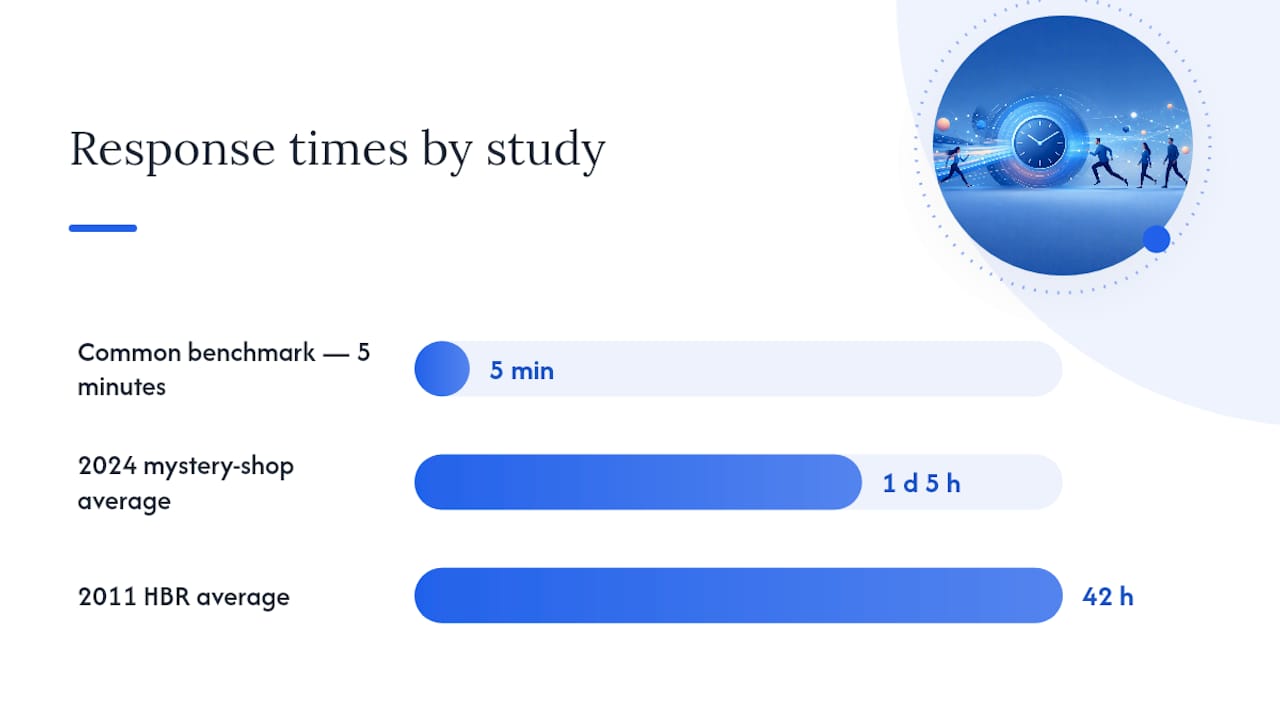
The most cited number in this space, that responding within five minutes generates roughly 100 times higher odds of contact and 21 times higher odds of qualification than waiting 30 minutes, comes from the 2007 Lead Response Management study built on more than 15,000 web leads and over 100,000 dial attempts across six companies. That figure gets repeated constantly, almost always without its scope attached. It measured contact and qualification rates, not closed revenue, and it reflects call center dynamics from nearly two decades ago. Treat it as directional evidence that speed changes outcomes dramatically, not as a literal multiplier you can apply to your own pipeline.
The Provenance Problem: Any speed-to-lead statistic you see quoted needs three things attached before you trust it: the sample size, the clock definition, and the denominator. Without those, a “100x” claim and a “2x” claim could describe the exact same underlying behavior measured two different ways.
A more recent and more rigorously scoped data point comes from Harvard Business Review’s 2011 audit of 2,241 US companies. Among firms that responded within 30 days at all, the average response time was about 42 hours, and 23% of the companies audited never responded to the lead whatsoever. The same research, drawing on a separate large lead dataset, found that reps who contacted a lead within one hour were several times more likely to qualify that lead than reps who waited longer. That’s a much more conservative and more defensible number than the 2007 figures, and it comes from a larger, more diverse sample.
The pattern holds in newer audits too. A 2024 mystery-shop study sent demo requests to 1,000 B2B SaaS websites and got 365 replies, averaging roughly one day and five hours to first response. Here’s the takeaway that matters more than any single multiplier: most B2B companies are still catastrophically slow, and that gap is your opportunity. You don’t need to beat a mythical 100x benchmark. You need to beat the competitor who takes 42 hours or never calls back at all.
What Response Time Should You Actually Target?
Benchmarks only work when they’re tiered to lead intent. A demo request and a whitepaper download are not the same event, and treating them with the same SLA either burns out your reps chasing cold leads or lets your hottest prospects go cold waiting for a callback.
- High-intent leads (demo requests, pricing pages, “contact sales” forms): target a meaningful human or AI-assisted response inside five minutes, with an automated acknowledgment firing in under 60 seconds to hold the prospect’s attention while a rep gets looped in.
- Mid-intent leads (content downloads with buying-stage signals, webinar attendees who ask a question, pipeline reactivation replies): target under one hour.
- Low-intent leads (newsletter signups, early-funnel content, generic inquiries): a 24-hour window or the standard nurture cadence is acceptable.
On the reporting side, aim for 80 to 90% SLA compliance within each tier rather than chasing 100%. A hard 100% target usually means your SLA windows are too loose to be useful. And when you report internally, use the median response time rather than the mean: a handful of overnight leads that sat for 10 hours will drag your average into meaningless territory while the median tells you what a typical prospect actually experiences.
Pro Tip: Set your SLA clock to pause during defined off hours only if your buyers genuinely don’t expect weekend or evening response. B2B buyers researching vendors at 9 p.m. on a Tuesday still expect a human or at least a competent bot to answer.
How to Actually Cut Your Response Time
Most teams try to fix speed to lead by telling reps to “move faster.” That approach fails almost every time, because the delay usually isn’t rep laziness. It’s architecture. The lead sits in a queue, waits for enrichment, waits for routing logic, and only then lands in front of a human who still has to context switch out of whatever they were doing. Fixing the system beats exhorting the people in it.
-
Audit your current state for 90 days before changing anything. Pull every lead timestamp from the form platform itself, not from your CRM’s “created date” field, which often lags the actual submission by minutes or hours due to sync jobs. Segment the results by lead type so you know your real baseline per tier, not a blended average that hides your worst offenders.
-
Automate everything that happens before a rep ever sees the lead. An enrichment waterfall should pull firmographic and contact data automatically the instant a lead arrives, rather than making a rep look up the company manually. Lead-to-account matching should run against your CRM in real time so a new lead from an existing account routes to the assigned rep instead of sitting in a generic queue. Intelligent routing rules based on territory, deal size, and product interest can shrink the processing half of your clock from hours to single-digit seconds, and that processing delay is usually the biggest hidden cost in your current numbers.
-
Fire a personalized auto-acknowledgment the instant the lead lands, with a calendar link embedded. This doesn’t replace human follow-up. It buys time. A prospect who books a 15-minute call directly off your acknowledgment email has effectively self-served their own next step, and testing on this tactic shows it reliably converts idle wait time into booked meetings while a rep is still reviewing the enriched record.
-
Build conditional sequencing for unclaimed leads. If a routed lead sits unclaimed past a defined threshold, say, three minutes for a high-intent lead, an AI voice agent or chatbot should engage first rather than letting the lead go cold. This isn’t about replacing reps. It’s about making sure no lead experiences total silence just because a rep was in a meeting.
-
Layer in escalation rules with real teeth. A lead unclaimed past its SLA window should trigger a mobile push notification to the assigned rep, then a Slack or SMS alert to their manager if it’s still unclaimed 10 minutes later, then automatic reassignment to the next available rep in the routing pool. Escalation without reassignment is just a louder notification. It needs to actually move the lead to someone who will act.
The common thread across all five steps: none of them depend on reps being more motivated. They depend on the system making the fast response the default path, with human effort applied only where judgment is genuinely required.
How to Measure and Report Speed to Lead Correctly
Get the clock definition wrong and every downstream report is wrong with it. Start the clock at the form platform’s own submit timestamp, not your CRM’s lead-created timestamp, since the gap between those two events can run anywhere from seconds to hours depending on your integration setup. Stop the clock at the first outreach that meets your own definition of meaningful, and write that definition down so every rep and every dashboard applies it the same way.
Report using median time and distribution buckets rather than a single average figure:
- 0 to 5 minutes: your high-intent SLA target
- 5 to 60 minutes: acceptable for mid-intent leads
- 1 to 24 hours: the low-intent nurture zone
- 24 hours plus: a breach that should trigger a root-cause review, not just a data point
A dashboard built on those buckets should track four numbers on a rolling basis: median speed to lead by tier, SLA adherence rate as a percentage, lead-to-meeting conversion rate broken out by response bucket, and breach rate by hour of day. That last metric is the one most teams skip, and it’s usually the one that exposes your biggest gap: a routing system that performs beautifully from 9 to 5 and falls apart every evening and weekend.
Three pitfalls quietly corrupt these numbers in almost every RevOps stack. CRM sync lag inserts a delay between the real event and when your system logs it. Poor deduplication logic can log the same lead twice, once through a form and once through a chat session, and count the second “response” as a duplicate contact rather than the follow-up it actually is. And picking the wrong start event, using “lead assigned” instead of “lead submitted,” makes your team look faster than it actually is to the prospect sitting on the other end.
A 30/90/180-Day Roadmap to Get There
Building a serious speed-to-lead program is not a weekend project, but it also doesn’t require a year-long transformation initiative. Here’s a phased path that operations leaders can actually execute with existing headcount.
-
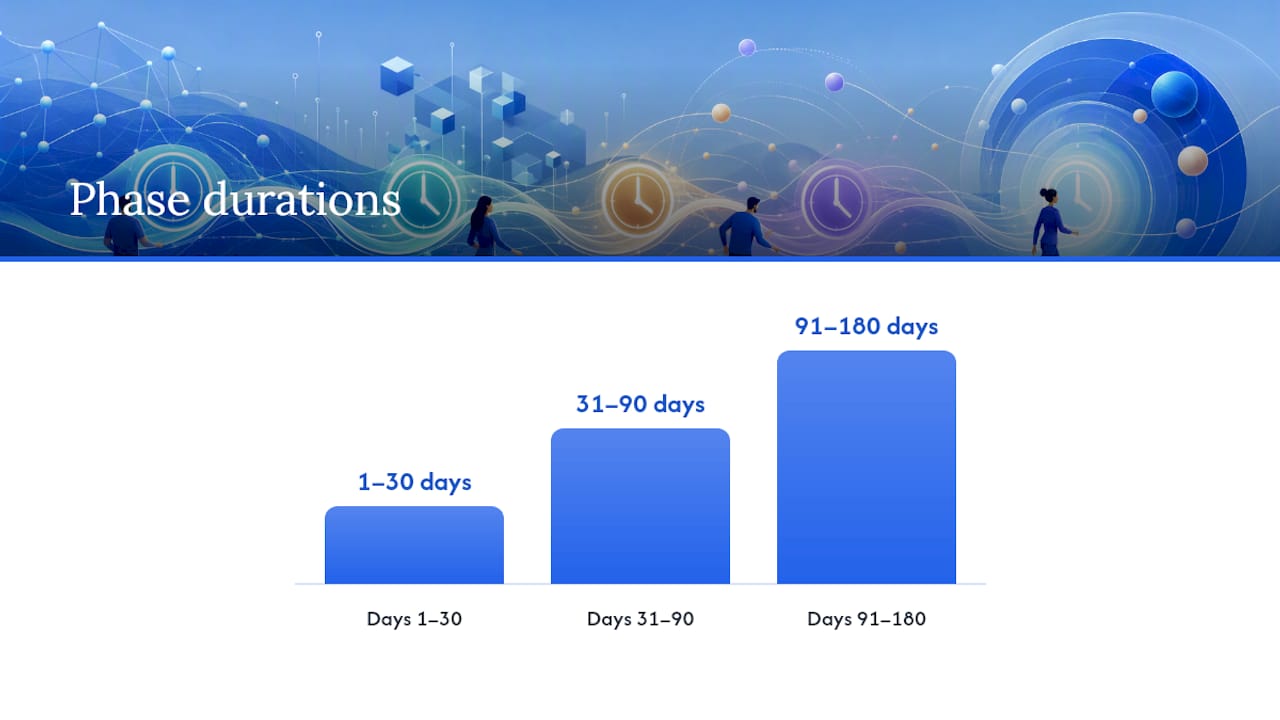
Days 1 to 30: Instrument and define. Audit every lead source’s timestamp accuracy, define your lead tiers and their SLA windows in writing, and deploy a basic auto-acknowledgment for at least your highest-intent lead type. This phase is about visibility, not sophistication.
-
Days 31 to 90: Automate the middle. Stand up a routing engine that assigns leads based on territory and deal criteria without human triage. Build or buy an enrichment waterfall so reps never manually look up firmographic data again. Add SLA breach alerts and embed calendar booking links in every acknowledgment touch.
-
Days 91 to 180: Layer in intelligence and governance. Introduce AI-assisted voice or chat fallback for leads that go unclaimed past their SLA window. Start tuning routing rules based on the conversion-by-bucket data your dashboard has accumulated. Build an executive dashboard that surfaces median speed to lead, adherence rate, and breach patterns for leadership review.
Pro Tip: Assign one named owner for speed-to-lead governance from day one, ideally someone in RevOps rather than sales leadership. When accountability is diffuse across “the whole sales team,” breach rates quietly creep back up within a quarter.
Ownership matters as much as tooling. Write a short runbook that documents your SLA definitions, escalation triggers, and reassignment logic, and train every new rep on it during onboarding rather than treating it as tribal knowledge passed down informally.
How MediaBloom Puts Speed to Lead Into Practice
Closing the gap between “we know we should respond faster” and “we consistently do” is where most B2B teams stall out. MediaBloom’s platform is built specifically for that gap, combining AI voice agents that handle inbound and outbound calls, chatbots that engage web visitors the instant they land on a page, and multichannel automation that spans voice, SMS, email, and chat into one coordinated response layer.
The integration piece matters more than it sounds. A speed-to-lead system that can’t talk to your existing CRM just creates a second queue to manage. A modern speed-to-lead system connects to many CRM platforms, so lead enrichment, routing, and appointment booking happen inside the systems teams already use rather than forcing a workflow migration.
In verticals where response time is directly tied to conversion, insurance, financial services, and real estate among them, the typical pattern MediaBloom’s clients see is engagement under 60 seconds from the moment a lead arrives, driven by AI handling the first touch while human reps focus on qualified conversations. Onboarding often covers compliance posture alongside technical integration work, so speed gains don’t come at the cost of governance.
Systems Beat Slogans
Most speed-to-lead advice tells reps to “just respond faster,” as if the bottleneck were willpower. It rarely is. The bottleneck is architecture: leads sitting in unrouted queues, enrichment done manually, acknowledgments that don’t exist. Fix the pipes before you fix the people.
The leadership move that actually works is treating speed to lead as a cross-functional owned metric, not a sales team scorecard item. RevOps, marketing, and sales all touch the clock at different points, and none of them can fix it alone. Start with one step this week: pull your median response time by lead tier for the last 30 days. Most leaders are shocked by what they find.
— MediaBloom
See Speed to Lead in Action
There’s no substitute for watching a system engage a lead in real time versus reading about one in theory. MediaBloom gives revenue teams a done-for-you path to sub-60-second engagement, without the months of internal build-out a custom routing and automation stack usually demands.

Companies like the ones featured in MediaBloom’s Fifth Avenue Leads case study and My Legal Coach case study show what happens when AI voice agents, chatbots, and CRM-integrated routing replace the manual triage most teams still run today. If you’re evaluating whether an automation-first approach fits your lead volume and vertical, browse the full set of AI appointment setting case studies for outcomes across industries, then get a demo of the platform to see how your own lead flow would route through it.
Sources and Further Reading
- The Short Life of Online Sales Leads, Harvard Business Review’s 2011 audit of 2,241 companies, the source of the 42-hour average response figure and the one-hour qualification advantage.
- Speed to Lead Statistics: 14 Studies, 18 Different Clocks, an audit tracing the original 100x/21x figures back to their source and documenting how inconsistent clock definitions distort the field.
- Speed to Lead: The B2B Guide to Faster Response, practitioner guidance on tiered SLA targets and automation-first architecture.
- Speed to Lead: Traced to Their Real Sources, recent mystery-shop audit data showing real-world average response times among B2B companies.
Sources
Because researchers use different clock definitions, some measure time to contact attempt, others measure time to actual contact or qualification, and an audit of 14 sources found 18 distinct definitions in use, which makes raw comparisons across studies unreliable without checking each one’s scope.
- The Short Life of Online Sales Leads (Harvard Business Review)
- Speed to Lead Statistics: 14 Studies, 18 Different Clocks (IVRISTech audit)
- Speed to Lead: Traced to Their Real Sources (LeadSource)
FAQ
What Does Speed to Lead Mean?
Speed to lead is the time between a prospect’s action, like submitting a form or starting a chat, and your first meaningful response. It’s typically measured as a median across lead tiers rather than a single average figure.
How Important Is Speed to Lead for Conversion?
It’s one of the strongest levers available: HBR’s audit found leads contacted within an hour were nearly seven times more likely to qualify than those contacted an hour later, and most companies still respond far slower than that window.
Can AI Actually Improve Speed to Lead?
Yes. AI voice agents and chatbots can engage a lead within seconds of arrival, which is why platforms like MediaBloom’s speed-to-lead solution are built specifically to handle the first touch while human reps focus on qualified conversations.