SMS deliverability is the percentage of sent text messages that carriers confirm as delivered to a live handset, calculated as delivered messages divided by total sent, times 100. A healthy rate sits at or above 95% for marketing texts and closer to 98% for transactional ones. The first move for any team seeing weak numbers is not rewriting copy. It is auditing your 10DLC registration and routing setup.
TL;DR:
- Standard delivery rates for marketing texts should be at or above 95%, while transactional messages aim for 98 percent or higher.
- Nearly all delivery failures are infrastructure-related, with issues such as carrier filtering, gray routes, or registration mismatches causing most problems.
- Proper registration, verified consent, and list hygiene are critical steps to improve deliverability and avoid carrier throttling or blocking.
- Running daily metrics on carrier-specific delivery rates and error trends helps catch issues early and prevents losses in campaign effectiveness.
- Choosing a provider with verified carrier routes and comprehensive support simplifies compliance and enhances overall messaging reliability.
Table of Contents
- What Does SMS Deliverability Actually Measure?
- Why Deliverability Problems Cost More Than They Look Like
- Common Causes of SMS Delivery Failure
- The Registration and Compliance Layer That Decides Whether Carriers Trust You
- A Working Checklist to Improve SMS Deliverability
- What to Track Daily and How Fast to React
- How MediaBloom Approaches Deliverability Operations
- Build It In-House or Bring In a Managed Vendor?
- Get Deliverability Handled Instead of Guessed At
- Where to Verify These Rules Yourself
- Sources
- FAQ
What Does SMS Deliverability Actually Measure?
Every text you send generates a delivery receipt (DLR) as it moves through the carrier network. That receipt reports a status: accepted by the carrier, delivered to the handset, or undelivered/rejected. The delivery rate formula is simple, delivered messages divided by messages sent, but the number behind it depends heavily on how honestly your provider’s routes report status.
Here’s the catch most marketers miss: not every DLR tells the truth. Direct carrier connections report real, carrier-confirmed statuses. Gray routes, unofficial paths that repurpose consumer or international connections for bulk business texting, often report a message as “delivered” the moment it leaves the sending server, regardless of what happens afterward. That gap between reported and actual delivery is why two platforms can show you different numbers for the same campaign.
- Accepted: the carrier’s network has taken the message for processing.
- Delivered: the handset’s carrier confirms the message reached the device.
- Undelivered/rejected: the message was blocked, filtered, or failed to reach a valid destination.
Why Deliverability Problems Cost More Than They Look Like
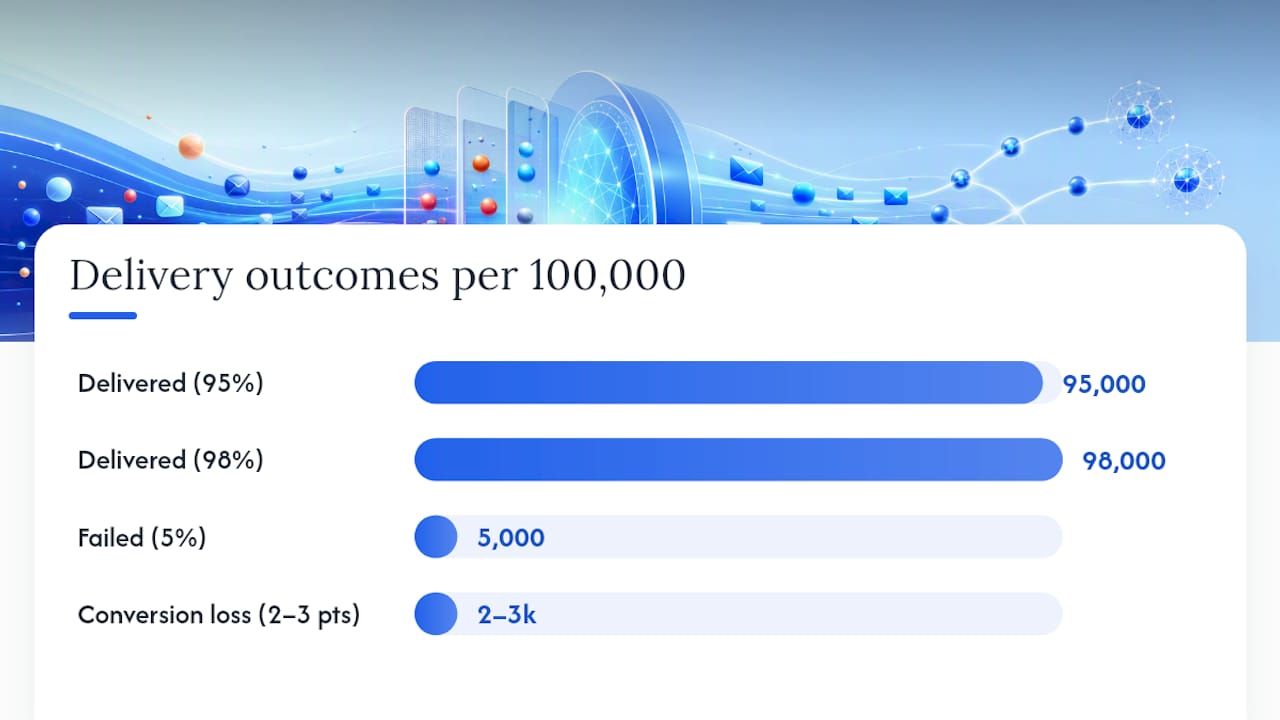
A 5% failure rate on a 100,000-message campaign is 5,000 customers who never got your appointment reminder, discount code, or one-time password. You still paid for those messages. You just did not get the outcome you were paying for.
A gap you can measure, and one you’re probably losing money to right now. Marketing texts should land at 95% delivery or higher, with well-configured transactional flows reaching 95 to 98%. One-time passcodes make the stakes obvious: if an OTP fails to arrive within its validity window, the customer abandons checkout, and that is a completed sale walking away over a routing failure, not a pricing objection or a product problem. Multiply that across a login flow processing thousands of authentications daily, and a two- or three-point gap in delivery rate becomes a measurable dent in conversion.
Common Causes of SMS Delivery Failure
Before touching your message copy, work through the list below in order. Most delivery failures trace back to infrastructure, not creative.
- Carrier filtering and content scoring. Carriers score messages on link structure, sudden sending-volume changes, and complaint history. A message that looks like spam to a filtering algorithm gets blocked regardless of how relevant it is to the recipient.
- Gray routes. Traffic pushed through unofficial or international paths gets deprioritized, throttled, or silently dropped by US carriers, even when your dashboard shows it as sent.
- Unregistered sender or campaign mismatch. If your 10DLC campaign registration does not match what The Campaign Registry has on file, or your templates don’t match your declared use case, carriers reject or heavily throttle the traffic.
- Invalid, ported, or landline numbers. Numbers that have changed carriers, converted to landlines, or were never valid mobile numbers to begin with fail outright. Poor list hygiene compounds this over time.
- Volume spikes. A number that suddenly jumps from a few hundred messages a day to tens of thousands looks like spam to carrier algorithms, even if the increase is a legitimate seasonal campaign.
- Device and carrier-side issues. Full inboxes, blocked senders, and regional carrier outages sit outside your control but still show up in your delivery numbers, so it pays to isolate them before assuming a systemic problem.
The Registration and Compliance Layer That Decides Whether Carriers Trust You
US carriers no longer treat business texting as an open channel. Since the 2023 to 2025 enforcement push, unregistered long-code traffic has become unreliable at best and blocked at worst. Two systems now gate almost every A2P (application-to-person) message sent in the United States.
A2P 10DLC and The Campaign Registry require you to register your brand and describe your specific use case (marketing, appointment reminders, two-factor authentication, and so on) before carriers assign your traffic a trust score. Low trust scores mean throttled throughput; high scores mean your messages move faster and get filtered less aggressively. CTIA Messaging Principles function as the practical rulebook carriers use to evaluate whether your registered use case matches your actual message content. A mismatch between what you registered and what you send is one of the fastest ways to get flagged, and treating CTIA and TCR requirements as part of initial campaign design, rather than a post-launch fix, avoids most of that friction.
| Requirement | What it governs | Deliverability impact |
|---|---|---|
| A2P 10DLC / TCR | Brand and campaign registration | Determines trust score and throughput |
| CTIA Messaging Principles | Content and use-case matching | Drives carrier filtering decisions |
| TCPA / FCC rules | Consent, opt-out handling | Legal exposure plus carrier-level blocking |
The FCC’s Second Report and Order extends National Do-Not-Call Registry protections to text messages and requires terminating carriers to block texts once the Commission notifies them of illegal messaging. Registration gets your traffic recognized. Consent, meaning documented, verifiable opt-ins under TCPA, keeps you compliant and out of the blocking queue in the first place. You need both. Registration without clean consent still gets you blocked eventually, and consent without registration still gets throttled by carriers who don’t recognize your traffic.
A Working Checklist to Improve SMS Deliverability
Fixing deliverability is mostly disciplined maintenance, not clever tactics. Work through this in order:
- Capture and verify consent. Use double opt-in where your use case allows it, and keep a timestamped record of every consent event.
- Register your campaign correctly. Match your TCR use-case description to your actual message content before you send a single text.
- Clean your number list at capture. Validate mobile numbers in real time and strip landlines, invalid formats, and duplicates before they ever hit a send.
- Remove hard bounces immediately. A number that fails once and gets retried repeatedly drags down your sender reputation for every message after it.
- Warm new numbers gradually. Ramp volume over days or weeks rather than firing full campaign volume on day one, since sudden spikes read as spam to carrier filters.
- Use branded HTTPS links, never public shorteners. Generic shortened links get flagged more often than branded, traceable domains.
- Segment and control frequency. Fewer, better-targeted messages outperform blasting the full list on every send, and respecting quiet hours by recipient time zone, not sender time zone, cuts complaint rates.
- Choose a provider with documented direct carrier routes. Ask for routing documentation before you sign, not after your first campaign underperforms.
Pro Tip: Run a sample test across your three or four largest carriers before scaling any new campaign. A route that performs well on one carrier can silently fail on another, and you will not catch that from aggregate delivery numbers alone.
What to Track Daily and How Fast to React
Deliverability problems compound quietly. By the time your aggregate numbers look bad, you have usually already lost days of underperformance you could have caught early.
- Delivery rate by carrier, not just in aggregate. A single carrier dragging down your overall number points to a route problem, not a content problem.
- DLR error rate, with anything climbing above roughly 6% treated as a red flag worth immediate investigation.
- Opt-out and complaint rate, since spikes here often precede carrier filtering before your delivery rate itself drops.
- Click-through rate, which can reveal silent delivery failures even when your DLRs look clean, particularly on gray routes reporting false positives.
When a red flag appears, pause the affected segment, isolate the carrier or route causing it, and run a small sample test before resuming full volume. For time-sensitive flows like authentication codes, keep a fallback channel, voice calls or app-based push, ready so a delivery failure doesn’t cost you the transaction entirely.
How MediaBloom Approaches Deliverability Operations
Reliable SMS delivery isn’t a single fix. It’s registration done right, routes verified against real carriers, and monitoring that catches problems before customers notice them.
MediaBloom builds SMS into a broader omnichannel messaging stack, pairing text with voice, chat, and email so a delivery failure on one channel doesn’t stall an entire lead flow. Work with a client like Commserve Connect shows what that looks like operationally. Any vendor you evaluate should hand you routing documentation, registration support, and a remediation SLA before you sign, not after your first campaign underperforms.
— MediaBloom
Build It In-House or Bring In a Managed Vendor?
Running deliverability in-house demands real capability: dedicated registration management, multi-carrier monitoring, and staff who can diagnose route problems fast. That is a lot of overhead for a marketing team whose real job is campaigns, not carrier compliance. A managed vendor earns its keep when it brings direct carrier routes, registration handling, and remediation support you would otherwise build from scratch.

Get Deliverability Handled Instead of Guessed At
Chasing gray-route DLRs and mismatched TCR templates is not where your marketing team’s time belongs. Mediabloom is the alternative to piecing together deliverability yourself, an all-in-one platform that folds SMS into a broader omnichannel setup covering voice agents, chatbots, and sales automation, with registration and routing handled as part of deployment rather than left for your team to untangle after launch.

Some companies have used MediaBloom’s platform to move leads across channels, generating substantial monthly leads without building carrier compliance infrastructure from the ground up. If you’re evaluating a vendor for SMS or broader omnichannel messaging, ask for routing documentation, 10DLC and TCR support details, and case-study results during the demo. That’s exactly what a demo of MediaBloom’s platform is built to show you, alongside how Reactivation AI can put underperforming contact lists back to work once your messaging infrastructure is solid. For teams that also need a broader campaign playbook, this marketing automation checklist is a useful companion resource.
Where to Verify These Rules Yourself
The FCC’s Second Report and Order covers text-blocking mandates and Do-Not-Call protections in full legal detail. Holland & Knight’s primer on CTIA messaging principles breaks down how carriers apply those rules in practice. For technical routing and 10DLC mechanics, Authgear’s deliverability explainer and Omnisend’s best-practices guide both go deeper into the operational fixes covered above.
Sources
- FCC Second Report and Order (text blocking, DNC protections)
- What is SMS Deliverability: Tips to Improve it in 2026 (Omnisend)
- SMS Deliverability: Why texts fail & how to fix it (Authgear)
FAQ
Is SMS Becoming Obsolete?
No. SMS remains one of the highest open-rate channels available to marketers, and carriers continue investing in A2P infrastructure like 10DLC specifically because business texting volume keeps growing, not shrinking. The channel is getting more regulated, not less relevant.
Do SMS Texts Always Get Delivered?
No, and delivery receipts don’t always tell the full story either. Gray routes in particular can report a message as delivered when it never actually reached the handset, which is why sample testing across carriers matters more than trusting a dashboard number alone.
Is SMS Text Blasting Illegal?
Sending unsolicited bulk texts without proper consent violates TCPA rules, and the FCC’s Second Report and Order extends Do-Not-Call protections to text messaging specifically. Legal, compliant SMS marketing requires documented opt-in consent and proper campaign registration, not a blast to every number you can find.
What Causes a Delay in Delivering SMS Messages?
Delays typically trace back to carrier filtering, volume spikes that trigger throttling, or gray routes that queue messages behind other traffic. Checking your registration status and route type is a faster diagnostic step than assuming the delay is random network congestion.