

By the end of 2026, conversational AI will slash global contact center labor costs by $80 billion. If your sales pipeline still relies on manual qualification or fragmented tools, you aren't just losing efficiency; you're hemorrhaging revenue. Modern enterprise growth requires more than a basic chat widget. It demands sophisticated AI sales chatbot solutions that act as the foundational architecture for your revenue operations. You've likely felt the sting of low-quality leads clogging your pipeline and the high cost of maintaining human BPO for initial outreach. It's a common bottleneck that stalls scaling and creates data silos between your chat tools and your CRM.
We're here to help you bridge that gap. This article delivers the definitive blueprint for building an autonomous sales assistant that works 24/7 to qualify leads and book meetings without human intervention. You'll master the logic required to engineer a system that integrates seamlessly into your existing stack. We'll explore the technical requirements for real-time CRM synchronization and the strategic framework needed to transform a simple bot into a high-conversion AI engine. It's time to stop answering FAQs and start closing deals at scale.
Key Takeaways
- Learn why legacy rule-based bots are a strategic liability and how to transition to LLM-powered agents that drive tangible revenue.
- Identify the three architectural pillars of high-performance AI sales chatbot solutions to ensure technical mastery over complex sales logic.
- Evaluate the critical trade-offs between no-code speed and custom API flexibility to secure long-term enterprise scalability.
- Master a 5-step execution blueprint for mapping user journeys and engineering brand-aligned personas that convert.
- Synchronize your autonomous assistant with a multi-channel revenue engine to maintain a unified, data-rich pipeline across your CRM.
The Evolution of Sales Chatbots: Moving Beyond Basic Scripts
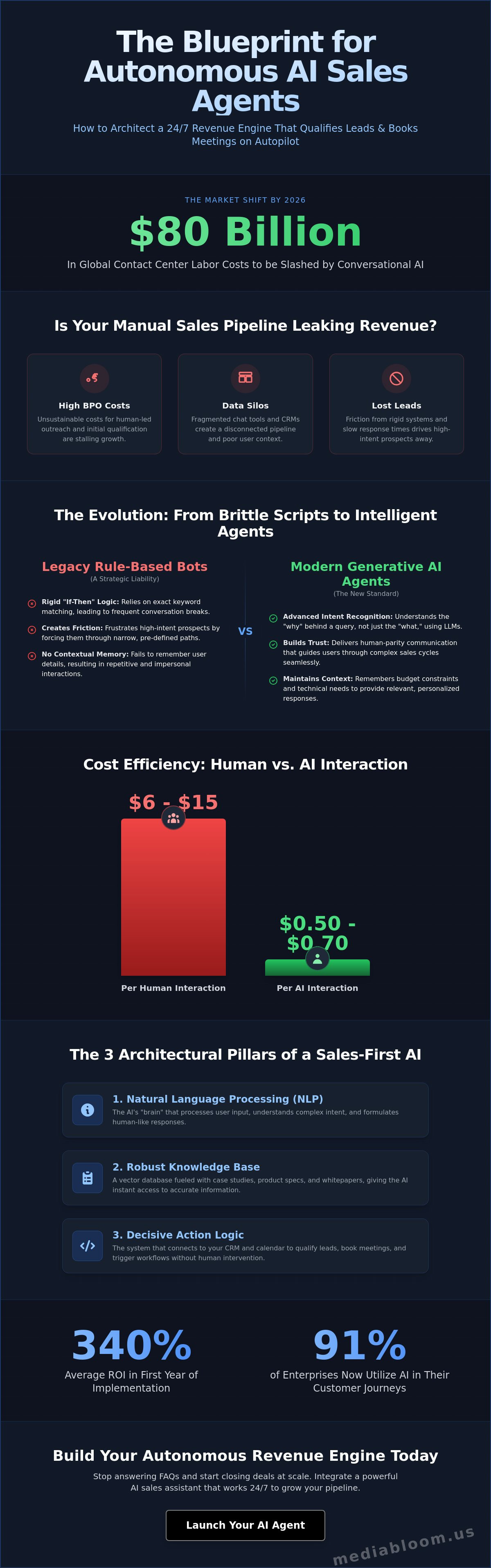
Legacy chatbots were essentially digital filing cabinets. They relied on rigid "if-then" logic that often frustrated high-intent prospects by forcing them through narrow, predictable paths. The Evolution of Sales Chatbots has moved past these primitive scripts into the era of agentic AI. In 2026, high-end brands view rule-based bots as a liability because they lack the nuance required for complex enterprise sales. Modern AI sales chatbot solutions leverage Large Language Models like GPT-4o and Claude 3 to achieve human-parity communication. They don't just respond; they understand. This shift from rigid decision trees to autonomous conversational agents is the new standard for revenue operations.
To better understand how these systems are deployed for growth, watch this breakdown:
Rule-Based vs. Generative AI: The Sales Impact
Rule-based bots are dying because they rely on keyword matching. If a user doesn't use the exact phrase programmed into the system, the conversation breaks. Generative AI utilizes sophisticated intent recognition. It understands the "why" behind a query, not just the "what." This creates a massive performance gap in lead retention. While old tech creates friction that drives prospects away, modern AI sales chatbot solutions maintain contextual memory. They remember technical requirements or budget constraints mentioned earlier in the session. This continuity is vital for complex sales cycles where building trust is as important as providing information.
Why 2026 is the Year of the Autonomous Revenue Engine
Human-led BPO services are becoming unsustainable for initial qualification. Research shows that a live human agent interaction costs between $6 and $15, whereas an AI interaction costs between $0.50 and $0.70. This cost-efficiency allows businesses to provide 24/7 availability without scaling headcount. These autonomous agents are the backbone of a modern lead nurturing framework. They provide immediate gratification to prospects, which has helped companies achieve an average ROI of 340% in their first year of implementation. With 91% of enterprises now utilizing AI in their customer journeys, the transition to an autonomous revenue engine is no longer optional. It's a competitive necessity for any business looking to scale efficiently.
Architecting the Conversation: Core Components of a Sales-First AI
A sales-first AI chatbot isn't a customer support tool. It's a data-integrated agent designed for high-velocity conversion. To build elite AI sales chatbot solutions, you must move beyond simple scripts and focus on three architectural pillars: Natural Language Processing (NLP), a robust Knowledge Base, and decisive Action Logic. This "Brain" functions as your top-performing SDR. It processes proprietary company data in milliseconds to provide accurate, brand-aligned responses. Consistency is non-negotiable. Every automated interaction must reflect your corporate persona. This ensures that the transition from AI to human sales remains indistinguishable and professional. In 2026, 91% of enterprises have already implemented chatbots in some capacity. The difference between a generic tool and a revenue engine lies in how these components interact to drive outcomes.
The Knowledge Base: Priming Your Bot for Success
Context is the fuel for your revenue engine. You must feed your AI the same materials your human reps use: case studies, whitepapers, and granular product specifications. This data is stored in a Vector Database. Think of this as a high-speed, intelligent index that allows the AI to retrieve the perfect answer instantly without hallucinating. Adopting a custom AI voice agent mindset is essential here. Whether the medium is text or voice, the underlying intelligence relies on the same structured data sets to maintain authority and technical accuracy. This strategic preparation is a core part of Platform Selection: Evaluating Frameworks for Enterprise Scalability. Without a deep knowledge base, your bot is just a script; with it, it's a strategic architect of the buyer journey.
Integration Logic: Connecting Chat to Your CRM
Isolation is the enemy of efficiency. Your chatbot must sync in real-time with your sales stack. When a prospect returns to your site, the AI should recognize them via CRM data, referencing previous interactions to personalize the dialogue. This isn't just about greeting them by name. It's about knowing their specific pain points and their current stage in the buyer journey. Modern systems use Webhooks to trigger immediate sales alerts the moment a high-value action occurs, such as a lead qualifying themselves for a demo. This seamless data flow reduces fragmented information and ensures your sales team has the full context before they ever hop on a call. If you're ready to modernize your infrastructure, it's time to discuss your custom CRM automation setup with a specialist. Scaling operations requires this level of technical mastery and operational excellence.
Platform Selection: Evaluating Frameworks for Enterprise Scalability
Choosing your platform is a binary decision between rapid deployment and long-term sovereignty. Speed-to-market is a seductive metric, but technical flexibility is the true currency of enterprise growth. Selecting an inadequate framework creates technical debt that can paralyze your revenue operations as you scale. High-performing AI sales chatbot solutions must balance ease of use with the ability to execute complex, multi-step sales logic. For enterprise-level brands, this often necessitates custom CRM automation setups to ensure data flows without friction between the chat interface and the sales stack. Security is equally paramount. In 2026, compliance is a prerequisite. Your architecture must meet SOC2 standards, utilize end-to-end data encryption, and satisfy the expanded requirements of the CCPA and GDPR to protect consumer data rights.
No-Code vs. Custom Build: Which Strategy Wins?
Off-the-shelf, no-code solutions often hit a functional ceiling when dealing with intricate sales funnels. They lack the granular control required for the hyper-personalization that modern buyers expect. A custom-built solution becomes a necessary ROI driver when your sales process involves unique data points or specialized qualification criteria that standard tools cannot handle. By 2026, it's predicted that 40% of enterprise applications will include task-specific AI agents. To ensure your vendor can keep pace, use this evaluation checklist:
- Does the platform support real-time API hooks and "agentic" capabilities?
- Can the infrastructure handle high-volume concurrent sessions without latency?
- Is there a clear pathway for LLM model updates to GPT-4o or Gemini 1.5?
- Does the vendor provide transparent pricing models, such as per-resolution or per-conversation fees?
Scalability and Infrastructure Requirements
Your architecture must exist where your customers are. This demands multi-channel deployment across Web, WhatsApp, and SMS to maintain a unified brand presence. High-performance systems are engineered to handle massive spikes in traffic, especially when paired with strategic ad management services that drive targeted prospects to your bot. If your bot crashes during a peak campaign, your ROI evaporates. Build for the surge, not the average. Efficient AI sales chatbot solutions utilize modular architecture, allowing you to swap out language models or add new communication channels without rebuilding your entire logic from scratch. This level of technical mastery ensures your revenue engine remains resilient and adaptable in a volatile market.
The 5-Step Blueprint to Building Your AI Sales Chatbot
Architecting a revenue engine requires moving from theoretical planning to tactical execution. This 5-step blueprint transforms your selected platform into a high-performance asset. It's not just about installing software; it's about engineering a system that understands human nuance and drives specific commercial outcomes. Implementing elite AI sales chatbot solutions demands a rigorous focus on a structured progression. You must map the user journey, engineer the persona, integrate the stack, conduct rigorous testing, and commit to iterative optimization. This methodical approach ensures your bot doesn't just answer questions but actively moves the needle on your bottom line.
Mapping Intent: Designing for the Close
Intent mapping is the process of aligning AI responses with specific stages of the buyer journey. To design for the close, you must identify high-intent buying signals. These are specific queries about implementation timelines, technical API capabilities, or security compliance. Once these signals are detected, the system must trigger a conversion milestone, such as booking a meeting. You must also define clear hand-off points where the AI transitions the conversation to a human sales closer. This transition must be seamless to maintain the momentum of the deal and prevent lead leakage. If the hand-off is clunky, you risk losing a qualified prospect at the most critical moment.
Prompt Engineering for Sales Conversions
Your bot's persona is its competitive edge. You don't want a passive FAQ bot; you need a high-energy sales assistant that reflects your brand's drive. Prompt engineering involves setting strict guardrails to keep the AI focused. These guardrails prevent the bot from hallucinating prices or making unsupported service guarantees. For instance, if a prospect asks for a custom quote, the bot should be programmed to collect necessary data points rather than inventing a number. Always A/B test your opening hooks. Small variations in how the bot initiates a conversation can lead to significant differences in engagement. In a competitive market, a 5% increase in chat initiation can result in dozens of additional qualified leads per month.
Testing and Optimization Cycles
Deployment isn't the finish line. It's the start of the optimization phase. Use a human-in-the-loop model during the initial rollout. This allows your sales team to monitor live interactions and step in if the AI encounters an edge case it isn't yet trained to handle. Analyze drop-off points in the chat flow religiously. If users consistently exit the chat after a specific question, your logic is likely too complex or the tone is off. Constant optimization is the hallmark of a high-performance engine. It's a cycle of monitoring, learning, and refining that keeps your system ahead of the curve. If you're ready to engineer a system that scales your revenue without increasing your headcount, contact our automation architects today to begin your custom build.
Integrating Your Chatbot into a Multi-Channel Revenue Engine
Chatbots are not standalone widgets. They are the frontline of an automated workforce. High-performance AI sales chatbot solutions function as first responders, qualifying traffic before routing it to the next stage of your funnel. This creates a powerful synergy with email marketing for sales. When a prospect engages with a bot but doesn't book a meeting, that data should trigger a personalized email sequence to nurture the lead. Conversely, an email click can land a user on a page where the bot already knows their history. This bi-directional data flow ensures no prospect falls through the cracks. It transforms isolated interactions into a continuous conversation.
Managing these interactions requires a Unified Inbox strategy. This approach centralizes conversations from web chat, SMS, and WhatsApp into one operational view. It allows your sales team to oversee AI performance and intervene only when a high-value prospect requires a human touch. This isn't about replacing people; it's about optimizing their time. Your human closers should focus entirely on closing while the AI handles the opening. By centralizing these channels, you eliminate data silos and provide a seamless experience for the buyer. It's a methodical way to scale operations without bloated overhead.
The Synergy of Voice and Chat
The future of revenue operations is omni-channel. Modern architecture allows you to move a lead from a text-based web chat to an AI voice call automatically. If a prospect expresses high intent during a chat session, the system can initiate an outbound call in seconds to strike while the iron is hot. This creates a single customer data profile across all channels. Omni-channel autonomous agents ensure that whether a customer speaks or types, the brand experience remains cohesive. This level of technical mastery is what separates market leaders from those struggling with fragmented tools. It provides a 360-degree view of the lead, ensuring every touchpoint is informed by the last.
Closing the Loop with MediaBloom
MediaBloom acts as the strategic architect of these complex ecosystems. We don't just sell software; we build the infrastructure for autonomous growth. Generic, off-the-shelf tools can't match the performance of a custom-engineered revenue engine. Our team specializes in CRM automation setup and custom AI automations that transform fragmented tools into a unified machine. We focus on output, reliability, and scaling your operations to meet 2026 standards. If you're ready to see how this technology can scale your revenue, watch a demo of our systems in action. Transition from manual workflows to a high-velocity, autonomous growth engine today.
Engineer Your Future: Deploying the 2026 Revenue Engine
The transition from rigid scripts to autonomous, intent-driven agents is a foundational requirement for enterprise survival. We've mapped the strategic blueprint for high-performance AI sales chatbot solutions, from architecting the knowledge base to synchronizing your entire multi-channel stack. Success in 2026 hinges on your ability to deploy systems that qualify leads and book meetings with technical precision. You now have the architectural framework to move beyond passive widgets and build a proactive sales engine that never sleeps. MediaBloom leverages human-parity AI to deliver enterprise-grade results that generic tools simply can't replicate. Our custom CRM integrations ensure zero data leakage across your pipeline, keeping your data clean and your sales team focused on closing. We specialize in high-energy sales environments where speed and reliability are the only metrics that matter.
Ready to architect your autonomous revenue engine? Contact MediaBloom today. It's time to stop managing manual workflows and start scaling your growth with an engine built for the future. Your path to operational excellence starts here.
Frequently Asked Questions
How long does it take to build a custom sales chatbot?
A standard enterprise-grade build typically spans four to eight weeks from architectural mapping to full CRM integration. This timeline accounts for persona engineering, vector database ingestion, and rigorous intent testing. Rapid no-code deployments might take less time; however, custom-built revenue engines require this window to ensure operational excellence and brand alignment across your entire sales stack.
Can an AI chatbot really handle complex B2B sales objections?
Modern AI sales chatbot solutions utilize LLMs like GPT-4o to process and counter complex objections with technical parity. By training the bot on your proprietary whitepapers and case studies, it can address specific concerns regarding ROI, security, and implementation. It doesn't just read a script. It understands the prospect's intent and provides contextually relevant rebuttals that mirror your top-performing human reps.
Is it possible to integrate my sales chatbot with HubSpot or Salesforce?
Seamless integration with major CRMs like HubSpot and Salesforce is a core requirement for any high-conversion engine. This ensures real-time data synchronization and prevents lead leakage. The bot can automatically update contact records, log conversation transcripts, and trigger sales alerts via webhooks the moment a prospect qualifies themselves for a demo or a discovery call.
How do I ensure my sales chatbot doesn’t sound like a robot?
Sophisticated prompt engineering and brand persona mapping eliminate the robotic feel of legacy systems. By defining a specific high-energy voice and providing the AI with nuanced conversational guardrails, the bot mimics the cadence of your actual team. It uses natural language processing to maintain flow and context across multi-turn dialogues, ensuring the brand experience remains professional and indistinguishable from human outreach.
What is the average ROI of an AI sales chatbot for mid-sized businesses?
Companies report an average ROI of 340% in the first year of implementing conversational AI technology. This return is driven by a massive reduction in qualification costs and a significant increase in meeting book rates. AI interactions typically cost between $0.50 and $0.70 each, compared to $6 to $15 for a live human agent, providing immediate cost-efficiency at scale.
Do I need a developer to build a sales chatbot in 2026?
While no-code platforms exist, architecting a custom revenue engine with deep CRM hooks usually requires specialized technical expertise. A developer or automation architect ensures that your data flows are secure and that your agentic AI can perform tasks like checking inventory or processing quotes. Professional builds prioritize long-term scalability and technical mastery over the limitations of off-the-shelf tools.
How does a sales chatbot handle data privacy and security?
Elite AI sales chatbot solutions are built with SOC2 compliance and end-to-end encryption as foundational features. They are designed to meet the strict requirements of the CCPA and GDPR, ensuring that consumer data rights are respected. This includes automated data deletion protocols and clear disclosure of AI interaction as mandated by 2026 state-level disclosure laws.
What happens if the chatbot can’t answer a prospect’s question?
The system utilizes a human-in-the-loop model to escalate unresolved queries to a live sales rep instantly. If the AI reaches the edge of its knowledge base, it transparently offers to bring in a specialist or schedules a follow-up call directly in the CRM. This prevents prospect frustration and ensures that complex technical inquiries are always handled by the appropriate authority without losing momentum.


