
AI-driven lead generation is defined as the use of machine learning, natural language processing, and predictive analytics to automate and accelerate every stage of the lead management process, from discovery through qualification to close. How lead generation scales with AI is no longer a theoretical question. Platforms like Salesforce, HubSpot, and Mediabloom are generating measurable pipeline gains by deploying AI across scoring, outreach, and follow-up workflows. B2B companies using AI report a 120% increase in qualified leads and 28% conversion rate gains. That level of output is not achievable with human SDR teams alone. The difference is systematic automation applied at every stage of the funnel.
How does lead generation scale with AI?
AI scales lead generation by removing the manual bottlenecks that cap human output. A sales rep can work a fixed number of accounts per day. An AI system can process thousands of signals simultaneously, score every lead in real time, and trigger personalized outreach without delay.
The three core mechanisms are scoring, enrichment, and sequencing. AI scoring models evaluate leads against your ideal customer profile using both static firmographic data and dynamic behavioral signals. Enrichment layers pull in intent data, technographic signals, and CRM history to build a complete picture of each prospect. Sequencing engines then deploy the right message at the right time based on where each lead sits in the funnel.

83% of sales reps using AI agents report measurable improvements in their pipeline. A properly configured AI lead generation system can be operational in one to two weeks. Those two facts together explain why AI adoption in lead generation has accelerated faster than in almost any other sales function.
How does AI automate lead qualification and scoring?
AI qualification works through classifiers and scoring models trained on your historical conversion data. The system assigns a numeric score to each inbound lead based on fit, intent, and engagement signals. Leads above a threshold route directly to sales. Leads below it enter a nurture sequence. No human judgment required at the top of the funnel.
The practical impact on sales rep productivity is significant. When reps only see pre-qualified leads, they spend less time on discovery calls that go nowhere. AI tools automate administrative tasks like data research and CRM hygiene, freeing human reps for high-value personalized outreach. That reallocation of effort is where the efficiency gains actually show up.
Real-time enrichment is the piece most teams underestimate. As a prospect engages with your content, the AI updates their score dynamically. A lead who downloads a pricing page and watches a demo video gets a score bump instantly. That signal reaches a rep within seconds, not hours.
Implementation timelines are predictable. Organizations see improved lead quality and time savings within 30–45 days of AI implementation, with pipeline velocity and conversion improvements typically maturing after 90–120 days as models accumulate data.
Key elements of an effective AI qualification setup:
- ICP scoring model: Define firmographic and behavioral attributes that correlate with closed deals in your CRM.
- Intent signal integration: Connect third-party intent data sources to detect in-market behavior before a prospect contacts you.
- Threshold routing rules: Set score cutoffs that automatically route leads to sales, nurture, or disqualification buckets.
- Feedback loops: Feed closed-won and closed-lost data back into the model monthly to improve accuracy over time.
Pro Tip: Never let AI qualification run without a human review layer for your top-tier accounts. High-value enterprise leads often carry nuanced context that a scoring model will miss. Use AI to filter volume and humans to judge fit at the top.
In what ways does AI personalize outreach at scale?
AI personalization in outreach operates on engagement data, not assumptions. The system tracks how a prospect responds to each message, then adapts the next touchpoint accordingly. A prospect who opens three emails but never replies gets a different follow-up angle than one who clicked a link and visited your pricing page.
AI dynamically personalizes outreach sequences by adapting message cadence, angles, and responses based on prospect engagement signals. This approach has driven reply rates from 1.1% to over 9% in documented case studies. That is an eightfold improvement from the same contact list, achieved purely through smarter sequencing.
The four mechanisms AI uses to personalize at scale:
- Dynamic email generation: AI writes subject lines and body copy tailored to each prospect’s industry, role, and recent behavior. Tools like AI writing engines integrated into outreach platforms generate hundreds of unique variants without manual copywriting.
- Chatbot qualification flows: AI chatbots on landing pages engage visitors in real time, ask qualifying questions, and route high-fit prospects to a booking link. Mediabloom’s chatbot layer handles this across SMS, email, and web chat simultaneously.
- Multi-touch sequence adaptation: The AI monitors open rates, click rates, and reply sentiment across every touchpoint. It adjusts send times, message length, and call-to-action framing based on what is working for each segment.
- Follow-up trigger automation: When a prospect takes a high-intent action, such as revisiting a product page or opening a proposal, the AI fires an immediate follow-up. Speed to response is a primary driver of conversion, and AI eliminates the lag that human teams cannot avoid.
For teams running automated lead follow-up, the compounding effect of these four mechanisms is substantial. Each touchpoint informs the next, and the system gets more accurate with every interaction.
How does AI analyze behavior for segmentation and targeting?
AI segmentation replaces static list-based targeting with dynamic, signal-driven groupings. Instead of segmenting by job title alone, AI combines firmographic data, technographic signals, web behavior, and CRM opportunity history to build segments that actually predict purchase intent.
AI lead generation systems use signal layers combining static firmographics with dynamic intent signals, evaluated with large language models for accuracy. Complex, multi-dimensional scoring outperforms simple keyword or rule-based approaches on every measurable outcome. The practical difference shows up in campaign performance: tighter segments produce higher click-through rates and lower cost per qualified lead.
Pro Tip: Connect your CRM’s closed-won opportunity data to your AI segmentation model. Closed-loop data tells the AI which segment attributes actually convert, not just which ones engage. That distinction drives targeting accuracy far beyond what behavioral signals alone can achieve.
| Segmentation approach | Data inputs | Targeting accuracy | Business impact |
|---|---|---|---|
| Traditional (rule-based) | Job title, company size, industry | Low to moderate | High volume, low conversion |
| AI-driven (signal-based) | Intent data, behavior, CRM history, technographics | High | Lower volume, higher conversion rate |
| AI with closed-loop CRM | All above plus won/lost deal data | Very high | Highest ROI, fastest pipeline maturity |
The table above shows why AI-driven segmentation with closed-loop data is the standard for teams serious about pipeline quality. Traditional segmentation fills the top of the funnel. AI segmentation fills the pipeline with leads that close.
For a deeper look at how intent signals feed into this process, the intent-based lead generation guide covers the mechanics in detail.
What is the right sequence to implement AI lead generation?
AI lead generation is fundamentally a sequencing problem, not a tool problem. Teams that buy the right software but skip the design phase waste entire quarters optimizing the wrong metrics. Skipping sequencing wastes quarters optimizing wrong metrics, and measurement infrastructure must be built early and in parallel with every other step.
The correct sequence:
- Step 1: Design workflows first. Map the four core jobs of lead generation: target, reach, qualify, and follow-up. Assign each job to either AI or a human based on where judgment is required. Defining clear roles between AI and humans prevents the misalignment that is the primary source of lead gen inefficiency.
- Step 2: Build the ICP scoring model. Pull closed-won data from your CRM. Identify the firmographic and behavioral attributes that correlate with revenue. Build your scoring model before you launch any outbound.
- Step 3: Launch outbound with AI sequencing. Deploy AI-generated sequences to your scored prospect list. Start with a single segment to validate message-market fit before scaling to the full list.
- Step 4: Optimize paid channels. Once organic outbound is producing signal, feed that data into paid media targeting. Connect CRM data to your ad platforms for AI-driven audience optimization that improves cost per lead over time.
- Step 5: Measure pipeline, not just activity. Track qualified pipeline generated and closed revenue, not open rates or click-through rates. Surface metrics tell you about activity. Pipeline metrics tell you about results.
The most common mistake is automating low-value email sending before the scoring model is validated. This floods the pipeline with unqualified leads and trains the sales team to distrust the system. Sequence discipline prevents that outcome. For teams setting up these systems for the first time, the AI lead capture setup guide covers the technical configuration steps in detail.
What are the measurable outcomes from scaling lead generation with AI?
The business case for AI in lead generation is well documented. B2B companies using AI report a 120% increase in qualified leads and 28% conversion rate gains, with ROI often appearing within 30–60 days of proper configuration. AI also reduces total cost of ownership dramatically compared to traditional SDR teams. That cost reduction is the reason AI-first revenue teams are replacing headcount with systems.
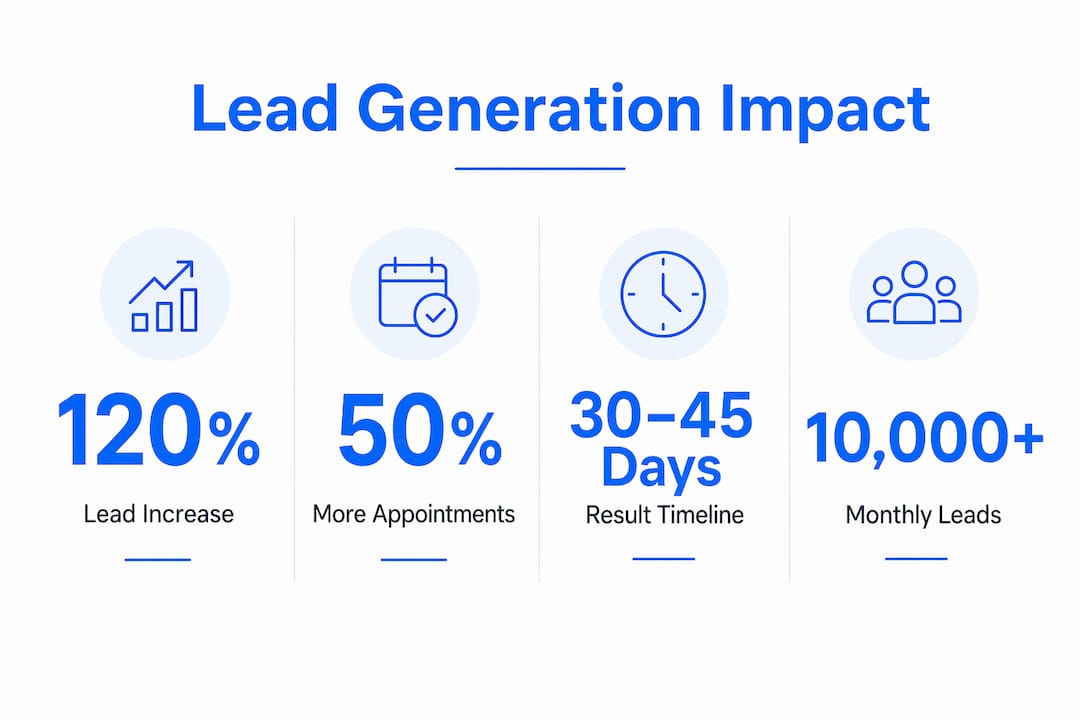
Organizations see up to a 50% increase in leads and appointments within 30–45 days of AI implementation. Pipeline velocity and conversion improvements mature after 90–120 days as models accumulate data and improve accuracy. The two-phase timeline is predictable and repeatable across industries.
| Metric | Typical result | Timeline |
|---|---|---|
| Qualified lead volume | Up to 120% increase | 30–60 days post-launch |
| Conversion rate | Up to 28% improvement | 60–90 days post-launch |
| Reply rate on outreach | From 1.1% to over 9% | 30–45 days with AI sequencing |
| Lead and appointment volume | Up to 50% increase | 30–45 days initial |
| Pipeline maturity | Full model accuracy | 90–120 days |
The cost comparison with human SDR teams is where the business case becomes undeniable. A fully loaded SDR costs significantly more annually than an AI system that operates around the clock, never misses a follow-up, and scales without additional headcount. For AI engagement in service businesses, the ROI calculation is even more favorable because service businesses rely heavily on appointment volume, which AI books automatically.
Mediabloom clients Miracle Ear and 1-800 Accountant have each used this model to generate over 10,000 monthly leads. That output requires an AI workforce operating across voice agents, chatbots, and automated outreach simultaneously. No human team achieves that volume at comparable cost.
Key Takeaways
AI scales lead generation by automating qualification, personalizing outreach, and building dynamic segments that improve with every closed deal fed back into the model.
| Point | Details |
|---|---|
| Sequence before you automate | Design workflows and build your ICP scoring model before launching any outbound campaigns. |
| AI qualification frees reps | AI handles scoring and routing so human reps focus on high-value, judgment-based conversations. |
| Personalization drives reply rates | AI-adapted sequences have lifted reply rates from 1.1% to over 9% in documented cases. |
| Closed-loop data improves targeting | Feeding won/lost CRM data back into AI segmentation models produces the highest targeting accuracy. |
| Measure pipeline, not activity | Track qualified pipeline and closed revenue, not open rates, to evaluate AI lead gen performance. |
What Mediabloom has learned about scaling lead generation with AI
The biggest mistake we see is teams treating AI as a volume lever before they have a validated scoring model. They automate outreach to a broad list, generate thousands of touchpoints, and then wonder why the pipeline is full of leads that never close. The problem is not the AI. The problem is that the system was given the wrong instructions from the start.
The teams that scale successfully share one habit: they define their ideal customer profile with surgical precision before they touch any automation tool. They know which firmographic attributes, behavioral signals, and technographic markers correlate with closed revenue. That definition becomes the foundation of every scoring model, every sequence, and every paid audience. Without it, AI amplifies noise instead of signal.
We have also observed that the human-AI division of labor matters more than most teams realize. AI should own the administrative layer: data research, CRM hygiene, initial scoring, and first-touch outreach. Humans should own the judgment layer: complex objection handling, relationship-building with strategic accounts, and final qualification calls. When those roles blur, quality drops on both sides.
The last insight is about measurement. Teams that optimize for pipeline outcomes, not surface engagement metrics, compound their results faster. An AI system that generates fewer but better leads is more valuable than one that floods the CRM with noise. Continuous measurement and monthly model updates are what separate teams that plateau from teams that keep improving.
— Mediabloom
Mediabloom’s AI platform for lead generation at scale
Mediabloom builds the AI workforce that powers this entire process, from first touch to booked appointment.
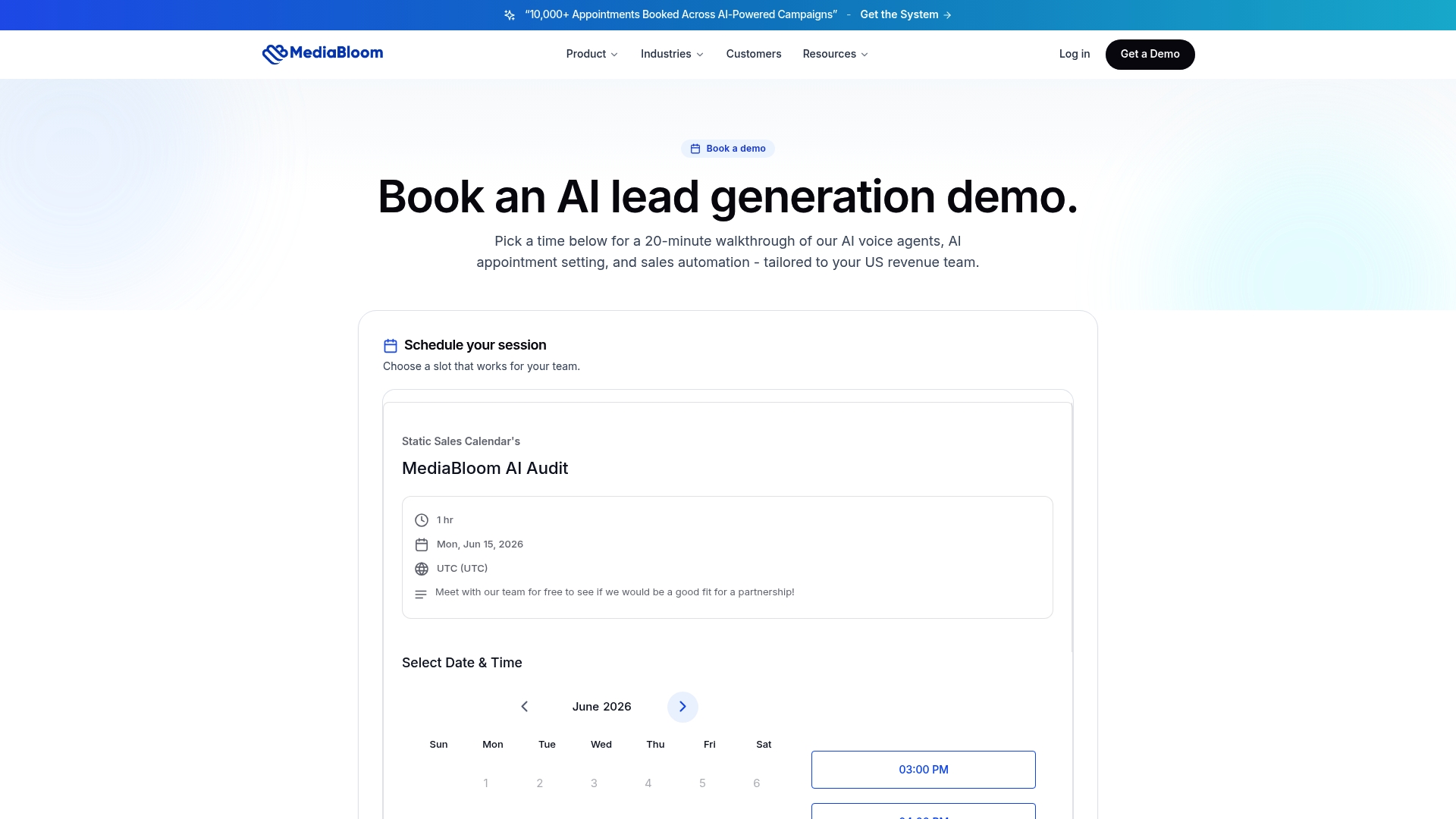
Mediabloom’s platform integrates AI voice agents, chatbots, and cold outbound campaigns into a single system that qualifies leads, books appointments, and feeds clean data back into your CRM. Clients like Miracle Ear and 1-800 Accountant generate over 10,000 monthly leads through this model. The platform operates across SMS, email, and web chat simultaneously, so no lead goes uncontacted regardless of channel. Review the client results to see specific outcomes by industry, or visit Mediabloom’s AI lead generation platform to see how the system fits your pipeline goals.
FAQ
What does AI actually do in lead generation?
AI automates scoring, enrichment, outreach sequencing, and follow-up across the entire lead funnel. It processes behavioral and firmographic signals to qualify leads and trigger personalized contact without manual input.
How long does it take to see results from AI lead generation?
Organizations typically see improved lead quality and volume within 30–45 days of implementation. Full pipeline velocity and conversion improvements mature after 90–120 days as AI models accumulate data.
What is the biggest mistake teams make with AI lead generation?
The most common mistake is automating outreach before building a validated ICP scoring model. This fills the pipeline with unqualified leads and reduces trust in the system across the sales team.
How does AI personalization improve outreach reply rates?
AI adapts message cadence, angles, and content based on each prospect’s engagement signals. This approach has lifted reply rates from 1.1% to over 9% in documented case studies.
Do I need an AI sales agent or a full platform to scale lead generation?
A single AI sales agent handles outbound and qualification tasks effectively for smaller pipelines. Larger revenue teams benefit from a full platform that integrates scoring, sequencing, chatbots, and CRM enrichment in one system.


