
An AI sales agent is defined as autonomous software that independently performs end-to-end sales tasks, including lead qualification, customer engagement, follow-up, and meeting scheduling, with minimal human input. Unlike a simple chatbot or rules-based workflow tool, an AI sales agent reasons over sales goals, selects appropriate actions, and updates CRM records without waiting for a human prompt. The industry term for this category is “autonomous AI agent,” and the phrase “AI sales agent” describes its specific deployment in revenue workflows. Platforms like Salesforce, IBM, and Mediabloom have each built products in this category, signaling that autonomous sales AI has moved from experiment to standard practice for competitive sales teams.
What is an AI sales agent and how does it differ from a chatbot?
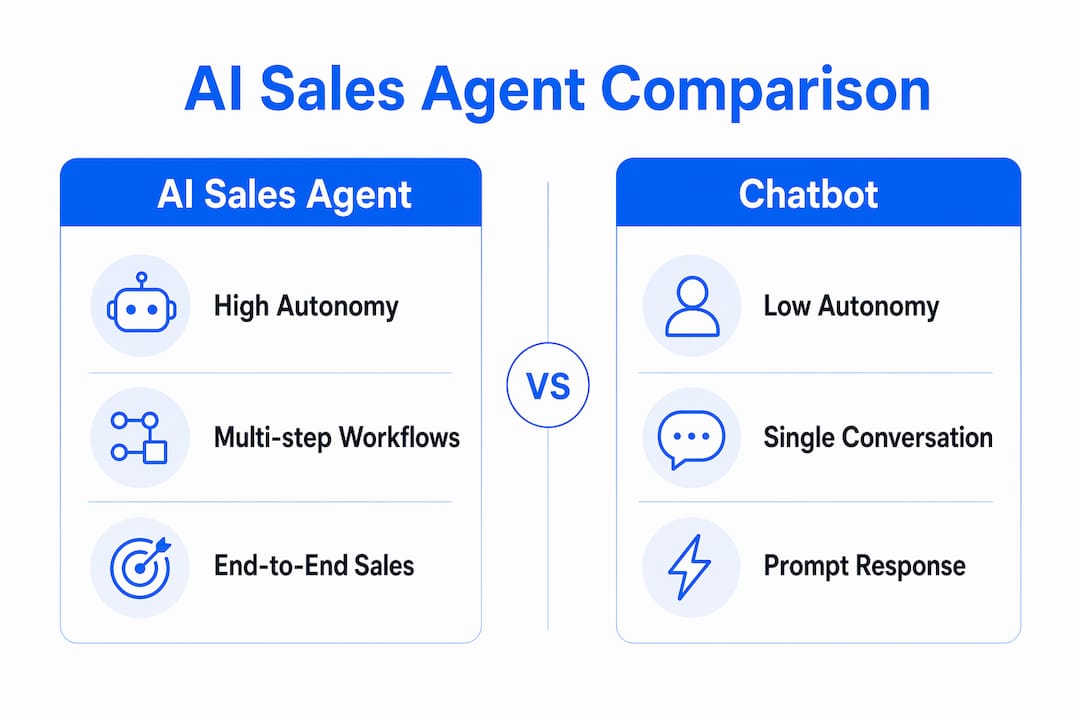
AI sales agents and chatbots are architecturally different, not just functionally different. A chatbot responds to prompts and retrieves knowledge within a single session. An AI sales agent plans and executes multi-step workflows, calling external tools, verifying outcomes, and updating records across multiple systems. That distinction matters enormously when you are deciding which technology to deploy at which stage of your funnel.

The clearest way to see the difference is through what each tool actually does when a new lead comes in. A chatbot answers the lead’s question and ends the session. An AI sales agent detects the inbound signal, scores the lead against your qualification criteria, sends a personalized follow-up email, checks calendar availability, books a meeting, and logs every action in your CRM. No human touches the workflow until the meeting appears on a rep’s calendar.
Agents work best in repetitive, structured workflows like qualification, CRM updating, and scheduling. Chatbots remain better suited for low-effort FAQ deflection. Mapping the right tool to the right funnel stage is the first decision any sales leader needs to make before deploying either technology.
AI sales agent vs. AI SDR: what is the difference?
An AI SDR, or AI Sales Development Representative, is a targeted subset of the broader AI sales agent category. AI SDRs focus specifically on prospect research, lead qualification, outbound email personalization, follow-up sequencing, and CRM updates. They automate the time-sensitive, repetitive tasks that human SDRs spend most of their day on, but they do not replace complex human judgment in later sales stages.
IBM frames AI SDRs as an autonomy layer that scales early-funnel interactions by deciding who to contact, when, and how. That framing is more accurate than thinking of them as “faster email tools.” The decision-making component is what separates an AI SDR from a sequencing platform like a basic email automation tool.
Comparison: AI sales agent vs. chatbot vs. AI SDR
| Feature | AI sales agent | Chatbot | AI SDR |
|---|---|---|---|
| Autonomy level | High: plans, acts, verifies | Low: responds to prompts | Medium: automates SDR task set |
| Workflow complexity | Multi-step, cross-system | Single-session conversation | Multi-step, top-of-funnel focused |
| CRM integration | Full read/write | Typically read-only | Full read/write |
| Best use case | End-to-end sales workflows | FAQ deflection, basic support | Prospecting, qualification, outreach |
| Human escalation | Yes, for complex scenarios | Rarely built in | Yes, for qualified opportunities |
How do AI sales agents work?
AI sales agents operate in a continuous detection-to-learning loop. The agent detects a signal, such as a new form submission or a CRM status change, decides on the next best action, executes that action autonomously, logs the result, and refines its future decisions based on outcomes. This loop runs without human initiation at each step.
The technology stack underneath this loop includes large language models for natural language generation and understanding, machine learning models for lead scoring and prioritization, and API integrations with CRMs like Salesforce or HubSpot, calendar tools like Google Calendar or Outlook, and outreach platforms. The agent does not operate in isolation. It reads from and writes to every connected system in real time.
Data quality is the single most important factor in how well this loop performs. Fragmented or outdated CRM data causes biased decisions that directly affect sales outcomes. An agent working from stale contact records will prioritize the wrong leads, send irrelevant messages, and book meetings with prospects who already converted or churned. Garbage in, garbage out applies here with measurable revenue consequences.
The five stages of an AI sales agent workflow
- Signal detection: The agent monitors CRM events, web activity, email opens, or inbound form fills to identify leads that meet predefined criteria.
- Action decision: Using lead scoring models and goal parameters, the agent selects the next best action, whether that is sending an email, placing a call, or updating a record.
- Autonomous execution: The agent sends the message, books the meeting, or updates the CRM entry without human approval for standard workflow steps.
- Result logging: Every action and outcome is written back to the CRM or engagement platform, creating a complete audit trail.
- Learning and refinement: The agent uses outcome data to adjust future prioritization and messaging, improving performance over time.
Human-in-the-loop escalation is built into well-designed agents for scenarios that fall outside structured workflows, such as pricing discussions, contract negotiations, or complex objections. The agent flags these situations and routes them to a human rep rather than attempting an autonomous response.
Pro Tip: Before deploying an AI sales agent, audit your CRM for duplicate records, missing contact fields, and outdated company data. A two-week data cleanup before go-live will produce measurably better agent performance from day one.
What are the practical benefits of AI sales agents for sales teams?
AI sales agents deliver practical benefits including 24/7 availability, unlimited scalability, freedom from repetitive tasks for human reps, increased quota attainment, personalized outreach at scale, and automated scheduling. Each of these benefits compounds when the agent is deployed consistently across a high-volume funnel. A single AI sales agent can handle the top-of-funnel workload that would otherwise require multiple human SDRs working full shifts.
The most immediate ROI for most businesses comes from follow-up speed and consistency. Human reps delay follow-ups due to competing priorities. An AI sales agent responds to every inbound lead within seconds, every time, regardless of time zone or business hours. Speed to lead is one of the strongest predictors of conversion rate in outbound and inbound sales alike.
Top use cases by funnel stage
Top of funnel:
- Automated prospect research and list building based on ICP criteria
- Inbound lead qualification via chat, email, or voice
- Personalized outreach sequences triggered by behavioral signals
- Intent-based lead generation using real-time data signals
Mid-funnel:
- Meeting scheduling and calendar management without rep involvement
- Follow-up sequences triggered by non-response or engagement signals
- CRM record updates after every interaction
Sales coaching and enablement:
- Salesforce categorizes assistive AI agents as a distinct type that supports human reps with real-time feedback and sales coaching roleplay rather than executing full autonomous workflows. These agents help reps prepare for objections, practice discovery calls, and receive post-call analysis.
The augmentation framing is the right one. AI sales agents do not replace human sales teams. They remove the high-volume, low-complexity work so that human reps can focus on relationship-building, negotiation, and closing. Multilingual voice agents now handle outbound calls in multiple languages, expanding reach without adding headcount. That is a capability shift, not a headcount reduction.
How to implement AI sales agents: key considerations and best practices
Successful AI sales agent deployment starts with CRM data quality and integration depth. Implementing AI sales agents successfully requires high-quality, integrated CRM data, proper guardrails with human escalation for complex sales steps, and incremental deployment to manage risk and preserve buyer trust. Skipping any of these three requirements produces an agent that performs poorly and erodes confidence in the technology.
Integration depth matters as much as data quality. An agent that can read your CRM but cannot write back to it creates manual reconciliation work that eliminates the time savings it was supposed to generate. Before selecting a platform, verify that the agent has full read and write access to your CRM, your calendar system, and your outreach tools.
Common pitfalls to avoid
- Over-automation: Deploying agents in complex negotiation or pricing scenarios without human escalation paths damages buyer relationships and deal outcomes.
- Compliance gaps: Outbound voice calls and SMS require consent under regulations like the TCPA in the United States. Agents must be configured to respect opt-out signals and consent records.
- Undefined escalation rules: Without clear rules for when the agent hands off to a human, complex situations get handled poorly or not at all.
- Ignoring agent output data: The logging and learning loop only improves performance if someone reviews outcome data and adjusts agent parameters regularly.
Balancing automation with human intervention is not a weakness in your deployment. It is the design. Businesses that adopt a human-in-the-loop approach where AI agents manage high-volume structured tasks while humans handle negotiation and pricing decisions consistently report higher buyer confidence and better close rates than fully automated approaches.
Pro Tip: Deploy your AI sales agent on one workflow, such as inbound lead qualification, before expanding to outbound prospecting or scheduling. Incremental rollout lets you validate data quality, escalation rules, and messaging before scaling to higher-stakes interactions.
Evaluating AI sales agents by their ability to autonomously deliver outcomes like lead qualification and meeting booking, rather than just conversation quality, is the standard that separates effective deployments from expensive experiments. Ask vendors for outcome metrics, not just engagement metrics.
Key Takeaways
AI sales agents are autonomous software systems that execute structured sales workflows independently, and their performance depends directly on CRM data quality, clear escalation rules, and incremental deployment.
| Point | Details |
|---|---|
| Core definition | An AI sales agent autonomously executes end-to-end sales tasks including qualification, outreach, and scheduling. |
| Agents vs. chatbots | Chatbots respond to prompts; AI agents plan, act across systems, and verify outcomes in multi-step workflows. |
| AI SDR distinction | AI SDRs are a focused subset handling top-of-funnel tasks like prospecting, sequencing, and CRM updates. |
| Data quality is critical | Fragmented or outdated CRM data produces biased agent decisions that directly reduce sales performance. |
| Human-in-the-loop design | Keep humans in the loop for pricing, negotiation, and complex objections to protect buyer trust and deal outcomes. |
The uncomfortable truth about AI sales agents most vendors won’t tell you
At Mediabloom, we have deployed AI sales agents across industries ranging from healthcare to professional services, and the pattern we see most often is this: companies invest in the technology and underinvest in the data infrastructure that makes it work. The agent is not the hard part. Clean, connected, current CRM data is the hard part.
The second thing we have learned is that the “replace vs. augment” debate is mostly a distraction. The real question is where in your funnel human judgment creates irreplaceable value and where it is simply being applied to tasks that a well-configured agent can handle more consistently. For most B2B sales teams, that line falls somewhere between qualification and discovery. Agents own everything before that line. Humans own everything after it.
The future of sales is not fully automated. It is a hybrid workflow where AI agents handle volume and consistency while human reps focus on the conversations that actually require trust, creativity, and judgment. The companies building that hybrid model now are the ones that will have a structural advantage in 2027 and beyond. The companies waiting for a perfect, fully autonomous solution are waiting for something that does not serve buyers well and probably never will.
Thoughtful adoption beats fast adoption every time. Deploy narrow, measure outcomes, expand deliberately, and keep humans in the loop for the decisions that matter most to your buyers.
— Mediabloom
How Mediabloom deploys AI sales agents for measurable results
Mediabloom builds and deploys AI agents for sales, combining voice agents, chatbots, and sales automation into one platform that qualifies leads, books appointments, and updates your CRM automatically. Clients like Miracle Ear and 1-800 Accountant generate over 10,000 monthly leads using this system.
Mediabloom’s platform covers the full top-of-funnel workflow, from inbound response in under 60 seconds to multi-channel follow-up across SMS, email, and chat. The Sky Consulting case study shows how autonomous agents handle outbound prospect engagement at scale without adding headcount. If you are evaluating AI sales agent platforms, the Mediabloom solutions overview is the right starting point to see what a fully integrated deployment looks like in practice.
FAQ
What is an AI sales agent in simple terms?
An AI sales agent is software that independently handles sales tasks like qualifying leads, sending follow-ups, and booking meetings without requiring a human to initiate each step. It connects to your CRM and calendar to execute and log every action automatically.
How is an AI sales agent different from a chatbot?
A chatbot responds to user prompts within a single conversation. An AI sales agent plans and executes multi-step workflows across multiple systems, including CRM updates and meeting scheduling, with no prompt required at each step.
What is an AI sales development rep?
An AI SDR is a specialized type of AI sales agent focused on top-of-funnel tasks including prospect research, outbound email personalization, lead qualification, and follow-up sequencing. It automates the repetitive work of a human SDR but does not replace judgment-heavy sales conversations.
What is AI-assisted sales coaching?
AI-assisted sales coaching uses assistive AI agents to support human reps with real-time feedback, objection handling practice, and post-call analysis. These agents do not execute autonomous sales workflows but help reps improve performance through structured coaching interactions.
Do AI sales agents replace human sales reps?
AI sales agents augment human sales teams rather than replace them. They handle high-volume, structured tasks like qualification and scheduling while humans manage negotiation, pricing, and relationship-driven conversations that require trust and judgment.


