
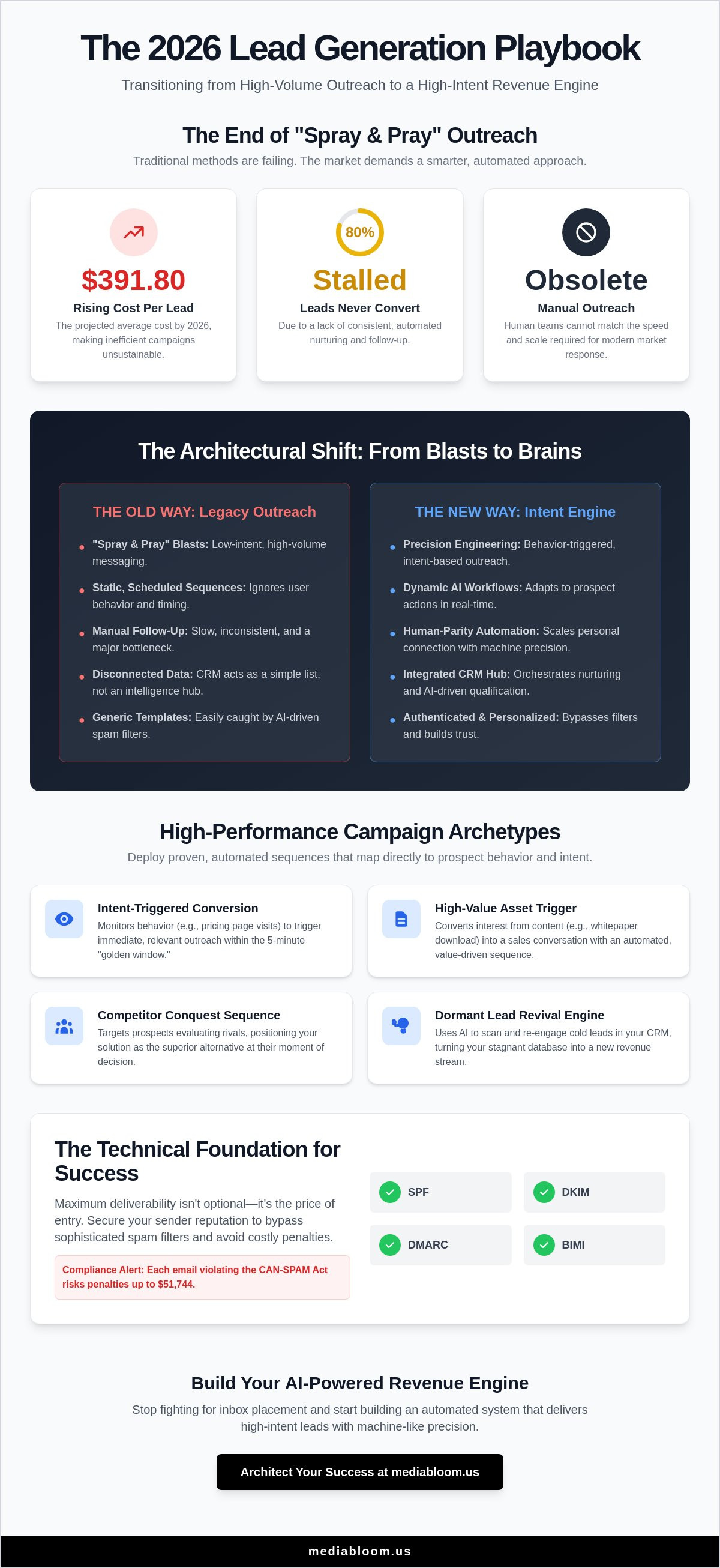
With the average cost per lead climbing to $391.80 in 2026, the era of high-volume, low-intent "spray and pray" outreach is officially dead. You likely feel the pressure of declining open rates and the constant friction of disconnected CRM data. It is exhausting to fight spam filters only to have 80% of your leads stall because of a lack of consistent, automated nurturing.
Success in this market is not about the individual message you send; it is about the automated intent-engine that triggers it. This guide provides the blueprint to master high-performance lead generation email campaigns using AI-driven architectures. You will learn how to turn cold outreach into a scalable revenue engine that delivers high-intent lead flow while eliminating manual follow-up fatigue.
We are diving into the specific campaign examples and technical frameworks that ensure your ROI stays predictable. From full DMARC authentication to AI-powered personalization, you are about to build a system that feels personal but scales with machine-like precision.
Key Takeaways
- Transition from legacy "blast" marketing to intent-based communication ecosystems that treat outreach as a precision-engineered architecture.
- Deploy high-performance lead generation email campaigns using proven archetypes like "High-Value Asset" triggers and "Competitor Conquest" sequences.
- Leverage your CRM as the central intelligence hub to orchestrate automated lead nurturing and AI-driven qualification before prospects reach the inbox.
- Secure maximum deliverability by implementing a technical infrastructure of SPF, DKIM, DMARC, and BIMI protocols to bypass sophisticated spam filters.
- Scale revenue operations by replacing manual outreach liabilities with automated workflows and AI voice agents designed for high-speed market response.
Architecting Lead Generation Email Campaigns for 2026
Modern lead generation email campaigns function as intent-based communication ecosystems rather than simple messaging tools. Legacy "blast" marketing is obsolete. Modern revenue leaders have replaced static, scheduled sequences with precision-engineered, behavioral-triggered workflows. You aren't just sending mail. You are building an infrastructure that captures interest and accelerates it toward a conversion. With the average cost per lead reaching $391.80, every touchpoint must be optimized for maximum relevance.
The "one-size-fits-all" newsletter is dead for lead acquisition. High-intent prospects demand immediate value and context. If your outreach doesn't align with their current stage in the What is Lead Generation? process, it's ignored. You need a system that adapts to the individual, not a calendar. This shift requires a move away from simple outreach toward a fully integrated revenue engine.
The Core Components of a Modern Campaign
Building a high-performance framework requires three non-negotiable pillars that work in tandem. First, Clean Data ensures high-integrity prospect lists that protect sender reputation. Second, Intent Triggers act as real-world signals, such as pricing page visits, that activate specific outreach paths. Finally, Dynamic Content uses AI-optimized copy to adjust based on the recipient's industry and pain points. The lead magnet has evolved; it's now a strategic data-collection mechanism designed to qualify interest and fuel the next stage of the nurturing cycle. Intent-Based Outreach is the 2026 standard where every touchpoint is earned through demonstrated prospect behavior.
Why Traditional Outreach Fails Today
Inbox competition is at an all-time high. AI-driven spam filters now analyze linguistic patterns and sender behavior with surgical precision. If your lead generation email campaigns look like generic templates, they won't even reach the "Promotions" tab. Stricter regulations make technical compliance a survival requirement. Each separate email in violation of the CAN-SPAM Act is subject to penalties of up to $51,744. You can't afford a single mistake in your technical setup.
Manual follow-ups are the single biggest bottleneck in 2026 sales operations. Human teams can't match the speed and consistency required to nurture leads before they go cold. The solution is Human-Parity Automation. This technology uses sophisticated AI to mirror the nuance and personalization of a human executive while maintaining the scale of a machine. It's about being everywhere at once without sacrificing the quality of the connection.
High-Performance Campaign Examples and Archetypes
Success in 2026 requires moving beyond basic templates. You need specific archetypes that map to prospect behavior. The "High-Value Asset" Trigger is a prime example. When a prospect downloads a whitepaper, your system shouldn't just send a "thank you" email. It must trigger a sequence designed to convert that interest into a sales call within minutes. This aligns with a sophisticated Online Lead Generation Framework that prioritizes immediate engagement and technical precision.
The "Competitor Conquest" Sequence is another high-performance model. It targets prospects who are actively looking for alternatives to your rivals. By positioning your solution as the superior upgrade, you capture high-intent traffic at the moment of peak frustration. Similarly, the "Dormant Lead Revival" Engine uses AI to scan your existing CRM for records that went cold. Since 80% of new leads never convert due to a lack of lead nurturing, this engine identifies "zombie" leads and re-engages them with fresh, relevant value propositions. This turns a stagnant database into a secondary revenue stream.
Finally, "Event-Driven" Outreach capitalizes on the momentum of webinars or trade shows. These lead generation email campaigns succeed because they leverage a shared experience to bypass the typical "cold" barrier. Speed is the critical variable here; the architecture must be ready to fire the moment the event concludes.
The Intent-Triggered Conversion Model
Automated systems must monitor website behavior to trigger outreach. If a prospect visits your pricing page three times in 24 hours, they're signaling a high intent to buy. The "golden window" for a response is five minutes. Waiting longer allows the prospect's focus to shift or a competitor to intervene. Track these five high-intent triggers to maximize your strike rate:
- Multiple visits to the pricing or "request a demo" page within a single session.
- Engagement with high-intent case studies related to a specific industry vertical.
- Click-throughs on technical whitepapers or integration documentation.
- Abandoned form completions where contact data was partially entered but not submitted.
- Interaction with on-site AI chatbots regarding specific feature sets or trial periods.
B2B Multi-Touch Orchestration
Modern outreach isn't a single-channel effort. It's a 7-touch sequence that orchestrates email, automated LinkedIn messaging, and AI voice agents into a seamless flow. This approach follows a "Value-First" philosophy. You solve a specific pain point or provide a unique insight before ever asking for a meeting. This builds the authority required to win in a crowded market. If you want to see how these architectures scale across different industries, explore MediaBloom Solutions for advanced implementation strategies.
Effective lead generation email campaigns act as the connective tissue of your revenue operations. They don't just send messages; they build a predictable path from awareness to revenue. If you're ready to upgrade your outreach engine, connect with our team to discuss a custom framework for your business.
The Infrastructure of Success: CRM and AI Integration
Your CRM is the central processor of your revenue machine. It's no longer just a passive storage unit for contact names; it's the active brain behind every high-performance touchpoint. By treating the CRM as the conductor of your lead generation email campaigns, you ensure that every interaction is fueled by real-time data. This integration allows for a seamless transition between stages, where a prospect's behavior dictates the next move in the sequence. Without this centralized intelligence, your outreach is just noise.
Integrating AI chatbots to qualify leads before they ever reach the inbox is a critical efficiency play. These bots act as high-speed filters, identifying intent and gathering essential data points. This ensures your sales team only spends energy on prospects that meet your specific criteria. To maintain this technical mastery, you must also prioritize compliance. Referencing the CAN-SPAM Act Compliance Guide is essential for ensuring your automated infrastructure remains legally secure and operationally sound.
Closed-loop reporting is the final piece of the architectural puzzle. It allows you to trace every dollar of revenue back to the specific email trigger that started the journey. This visibility is what transforms a marketing expense into a predictable revenue engine. For a deeper look at how this fits into a broader strategy, review our framework on Email Marketing for Sales in 2026.
Automating the Sales Pipeline
Status changes within your CRM should act as binary switches for your outreach. When a lead moves from "Qualified" to "Demo Scheduled," the system must instantly kill the nurturing sequence and activate the preparation track. Lead scoring determines the intensity of the response. High-value targets receive immediate human attention, while mid-funnel leads are managed through AI-driven nurturing. Mastering these triggers is the core of Data-Driven Email Marketing, where metrics dictate the pace of the sale.
Leveraging AI Voice Agents for Seamless Nurturing
Email is the signal; voice is the confirmation. When a prospect engages with one of your lead generation email campaigns, the window of opportunity is narrow. An AI voice agent can follow up on an email open in real-time, providing a "surround sound" marketing experience that feels both personal and high-tech. This multi-channel approach significantly increases the psychological impact of your brand. It positions your company as an established, deeply competent operation that is always one step ahead. You can see the tangible impact of these integrated systems in the MediaBloom Case Studies, where automation drives direct revenue growth.
Optimizing for Deliverability and Response Rates
Technical integrity is the foundation of every high-performance revenue engine. In 2026, simply having a great offer isn't enough; you must prove your legitimacy to increasingly hostile ISP filters. High-performance lead generation email campaigns require a rigorous technical setup to ensure your message actually reaches the recipient. Data confirms that domains with full authentication, including SPF, DKIM, and DMARC, achieve an 89.1% inbox placement rate. Those without full DMARC authentication struggle at 44.2%. Adding BIMI (Brand Indicators for Message Identification) further builds trust by displaying your verified logo, signaling authority before the email is even opened.
Launching a new outbound domain without a warming period is a catastrophic error. You must gradually scale sending volume to establish a positive reputation. This process signals to mail servers that your activity is legitimate and not a sudden burst of spam. For a comprehensive look at maximizing visibility, see our guide on How to Improve Email Open Rates.
Crafting Copy That Bypasses AI Filters
AI filters are the new gatekeepers of the B2B inbox. They are trained to identify and bury "salesy" superlatives and generic templates. To bypass these filters, your copy must shift from broad claims to data-backed assertions and specific pain points. Contextual Personalization is the practice of aligning message content with real-time prospect behavior and specific industry pressures. Adhering to the "Short & Direct" Rule is also essential. B2B emails under 100 words consistently convert better because they respect the recipient's time and focus on a single, clear objective.
A/B Testing in the Age of Automation
Automation allows you to move beyond basic subject line testing. You should now test different "Intent Triggers" and "Offer Types" to see what resonates with specific segments. Use AI to generate and deploy 100+ variations of a single campaign simultaneously. This allows the system to identify winning combinations at a speed impossible for human teams. While scaling, monitor "Negative Signals" like unsubscribes or spam reports. These are the early warning signs of domain health degradation. If you're ready to secure your technical infrastructure, connect with our deliverability experts to audit your current setup.
Partnering with MediaBloom: Your AI-Powered Revenue Engine
Manual management of your outreach is no longer a viable strategy. It's a liability. In a market where lead costs continue to rise, relying on human-speed follow-ups ensures that high-intent prospects will slip through the cracks. MediaBloom architects lead generation email campaigns that function as self-sustaining revenue engines. We replace fragmented tactics with a unified architecture that connects every touchpoint to a measurable outcome. This isn't about sending more mail; it's about sending the right message at the exact moment of peak interest.
Our unique approach combines sophisticated CRM Automation Setup with cutting-edge AI Voice Agents. This integration ensures that when a prospect engages with an email, the response is immediate and intelligent. You aren't just buying Email Marketing Services; you're investing in a complete overhaul of your sales infrastructure. By transitioning from isolated marketing campaigns to Automated Revenue Operations, you gain a predictable flow of sales-ready opportunities. You can see this technology in action by viewing a MediaBloom Demo today.
The MediaBloom Advantage
We deploy an Automated AI Workforce that handles the complex work of lead nurturing 24/7. This system doesn't get fatigued or miss a follow-up window. It operates with the technical mastery required to maintain high deliverability while delivering the personal touch necessary for conversion. Our team builds Custom AI Automations that sync perfectly with your existing tech stack, eliminating the data silos that plague traditional marketing departments. Every component of our system is designed to accelerate the prospect's journey from awareness to a closed deal.
As a premier B2B Email Marketing Agency, our focus is entirely on your ROI. We build systems that provide high-intent lead flow and automated nurturing that feels personal to the recipient. We don't just "send emails." We build the digital infrastructure that allows your sales team to focus on high-value closing activities rather than chasing cold leads. This shift in focus is what separates market leaders from those struggling with manual follow-up fatigue.
Take the Next Step Toward Scalable Growth
Speed is your most critical asset in 2026. Your competitors are already adopting AI-driven architectures to capture market share. Delaying your automation strategy only increases your cost per acquisition and leaves your domain reputation vulnerable to outdated practices. We invite you to a strategic consultation where we'll analyze your current sales pipeline and identify the specific bottlenecks holding you back. Our experts will show you how to turn cold outreach into a scalable revenue engine that delivers consistent results. It's time to stop guessing and start scaling with a system built for the future of B2B commerce. Contact MediaBloom Today to begin your transition to high-performance revenue operations.
Mastering the Future of Revenue Operations
The transition from manual outreach to an automated intent-engine is no longer optional; it's the standard for survival. You've seen how precision architecture and behavioral triggers outperform legacy "blast" tactics. By prioritizing technical deliverability and lead generation email campaigns fueled by real-time CRM data, you eliminate the friction that stalls growth. High-performance outreach in 2026 requires a shift from isolated marketing efforts to a unified, machine-like revenue engine.
MediaBloom provides the digital infrastructure to make this transition seamless. We specialize in custom AI voice agent integration and full CRM workflow automation to ensure your pipeline never goes cold. Our focus remains entirely on data-driven ROI management, turning complex technical frameworks into predictable revenue streams. Don't let manual follow-up fatigue limit your scale while competitors automate their success.
Architect Your Automated Revenue Engine with MediaBloom and take command of your market today. The tools for exponential growth are ready for deployment.
Frequently Asked Questions
Are lead generation email campaigns still effective in 2026?
Yes. Email marketing remains a dominant revenue driver in 2026, delivering an average ROI of $36 to $42 for every dollar spent. Success depends on moving away from legacy "blast" tactics toward precision-engineered lead generation email campaigns. Automated emails now see open rates of 30.63%, which is significantly higher than standard marketing blasts. This effectiveness is driven by intent-based triggers that align with modern buyer behavior and technical deliverability standards.
How do I avoid my lead generation emails going to the spam folder?
You must implement full technical authentication including SPF, DKIM, and DMARC protocols. Research shows that authenticated domains achieve an 89.1% inbox placement rate, while those without DMARC fall to 44.2%. Additionally, use AI-driven copy optimization to remove linguistic spam triggers. Focusing on data-backed claims rather than "salesy" superlatives helps you bypass the sophisticated AI filters that major email service providers use to protect inboxes in 2026.
What is the ideal frequency for a B2B lead generation email sequence?
Frequency should be dictated by prospect behavior rather than a rigid calendar. A standard B2B sequence typically utilizes a 7-touch multichannel approach over 14 to 21 days. However, the timing of the initial touch is the most critical variable. If a prospect triggers an intent signal, such as visiting a pricing page, your system should respond within the five-minute "golden window" to capitalize on peak interest.
How can AI improve my lead generation email response rates?
AI improves response rates by scaling hyper-personalization that human teams can't match. AI-generated subject lines alone can increase open rates by 26% by analyzing what resonates with specific industry pain points. Furthermore, AI allows you to test 100 or more variations of a single campaign simultaneously. This rapid experimentation identifies the highest-converting linguistic patterns and delivery times, ensuring your outreach stays ahead of market shifts.
What is the difference between cold email and lead nurturing?
Cold email is the initial outreach to high-intent prospects who have no prior relationship with your brand. Lead nurturing is the automated process of guiding those prospects through the sales funnel after they've engaged. Since 80% of new leads never convert without consistent nurturing, both are critical stages of lead generation email campaigns. One captures initial interest, while the other prevents lead decay and accelerates the closing process.
Do I need a custom CRM setup for automated email marketing?
Yes. A custom CRM setup serves as the central intelligence hub for your entire revenue engine. It's the only way to trigger specific email tracks based on real-time status changes or lead scoring. Without this tailored integration, your outreach remains a disconnected silo rather than a responsive ecosystem. A properly architected CRM ensures that every automated message is perfectly timed to the prospect's current stage in the buying journey.
How do I measure the ROI of my email lead generation campaigns?
You must use closed-loop reporting to trace every closed deal back to the specific email trigger that started the journey. With the average cost per lead reaching $391.80 in 2026, tracking efficiency is vital. Compare your automated click-through rates, which average 7.39%, against standard campaign benchmarks of 2.27%. This delta provides a clear picture of the performance lift generated by your AI-driven automation and technical infrastructure.