To be compliant, U.S. telemarketers must treat the National Do Not Call Registry, the TCPA, and the TSR as co-equal obligations. Stop calling registered numbers, verify express written consent before any autodialed or AI call reaches a mobile phone, and keep audit-ready records. The FTC and FCC enforce these rules, private TCPA lawsuits carry per-call damages that can be trebled, and several states layer on their own registration requirements.
TL;DR:
- Companies must verify express written consent and ensure the consent record matches the dialed mobile number to avoid TCPA violations.
- Daily scrubbing against the Do Not Call Registry and internal suppression lists is essential, with real-time API checks preferred over periodic batch processes.
- Recordkeeping requirements include storing call timestamps, consent details, and disclosure scripts for at least five years to support enforcement and defense.
- Outsourcing telemarketing does not eliminate liability; sellers must retain control over consent verification and audit vendor compliance procedures regularly.
- AI outbound calling must integrate consent logging and list scrubbing within the same system to prevent violations, especially as regulatory scrutiny tightens.
Table of Contents
- Immediate Compliance Checklist Telemarketers Can Run Now
- How the TCPA and TSR Apply to Telemarketing
- Exemptions and the Rules for Express Written Consent
- DNC Scrubbing Cadence and Technical Controls for AI Campaigns
- Recordkeeping and Audit-Ready Documentation
- How to Manage Third Parties and Allocate Liability
- Civil Penalties, Private Damages, and Enforcement Triggers
- A Practical Program: Policies, Training, and Monitoring
- MediaBloom’s Perspective on Compliance-First AI Calling
- How MediaBloom Helps Teams Stay DNC and TCPA Compliant
- Authoritative Regulatory Resources
- Sources
- FAQ
Immediate Compliance Checklist Telemarketers Can Run Now
Before your next campaign launches, run this checklist against your current lists and scripts. Most violations trace back to a skipped step here, not a misunderstood law.
- Confirm your Registry scrub is 31 days old or newer across every list feeding a live dialer.
- Cross-check leads against your internal suppression list and any litigator or serial-complainant lists you maintain.
- Verify prior express written consent exists for every mobile number receiving an autodialed or AI-generated call, and that the consent record matches the exact number dialed.
- Confirm your caller ID displays accurately, your opening disclosure script is current, and opt-out requests are captured and logged automatically.
- Check that your company holds its own Subscription Account Number (SAN) if you’re a seller, separate from any vendor’s SAN, and that vendor dialer access is restricted to verified lists.
Pro Tip: Run this checklist as a pre-launch gate inside your dialer workflow, not as a monthly review. A single skipped scrub can turn one afternoon of dialing into hundreds of individual violations.
How the TCPA and TSR Apply to Telemarketing
Two federal frameworks govern almost every outbound call your team makes, and they don’t overlap perfectly.
The Telephone Consumer Protection Act (TCPA) regulates the technology behind the call. Section 227(b) restricts autodialed calls, prerecorded or artificial voice messages, and texts, primarily protecting mobile numbers. Section 227© is the section that created the National Do Not Call Registry itself, giving consumers a way to block telemarketing calls regardless of whether a dialer is involved. That distinction matters for AI voice campaigns: an AI agent placing outbound calls to cell phones typically triggers 227(b) obligations even when the recipient’s number isn’t on the Registry.
The Telemarketing Sales Rule (TSR), enforced by the FTC, works alongside the TCPA but focuses on commercial practices: it created the Registry’s operational rules, sets calling-hour limits (8 a.m. to 9 p.m. in the recipient’s time zone), mandates specific disclosures during the call, and requires detailed recordkeeping.
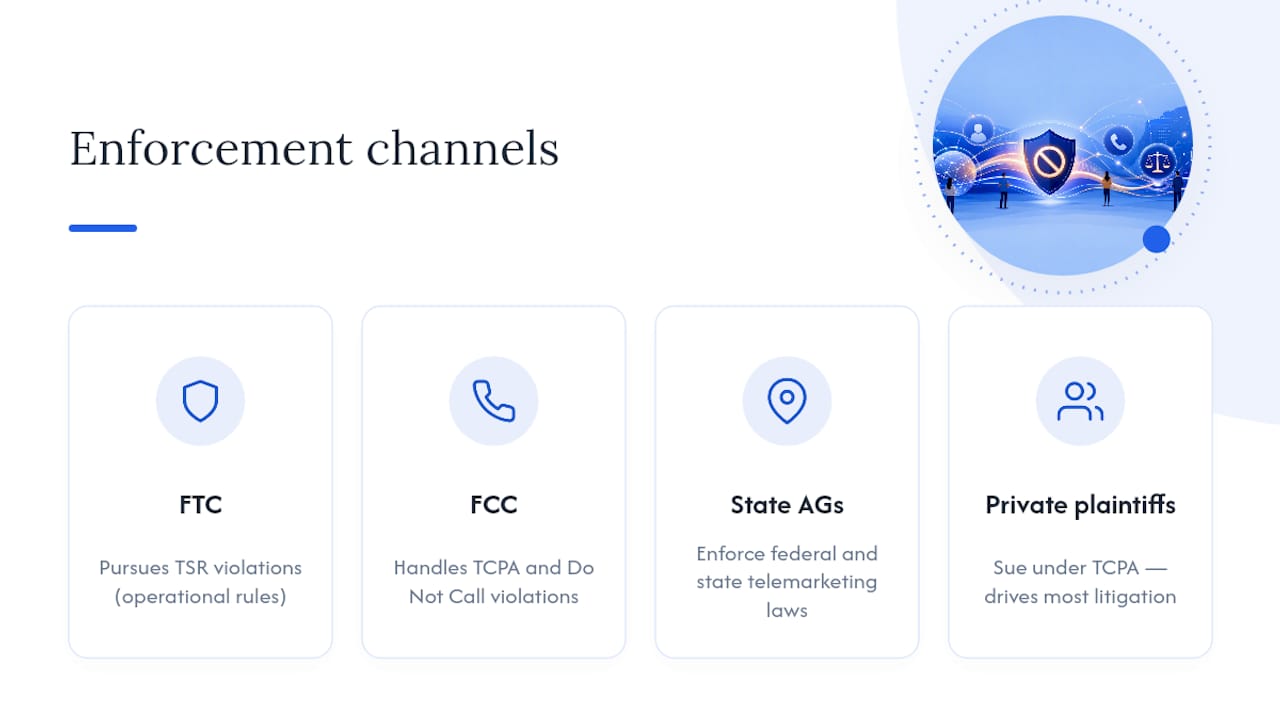
Enforcement runs through four channels: the FTC pursues TSR violations, the FCC handles TCPA and Do Not Call rule violations, state attorneys general enforce both federal and state-specific telemarketing statutes, and private plaintiffs sue directly under the TCPA. This last channel drives the most litigation volume. A single mismatched consent record can become a class action long before any regulator notices the pattern.
The safe harbor under both rules protects businesses that maintain routine compliance practices, current Registry scrubs, and documented procedures, even if an isolated call slips through.
Exemptions and the Rules for Express Written Consent
Two narrow exemptions let businesses call numbers on the Registry, and both get misused constantly.
The established business relationship (EBR) exemption covers a purchase, transaction, or completed service within the prior 18 months, or a consumer inquiry or application within the prior 3 months. Once a customer submits an entity-specific do-not-call request, though, that request overrides the EBR immediately and permanently for that business, regardless of how recent the transaction was.
Express written consent is the other path, and it has strict form requirements when the call involves an autodialer, prerecorded message, or AI voice system directed at a mobile number:
- The agreement must clearly name the specific seller authorized to call.
- It must include the exact telephone number the consumer is authorizing, not a blanket authorization.
- It requires a signature, physical or valid electronic, tied to that specific disclosure.
- The consumer must be informed the call may use an automatic dialer or artificial voice technology.
A consent record that survives litigation includes a timestamp accurate to the second, the consumer’s IP address, the source form or landing page, and the exact disclosure language shown at signup, stored in an immutable log or WORM format. A record that says only “customer opted in” with no number, date, or disclosure text will not hold up.
Two common shortcuts create outsized risk: labeling a commercial pitch as a “nonprofit survey” to dodge disclosure rules, and stretching an EBR based on a single old inquiry into ongoing marketing rights. Both invite scrutiny.
DNC Scrubbing Cadence and Technical Controls for AI Campaigns
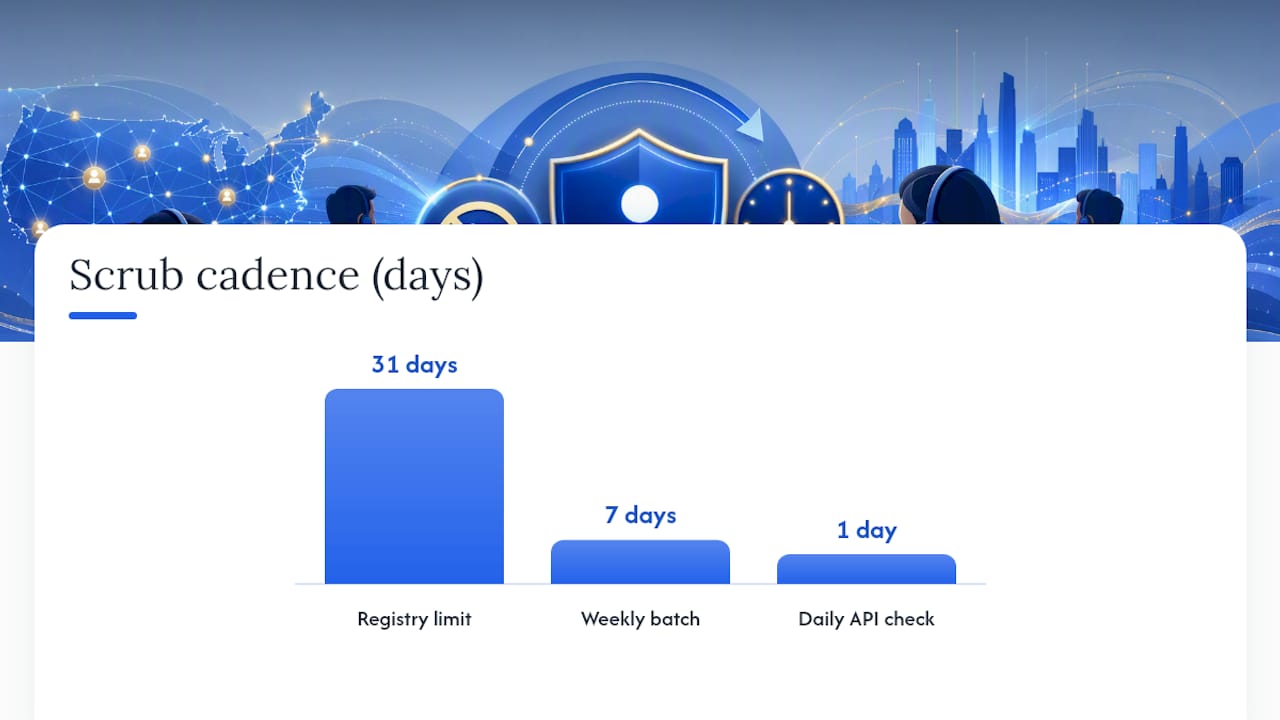
The Registry sets 31 days as the outer limit for a compliant scrub, but treating that as your target instead of your ceiling is how violations happen. A list scrubbed on day 30 can still contain numbers a consumer registered on day 3.
- Scrub against the National Do Not Call Registry, any applicable state registry, your internal company suppression list, and known litigator or serial-complainant lists before every campaign launch.
- Integrate scrubbing directly into lead ingestion through an API check, so numbers get validated the moment they enter your CRM rather than in a weekly batch.
- Add a pre-dial check inside the dialer itself, catching numbers that registered or opted out between your last batch scrub and the actual call.
- For any AI or autodialed campaign targeting mobile numbers, confirm the stored consent record matches the number being dialed exactly, not a normalized or reformatted version, as discussed in AI Objection Handling Tools: Real Calls or Roleplay?.
Real-time API scrubbing before each dial closes the gap that periodic batch scrubs leave open, and it’s increasingly the baseline expectation rather than an advanced feature.
Pro Tip: Set your internal scrub cadence to daily, even though the rule allows 31 days. The cost of a daily API check is trivial compared to a single mismatched-consent lawsuit.
Recordkeeping and Audit-Ready Documentation
The amended TSR requires call detail records, copies of any prerecorded or artificial voice messages used, and documented consent artifacts, with expanded retention and monitoring obligations built into the current rule.
A conservative retention window is five years, covering documentation longer than most state statutes of limitations for telemarketing claims. Each record should capture:
- Timestamp of the call and the consent event, down to the second.
- Script version used, including any disclosure language active at that time.
- Lead source and campaign ID.
- IP address and access logs tied to consent capture, when digital.
By the numbers: TSR penalties can exceed $50,000 per violating call, and TCPA statutory damages run $500 per violation, trebled to $1,500 when a violation is found willful. A single flawed list of a few hundred numbers can generate exposure in the hundreds of thousands before legal fees.
Store records in an indexed, exportable format so you can produce a specific consumer’s consent history within minutes of a regulator or litigant request, not days. Track your DNC match rate and consent verification pass rate weekly; a sudden spike in either is usually the first sign a vendor or data source has gone stale.
How to Manage Third Parties and Allocate Liability
Outsourcing your dialing doesn’t outsource your liability. The FTC is explicit that sellers remain responsible for compliance even when a third-party telemarketer places the calls, and sellers should hold their own SAN rather than relying entirely on a vendor’s subscription.
Contracts with any outbound vendor should require:
- Indemnification for violations traced to the vendor’s list handling or scripts.
- Audit rights allowing you to inspect scrub logs and consent records on demand.
- A defined SLA for scrub success rates and consent documentation quality.
- Data security certifications appropriate to the sensitivity of the data handled.
Operationally, that means an onboarding checklist before any vendor touches your leads, periodic audits of their consent verification workflow, and a documented remediation path when scrub failures appear. Track vendor performance the same way you’d track an internal KPI, and be willing to suspend access the moment match-rate failures repeat.
Civil Penalties, Private Damages, and Enforcement Triggers
The financial exposure here isn’t theoretical. TSR violations can draw penalties exceeding $50,000 per call, and TCPA private plaintiffs can recover $500 per violation, trebled to $1,500 for willful conduct, under the FTC’s own compliance guidance.
Class actions are where this becomes dangerous at scale. A single campaign that dials a few thousand stale numbers can generate a few thousand separate statutory claims, and courts don’t require proof of actual harm for TCPA damages to apply. Regulators typically build cases from consumer complaint patterns, often triggered by a spike in reports to the FTC or FCC complaint portals rather than a single incident.
The strongest defense is documented, routine safe-harbor practice: current scrubs, verified consent, and a fast remediation record when something slips through.
A Practical Program: Policies, Training, and Monitoring
Turning these obligations into a working program means assigning owners and schedules, not just writing a policy binder that sits unread.
- Maintain a written DNC and TCPA compliance policy, accessible to every agent and available on demand if a regulator or plaintiff’s attorney requests it.
- Train agents at onboarding and on a recurring cadence, covering disclosure scripts, opt-out handling, and what to do when a consumer invokes an entity-specific do-not-call request mid-call.
- Run daily list scrubs, weekly consent and match-rate reports, and a quarterly full audit of your recordkeeping system.
- Track consent verification pass rate, DNC match rate, opt-out processing speed, and call abandonment rate as your core KPIs, and set alert thresholds for each.
- Build an incident response path: intake the complaint, assemble the relevant call and consent logs, run an internal review, notify the vendor if applicable, and prepare a documented response for the regulator or plaintiff.
Pro Tip: Assign one person as your DNC compliance owner, even at a small call center. Diffuse ownership is how scrub failures go unnoticed for weeks.
MediaBloom’s Perspective on Compliance-First AI Calling
AI outbound calling doesn’t get a compliance exemption, and it shouldn’t want one. MediaBloom builds consent logging, SOC 2 and HIPAA-ready infrastructure, and integrated list scrubbing directly into its voice agent and automation workflows, because an AI system dialing a mobile number without verified express written consent creates the exact TCPA exposure described above, only faster and at higher volume.
The practical reality: AI outbound works well within a compliance program that already enforces real-time scrubbing and airtight consent capture. It does not replace the written policies, training, and audit trail your program still needs. Platforms should support that structure, not substitute for it.
— MediaBloom
How MediaBloom Helps Teams Stay DNC and TCPA Compliant
Some AI platforms give outbound teams what a manual compliance stack usually can’t: scrubbing, consent logging, and dialing behavior working from the same system instead of three disconnected tools.

That matters because most violations happen in the gaps between systems, a list that scrubbed clean in one platform but got dialed through another that never saw the update. Certain AI voice agents and outbound automation integrate list scrubbing and consent verification into the same pipeline that qualifies leads and books appointments, reducing the chance that a number that shouldn’t be called reaches a dialer. Teams in regulated categories, from insurance to financial services, use this to keep pace with campaign volume without losing the audit trail a regulator or plaintiff’s attorney would ask for. The Fifth Avenue Leads case study shows what that looks like running at scale.
If your current stack can’t produce a consent record in minutes when asked, that’s worth fixing before your next campaign, not after a complaint arrives. Request a demo to see how a compliance-integrated deployment fits your outbound program.
Authoritative Regulatory Resources
For primary reference, consult the FTC’s Telemarketing Sales Rule guidance, the FCC’s Do Not Call resources, and the Registry’s business FAQ page. Several states, including Florida, Pennsylvania, and Texas, require separate telemarketing registration or bonding.
This article is general information, not a substitute for advice from a qualified lawyer. Consult a qualified legal professional about your own circumstances before acting on anything here.
Sources
- Complying with the Telemarketing Sales Rule | FTC
- National Do Not Call Registry FAQs
- Do Not Call | Federal Communications Commission
FAQ
How Do I Stop Getting 20 Spam Calls a Day?
Register your number on the National Do Not Call Registry and report unwanted calls directly to the FTC. Many unwanted calls come from illegal robocalls that ignore the Registry entirely, so a call-blocking app from your carrier often helps more than registration alone.
What Happens if You Call a Registered DNC Number?
A single call to a registered number without an exemption can expose the caller to TSR penalties exceeding $50,000 and TCPA statutory damages of $500 per violation, trebled to $1,500 for willful conduct.
Does Pressing 9 Stop Telemarketers?
Pressing 9 or any opt-out digit only works with legitimate telemarketers who honor opt-out requests as required by law. Illegal robocall operations often use that keypress to confirm your number is active, which can increase call volume instead of reducing it.
Is the Do Not Call Registry Still Active?
Yes, the Registry remains active and enforceable, and businesses must scrub against it at least every 31 days to qualify for safe-harbor protection under the TSR.
Who Is Liable if My Outsourced Call Center Violates DNC Rules?
The seller retains liability even when a third-party telemarketer places the calls, which is why sellers should maintain their own SAN and retain audit access to vendor records.