

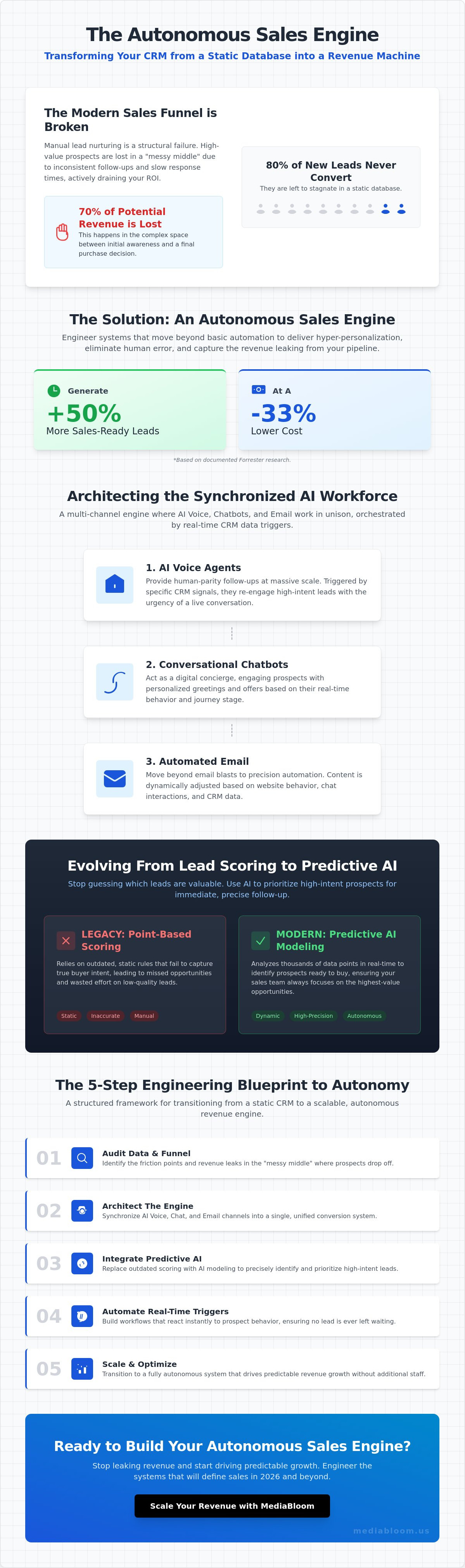
Eighty percent of new leads never convert into sales, primarily because they're left to stagnate in a static database. In 2026, manual crm lead nurturing is no longer just a bottleneck; it's a structural failure that actively drains your ROI. You've likely watched high-value prospects fall through the cracks because your team couldn't maintain consistent, personalized follow-ups at scale. Relying on more BPO staff is a legacy fix that won't solve a systemic architectural problem.
You understand that your CRM should be a high-performance revenue engine, yet it often feels like an expensive filing cabinet. It's time to bridge that gap. This briefing provides the technical blueprint to master the architecture and AI strategies required to build a truly autonomous sales engine. We'll show you how to engineer systems that generate 50% more sales-ready leads at a 33% lower cost, based on documented Forrester research. We are moving beyond basic automation to explore AI-native workflows that deliver the hyper-personalization needed to convert MQLs into SQLs with absolute precision.
Key Takeaways
- Identify why the "messy middle" of the sales funnel accounts for 70% of lost revenue and how to re-engineer it for maximum retention.
- Master the technical architecture of crm lead nurturing by synchronizing AI voice agents, chatbots, and automated email sequences into a unified conversion engine.
- Discover how predictive AI modeling replaces outdated point-based lead scoring to prioritize high-intent prospects for immediate follow-up.
- Implement a five-step engineering blueprint to audit lead data and eliminate the friction points where prospects typically drop off.
- Transition from a static database to a scalable, autonomous system that drives predictable revenue growth without the need for additional BPO staff.
What is CRM Lead Nurturing in the Era of Autonomous Sales?
Modern lead nurturing is no longer a soft skill or a creative afterthought. It's a technical engineering discipline. In the 2026 landscape, crm lead nurturing is defined as the automated orchestration of prospect progression through the sales funnel, powered by real-time data triggers and integrated AI logic. It moves beyond simple "follow-ups" to create a system where every interaction is a calculated step toward conversion. While legacy systems treated the CRM as a digital rolodex, the autonomous model transforms it into the central nervous system of your entire revenue operation.
The stakes for this transformation are high. Industry data indicates that the "messy middle" of the funnel; the complex space between initial awareness and a final purchase decision; is where 70% of potential revenue is lost. Leads enter the system with high intent but dissipate due to inconsistent manual touchpoints or slow response times. By architecting an autonomous engine within your Customer Relationship Management (CRM), you eliminate human error and ensure no prospect is left behind. This isn't just about efficiency; it's about capturing the massive volume of revenue that currently leaks out of your pipeline.
The Evolution from Email Blasts to Precision Automation
Legacy email blasts have become tactical noise. In a high-sophistication market, "one-size-fits-all" sequences are ignored by prospects and flagged by filters. Success now requires hyper-personalization at scale. This shift demands a move toward precision automation where content is dynamically adjusted based on real-time CRM data, such as website behavior or industry-specific pain points. By leveraging platforms like Editivo for content automation, editorial teams can ensure their messaging remains consistent and high-quality across these complex workflows. At MediaBloom, we view this as an architectural challenge. We don't just write emails; we build the infrastructure that allows AI to deliver the right message at the exact millisecond it's most impactful.
Key Metrics: Measuring the Success of Your Nurture Engine
To scale predictably, you must stop tracking vanity metrics. Open rates and click-throughs are secondary to MQL-to-SQL conversion velocity. You need to know how fast your system moves a lead from a cold inquiry to a qualified sales conversation. High-performance teams focus on "nurture-to-close" timeframes to prove absolute ROI. This level of precision is only possible with rigorous data hygiene. If your CRM data is fragmented or outdated, your automation will fail. Maintaining a clean, synchronized database is the only way to ensure your autonomous engine runs at peak performance without technical friction.
Architecting the Multi-Channel Nurture Engine
Building an effective lead nurturing strategy in 2026 requires more than a sequence of scheduled emails. You need a synchronized AI workforce. This workforce consists of three primary pillars: AI voice agents, conversational chatbots, and automated email sequences. When these components operate in silos, the prospect experience feels fragmented and mechanical. True crm lead nurturing occurs when these channels are architected to share data in real-time. This ensures that a lead never receives a redundant email after finishing a phone conversation with an AI agent. Consistency is the foundation of trust.
Custom CRM workflows act as the traffic controller for this multi-channel engine. They prevent message duplication and ensure channel-specific relevance across the entire journey. For example, if a lead clicks an email link but doesn't book a meeting, the CRM should immediately trigger a personalized chatbot greeting on their next site visit. If that interaction doesn't result in a conversion, the system escalates the lead to a voice agent for a direct touch. This approach ensures you're meeting the prospect where they are, using the medium they prefer at that specific moment in their journey.
AI Voice Agents: The Missing Link in Nurturing
Traditional nurturing often stalls because it lacks the urgency of a live conversation. AI voice agents solve this by handling high-energy sales follow-ups at a scale impossible for human teams. These agents provide human-parity interaction, maintaining your brand’s authority while executing thousands of calls simultaneously. The technical advantage lies in the trigger logic. Instead of cold calling, these agents re-engage leads based on specific CRM signals. If a prospect visits your pricing page multiple times, the system triggers an immediate, personalized follow-up call to answer questions in real-time.
Conversational Chatbots for Real-Time Qualification
Chatbots are your frontline for real-time qualification. While a lead is active on your site, the chatbot captures intent data that email simply can't reach. It asks the qualifying questions, identifies the prospect's specific pain points, and feeds that data back into the CRM. This loop refines the subsequent crm lead nurturing steps. If the chatbot identifies a lead as "high intent," it bypasses the standard email drip and moves directly to a meeting booking interface. Bridging the gap between a chat interaction and a booked sales meeting is critical for maintaining conversion velocity. If you're ready to deploy this level of technical sophistication, it's time to consult with our architecture team.
How to Build Your CRM Lead Nurturing Workflow: A 5-Step Blueprint
Transforming your CRM into an autonomous engine requires a methodical, five-step assembly process. You can't simply turn on automation and expect results. You must architect the logic first. This blueprint moves your crm lead nurturing from a series of disconnected emails to a high-performance conversion machine. It's about building a system that thinks, reacts, and scales without constant human intervention.
- Step 1: Audit and Segment. Review your current lead data. Stop grouping prospects by generic demographics. Instead, segment them by intent level based on their interactions with your digital assets.
- Step 2: Map Friction Points. Visualize the customer journey. Identify exactly where leads drop off. These "friction points" are where your nurture sequences must be most aggressive and personalized.
- Step 3: Engineer Trigger-Action Logic. Define the "If X, then Y" rules. If a lead downloads a whitepaper, the system shouldn't just send a thank-you email; it should trigger a specific intent-based branch.
- Step 4: Deploy the AI Workforce. Integrate your AI voice agents and chatbots into these branches. Let the technology handle the repeatable, high-volume communication tasks that currently bog down your sales team.
- Step 5: Optimize for Velocity. Execute rigorous A/B testing on your sequences. Don't just test subject lines. Test the timing between touches and the channel mix to maximize your MQL-to-SQL conversion velocity.
Segmentation: The Foundation of Relevance
Generic messaging is the fastest way to lose a prospect's attention. To achieve true precision, you must move beyond demographic segmentation and into behavioral-based buckets. Use CRM tags to identify specific actions, such as multiple visits to a case study page or engagement with a specific ad campaign. These tags trigger specialized nurture "branches" tailored to that prospect's unique pain points. Ensuring your custom CRM automation supports dynamic list membership is critical. When a lead's behavior changes, their segment must update instantly to keep the messaging relevant.
Logic Engineering: Building the "If/Then" Framework
Visualizing your workflow from lead intake to closed-won is essential for identifying technical gaps. You aren't just drawing lines; you're engineering a fail-safe system. One of the most common logic pitfalls is the "infinite loop," where a lead gets stuck in a repetitive sequence because a goal completion wasn't properly tracked. You must build clear exit triggers for every stage. The trigger-action mechanism is the heartbeat of modern crm lead nurturing, providing the rhythmic precision needed to move prospects forward. When this logic is sound, your sales engine runs with absolute reliability, allowing your team to focus exclusively on closing high-intent deals.
Lead Scoring and AI Qualification: The Precision Layer
Static lead scoring is a relic of the past. In 2026, assigning arbitrary points for email opens or page visits is no longer sufficient to drive a high-performance sales engine. Modern crm lead nurturing relies on predictive modeling to identify high-value targets with mathematical certainty. Instead of guessing which behaviors indicate intent, AI analyzes thousands of data points from historical conversions to predict which prospects are most likely to close. This shift from reactive to proactive qualification ensures your sales resources are never wasted on low-probability leads.
Real-time scoring is the catalyst for immediate action. When a lead’s predictive score crosses a specific threshold, the system doesn't just send another email. It triggers an immediate follow-up from an AI voice agent. This speed to lead is critical. If you wait hours for a human rep to review a score, the window of high intent has already closed. By automating the qualification layer, you ensure that every "hot" lead is engaged at the exact moment their interest peaks. If your current system lacks this level of responsiveness, it's time to upgrade your CRM architecture.
Some executives fear that increased automation leads to a robotic customer experience. The reality is the opposite. Data-driven personalization uses the depth of your CRM to craft interactions that feel more human because they are contextually relevant. By leveraging negative scoring, you can also filter out non-ideal prospects, such as competitors or students, before they ever enter a sequence. This maintains a high-signal environment where your autonomous engine only interacts with viable revenue opportunities.
Predictive Modeling vs. Traditional Lead Scoring
Traditional scoring systems are too rigid for the modern buyer's journey. AI-driven predictive modeling analyzes your entire historical dataset to find the "hidden" signals of a buyer. It integrates third-party data signals, such as intent data from across the web, to provide a 360-degree view of the lead before the first interaction. This level of technical sophistication is essential for effective AI sales pipeline management. You aren't just tracking leads; you're managing a self-optimizing revenue stream.
Maintaining Data Integrity in a High-Volume Engine
The "Garbage In, Garbage Out" rule is the primary threat to autonomous crm lead nurturing. If your data is fragmented or inaccurate, your AI agents will deliver irrelevant messages. You must implement automated data cleaning workflows that verify email addresses, enrich company profiles, and merge duplicate records in real-time. This isn't a "set and forget" task. CRM admins must audit automation performance weekly to ensure the logic remains aligned with shifting market conditions. High-performance nurturing requires a foundation of pristine data to maintain its conversion velocity.
Scaling Your Revenue with MediaBloom’s Autonomous Solutions
Deploying a high-performance sales engine requires more than just subscribing to a platform. It demands a strategic architect who understands how to bridge the gap between technical infrastructure and revenue outcomes. MediaBloom positions your business at the forefront of this evolution. We transform your existing database into an autonomous conversion machine, ensuring that speed, scale, and zero lead leakage become your new operational standard. By engineering a system that never forgets a lead, we eliminate the manual follow-up failures that currently cost you deals.
The synergy between different communication channels is where true growth happens. Successfully integrating email marketing for sales with real-time AI automation creates a persistent presence in the prospect's journey. You aren't just sending messages; you're maintaining a sophisticated, data-driven dialogue that adapts to buyer behavior. This level of crm lead nurturing ensures that your brand remains the obvious choice when a prospect is ready to buy. Stop losing revenue to inconsistent human effort and start scaling with a system built for 2026.
Custom AI Automations Built for Enterprise ROI
Standard, off-the-shelf software is rarely enough for high-growth teams with complex sales cycles. It offers a framework but lacks the specialized engine required for enterprise-level output. The MediaBloom approach focuses on building bespoke workflows that mirror your best salesperson’s logic and intuition. We leverage advanced CRM automation to eliminate the manual admin tasks that drain your team's productivity. When your infrastructure handles the data entry and initial qualification, your human reps can focus entirely on high-value closing activities.
Deploy Your Autonomous Workforce Today
The transition from manual to autonomous revenue operations is a strategic pivot that begins with a comprehensive audit. We analyze your current crm lead nurturing pathways to identify where technical friction is stalling your growth. Our team then engineers the AI-driven sequences and trigger-action logic required to automate the "messy middle" of your funnel. This isn't a theoretical upgrade; it's a fundamental shift in how your business generates revenue.
- Audit: Identify every point of lead leakage in your current CRM setup.
- Architect: Build the logic-driven branches that power your AI workforce.
- Execute: Deploy AI voice agents and chatbots to handle high-volume engagement.
- Optimize: Use real-time data to refine conversion velocity and maximize ROI.
Don't let your competitors claim the future of your industry. The technology to dominate your market is available now. We invite you to watch a demo of the MediaBloom engine in action and see exactly how an autonomous sales workforce can transform your bottom line. It's time to stop managing a database and start running a revenue engine.
Dominate the Future of Revenue Operations
The era of passive databases is over. Success in 2026 requires a shift from manual follow-ups to a technical architecture that prioritizes conversion velocity. By implementing a sophisticated crm lead nurturing strategy, you move beyond basic automation and into the realm of autonomous revenue generation. We've explored how predictive modeling and multi-channel synchronization turn stagnant leads into predictable growth.
MediaBloom provides the strategic blueprint to make this transition seamless. Our custom AI workflows are engineered for high-growth scalability, utilizing human-parity AI voice agents to ensure your brand authority remains intact at every touchpoint. We build the strategic CRM architecture that eliminates lead leakage and maximizes your ROI. Stop losing high-value deals to inconsistent manual processes. It's time to build an engine that works as hard as your best salesperson, 24/7.
Architect Your Autonomous Revenue Engine and Contact MediaBloom today to lead your industry into the next phase of sales innovation. The future of your revenue is autonomous.
Frequently Asked Questions
How does CRM lead nurturing differ from traditional email marketing?
CRM lead nurturing is fundamentally different from traditional email marketing because it relies on behavioral triggers rather than static schedules. While traditional email often uses a batch and blast approach, a nurture engine reacts to specific prospect actions in real-time. It uses the CRM as a central brain to coordinate messages across email, SMS, and voice. This ensures every interaction is contextually relevant to the buyer's current stage.
Can I implement automated lead nurturing in any CRM platform?
Most modern platforms support basic automation, but high-performance crm lead nurturing requires a system with robust API capabilities and advanced logic engines. Platforms like Salesforce, HubSpot, and Microsoft Dynamics 365 are industry standards for this level of technical architecture. The key isn't just the software choice; it's the underlying workflow engineering that allows for seamless data flow between your AI tools and the lead database.
Will automated lead nurturing make my brand feel impersonal?
Automated nurturing actually makes your brand feel more personal by delivering the right information at the exact moment it's needed. Impersonal feelings arise from irrelevant, generic messaging. By leveraging real-time CRM data, your autonomous engine addresses specific pain points and behaviors. This level of precision creates a high-sophistication experience that mirrors a one-on-one consultation, even when operating at a massive scale.
How much time does it take to see ROI from a CRM nurture engine?
Efficiency gains, such as reduced manual admin time, are visible within the first 30 days of deployment. However, tangible ROI in terms of closed-won revenue typically materializes within three to six months. This timeframe allows the system to move prospects through the optimized messy middle of your funnel. The speed of results depends heavily on your current lead volume and the technical accuracy of your initial workflow engineering.
What is the most common mistake businesses make with CRM automation?
The most frequent failure is the set and forget mentality. Many businesses build complex workflows but fail to implement automated data cleaning or weekly performance audits. Without rigorous data hygiene, your crm lead nurturing sequences will eventually deliver irrelevant content to the wrong segments. Automation is a living engine that requires consistent technical oversight to maintain its conversion velocity and accuracy over time.
How do AI voice agents integrate into a lead nurturing sequence?
AI voice agents function as an immediate escalation layer within your sequence. When a lead hits a specific intent threshold; such as visiting a pricing page three times; the CRM triggers a voice agent for a human-parity follow-up call. This bridges the gap between digital engagement and a booked meeting. It ensures that high-intent prospects receive a direct touch within seconds, significantly increasing your MQL-to-SQL conversion rates.
Is lead scoring necessary for a successful nurturing strategy?
Predictive lead scoring is essential for any high-performance strategy. Without a precision scoring layer, your system treats a casual blog reader the same as a high-intent decision-maker. Scoring allows your autonomous engine to prioritize resources, triggering aggressive AI voice follow-ups for hot leads while keeping colder prospects in lower-energy email tracks. It's the mechanism that ensures your sales workforce focuses only on the most viable revenue opportunities.
How do I handle leads that don’t respond to automated nurturing?
Leads that don't respond should be moved into long-term, low-frequency brand awareness tracks rather than being discarded. Your system can use negative scoring to deprioritize these contacts, saving high-energy resources like AI voice agents for more active prospects. Re-engagement triggers can be set to move them back into an active sequence if they show new signs of life, such as visiting your site after a long period of inactivity.


