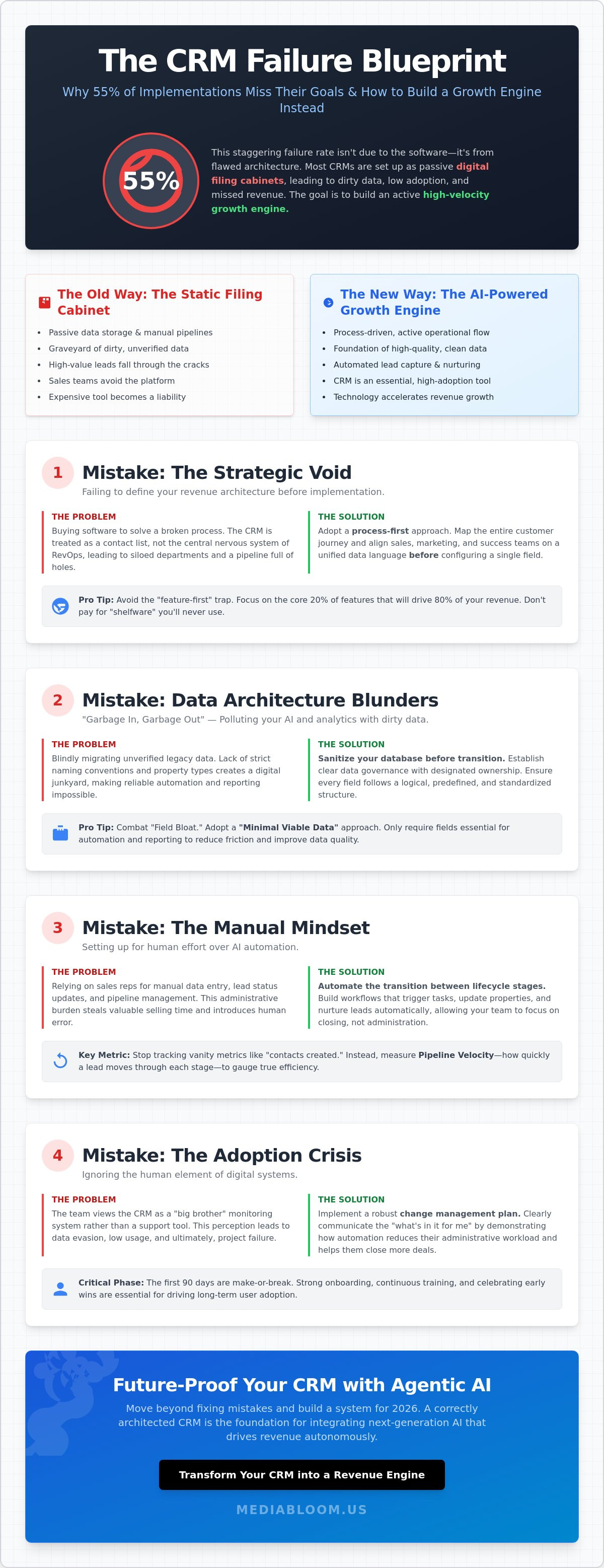
55% of CRM implementations fail to meet their primary objectives because they're built as static filing cabinets rather than high-velocity engines. Often, these failures stem from common crm setup mistakes that prioritize passive data storage over active operational flow. You likely feel this friction every day. Your sales team avoids the platform, your reporting is a graveyard of dirty data, and high-value leads are falling through the cracks of a manual pipeline. It's a common frustration for leaders who expect their technology to accelerate growth, not hinder it. When your infrastructure is flawed, even the most expensive tools become liabilities.
We'll identify the configuration errors that sabotage your sales velocity and prevent you from scaling with 2026's agentic AI. You'll learn how to eliminate these flaws to build a seamless, automated sales pipeline that drives revenue without adding headcount. We are moving beyond simple contact management into the era of the strategic revenue architect. This article provides the blueprint for a system that captures every lead, cleans every data point, and provides total visibility into your revenue drivers.
Key Takeaways
- Transition from a software-first approach to a process-driven architecture that treats your CRM as a growth engine rather than a static database.
- Eliminate common crm setup mistakes by standardizing data naming conventions and properties to ensure your AI automations are built on a foundation of high-quality information.
- Reduce manual data entry and lead leakage by automating the transition between lifecycle stages, allowing your sales team to focus on closing instead of administration.
- Implement a robust change management plan to drive user adoption, positioning the CRM as an essential support tool rather than a monitoring system.
- Future-proof your sales stack by integrating agentic AI solutions, such as custom voice agents, to handle top-of-funnel qualification and lead nurturing autonomously.
The Strategic Void: Failing to Define Your Revenue Architecture
Revenue isn't an accident; it's an architectural outcome. Many executives treat their Customer Relationship Management (CRM) as a digital filing cabinet. They use it to store contacts, log notes, and archive dead deals. This is one of the most common crm setup mistakes in modern business. A high-performance CRM must function as a growth engine. It's the central nervous system of your Revenue Operations (RevOps). If the system isn't designed to drive action, it's merely an expensive ledger of missed opportunities.
Success requires a process-first implementation. Buying software to solve a broken process only helps you fail faster at scale. You must align stakeholders across sales, marketing, and customer success before a single field is configured. This alignment ensures that every department speaks the same data language. Map the entire customer journey before touching a single setting. Identify every touchpoint from the initial AI chatbot interaction to the final contract signature. Without this map, your CRM configuration will be a collection of silos rather than a unified pipeline.
According to 2026 data from Wave Connect, 55% of CRM implementations fail to meet their primary objectives. This failure rate is often tied to a lack of strategic vision. Leaders often rush into deployment without defining what "success" looks like for their specific infrastructure. You aren't just installing software. You're building a foundation for scalable operations.
The "Feature-First" Trap in CRM Selection
Most businesses fall into the trap of purchasing enterprise-grade tiers filled with features they'll never use. This creates "shelfware." It's a waste of capital and adds unnecessary complexity to the user interface. Focus on the core 20% of features that drive 80% of your revenue. Identify the tools that actually remove friction from the sales process. Avoid the distraction of shiny native integrations that don't serve your specific workflow. If a feature doesn't automate a high-value task or provide critical data, it's just noise that slows down your team.
Setting KPIs That Actually Drive Sales Velocity
Stop tracking vanity metrics. "Total contacts created" is a meaningless number that often hides deep operational inefficiency. High-performance teams focus on pipeline velocity instead. Measure how quickly a lead moves through each lifecycle stage. Focus on lead-to-close ratios and the density of automated touchpoints per deal. Establish a clear ROI baseline before the deployment phase begins. You need to know exactly how much time you expect to save through CRM automation setup and custom AI integrations. If you can't measure the efficiency gain, you can't optimize the engine.
Data Architecture Blunders: Garbage In, Garbage Out
Data is the fuel for your revenue engine. If that fuel is contaminated with "dirty" legacy records, the entire system grinds to a halt. One of the most expensive common crm setup mistakes is the blind migration of unverified data into a fresh environment. It's a costly error that pollutes your analytics and renders your AI predictive models useless. You must sanitize your database before the transition. Clean data is the only foundation for scalable automation.
Standardization is your primary defense against operational chaos. Failing to establish strict naming conventions and property types creates a fragmented view of the customer. Every department must agree on what a "Lead" or "Qualified Opportunity" actually means. Without clear data governance and designated ownership roles, your CRM quickly devolves into a digital junkyard. High-performance teams assign a "Data Architect" or RevOps lead to maintain the integrity of the system. This ensures that every entry follows a logical, predefined structure.
Field Bloat and the Death of User Experience
Over-organizing is a paradox that kills productivity. While it's tempting to capture every possible detail, excessive custom fields create massive friction. When sales reps face dozens of mandatory fields, they resort to data evasion or "pencil whipping" to save time. This leads to many CRM implementation challenges that stall adoption in the first 90 days. Adopt a "Minimal Viable Data" approach. Distinguish between "need-to-know" data points that drive automation and "nice-to-know" details that just clutter the screen. Keep the interface lean to keep your reps focused on selling.
Standardizing Data Entry for Automated Reporting
Accuracy in reporting depends on rigid structure. Replace free-text fields with dropdown menus wherever possible. Free-text is the enemy of automation; it makes it impossible to aggregate data or trigger reliable workflows. Develop a comprehensive data dictionary to maintain consistency across the organization. This document acts as the blueprint for every property in your system, ensuring that "Enterprise" in marketing means the same thing in sales.
To further reduce the administrative burden on your team, prioritize automated data enrichment. Instead of forcing agents to manually research company sizes or industry codes, use CRM automation setup to pull this information from external databases automatically. This keeps your pipeline clean without slowing down your sales velocity. By architecting your data with precision, you transform your CRM from a static record into a high-performance asset.
The Manual Mindset: Setting Up for Human Effort Over AI Automation
Efficiency is the only metric that matters in 2026. Despite this, the most prevalent of all common crm setup mistakes is architecting a system that relies on human intervention for routine data entry. Industry research indicates that the average sales representative spends only 28% of their time actually selling; the rest is consumed by administrative tasks and manual updates. This creates a bottleneck that kills pipeline velocity and suppresses revenue. A modern CRM shouldn't be a diary of past events. It must be an autonomous agent that triggers the next move based on real-time intent signals.
Failing to automate the transition from Marketing Qualified Lead (MQL) to Sales Qualified Lead (SQL) is a recipe for lead decay. In a high-speed market, seconds count. When a prospect engages with your content or an AI Chatbot, the handoff must be instantaneous. Manual handoffs lead to common mistakes in customer understanding, as critical context is often lost in translation between teams. Your infrastructure should be "automated by default." If a task can be codified, it must be removed from the human workload. This shift allows your team to focus on high-leverage strategy rather than data hygiene.
Treating CRM as a Passive Repository Instead of an Active Agent
The legacy approach to CRM focuses on recording what happened. This is a reactive posture that limits growth. 2026's winners utilize an Active CRM Architecture. Active CRM Architecture is a system that executes tasks without human prompts. It doesn't wait for a rep to schedule a follow-up. It triggers automated lead nurturing sequences the moment a lead's behavior indicates intent. It moves prospects through the funnel based on real-time data, ensuring that no opportunity is left to stagnate in a forgotten folder. This is the difference between a database and a revenue engine.
Missing the Integration Window for AI Voice Agents
Integration of AI voice agents is no longer a luxury. These tools should be your primary data-entry point for lead qualification. When an AI voice agent handles an initial discovery call, it captures every nuance of the conversation. It automatically updates CRM records with precise, structured data, closing the loop between verbal communication and digital records. This eliminates the "Administrative Tax" that typically burdens your top closers. By removing the need for manual post-call notes, you allow your sales talent to stay in their flow state. They focus on high-value negotiations while the machine handles the bureaucracy. If your CRM setup doesn't account for this autonomous loop, you're building a legacy system in an AI world.
The Adoption Crisis: Ignoring the Human Element of Digital Systems
Technology is only as effective as the people who use it. Even the most sophisticated architecture will collapse if your frontline sales team rejects the platform. One of the most recurring common crm setup mistakes is treating implementation as a purely technical project. It isn't. It is a psychological shift. Without a dedicated change management plan, most CRM deployments fail within the first 90 days. This happens because leaders prioritize data collection over user experience, leaving the sales team feeling burdened rather than empowered.
Avoid the trap of using your CRM as a surveillance tool. When management focuses solely on monitoring activity levels, reps become defensive. They enter the bare minimum data or manipulate entries to satisfy vanity metrics. Instead, position the system as a support engine. Show them how CRM automation setup removes the administrative weight from their shoulders. Address the "What’s In It For Me?" (WIIFM) factor immediately. If a rep can see that the system saves them five hours of manual follow-up every week, adoption becomes inevitable.
Building a Culture of CRM Accountability
Accountability starts with a single, non-negotiable rule: "If it’s not in the CRM, it didn’t happen." This ensures the platform remains the definitive source of truth for the entire organization. However, enforcement shouldn't be purely punitive. Gamify the experience to drive engagement. Create leaderboards that reward data accuracy, timely updates, and automated sequence triggers. Most importantly, involve your end-users during the configuration phase. When reps help design the workflows, they build a sense of ownership that makes adoption a point of pride rather than a chore.
Training for Evolution, Not Just Onboarding
Onboarding is just the beginning. Systems evolve, and your training must keep pace. Static, day-long seminars are ineffective and quickly forgotten. Instead, implement monthly "Optimization Sprints" to refine your automated workflows based on real-world feedback. Provide bite-sized, role-specific training modules that reps can consume in minutes. This keeps the team sharp as new features or AI integrations are deployed. Identify "CRM Champions" in every department. These power users act as internal consultants, providing peer-to-peer support that is often more effective than top-down directives. To ensure your team is fully equipped for the 2026 sales landscape, partner with MediaBloom for expert CRM automation setup and team training.
Future-Proofing Your CRM: MediaBloom’s AI-Integrated Blueprint
Static systems are obsolete. To dominate the 2026 market, you must transition to a headless CRM architecture where AI handles the heavy lifting of data processing and lead management. This approach bypasses the most common crm setup mistakes by decoupling the user interface from the logic layer. It allows for a more flexible, modular engine. MediaBloom acts as your strategic architect, building an infrastructure that scales your revenue operations without the need for additional headcount. We move beyond simple storage into the era of agentic AI.
With 83% of companies already utilizing AI features within their CRM for automation and personalization, staying competitive requires a connected data model rather than a single, monolithic customer view. Our blueprint focuses on creating a system that learns. We implement automated lead nurturing that adapts in real-time to prospect behavior, ensuring your messaging is always relevant. This isn't just about sending emails; it's about architecting a responsive ecosystem that anticipates the needs of your pipeline.
Deploying the Automated AI Workforce
Human-operated BPO services are a legacy solution for a modern problem. MediaBloom’s AI voice agents sync directly with your CRM to provide instant, structured updates after every interaction. This eliminates the delay between a discovery call and the next action step. By integrating custom AI automations, you remove the bottleneck of manual follow-ups entirely. Your sales engine scales its communication volume instantly. You gain the ability to handle thousands of top-of-funnel qualifications simultaneously without expanding your payroll. It's about maximizing output while maintaining technical mastery.
The 90-Day CRM Optimization Roadmap
Scaling a revenue engine requires a methodical, rapid progression. We don't just "install" software; we re-engineer your sales infrastructure. Our roadmap is designed to move you from friction to flow in three decisive phases:
- Phase 1: Audit and Architecture - We identify existing friction points and data silos that are currently sabotaging your sales velocity.
- Phase 2: Automation Overlay - Our team deploys AI voice agents, chatbots, and nurturing sequences to handle routine tasks autonomously.
- Phase 3: Scale and Refine - We use data-driven insights to maximize your ROI, ensuring the engine is tuned for peak performance.
Ready to automate your sales engine? Book a MediaBloom consultation.
Master Your Revenue Architecture
Your CRM is the central nervous system of your growth. We've identified that a process-first strategy and rigid data hygiene transform a static database into a high-velocity engine. Avoiding common crm setup mistakes requires a decisive shift from manual record-keeping to autonomous execution. You must prioritize user adoption and continuous optimization to stay ahead of the 55% of implementations that fail. The future of sales belongs to those who architect for automation today.
MediaBloom provides the technical mastery needed to bridge the gap between legacy systems and agentic AI. Our custom AI voice agents deliver instant lead qualification while our expert CRM automation setup ensures your workflows remain seamless. We combine this with data-driven digital marketing management to scale your operations at a national level. Eliminate technical friction and start leveraging a system built for maximum output.
Architect Your AI-Driven Sales Engine with MediaBloom
The infrastructure you build now determines the revenue you capture tomorrow. It's time to claim your position as a market leader.
Frequently Asked Questions
What is the most common reason CRM implementations fail?
Low user adoption is the primary driver of failure. Systems often fail because they are designed for management reporting rather than sales enablement. If a platform adds administrative friction without providing immediate value to the rep, the team will inevitably revert to spreadsheets. You must prioritize a system that actively assists the salesperson to ensure long term success.
How can AI voice agents improve my CRM data quality?
AI voice agents capture and transcribe structured data directly from prospect interactions. Unlike manual note-taking, these agents translate verbal details into specific CRM properties with absolute consistency. This prevents the "dirty data" caused by human error or fatigue. It ensures your database remains a reliable source of truth for your entire revenue operation.
Is it better to fix an old CRM setup or start from scratch?
Starting from scratch is often the superior choice to avoid carrying over common crm setup mistakes from legacy systems. If your current architecture is cluttered with redundant fields and broken workflows, a "clean room" implementation is more efficient. This allows you to build a modern, AI-ready engine without the constraints of technical debt or contaminated data silos.
How does automated lead nurturing integrate with a standard CRM?
Automated lead nurturing acts as the execution layer for your CRM data. When a prospect hits a specific trigger, such as a high intent website visit, the CRM signals the automation engine to fire a personalized sequence. This ensures that no lead stagnates. It maintains a high touch experience across the entire pipeline without requiring manual effort from your sales closers.
What is the "Revenue Operations" approach to CRM setup?
The Revenue Operations (RevOps) approach treats the CRM as a unified engine for marketing, sales, and customer success. Instead of fragmented silos, RevOps focuses on the end to end flow of data and pipeline velocity. It aligns every department around a single customer view. This strategy ensures that your technology supports sustainable growth rather than just individual department goals.
Can a small sales team benefit from complex CRM automation?
Small teams often see the greatest ROI from automation because it functions as a force multiplier. By eliminating common crm setup mistakes and deploying AI voice agents, a lean team can manage a volume of leads typically reserved for enterprise organizations. It allows you to scale your operations and increase revenue without the immediate need to add expensive headcount.
How do I ensure my sales team actually uses the new CRM?
Ensure the system provides more value than the effort it requires. If the CRM automates their follow-ups and delivers pre-qualified leads via AI chatbots, the team will naturally adopt the platform. Focus on reducing their workload rather than just increasing their oversight. Adoption is a logical response to a tool that makes closing deals easier and faster.
What role does AI play in reducing manual data entry for sales reps?
AI serves as an autonomous administrative assistant that handles the bureaucracy of sales. It enriches contact records, updates deal stages based on intent, and logs meeting outcomes automatically. This removes the "administrative tax" that typically buries high performing reps. By automating the data entry loop, you free your talent to focus on high leverage negotiations and closing strategy.