Chatbots win on speed and scale. Live chat wins on complex, emotional, or high-stakes issues. Most businesses get the best results from an AI-first hybrid: a chatbot handles the first response and routine work, then hands off to a human the moment judgment or empathy is required. The rest of this guide breaks down the trade-offs and gives you a checklist to build that model for your own support operation.
TL;DR:
- Chatbots respond instantly in under two seconds and operate 24/7 at a fraction of the cost, while human agents take two to three minutes during staffed hours.
- AI chatbots handle 60-80% of support volume with proper training, deflecting common questions and reducing operational costs significantly.
- Complex, emotionally charged issues or cases requiring judgment are better handled by human agents, especially in regulated industries or high-value transactions.
- Successful hybrid support relies on well-designed handoffs that preserve context and metadata, ensuring customer continuity and better resolution rates.
- Measuring first response time, deflection rate, escalation rate, CSAT, resolution rate, and cost per conversation is essential to prove the hybrid model’s effectiveness.
Table of Contents
- Chatbot vs Live Chat: What Each Term Actually Means
- Response Time, Cost, and Complexity: The Core Trade-Offs
- Chatbot Benefits and Risks vs Live Chat Benefits and Risks
- Which Businesses Should Use a Chatbot, Live Chat, or Both?
- How to Build a Handoff That Doesn’t Lose the Customer
- What Metrics Actually Prove the Hybrid Model Is Working
- Should You Choose a Chatbot, Live Chat, or a Hybrid?
- Why Bots Should Scale and Humans Should Judge
- How Mediabloom Handles the Handoff for You
- Sources
- FAQ
Chatbot vs Live Chat: What Each Term Actually Means
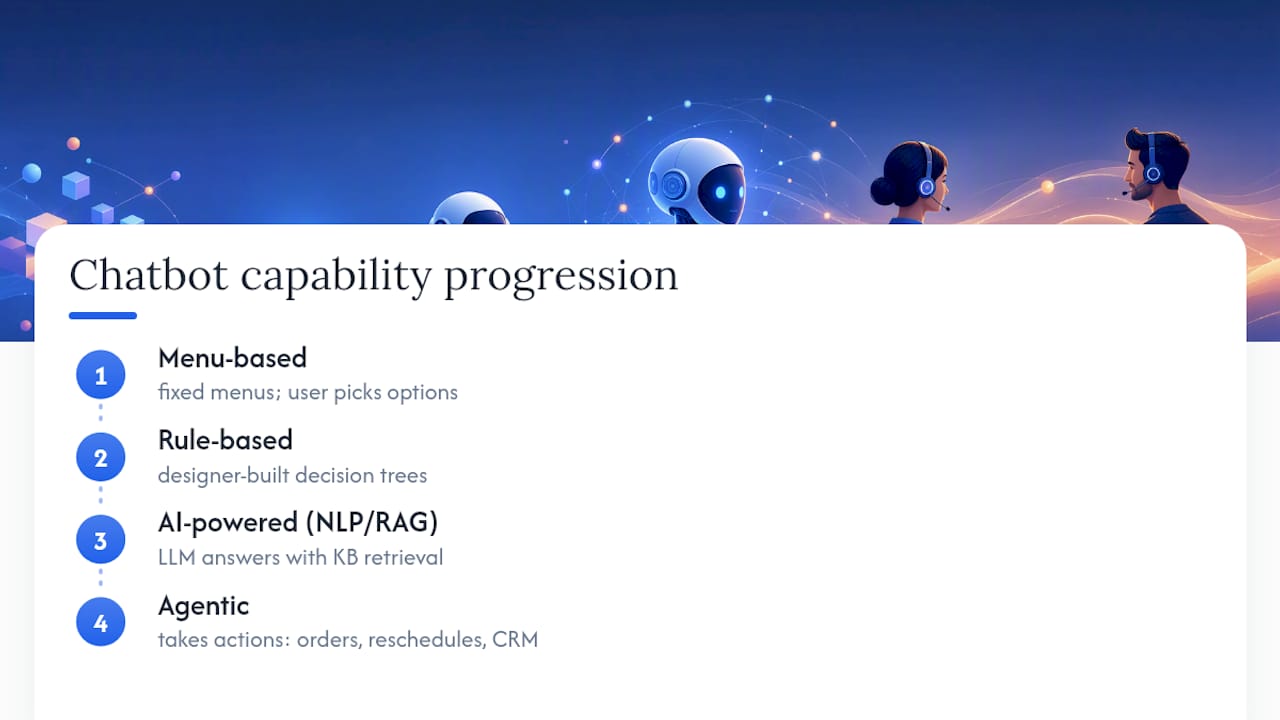
A rule-based chatbot follows scripted decision trees. It’s limited to the paths a designer built in advance, which makes it predictable but brittle the moment a customer phrases a question in an unexpected way. An AI chatbot is different: it runs on a large language model, often paired with retrieval-augmented generation (RAG) that pulls answers from your knowledge base, help docs, and past tickets in real time. That’s what lets it answer specific, unscripted questions instead of just matching keywords.
“AI agent” goes a step further. An agent doesn’t just answer questions, it takes action: checking order status in your backend, rescheduling an appointment, or updating a CRM record without a human touching the keyboard. IBM’s own taxonomy separates chatbot types into menu-based, rule-based, NLP/AI-powered, and agentic categories, and the gap between them is exactly the gap in what they can be trusted to handle alone.
Live chat, meanwhile, means a real person typing in real time, often assisted by AI features like smart routing or suggested replies. The terminology distinction matters because it determines where you can safely automate and where you still need a human backstop for escalation.
Response Time, Cost, and Complexity: The Core Trade-Offs
The math in one line: A chatbot answers in under 2 seconds, 24/7. A human agent answers in 2 to 3 minutes, only during staffed hours.
That speed differential is not a minor convenience. Forrester’s research on consumer expectations shows reply speed is one of the strongest drivers of both satisfaction and purchase decisions, and companies routinely underestimate how much a slow first response costs them in lost conversions.
Here’s how the two approaches stack up across the dimensions that actually affect a support budget:
- Response time: Chatbots answer in seconds; live agents take minutes, longer during peak volume.
- Availability: Chatbots run around the clock at no incremental labor cost; live chat is bound by staffed hours unless you pay for overnight or weekend coverage.
- Cost per conversation: AI-handled conversations cost a fraction of a human-handled one at scale, since pilot data shows the unit cost for bots stays flat as volume grows while human cost scales directly with headcount.
- Scalability: A chatbot can hold thousands of concurrent conversations with no drop in response time; a live agent can realistically manage 3 to 6 chats at once before quality slips.
- Complexity and empathy: Humans still win decisively on emotionally charged, ambiguous, or policy-exception cases, where discretion and judgment matter more than speed.
- Personalization: AI can personalize based on account data and history, but a live agent can read tone, adjust in the moment, and make a judgment call a script never anticipated.
Chatbot Benefits and Risks vs Live Chat Benefits and Risks
Every channel decision here is really a business trade-off dressed up as a technology choice. Get the framing right and the rest of the decision gets much easier.
Chatbot benefits show up fast: instant replies regardless of time zone, after-hours coverage without overtime pay, a marginal cost near zero once the bot is trained, and reliable lead capture even while your team sleeps. The risks are real too. A poorly trained bot can hallucinate an answer that sounds confident and is simply wrong, and a badly designed escalation trigger can trap a frustrated customer in a loop until they give up and churn.
Live chat benefits are the mirror image. A skilled agent brings empathy, can spot an upsell opportunity a bot would miss, and can troubleshoot a genuinely novel problem by reasoning through it rather than matching a pattern. The downside is cost and consistency: staffing a chat desk around the clock is expensive, coverage gaps are inevitable, and even trained agents make mistakes under pressure or fatigue.
- Chatbot pros: instant response, 24/7 coverage, low marginal cost, consistent lead qualification.
- Chatbot cons: hallucination risk, weak judgment on nuance, poor escalation design causes churn.
- Live chat pros: empathy, upsell ability, complex troubleshooting, human accountability.
- Live chat cons: high staffing cost, coverage gaps, variability in agent performance.
Pro Tip: Map each channel’s weaknesses to a specific KPI before you launch, not after. If churn is your biggest risk, over-invest in escalation design. If cost per resolution is your biggest risk, over-invest in bot training and deflection rate.
Which Businesses Should Use a Chatbot, Live Chat, or Both?
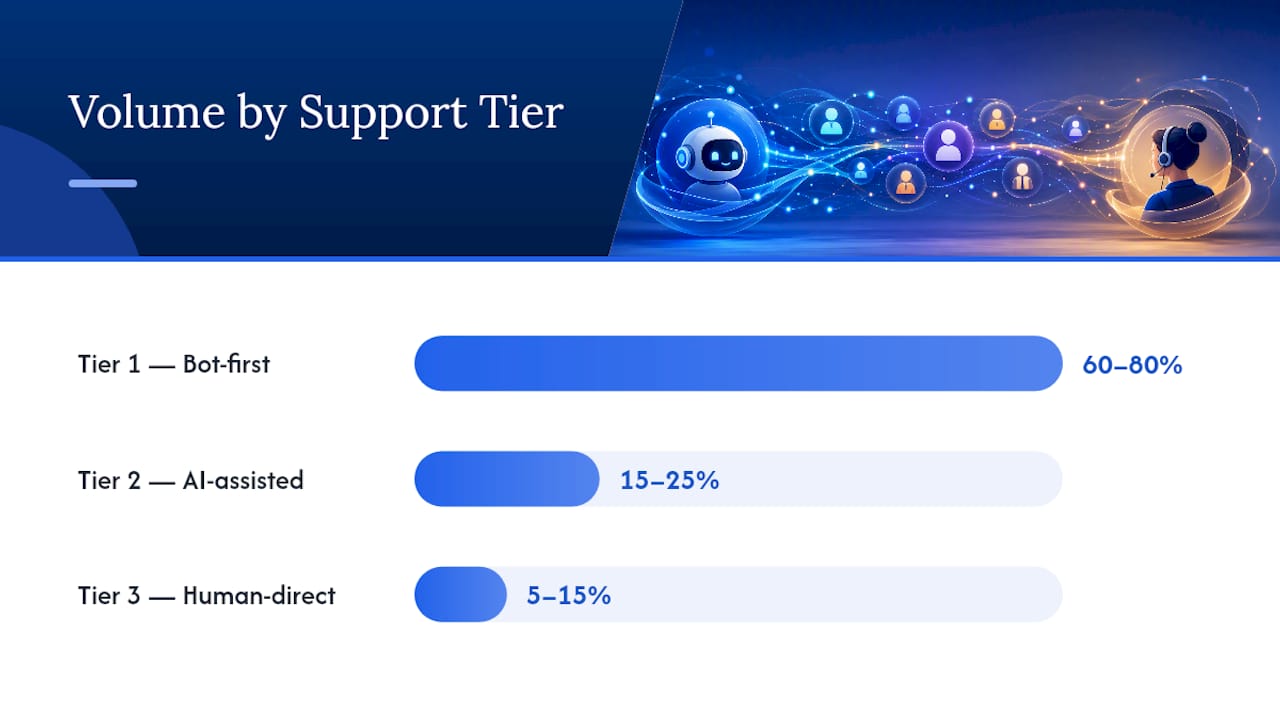
Most support operations fit into a three-tier model, and mapping your ticket types to these tiers is the fastest way to decide where automation belongs.
- Tier 1, bot-first: FAQs, order status, password resets, basic lead capture. This tier should realistically deflect 60% to 80% of incoming volume with a well-trained bot, freeing your team from repetitive work entirely.
- Tier 2, AI-assisted escalation: Moderate-complexity issues where the bot gathers context and hands off to a human with a summary already prepared. This usually represents 15% to 25% of volume and is where handoff design earns its keep.
- Tier 3, human-direct: High-stakes, relationship-driven, or emotionally charged issues, typically 5% to 15% of volume, where a customer should reach a person immediately with no bot layer in between.
The vertical changes the mix. E-commerce leans hard into Tier 1 for order tracking and returns, since a chatbot answering “where’s my package” at 2 a.m. can capture revenue and recover abandoned carts that would otherwise disappear overnight. SaaS support benefits from bots trained on product documentation to resolve setup and billing questions, while a regulated industry like healthcare or insurance often needs Tier 3 built in earlier, since compliance and liability concerns make a human review non-negotiable for anything beyond a scheduling question.
Audience matters too. Preferences split by generation, and younger customers are markedly more comfortable with automated interactions than older cohorts, who more often want a human for anything beyond a simple lookup. If your customer base skews older or your average transaction value is high, shift your tier boundaries toward human-first even if your ticket volume would otherwise justify heavier automation.
How to Build a Handoff That Doesn’t Lose the Customer
The single most common failure in hybrid support isn’t the bot being wrong. It’s the handoff losing context and forcing the customer to repeat themselves to a human who has no idea what already happened.
A well-designed handoff preserves the full transcript, relevant metadata, and a suggested next action so the receiving agent can pick up mid-conversation instead of starting cold. Escalation triggers should be explicit and measurable: a negative sentiment score, two or more failed resolution attempts, an outright “talk to a human” request, or a high-dollar transaction signal all belong on that list.
- Train the bot on live product pages, support tickets, and your knowledge base, and refresh that training on a set cycle so answers don’t go stale.
- Set clear escalation triggers instead of vague “if confused, escalate” logic.
- Give agents an AI-generated case summary and suggested response before they type a word.
- Track deflection rate, escalation rate, repeat-contact rate, and CSAT weekly, not quarterly.
- Coach agents specifically on handling escalations that arrive already frustrated, since those cases skew the hardest by design.
Platforms build customer service AI around exactly this mechanic, aiming to resolve tier-1 issues end-to-end while routing anything requiring judgment straight to a person with context intact.
Pro Tip: Audit your last 500 support tickets before you build anything. Categorizing what percentage a bot could realistically resolve tells you more about the right tier boundaries than any industry benchmark.
What Metrics Actually Prove the Hybrid Model Is Working
Six numbers matter here: first response time, deflection rate, escalation rate, CSAT, resolution rate, and cost per resolved conversation. Track all six, not just the ones that make the bot look good.
Rough ROI math: A business handling 3,000 conversations a month at a blended cost well above a few dollars per human-handled chat can see per-conversation cost drop sharply after deploying a bot, since AI unit cost stays flat while human cost scales with headcount. Break-even on setup and training investment often lands somewhere between 500 and 800 conversations per month.
Run any new deployment as a phased pilot rather than a full switch. Start with your highest-volume, lowest-complexity ticket category, measure deflection and CSAT for two to four weeks, and only expand scope once resolution rate holds steady. A pilot that maintains CSAT while cutting first response time is the clearest signal you’re ready to scale.
Should You Choose a Chatbot, Live Chat, or a Hybrid?
Run through this before committing budget:
- What percent of your tickets are repeat questions? Above 40% strongly favors a bot-first approach.
- Do customers need support outside staffed hours? If yes, a bot fills the gap without overtime cost.
- What’s your complexity mix? A support queue full of edge cases needs more Tier 3 capacity than the model above suggests.
- Are you in a regulated industry with compliance constraints on automated advice?
- What’s your budget and timeline for a pilot?
Scope the pilot with input from ops, product, support, and legal before you launch, not after something goes wrong.
Why Bots Should Scale and Humans Should Judge
The industry keeps framing chatbot vs live chat as a competition, and that framing wastes time. Bots are a scaling tool. Humans are a judgment tool. The businesses getting this right aren’t choosing sides, they’re building the handoff between the two so well that customers barely notice the switch.
The differentiator is whether the transfer between bot and human preserves context, tone, and urgency. Getting that transfer right makes both channels work better than alone.
— MediaBloom
How Mediabloom Handles the Handoff for You
An alternative to hiring and training a bigger support team just to cover nights and weekends is to deploy an AI chatbot that resolves routine tickets instantly and hands off flagged cases to your team with full context already attached, avoiding repeated questions and lost transcripts.

Some platforms run omnichannel chatbots across chat, SMS, and email, paired with voice agents and appointment setting so the same lead-qualification logic follows a customer across every channel they use. Companies in SaaS, insurance, and real estate have used this approach to cut response times while keeping human agents focused on the conversations that actually need them, as shown in the AI appointment setting case studies published online. If you’re ready to see what a properly designed handoff looks like for your ticket volume, book a walkthrough of a customer service AI platform and bring your last month of support data.
Sources
- AI vs Human customer service — HubSpot blog
- Forrester blog on consumer expectations
- US population share by generation — Statista
- Chatbot vs Live Chat: Which Should You Use in 2026? | Canary
FAQ
What Is the Difference Between Webchat and a Chatbot?
Webchat is simply the widget or interface where a conversation happens on a website; a chatbot is the automated system that can power that widget instead of a human typing the replies.
What Is the Difference Between a Chatbot and a Live Chat Agent?
A chatbot is software that answers automatically, often in under two seconds, while a live chat agent is a real person typing responses, usually taking 2 to 3 minutes for a first reply during staffed hours.
What Are the Four Types of Chatbots?
Industry taxonomy generally splits chatbots into menu-based, rule-based, NLP/AI-powered, and agentic types, with agentic bots able to take backend actions like updating records rather than just answering questions.
Is Live Chat Better Than a Chatbot for Complex Issues?
Yes. Human agents consistently outperform automation on complex, emotionally charged, or high-stakes issues where discretion and empathy matter more than speed.
Can a Chatbot and Live Chat Work Together?
Yes, and for most businesses this hybrid model performs best: a chatbot handles the first response and routine volume, then hands off to a human agent with full context when a case needs judgment, a pattern platforms like Mediabloom’s chatbots are built around.